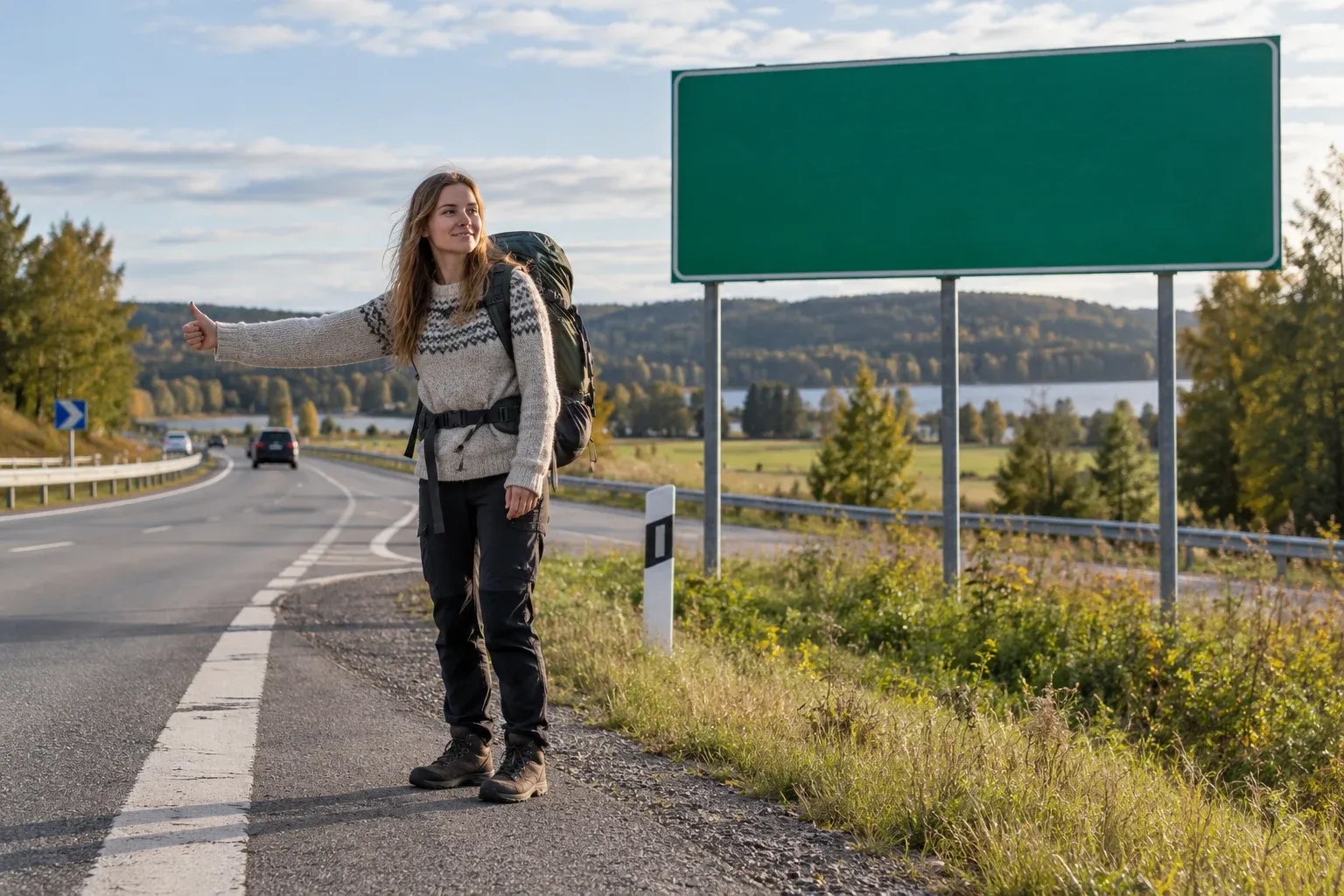
Most hitchhiking guides say “legal in Sweden, just not on motorways” and stop there. The useful detail is the ramp, the fine on each side of the car window, and an honest picture of how long you will actually stand there.
When you need this
You’re planning a budget trip north and wondering whether thumbing a ride is allowed. Or you’re standing at a motorway junction, unsure how far up the ramp you can go. Or the last bus has left a small town and the road out looks tempting.
Is hitchhiking legal in Sweden?
Yes. Sweden’s traffic ordinance (trafikförordningen) has no rule against hitchhiking (lifta), and its penalty chapter lists no such offence. We read the chapters on all road users, vehicles, pedestrians and motorways, and the penalty chapter, to be able to say that.
The rules that matter are about two other things: where you stand, and where a driver may legally stop. Get those right and you are fully within the law.
Motorways, expressways and their ramps
Pedestrians may not be on a motorway (motorväg) or an expressway (motortrafikled). Only motor vehicles built for at least 40 km/h may use them. Standing on the shoulder of either can bring a 1,000 kr fixed fine.
The ramps are where people slip up:
- Expressway ramps always count as part of the expressway.
- Motorway ramps belong to the motorway to the extent the county administrative board or municipality decides, which varies from place to place.
- The green E1 (motorway) or E3 (expressway) sign marks where the rules begin. Direction signs on and towards these roads are green, too.
The safe rule: once you have passed the green sign, you are where pedestrians are banned. Stand before it.
The ban cuts both ways. A driver may not stop on a motorway, an expressway or their ramps except at signed rest or parking areas, and doing so risks a 3,000 kr fine. So even a driver who wants to help you cannot legally pull over on the ramp.
Not every big road is a motorway. Many national roads, and even some E-roads, are ordinary roads where standing on the shoulder is allowed. The sign tells you which.
Where drivers may stop for you
Everywhere else, a car may pick you up if the driver can stop legally. Swedish stopping rules say a driver must stop on the right-hand side, as far from the middle of the road as possible, and never where it creates danger.
| A driver may not stop… | Why it matters to you |
|---|---|
| In a junction or within 10 m of one | Don’t stand right at the corner |
| Within 10 m before a pedestrian crossing | Move past the crossing |
| Near a crest or a bend with poor visibility | Pick a straight stretch |
| In a tunnel, roundabout or bus lane | Walk on to a lay-by |
| On a motorway, expressway or their ramps | Stand before the green sign |
At a marked bus stop, a car may stop only to let people on or off, and only without blocking a bus. Stopping to pick someone up is not parking, so a “no parking” sign on a main road (huvudled) does not stop a pick-up.
Everyone on the road also has a general duty not to obstruct traffic needlessly. A spot with room for a car to pull in protects both of you.
Where to stand instead
- Petrol stations and roadside cafés on the road out of town. Asking drivers face to face works far better than the thumb.
- The start of a motorway ramp, before the sign, where cars are still slow and there’s space to stop.
- Lay-bys and bus-stop pockets on ordinary roads, when no bus is due.
- Signed rest areas along the motorway, where drivers may legally stop. Ask to be dropped at one, never at an exit in the middle of nowhere.
Use a cardboard sign with the next big town or the road number, not your final destination. From big cities, take local transport to the last stop on the outbound road first.
How realistic is it?
Honestly: hitchhiking has become uncommon in Sweden. Swedes are polite but reserved with strangers, traffic is thin away from the south, and waits of an hour or more are normal. In Norrland and the inland, ordinary two-lane roads make standing legal almost everywhere, but traffic can be very light.
| Season | What to expect |
|---|---|
| Summer (June–August) | Long daylight, holiday traffic, best chances |
| Autumn and spring | Shorter days; start early |
| Winter | Early darkness, snow banks with no room to pull in, dangerous cold during waits |
Drivers rarely stop for someone at the roadside after dark. Start early, and carry a tent: wild camping under allemansrätten is the free fallback when the ride doesn’t come.
Staying safe
Sweden is a generally safe country, but hitching always means getting into a stranger’s car.
- Share your route and the car’s registration number with someone you trust before you get in.
- Decline any ride that feels wrong. Refusing costs you nothing.
- Wear a seatbelt. Every passenger must, and a passenger who doesn’t can be fined personally.
- Carry reflectors if you’ll be near the road at dusk.
- Save the numbers: 112 for emergencies, 114 14 for non-urgent police matters.
Road traffic is the bigger risk. Standing on a fast road with nowhere for a car to stop is how hitchhikers get hurt.
Ride-sharing and paying the driver
A hitchhiked lift is free. Offering to chip in for fuel is a courtesy, not an obligation. Someone who carries passengers as a business for payment is running taxi traffic, which needs a taxi permit.
For long distances, most Swedes who share rides now arrange them in advance through ride-sharing (samåkning) apps and websites, where drivers post trips and passengers share costs. It is often the more realistic option. See also traveling Sweden without a car for trains and buses.
Mistakes to avoid
- Walking up the on-ramp past the green motorway sign.
- Thumbing at the edge of a 100 km/h road with no room to pull in.
- Standing at a bus stop and blocking the bus.
- Starting late in the day in the north, where traffic thins out and buses are rare.
- Expecting the pick-up rates of decades ago.
Practical information
| Situation | Rule | Consequence |
|---|---|---|
| Pedestrian on a motorway or expressway | Banned | 1,000 kr fixed fine |
| Driver stopping on a motorway, expressway or ramp | Banned except at signed rest areas | 3,000 kr fixed fine |
| Passenger without a seatbelt | Must wear one | 1,500 kr fixed fine |
| Hitchhiking itself | Legal | Free; no permit or fee |
| Ride-sharing through an app | Agreed with the driver | Set by each driver or platform |
Amounts are from the Prosecution Authority’s fixed-fine catalogue (edition SFS 2025:917).
FAQ
Is hitchhiking legal in Sweden?
Yes. No Swedish law forbids asking drivers for a lift, and the traffic ordinance’s penalty chapter lists no hitchhiking offence. What is forbidden is being on foot on a motorway or expressway, including most on-ramps, which carries a 1,000 kr fixed fine. Stand before the green motorway sign, at a lay-by or at a petrol station instead.
Can I hitchhike on a motorway on-ramp in Sweden?
Only before the motorway begins. Expressway ramps always count as part of the expressway, and motorway ramps usually do, so once you pass the green E1 or E3 sign you are where pedestrians are banned. Drivers may not stop on the ramp either, at a 3,000 kr fine. Stand at the bottom of the ramp, where a car can pull in safely.
Is it easy to hitchhike in Sweden?
Not very. Hitchhiking has become uncommon, Swedes tend to be reserved with strangers, and waits of an hour or more are normal, longer in the sparsely populated north. Your chances improve in summer, on daylight starts, with a clear sign naming the next town, and by asking drivers directly at petrol stations rather than standing at the roadside.
Is hitchhiking safe in Sweden?
Sweden is generally a safe country, but hitching always means getting into a stranger’s car. Share your route and the car’s registration number with someone, trust your instincts and decline any ride that feels wrong. Avoid hitching after dark. Call 112 in an emergency and 114 14 for non-urgent police matters. Road traffic itself is the bigger risk.
Do I have to pay the driver when hitchhiking in Sweden?
No. Hitchhiking is a free lift, and offering to chip in for fuel is a courtesy, not an obligation. Someone who carries passengers as a business for payment is running taxi traffic and needs a taxi permit. Ride-sharing apps are different: there you agree a share of the costs with the driver in advance.
Can a driver stop anywhere to pick me up?
No. A driver may stop only on the right-hand side of the road and not in a junction, within 10 meters before a crossing, near a crest or blind bend, in a roundabout, in a bus lane or anywhere it creates danger. Stopping on motorways and their ramps is banned outright. Pick a spot with space for a car to pull in.
Related guides
- Traveling Sweden without a car — the trains and buses that make hitching optional.
- Pedestrian rules in Sweden — where you may walk and stand on Swedish roads.
- Swedish road signs — recognising the motorway and expressway signs that mark the no-go line.
- Driving in Sweden — the stopping rules from the driver’s side.
- Sweden on a budget — the other ways to keep transport costs down.
Facts verified 2026-10-06. Sources: Sveriges riksdag (trafikförordningen, vägmärkesförordningen, taxitrafiklagen), Åklagarmyndigheten, Transportstyrelsen, SOS Alarm — full register in this topic’s source file. Found something outdated? Tell us and we’ll fix it.