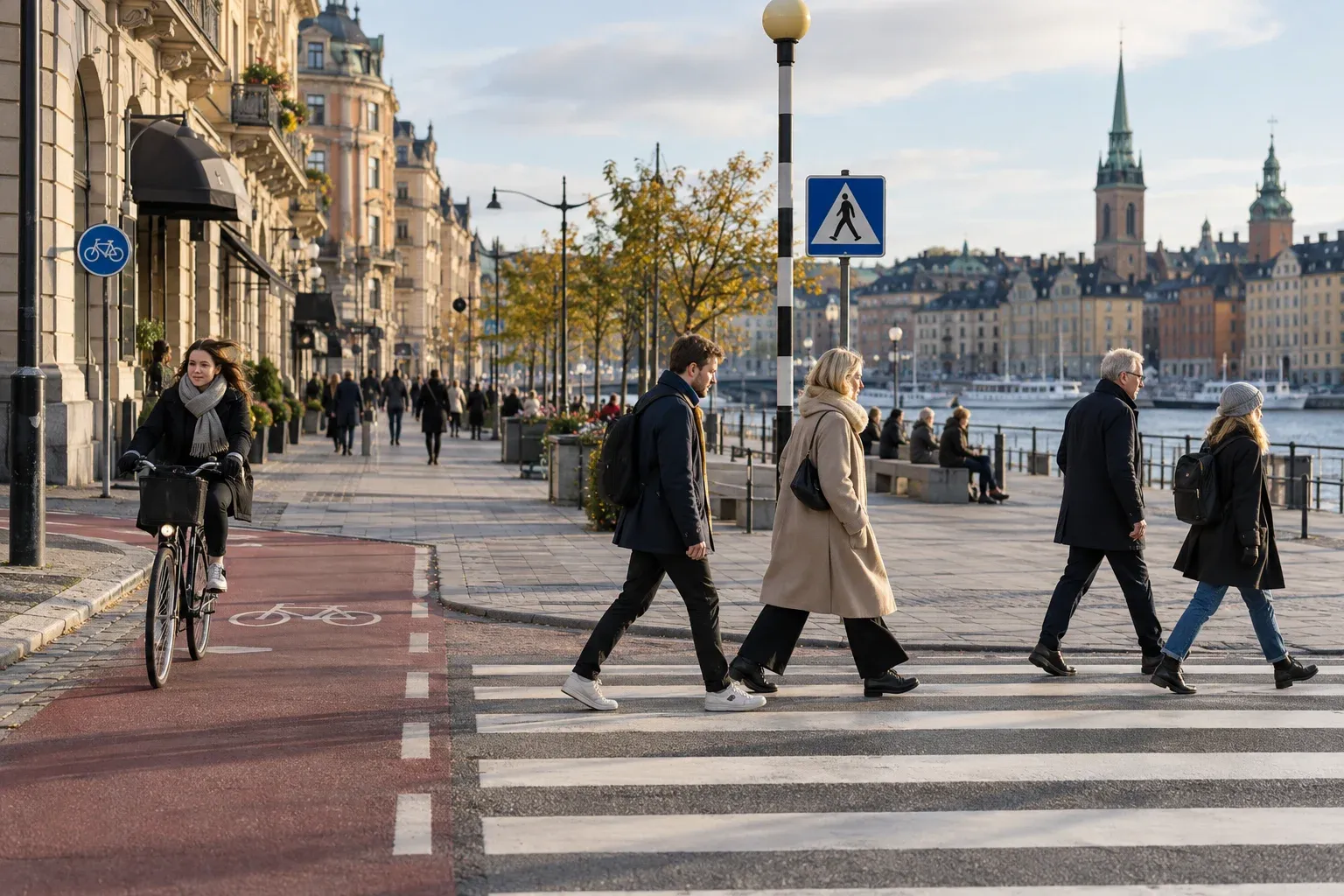
Most guides say jaywalking is legal in Sweden, or that it’s banned. Both are wrong. The traffic ordinance sets out a short list of rules for people on foot, fines exactly two of them, and protects you at zebra crossings more firmly than most countries do.
When you need this
You’re at a zebra crossing and not sure the car will stop. Or there’s a red-asphalt lane beside a narrow sidewalk and you wonder which is yours. Or the crossing is 30 meters away, the street is empty, and you’d like to know what crossing here would cost you.
Zebra crossings: drivers must stop
At an unsignalled crossing (obevakat övergångsställe), a driver must give way to anyone who is on the crossing or about to step onto it. That second part matters: standing at the curb facing the road is enough to oblige the driver to stop. A driver who doesn’t stop risks a fixed fine, higher if you were already on the crossing (amounts in the table below).
Swedish drivers take this seriously, and most will brake as soon as you approach the curb. Two limits apply:
- You still have to look. The law also obliges you to judge the distance and speed of approaching vehicles before stepping out. On winter ice, a car may simply be unable to stop.
- Riding a bike across doesn’t count. Drivers have no duty to give way to someone cycling over a zebra crossing. Get off and walk it across, and you’re a pedestrian with full protection.
At crossings with signals, the lights decide. Even so, a driver must let you finish crossing if you stepped out correctly, and a driver turning across the crossing must go slowly and give way.
Jaywalking: legal only when no crossing is nearby
Sweden’s rule is a two-step test:
- Is there a pedestrian crossing nearby? Then you must use it. Crossing beside it is an offence with a fixed fine.
- No crossing nearby? Then you may cross anywhere: straight across, preferably at a junction, without dawdling, and only if it causes no danger or inconvenience to traffic.
The same rule covers crossing a cycle path, not just the road. The law doesn’t define “nearby”, so use common sense: if you can see the crossing a few steps away, walk to it. Fines are uncommon, but the rule is real and in force.
Sidewalk, not bike lane
This is the rule visitors break most, often without noticing. On a road you must use the sidewalk (gångbana or trottoar) or the road shoulder (vägren). Only where neither exists may you walk on the cycle path or the road itself.
Walking along a cycle path while a usable sidewalk runs beside it is the second fined pedestrian offence, with the same fixed fine. In practice the bigger risk is the traffic. Bikes and rental e-scooters move fast on Swedish cycle paths and aren’t expecting anyone on foot.
How to tell them apart:
| What you see | What it is | Walk there? |
|---|---|---|
| Red asphalt or a white bicycle symbol | Cycle path (cykelbana) | Only if there is no sidewalk or shoulder |
| Walking-figure symbol, or a raised curb by the buildings | Sidewalk | Yes |
| Blue round sign with a pedestrian and a bicycle | Shared path | Yes, keep left |
| Blue sign split by a line, one symbol each side | Split path | Yes, on the pedestrian side |
When snow banks make a sidewalk impassable in winter, the cycle path or road becomes the legal place to walk.
Red lights: forbidden, but no set fine
A red standing figure (röd gubbe) forbids you to step onto the road or cycle path. If it turns red while you’re crossing, carry on to the other side, or stop on the central island if there is one.
Here’s the surprise: the penalty chapter of the traffic ordinance lists the pedestrian offences that can be fined, and ignoring a signal isn’t one of them. The prosecutor’s fixed-fine catalogue has no pedestrian amount for red lights. A cyclist who rides through red is fined; a pedestrian isn’t.
That isn’t permission. It’s still forbidden, and any road user, pedestrians included, who is seriously careless can be prosecuted for vårdslöshet i trafik (careless conduct in traffic), punished by day-fines.
Walking on roads without sidewalks
Outside towns, many roads have neither sidewalk nor shoulder. Then you walk in the carriageway, and the rule is to keep as far left as possible, facing oncoming traffic. The same applies on the shoulder and on a shared pedestrian and cycle path.
On a sidewalk or footpath used only by pedestrians, there’s no rule on which side to walk. Swedes generally keep right.
Motorways and expressways (motortrafikled) are closed to pedestrians entirely; only motor vehicles built for at least 40 km/h may use them.
Pedestrian streets, trams and who counts as a pedestrian
On a pedestrian street (gågata) or in a walking-speed zone (gångfartsområde), both signed at their entrances, you may walk anywhere, including down the middle. Vehicles must keep to walking pace and give way to you.
Every road user, pedestrians included, must give way to trams and to emergency vehicles using sirens. Trams run in the streets of Gothenburg, Norrköping, parts of Stockholm and Lund, and they can’t swerve.
The pedestrian rules also cover people who might not think of themselves as pedestrians:
- anyone on skis, roller skis, skates, rollerblades or a kick-sled (spark)
- anyone leading or pushing a bike, moped, stroller or wheelchair
- anyone moving at walking pace in a wheelchair, on a mobility device built for disabled users, or on a self-balancing device
Rollerbladers going faster than walking pace keep right instead of left where that’s more suitable. Drivers must also give way to pedestrians on sidewalks and when crossing a sidewalk from a driveway, and every road user must take special care around children, older people and people with visible disabilities.
Reflectors and headphones
No law requires pedestrians to wear reflectors, and no law restricts headphones or phones on foot. Only the general duty of care applies.
Reflectors are still the best safety advice on this page. According to Trafikverket, a driver on dipped headlights sees a reflector at about 125 meters, light clothes at about 60 meters, and dark clothes at only 20–30 meters. Most dark-season pedestrian accidents happen on lit streets in built-up areas, so a reflector (reflex) matters in town too.
- Wear it low, on the legs or arms, where it moves.
- Choose one that is CE- or SIS-marked, and replace it about every three years.
- Add a flashlight on busy roads without a sidewalk.
In winter, though, the bigger danger on foot is falling: over 95 percent of serious pedestrian injuries are falls. See walking on ice in winter.
Mistakes to avoid
- Walking two abreast along a red cycle path next to an empty sidewalk.
- Crossing mid-block a few steps from a zebra crossing.
- Expecting cars to stop for someone cycling over a zebra crossing.
- Walking on the right on a country road, with your back to the traffic.
- Assuming streetlights make you visible to drivers.
- Stopping on the cycle lane at a bus stop to check your phone.
Practical information
| Situation | Rule | Consequence |
|---|---|---|
| Walking in the cycle lane beside a usable sidewalk | Use sidewalk or shoulder | 500 kr fixed fine |
| Crossing beside a nearby zebra crossing | Use the crossing | 500 kr fixed fine |
| Crossing against a red walking figure | Forbidden | No fixed fine; careless conduct can mean day-fines |
| Car driver not stopping for you on an unsignalled crossing | Must give way | 3,000 kr (2,000 kr if you were about to step out) |
| Cyclist not giving way at an unsignalled crossing | Must give way | 1,500 kr (1,000 kr) |
| Walking without a reflector after dark | Advised, not required | No fine |
Amounts are from the Prosecution Authority’s fixed-fine catalogue (edition SFS 2025:917).
FAQ
Is jaywalking illegal in Sweden?
Partly. If a pedestrian crossing is nearby you must use it, and crossing beside it can cost a 500 kr fixed fine. If there is no crossing nearby, you may cross anywhere, straight over and preferably at a junction, provided you cause no danger or inconvenience to traffic. Fines are uncommon, but the rule is real and in force.
Do cars have to stop at zebra crossings in Sweden?
Yes, at unsignalled ones. A driver must give way to a pedestrian who is on the crossing or about to step onto it, and failing to do so can cost a car driver 3,000 kr. You must still judge the speed and distance of approaching cars before stepping out. Someone riding a bike across is not protected.
Can you walk in the bike lane in Sweden?
Not if there is a sidewalk or road shoulder. Pedestrians must use the sidewalk or shoulder, and only where neither exists may they walk on the cycle path or the road. Walking in the cycle lane beside a usable sidewalk can cost a 500 kr fixed fine. On shared paths, keep to the pedestrian side or to the left.
Can you get fined for crossing on a red light in Sweden as a pedestrian?
A red pedestrian signal forbids you to step onto the road, but the traffic ordinance’s penalty rules attach no fine to a pedestrian who ignores it, and the prosecutor’s fixed-fine catalogue lists none. It is still forbidden, and conduct that is careless enough can be prosecuted as careless conduct in traffic. Cyclists who ride through red pay 1,500 kr.
Which side of the road should I walk on in Sweden?
On the left, facing oncoming traffic, when you walk on the road shoulder, the carriageway or a shared pedestrian and cycle path. That lets you see cars coming and step aside. On a sidewalk or footpath used only by pedestrians, there is no rule; Swedes generally keep right and show mutual consideration.
Do pedestrians have to wear reflectors in Sweden?
No law requires it, but Trafikverket strongly advises it. With a reflector, a driver on dipped headlights sees you at about 125 meters; in dark clothes, at only 20 to 30 meters. Wear it low, on the legs or arms, and replace it about every three years. Most dark-season accidents happen on lit streets.
Related guides
- Cycling rules in Sweden — the other side of the cycle-path line, and why cyclists are fined for red lights when you aren’t.
- E-scooters and city bikes — what’s coming down the cycle lane, and why walking a scooter makes you a pedestrian.
- Walking on ice in winter — in winter, falls cause far more injuries than cars do.
- Laws tourists break without knowing — the other everyday rules with real fines.
- Driving in Sweden — the zebra-crossing duty from behind the wheel.
Facts verified 2026-10-06. Sources: Sveriges riksdag (trafikförordningen, vägmärkesförordningen, Traffic Offences Act), Åklagarmyndigheten, Transportstyrelsen, Trafikverket — full register in this topic’s source file. Found something outdated? Tell us and we’ll fix it.