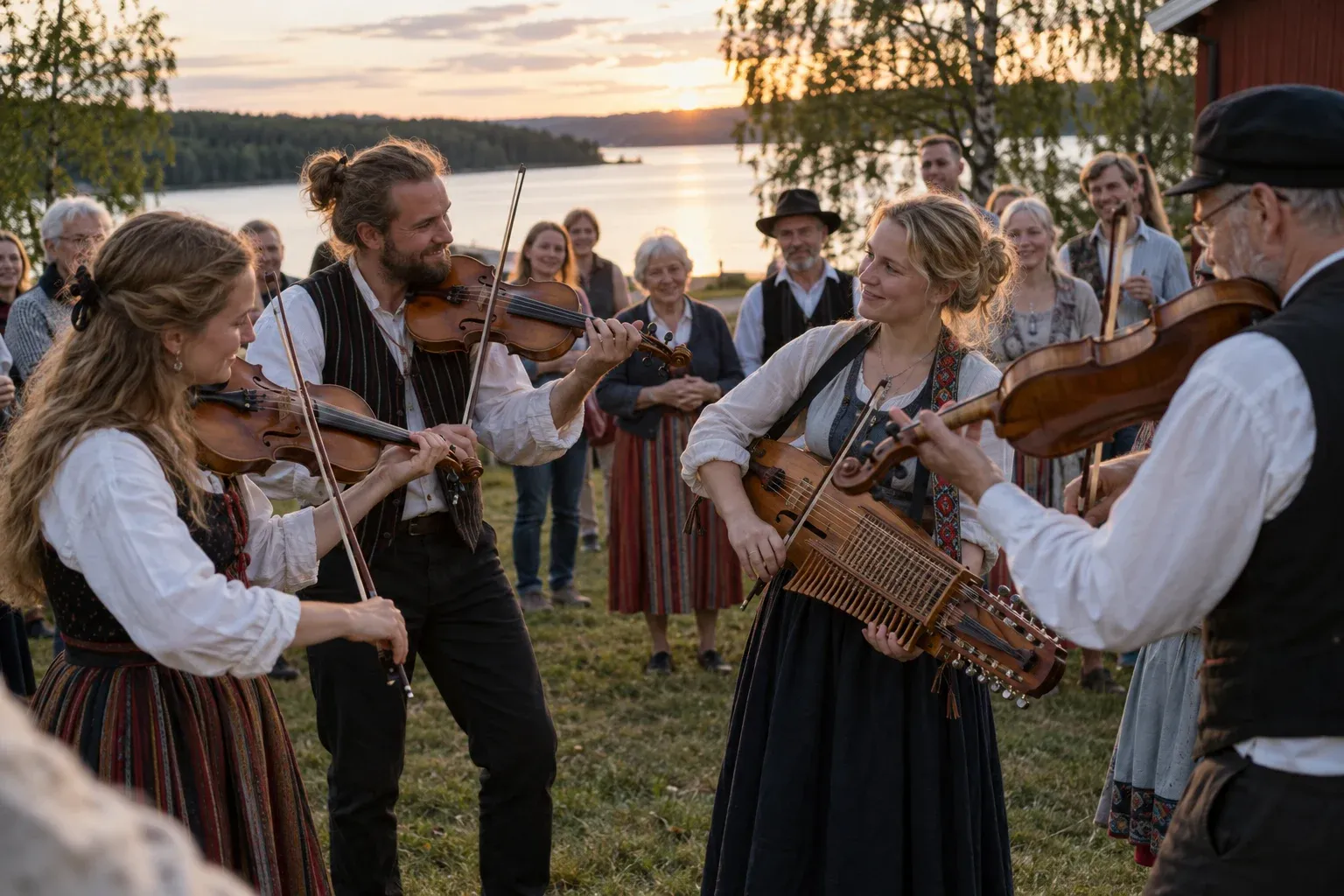
Sweden’s living folk music isn’t on a concert stage — it’s in a circle of fiddlers on a village green. Here is what a spelmansstämma is, the 2027 dates of the big three, how to get there, and what the title riksspelman actually means.
When you need this
You’re in Dalarna, Värmland or Hälsingland in June or July and see a poster that says spelmansstämma. You want living folk music rather than a staged show, or you play an instrument and wonder whether you can join in. Or you’re planning a Midsummer trip and want to know what happens in the weeks around it — and how to reach a village that has no bus.
What a spelmansstämma is
A spelmansstämma (“fiddlers’ gathering”; stämma for short) brings together spelmän — traditional folk musicians — with dancers and listeners. Svenska Folkdansringen, the Swedish Folk Dance Association, puts the difference from a festival simply: at a festival hired artists play to a listening audience, while at a stämma the point is that musicians meet and play with one another. They also play on stage and for dancing, and some stämmor book artists too.
The heart of the day is buskspel (“bush playing”): informal jams that form wherever a few musicians stand together, often far into the night. You can stand at the edge and listen. Most large stämmor are run by volunteer associations at village greens and open-air heritage sites (hembygdsgårdar).
The tradition has a famous founder. In 1906 the painter Anders Zorn organized a fiddlers’ gathering at Gesunda in Dalarna, and in 1910 he designed the silver badge that became the Zornmärket — still awarded today.
The big three in 2027
| Stämma | Region | 2027 date | What sets it apart |
|---|---|---|---|
| Ransätersstämman | Värmland | Thursday–Sunday, 10–13 June | “Always two weekends before Midsummer”; started 1971; concerts in four barns, dancing till sunrise |
| Delsbostämman | Hälsingland | Sunday 4 July (75th edition) | First Sunday in July at Delsbo Forngård, an open-air museum with Hälsingland farmhouses |
| Bingsjöstämman | Dalarna | Wednesday 7 July | Village stämma at Päkkosgården; by its own account Sweden’s largest, with Sweden’s biggest allspel |
Don’t trust the old date rule for Bingsjö. Many guides say it falls on the first Wednesday after Midsummer. In 2027 that would be 30 June — but the organizer has announced 7 July, and 2026’s edition was on 1 July. Always check the organizer’s site for the year you’re going.
Bingsjö sits in the middle of Stämmoveckan, a nine-day folk festival of stämmor, concerts, courses and village-hall dances across Dalarna, run with Folkmusikens Hus, from 3 to 11 July 2027. In Stockholm, Svenska Folkdansringen’s city stämma moved in 2026 from Kungsträdgården to Kristinehovs Malmgård by Hornstull (Sunday 16 August 2026); the 2027 date isn’t published yet.
Getting there and staying over
Bingsjö lies about 38 km north-east of Rättvik and 57 km from Falun. There is no public transport all the way: Dala Trafik buses stop daily at Lamborn on route 50, 6 km south, and the rest is up to you. The organizers point to a long-running Facebook carpool group for folk music and dance events.
Camping is on the fields around the village. Expect slopes, the odd boulder and mud in rain; there is no electricity for caravans or motorhomes and no showers, though there are toilets by each campsite and a bathing lake 3 km south. Caravans must face the road, drawbar out, so the rescue service can move them. Up to Tuesday you pay the camping fee to the landowner; on Wednesday the stämma collects it together with your entry wristband.
Ransäter is easy: 55 km north of Karlstad on route 62, or Värmlandstrafik bus 600 from Karlstad to the Ransäters Kyrka stop. Camping on site is included in the weekend ticket, and there are hot showers, though the hot water can run short at peak times. Food is sold on the grounds, including vegetarian and vegan options.
Warning: Ransäter sells tickets online through Tickster and swaps your QR code for a wristband at the gate. In 2026 there was only an emergency till on site — buy before you travel.
Delsbo Forngård is the heritage society’s open-air museum in Delsbo, Hälsingland. Check the organizer’s site for tickets and transport closer to the date.
Riksspelman and the Zorn badge
Riksspelman is a title, not a job. It belongs to musicians who hold the Zornmärket in silver or gold, awarded by Svenska Folkdansringen, a non-profit association — not by the state.
| Badge | How you get it | Title |
|---|---|---|
| Gold | Nomination only; one or two “particularly outstanding tradition bearers” a year | Riksspelman |
| Silver | Play three or four tunes before a jury at the annual audition | Riksspelman |
| Bronze / diploma | Same audition, lower award | — |
Anyone aged 16 or over may sign up. The jury listens for intonation, danceability, swing and a style rooted in tradition. Fiddles, nyckelharpas, clarinets, bagpipes, hurdy-gurdies, harmonicas and diatonic accordions are accepted — and so is kulning, the high herding call. The audition moves around the country: Falun in June 2026, followed by a riksspelman stämma in Leksand; Bohuslän in 2027; Ransäter in 2029. Among 2026’s new riksspelmän was a nyckelharpa player from Kyoto.
The nyckelharpa and the polska
The nyckelharpa is Sweden’s keyed fiddle: a bowed instrument held just below the chest, with wooden keys that stop the strings. The modern three-row chromatic model has three melody strings, a bass string and twelve resonance strings that give it its shimmer. It has been made and played in Sweden since at least the 1600s, with Uppland as its heartland.
It nearly vanished: in the 1950s only about ten people in Sweden could play it. August Bohlin’s chromatic design, popularized by Eric Sahlström (1912–1986), and the folk revival of the 1960s and 70s brought it back. Today it is played across Europe, the US and Japan, and in December 2023 the nyckelharpa network was added to UNESCO’s register of good safeguarding practices.
The music you’ll hear most is the polska: a couple dance, usually in triple time, with roots in the polonaise and many regional variants. Many Swedes learned it at folk music festivals during the 1970s boom, and the big stämmor still run dance courses and try-it dances.
How to take part
- Listen at a buskspel. Stand around the outside of the circle; the musicians play to each other.
- Learn the allspel tunes. Bingsjö and Ransäter publish each year’s allspelslåtar — the tunes everyone plays together on the main stage.
- Arrive early at Bingsjö. In 2026 the Tuesday before was a förstämma with spontaneous playing and dancing.
- Dance. Music for dancing is often played from a list of bands; join when the floor opens and leave space for turning couples.
- Bring the children. Ransäter and Bingsjö run children’s programs, and Ransäter let under-16s in free in 2026.
- Find something local. Sveriges Spelmäns Riksförbund has about 5,500 members in 23 regional federations that run music evenings, jams and smaller stämmor all year.
Mistakes to avoid
- Treating Bingsjö as a Midsummer event. It’s in the first week of July at the earliest.
- Expecting a festival lineup. The headline is people playing together; the stage program is the side dish.
- Filming from the middle of a jam. Step back to the outside of the circle.
- Calling every good fiddler a riksspelman. It’s a specific title from a jury audition or a gold award.
- Assuming the nyckelharpa is a museum relic. The dominant model is a 20th-century design, and players are found worldwide.
Practical information
| What | Detail |
|---|---|
| Ransätersstämman 2027 | 10–13 June, Ransäters Hembygdsgård, Värmland; tickets online via Tickster |
| Ransäter 2026 ticket terms | Thursday and Sunday free; Friday/Saturday day tickets; weekend ticket incl. camping; under-16s free; 2027 terms not yet published |
| Delsbostämman 2027 | Sunday 4 July, Delsbo Forngård; ticket terms not yet published |
| Bingsjöstämman 2027 | Wednesday 7 July; prices announced in spring 2027; camping fee separate |
| Bingsjö by public transport | Bus to Lamborn on route 50, then 6 km without public transport |
| Stämmoveckan 2027 | 3–11 July, across Dalarna |
| Zorn audition 2027 | Bohuslän (dates via Svenska Folkdansringen) |
| Fire bans on campsites | Set by the municipality — check before lighting a stove |
FAQ
What is a spelmansstämma?
A Swedish folk-music gathering where traditional musicians, dancers and listeners meet. Unlike a festival, where hired artists play to an audience, the point of a stämma is that musicians play with one another, in informal jams called buskspel, on stage and for dancing. The big ones run in June and July in Dalarna, Värmland and Hälsingland, and anyone may come to listen or dance.
When is Bingsjöstämman 2027?
Wednesday 7 July 2027, in the village of Bingsjö, about 38 km north-east of Rättvik in Dalarna. The organizers publish the program and prices later; prices come in spring 2027. In 2026 it was on 1 July, with an informal förstämma of spontaneous playing and dancing the day before, so it is not tied to the Wednesday after Midsummer.
Are spelmansstämmor free?
Not the big ones. Bingsjö charges for entry and camping, and Ransäter sells day and weekend tickets online, though in 2026 Thursday and Sunday were free and under-16s paid nothing. Smaller local stämmor are often cheaper or free. Once you are inside, everything is included: the jams, the dance floors and usually the allspel, where everyone plays together.
What is a riksspelman?
A folk musician who holds the Zornmärket in silver or gold, the badge created by Anders Zorn and awarded by Svenska Folkdansringen. Silver is earned by playing three or four tunes before a jury at an annual audition open to anyone aged 16 or over; gold goes to one or two outstanding tradition bearers a year by nomination. It is an association title, not a state honor.
What is a nyckelharpa?
Sweden’s keyed fiddle: a bowed string instrument held against the chest, with wooden keys that stop the strings. The modern three-row chromatic model has three melody strings, one bass string and twelve resonance strings that give it its shimmering sound. It has been made and played in Sweden since at least the 1600s, and its network was added to UNESCO’s register of good safeguarding practices in 2023.
Can I join in if I play an instrument?
Yes — that is the point of a stämma. Bring your instrument, learn the year’s allspel tunes from the organizer’s website, and listen at the edge of a buskspel circle before asking to play along. The repertoire is mostly polskas and other dance tunes, traditionally passed on by ear, so recordings help more than sheet music. Ransäter and Bingsjö also run courses in playing, singing and dance.
How do I get to Bingsjö without a car?
There is no public transport all the way. Dala Trafik buses stop daily at Lamborn on route 50, 6 km south of Bingsjö, and you must cover the last stretch yourself. The organizers recommend the long-running Facebook carpool group for folk music and dance events, where drivers and passengers find each other. Book accommodation or plan to camp, because there is no late bus home.
Related guides
- Dalarna — the county around Bingsjö, Rättvik and Leksand.
- Mora and Lake Siljan — the Zorn museum and Anders Zorn’s home.
- Midsummer in Sweden — maypole dancing, the other folk tradition in the same weeks.
- Summer music festivals in Sweden — the ticketed contrast, with age limits and bag rules.
- Swedish club life — the volunteer associations that run every stämma.
Facts verified 2026-10-06. Sources: Föreningen Bingsjöstämman, Föreningen Ransätersstämman, Delsbostämman, Delsbo hembygdsförening, Svenska Folkdansringen, Levande kulturarv (Isof), Sveriges Spelmäns Riksförbund, Folkmusikens Hus — full register in this topic’s source file. Found something outdated? Tell us and we’ll fix it.