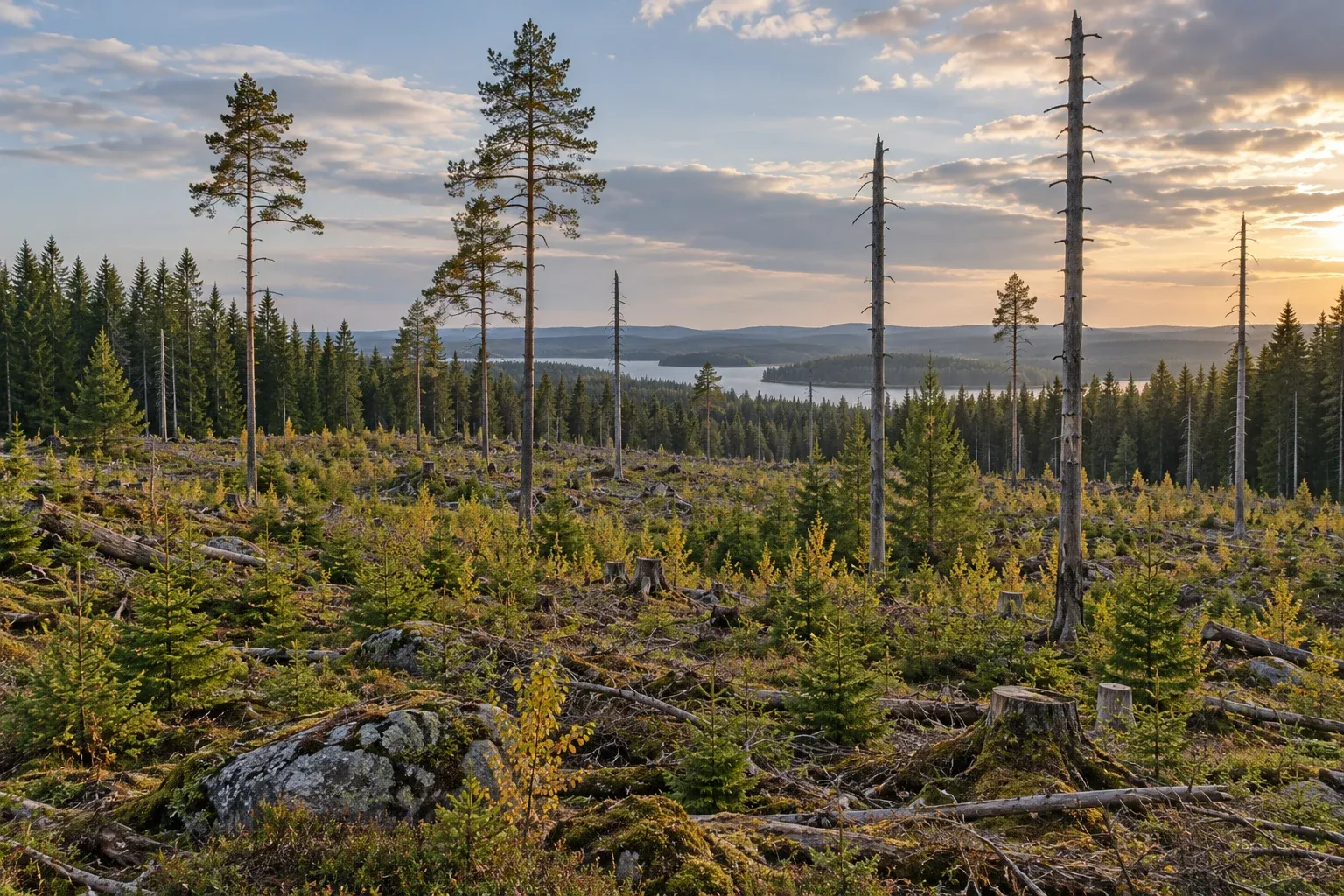
The straight rows, bare hillsides and log piles you see from the car aren’t a sign that something has gone wrong. They’re how most Swedish forest is run. Here’s what the law requires, who owns the land, and what it means for where you walk, drive and stop.
When you need this
You’ve driven past a huge clear-cut and wondered whether it’s legal. You want to walk, pick berries or camp in a forest that’s obviously managed. You’re about to take a gravel road to a lake, a logging truck is coming the other way, or you can hear a harvester working near the trail.
A working forest: why it looks the way it does
Sweden has 27.9 million hectares of forest land (skogsmark), about 68% of the country. Most of it is grown for timber, and it looks like it: even-aged stands, mostly pine (40% of standing timber) and spruce (38%), with 41–60 years the most common age class.
The method behind that look is clear-cut forestry (trakthyggesbruk), dominant in Sweden since the 1950s. A stand is felled, new forest is planted or regenerated, the young trees are cleaned (röjning) and thinned (gallring), and decades later the stand is felled again. Continuous-cover forestry (hyggesfritt), where the ground is never left bare, is used on less than 5% of forest land.
The scale is large. Sweden felled about 87 million cubic metres of timber in 2025 by preliminary figures, and owners notified about 240,000 ha for regeneration felling that year — an average of 4.1 ha per notification, though not every notified stand is cut.
Clear-cuts: what the law requires
A clear-cut is not illegal logging. The Forestry Act (skogsvårdslagen, 1979:429) calls the forest a national asset and a renewable resource, to be managed for a sustained good yield while biodiversity is preserved. Those two goals stand side by side, and the rules follow from them.
| Rule | What it means | Status |
|---|---|---|
| Notification | Regeneration felling of 0.5 ha or more must be notified to the Swedish Forest Agency (Skogsstyrelsen) six weeks in advance | Law |
| Replanting | New forest by planting, seeding or natural regeneration no later than the third year after the felling year | Law and agency regulations |
| Consideration | Leave bushes, single trees, tree groups and dead wood; avoid disproportionately large clear-cuts | Binding rules, summarized by Skogsstyrelsen |
| Mountain-adjacent forest | Felling needs a permit; clear-cuts over 20 ha need special reasons; no foreign tree species | Law |
| Reindeer lands | The local Sami herding community (sameby) must be offered consultation before felling in year-round grazing lands | Law |
So the tall dead trees and clumps of standing trees on a fresh clear-cut aren’t forgotten. They are left on purpose, for biodiversity. Thinning and pre-commercial cleaning need no notification at all.
Who owns the forest
Mostly ordinary people. In the latest ownership statistics we could read, individuals held 48% of Sweden’s declared productive forest land — about 311,000 people own forest. Private companies held 24%, state-owned companies 12% and the state 8%. The single largest owner is the state company Sveaskog.
The split differs sharply across the country:
| Region | Largest owner group |
|---|---|
| Götaland (south) | Individuals, about 77% |
| Svealand | Individuals, about 46% |
| Southern Norrland | Private companies, about 46% |
| Northern Norrland | Individuals, about 35%; most state and state-company forest lies here |
About 15 million hectares were certified under FSC or PEFC in 2021, most of it under both schemes.
Walking, picking and camping in a managed forest
Ownership doesn’t change your access. The right of public access (allemansrätten) applies in production forest just as in wild forest. You may walk, cycle and pick berries there; the full rules are in our guide to allemansrätten.
The exception visitors get wrong is the planting. Naturvårdsverket asks you to take a detour around newly planted forest with tender seedlings. Crossing land that can be damaged is the offence tagande av olovlig väg (unlawful passage) under the Penal Code. That doesn’t mean “planted forest” in general is off limits — almost all Swedish production forest was planted at some point. It means the fresh clear-cut full of knee-high seedlings.
Clear-cuts a few years old are often good berry ground, with raspberries and lingonberries in the open light — see our berry picking guide.
Signs matter too. A landowner may not put up “Private land” (Privat mark) or “No entry” (Ej obehöriga) signs to keep you out of allemansrätten land without a municipal permit. A sign warning of real danger, such as active logging, is a different thing and you should obey it.
Forest roads, barriers and logging trucks
Forestry opened up the Swedish backcountry with gravel forest roads (skogsbilvägar), and most of them are private. What you may do on them:
| You want to | Rule |
|---|---|
| Walk, cycle or ride | Allowed on private roads |
| Drive | Allowed unless the owner bans motor traffic with a sign or a barrier (bom) |
| Drive a road built or maintained with state subsidy | Must in most cases be kept open to public traffic |
| Drive during the spring thaw (tjällossning) | Roads may be closed to some or all vehicles while soft |
| Drive off the road into the forest | Banned — the Off-Road Driving Act exempts forestry, not visitors |
That last row trips people up. Forwarders leave tracks into the forest, and it looks as if you could follow them to a berry slope or a lake. You can’t: driving in terrain on bare ground is banned for everything except agriculture and forestry. Our guide to private roads, gates and barriers covers signs, parking and gates in detail.
Logging trucks are the other reason to drive with care. Sweden’s BK4 road network allows 74-tonne trucks, and a separate network allows combinations up to 34.5 m long. On a narrow gravel road, pull into a passing place early, and never park where a truck needs to turn or load.
Staying safe near logging
Sweden’s forests are safe by any measure, but logging sites have their own hazards:
- Harvesters (skördare): stay well back, make eye contact with the operator and wait for the machine to stop before you approach or pass. Saw chains and falling trees reach further than you think.
- Log piles (virkesupplag, timmertravar) by the road: never climb them, and keep children off. Logs can roll.
- Dead spruce: bark beetle (granbarkborre) attacks have left millions of cubic metres of dead spruce standing in parts of Götaland and Svealand. The trees can fall, so don’t rest or pitch a tent under grey, needle-less spruce.
- Autumn hunting: the same land is hunted in autumn — wear bright colors and see our guide to hiking during hunting season.
If you want to know before a trip whether fellings are planned near your route, Skogsstyrelsen’s free map Skogens karta shows felling notifications and completed fellings. It went into production on 1 October 2026 and replaces the older Skogens pärlor map that many guides still link to.
Where to find older forest
Old forest exists, but unevenly. Forest older than 140 years covers 13.7% of Sweden’s forest land, about 3.8 million hectares — 20.0% in northern Norrland but only 3.5% in Götaland. Formally protected areas make up 9.6% of forest land. In the south, nature reserves and national parks are your best bet.
Practical information
| Question | Answer |
|---|---|
| Share of Sweden that is forest | About 68% (27.9 million ha) |
| Main method | Clear-cut forestry; continuous cover on under 5% of forest land |
| Notification before felling | 0.5 ha or more, six weeks ahead |
| Replanting deadline | By the third year after the felling year |
| Owned by individuals | 48% of declared productive forest land |
| Largest single owner | Sveaskog (state-owned) |
| Old forest (over 140 years) | 13.7% of forest land |
| Formally protected | 9.6% of forest land |
| Logging truck limits | 74 tonnes on BK4 roads; up to 34.5 m on a designated network |
| Planned fellings map | Skogens karta (Skogsstyrelsen), free |
| Walking in production forest | Free under allemansrätten; detour around tender seedlings |
FAQ
Can I walk through a clear-cut or logging area in Sweden?
Yes. Allemansrätten applies in production forest, including on clear-cuts, so you may walk, pick berries and pass through. Take a detour around newly planted areas with tender seedlings, because crossing land that can be damaged is an offence. Where machines are working, keep well clear, obey warning signs and never climb the log piles.
Who owns the forest in Sweden?
Mostly private people. In Skogsstyrelsen’s latest ownership statistics, individuals held 48% of the declared productive forest land, private companies 24%, state-owned companies 12% and the state 8%. The state company Sveaskog is the largest single owner. In the south, individual owners hold about three-quarters; in the north, companies and the state hold much more.
Why does Sweden use clear-cutting?
Clear-cut forestry has been the dominant Swedish method since the 1950s, and the Forestry Act is built around it: production and biodiversity are equal goals, and every felling must be followed by new forest. A stand is felled, replanted or regenerated, thinned as it grows and felled again decades later. Continuous-cover forestry, where the ground is never left bare, is used on less than 5% of forest land.
Do Swedish forests have to be replanted after logging?
Yes. The Forestry Act makes the owner responsible for new forest after felling, and Skogsstyrelsen’s rules require regeneration by planting, seeding or natural regeneration no later than the third year after the felling year. Fellings of 0.5 ha or more must be notified six weeks in advance, including how regeneration will be secured.
Can I drive on Swedish logging roads?
Often, but not always. Most forest roads are private. The owner may ban motor traffic with a sign or a barrier, and roads built or maintained with state subsidy must in most cases stay open to the public. Walking and cycling are always allowed. Never drive off the road into the forest — that is banned.
Is there any old-growth forest left in Sweden?
Yes, but unevenly. Forest older than 140 years covers 13.7% of Sweden’s forest land, about 3.8 million hectares, much of it in the north. In Götaland it is only 3.5%. Formally protected areas make up 9.6% of forest land, so nature reserves and national parks are the surest places to find it.
Related guides
- Allemansrätten — the right of public access that applies in every forest, owned or not
- Berry picking in Sweden — what to pick on clear-cuts and forest edges, and when
- Private roads, gates and barriers — signs, parking and gates on the roads forestry built
- Nature reserves in Sweden — where the older, protected forest is, and its own rules
- Hiking during hunting season — the same forest in autumn, with hunters in it
Facts verified 2026-10-05. Sources: Sveriges riksdag (Skogsvårdslagen, Brottsbalken, Terrängkörningslagen), Skogsstyrelsen, SLU Riksskogstaxeringen, SCB, Naturvårdsverket, Trafikverket, Sveaskog — full register in this topic’s source file. Found something outdated? Tell us and we’ll fix it.