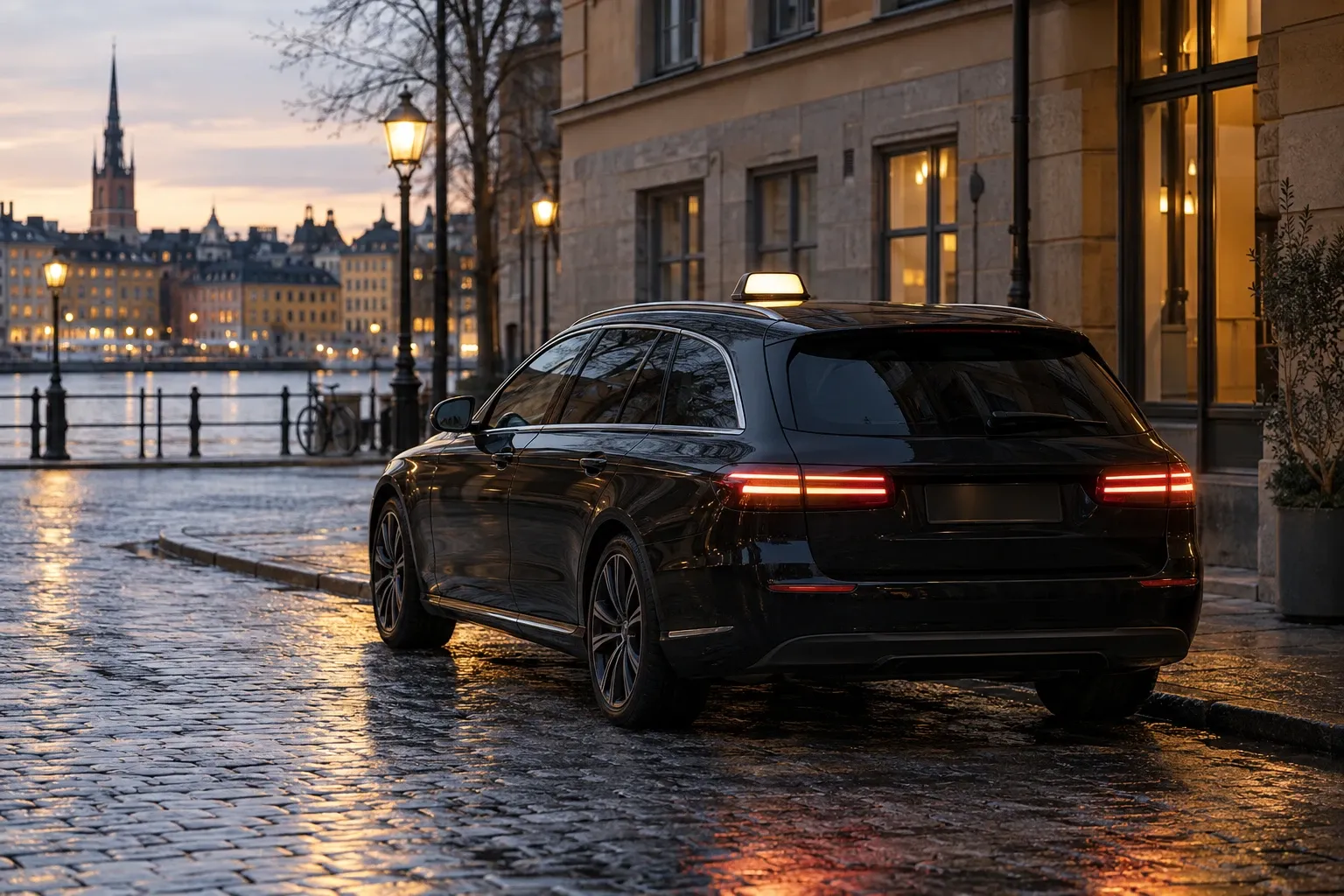
Swedish taxis are licensed and card-friendly, and the price is whatever the company decides. The law doesn’t cap fares. It makes every car show one number so you can compare. Learn to read it and you won’t be overcharged.
When you need this
You’re at a rank with five cars and five different stickers. You’ve just landed at Arlanda and someone in the arrivals hall is offering a ride. You’re deciding between the rank, a taxi company’s app and Uber. Or the bill at the end was far higher than you expected, and you want to know whether that was legal.
Why Swedish taxi prices vary so much
Sweden has no official taxi tariff and no price ceiling. Every licensed company sets its own prices, and an extreme price is lawful as long as it’s displayed. What the state regulates instead is transparency: every taxi must show its prices both inside and outside the car.
That works for passengers who read the sticker and fails for those who don’t. Konsumentverket (the Swedish Consumer Agency) reports that complaints about unreasonably high fares more than doubled from 2024 to 2025. In 2025, people who complained had paid on average about 1,410 kr more than they expected, up from about 814 kr the year before.
The government has noticed. On 20 August 2026 it told Transportstyrelsen (the Swedish Transport Agency) to review the price-information rules, noting that only one passenger in ten says they can use the displayed price to estimate a fare. An interim report is due by 30 June 2027. Until then, the rules below apply.
How to read the price sticker
The headline figure on every taxi is the jämförpris (comparison price). By law it’s the price, VAT included, of a trip of 10 kilometres lasting 15 minutes, including any base fee. It exists so you can compare companies at a glance.
| On the sticker | What it tells you |
|---|---|
| Jämförpris (large figure) | Cost of the 10 km / 15-minute reference trip in this car |
| Kr/km | Price per kilometre |
| Kr/timme | Price per hour, which runs while you sit in traffic |
| Fixed charge / base fee | Added once per trip |
| Endast fast pris enligt prislista | “Fixed price only, per price list”: no meter, ask the price |
The one thing it isn’t is a maximum. Konsumentverket says travelers routinely read the comparison price as the most they can be charged. It’s the price of a reference trip. A ride of 40 km in heavy traffic costs several times that number, and more still in a car with a high comparison price.
How to judge a number without knowing today’s prices: compare. Look at every car at the rank, or check one of the big companies’ comparison prices in its app before you travel so you know what normal looks like. Then use the legal threshold below as a warning light. A comparison price close to or above it isn’t illegal, but it’s at the level where the law assumes you need protection.
The 710 kr rule: when the driver must quote a maximum
If a car’s comparison price is above a threshold set in the taxi law (taxitrafiklagen), the driver must give you a binding highest price for your trip before it starts. If the driver won’t give one, don’t get in.
The threshold isn’t a fixed number any more. Since 1 January 2025 it has been 1.2% of the year’s price base amount (prisbasbelopp, an index the government sets annually), rounded down to the nearest ten kronor. The year that counts is the one in which you order the trip.
| Trips ordered in | Price base amount | Threshold |
|---|---|---|
| Until end of 2024 | — (fixed by law) | 500 kr |
| 2025 | 58,800 kr | 700 kr |
| 2026 | 59,200 kr | 710 kr |
You will still see “700 kr” on official pages. Both Transportstyrelsen’s and Konsumentverket’s consumer pages were showing the 2025 figure when we checked in September 2026. The statute gives 710 kr for 2026. The practical advice doesn’t change: if the comparison price is anywhere near that level, ask for the maximum price first.
Below the threshold, nothing obliges the driver to quote. You can still ask, and you can still walk away. Tell the driver where you’re going and ask what it will cost before the car moves.
Is this a real taxi?
A licensed Swedish taxi has yellow registration plates. Inside, the driver must display a taxi driver ID showing the six large digits of the driver code. Most cars have a meter. The exception is a pre-booked fixed-price car, covered below.
One myth to drop: taxi plates don’t necessarily end in a “T”. Plates made since 1 April 2017 have no T. Older ones with an embossed T are still valid, so you’ll see both. The yellow colour is the marker. A car with ordinary white plates offering rides isn’t a taxi, and you’d have no price information, no meter record and no receipt to complain with.
Uber, Bolt and booking apps
Uber and Bolt are legal in Sweden because they work inside the taxi system. Their drivers need a Swedish taxi driver licence (taxiförarlegitimation) and drive taxi-registered cars for a company with a taxi permit. The same goes for the established taxi companies’ own apps.
Since 2021 Swedish law has also allowed a taxi with no meter at all, on strict conditions. Every trip must be pre-booked at a fixed price through a licensed booking centre (beställningscentral), and you pay the booking centre, not the driver.
For a visitor, the appeal of any app is simple: you see the price before you accept. That price is your protection. What doesn’t come with it is the Arlanda contract cap described below, which covers only cars from the airport’s official ranks.
Where rip-offs happen
Konsumentverket names two hotspots: Arlanda and railway stations. The pattern is an unsolicited offer, a driver approaching you, which the agency describes as a surprise tactic that pushes people into decisions they regret.
At Arlanda there’s a second layer of protection. Only taxi companies with a contract with Swedavia, the airport operator, may pick up passengers there, and within a marked zone they accept a maximum fare. That cap applies only to rides from the airport and only to cars taken from the official ranks outside Terminal 2 and Terminal 5. Never accept a ride offered inside the arrivals hall. Only drivers meeting a pre-booked passenger may wait there. For the full comparison of taxi, train and coach from the airport, see Arlanda to Stockholm.
Landing at night? Pre-book. Swedavia says cars run short at peak arrival times.
Paying and receipts
In practice you can pay by card or phone in Swedish taxis, and app rides are charged in the app. Always take the receipt. By law it must show the car’s registration number, the company and the driver code, and since 1 September 2023 it can be electronic if you can receive one. It’s your evidence in a dispute and the quickest way to trace the car if you leave something behind.
Tipping is optional. Rounding up is common, and more is covered in tipping in Sweden. One more rule: drinking alcohol in a taxi is banned nationwide.
If you were overcharged
You may have to pay first and dispute afterwards. Arguing at the kerb rarely works. The complaint route does:
- Tell the driver you think the price is wrong.
- Keep the receipt and photograph the price sticker.
- Write to the taxi company, by email for example. Explain why the price is wrong and ask for the difference back.
- Paid by card? If the company refuses a clearly unjustified charge, Konsumentverket names disputing the payment through your bank as an option.
- Take it to ARN, the national consumer-disputes board (Allmänna reklamationsnämnden), if the company refuses or doesn’t answer. Filing costs 150 kr.
Practical information
| Item | Detail |
|---|---|
| Taxi fares | Uncapped; each company sets its own. Compare the jämförpris |
| Jämförpris | Price of 10 km in 15 minutes, VAT and base fee included |
| Binding-quote threshold | 710 kr jämförpris for trips ordered in 2026 (agency pages still show 700 kr) |
| Legal taxi | Yellow plates; driver ID with six-digit code displayed |
| Arlanda | Contract maximum within Swedavia’s zone, rides from the airport only, official ranks at Terminals 2 and 5 |
| App rides | Fixed price shown before you book |
| Receipt | Registration number, company, driver code; electronic allowed |
| Complaint | Company in writing, then ARN (150 kr fee) |
FAQ
How do taxi prices work in Sweden?
Every company sets its own prices, and there is no legal maximum. Instead, each taxi must display its prices inside and outside the car, headlined by the jämförpris: the cost of a standard 10 km, 15-minute trip. Use it to compare cars at a rank. It is not your fare — a longer trip costs proportionally more.
What is jämförpris on a Swedish taxi?
It is the comparison price: what that particular car charges, VAT and base fee included, for a trip of 10 kilometres lasting 15 minutes. The law makes every taxi show it so passengers can compare companies at a glance. Travelers often mistake it for a maximum price; it is not. Your trip can cost much more if it is longer.
Does a Swedish taxi driver have to tell me the price in advance?
Only when the car’s comparison price exceeds a legal threshold — 1.2% of the year’s price base amount, which is 710 kr for trips ordered in 2026. Then the driver must give a binding maximum price before the trip. Below that, nothing obliges a quote, but you can always ask and walk away.
Are Uber and Bolt legal in Sweden?
Yes. Drivers need a Swedish taxi driver licence and a taxi-registered car operating under a taxi permit, so an app ride is a licensed taxi ride. Prices are fixed and shown before you book. The Arlanda contract cap does not apply to app bookings; the app’s quote is your protection.
How do I avoid a taxi rip-off at Arlanda?
Walk out to the official taxi ranks outside Terminal 2 or Terminal 5, where only Swedavia-contracted companies pick up and a maximum fare applies within a marked zone. Never accept a ride from someone approaching you in the arrivals hall. Read the comparison price, confirm the fare before the doors close, or pre-book by app.
How do I complain about an expensive taxi in Sweden?
Tell the driver, keep the receipt and photograph the price sticker. Then write to the taxi company, for example by email, explaining why the price is wrong and asking for the difference back. If they refuse or do not answer, take it to ARN, the national consumer-disputes board; filing costs 150 kr.
Can I pay a Swedish taxi by card?
In practice, yes: card and phone payment are standard in Swedish taxis, and app rides are charged through the app. Always take the receipt, which by law must show the car’s registration number, the company and the driver code. Paying by card also leaves a record your bank can act on in a dispute.
Related guides
- Arlanda to Stockholm — taxi against the express train, commuter train and coach, with the station fee explained
- Getting around Sweden — where taxis fit in the whole transport system
- Stockholm public transport — often the cheaper way home, even late
- Tipping in Sweden — what, if anything, to add to the fare
- Drinking in public — why the bottle stays closed in the taxi
Facts verified 2026-09-23. Sources: Transportstyrelsen, the taxi law (taxitrafiklagen 2012:211) via Sveriges riksdag, Konsumentverket, Regeringen, SCB, Swedavia — full register in this topic’s source file. No fares or example comparison prices are published here; they vary by company. Found something outdated? Tell us and we’ll fix it.