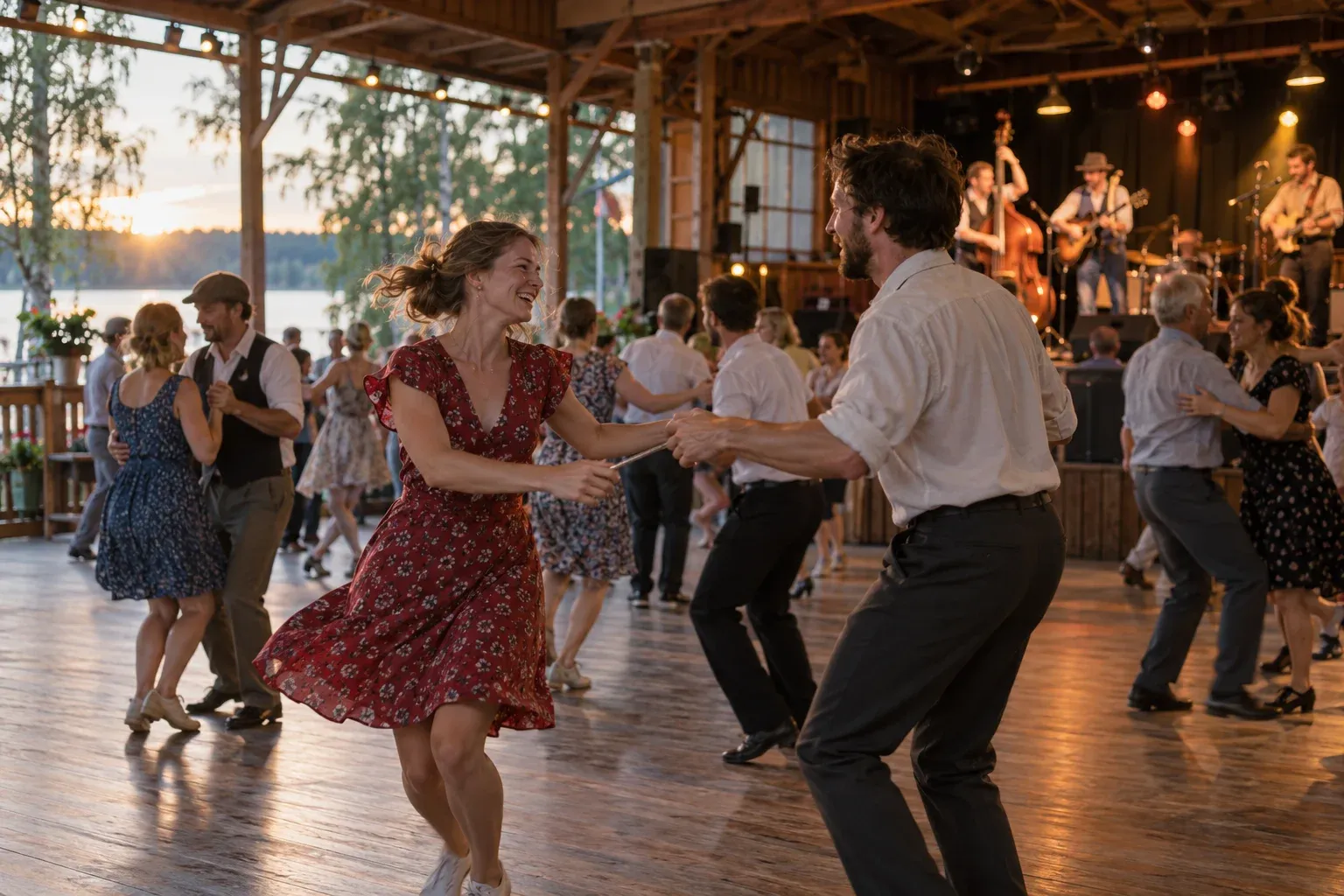
Bugg and foxtrot are Sweden’s most common social dances, and they grew up with live bands in parks the labour movement built. Here is what a dansband is, where folk parks came from, how a dance night works and what to expect in Malung.
When you need this
You see a poster saying “Dans till…” with a band name ending in z. You want a summer night out in Sweden that is not a nightclub. Malung in Dalarna is fully booked in mid-July and you wonder why. Or someone has invited you to a dance and you have no idea who asks whom, or what the steps are.
What a dansband is
A dansband (“dance band”) is a Swedish live band whose job is to get couples onto the floor. The usual lineup is electric bass, guitar, keyboards and drums; older bands added accordion or saxophone. The songs are mostly in Swedish, about love, friendship and home, in a steady 4/4 beat built for bugg and foxtrot.
The word took hold in the 1970s, when these smaller bands replaced the old big dance orchestras. That decade was the genre’s heyday: bands played the open-air dance floors of the folk parks in summer and the Folkets hus halls in winter, and Sweden had around 800 full-time dance bands at the peak. They still tour year-round, often by bus, playing several nights a week.
The genre’s image has swung back and forth. Disco in the late 1970s and 1980s brought talk of dansbandsdöden, “the death of dance bands”, and a nerdy reputation; the 1990s brought a revival. Today bands such as Donnez, Band of the Year at the Guldklaven awards in 2024 and 2026, say they want a younger audience.
One more thing you will notice: the z. Names like Lasse Stefanz and Larz-Kristerz are not typos. The habit is traced to a folk-park sign that ran out of the letter S, and it became the genre’s trademark.
Folk parks: where the dancing began
A folkpark, or Folkets Park (“people’s park”), is an open-air venue built by popular movements, above all the labour movement, for dancing, shows and meetings.
| Year | What happened |
|---|---|
| 1796 | Krokbornsparken in Hällefors is laid out; it is often called the first Swedish folk park and still exists |
| 1893 | The labour movement opens Sweden’s first Folkets Park in Malmö on 30 April |
| 1905 | The parks’ central body, Folkparkernas Centralorganisation, is formed |
| Late 1950s | Around 256 folk parks, from towns to forest crossroads |
| 2000 | The park and Folkets Hus organisations merge into Folkets Hus och Parker |
The national organisation calls the workers’ Folkets Park “a wholly Swedish phenomenon”, unlike the German Volkspark, where politics was banned. Through the first half of the 20th century, parks spread to rural crossroads and mill villages, with dancing and touring artists every Saturday.
Many parks have closed since, but others survive as dance and concert venues. Folkets Hus och Parker today has close to 500 member associations running halls, folk parks and cinemas around the country. In Malmö, the first Folkets Park is in the Möllevången district. ABBA fans will find a replica of the folk park where Björn and Benny met at ABBA The Museum.
Bugg and foxtrot: the dances
Two dances cover most of a dansband night:
| Dance | What it is like |
|---|---|
| Bugg | Fast, in 4/4 time; partners hold one or both hands rather than a closed hold; no fixed figures, the leader improvises turns and the follower follows |
| Foxtrot (fox) | A partner dance where you hold each other, unlike bugg; with bugg, the most common social dance in Sweden |
| Gammaldans | “Old-time” dances such as waltz, polka and schottis, played by some bands and at special events |
Bugg grew out of American swing dances such as the jitterbug, and the name has been used in Sweden since the late 1960s. Because it is improvised, a few basic steps and turns go a long way. You do not need to know a routine.
Dance-floor etiquette
Nobody publishes official rules for this; it is custom, and it varies from place to place. The basics:
- Anyone can ask. Social dancing is a way to meet people, and dancing with a stranger is the norm. The phrase is bjuda upp, “to ask someone to dance”.
- Dance one or a few songs, in some traditions always two, then thank your partner (tack för dansen) and find a new one.
- Etiquette is taught, not written down. At Dansbandsveckan, short evening sessions cover manners, how to lead and how to follow.
If you are nervous, take a beginner class first; see the next section. Dancing is also one of the easier ways into Swedish social life, a theme of our guide to making friends in Sweden.
Dansbandsveckan in Malung
Svenska Dansbandsveckan, the Swedish Dance Band Week, is the genre’s biggest gathering, held every July in the Folkets Park Orrskogen in Malung, Dalarna. It started in 1986 with six bands and is run by two non-profit associations, Malungs IF and Folkets Park Orrskogen. The organizer counts close to 100,000 visitors a year.
How the week works:
- Evenings: 82 bands over seven evenings on six roofed dance floors. The bands play nonstop: when one band takes a break, the next starts the following song straight away. Dancing runs 20:00–01:00, until 02:00 on Friday and Saturday.
- Days: free shows in Grönlandsparken in central Malung, 12:00–17:00, with a small dance floor beside the stage.
- Opening night: the Guldklaven gala, the dance-band industry’s awards, decided by a public phone vote plus jury prizes.
- Dance school: courses from beginner bugg to advanced foxtrot, and gammaldans classes with live music. The evening “survival course” for beginners is included in the evening ticket. In 2026, bugg courses for 8- to 17-year-olds were free with advance registration.
- Getting around: Orrskogen is about 1 km from the centre; free buses run 20:30–00:15, or it is roughly an 800-metre walk from Grönlandsparken.
Entry rules worth knowing before you go: children and young people up to and including 17 get in free, but under-15s only with a parent or guardian. One companion per disabled visitor enters free with a companion card. Children under 13 are not allowed into the evening shows in Tältet, the tent stage, because the volume exceeds the limit for events with young children. Bags are allowed; water bottles must be empty at the entrance.
Many visitors stay at campsites, so if you travel by motorhome, you will fit right in; see also Swedish campsites. Hotel rooms, an inn and private rentals exist too. Book as soon as your dates are set.
Dansband on TV
The genre had its prime-time moment with SVT’s Dansbandskampen, a contest between bands that ran from 2008 to 2010. Larz-Kristerz, The Playtones and Elisas won its three seasons, and SVT shelved the show in May 2011. No new season had been announced when we checked in October 2026, so Guldklaven in Malung is now the genre’s main showcase.
A note on the law
If you read that Sweden requires a police permit to dance, it is out of date. Since 1 July 2023 a public dance needs a police permit only when it is held on a public place. Other public dances are no longer on the permit list in the Public Order Act (ordningslagen). This is the organizer’s concern, not yours.
Practical information
| Item | Detail |
|---|---|
| Dansbandsveckan 2027 | 18–24 July 2027, Folkets Park Orrskogen, Malung |
| Size | 82 bands, six roofed floors, seven evenings |
| Evening dancing | 20:00–01:00; Friday and Saturday to 02:00 |
| Daytime shows | Grönlandsparken, 12:00–17:00, free |
| Entry age 17 and under | Free; under 15 only with a guardian |
| Tickets | Week, evening or four-day; cheaper online in advance than at the gate; admin fee added; prices change yearly |
| Next-year tickets | Limited Blind Bird tickets for 2027 went on sale on 18 July 2026, during the festival |
| Local dances | Folk parks and barn venues (loge) set their own prices |
FAQ
What is a dansband?
A dansband is a Swedish live band that plays music for couples to dance to, mostly bugg and foxtrot. A typical lineup is bass, guitar, keyboards and drums, sometimes with accordion or saxophone, and the songs are usually in Swedish about love and home. The bands tour year-round, outdoors at folk parks in summer and indoors in winter.
What is a folkpark in Sweden?
A folkpark, or Folkets Park, is a “people’s park” built by popular movements, above all the labour movement, for dancing, shows and meetings. The first labour-movement park opened in Malmö on 30 April 1893. Around 256 existed in the late 1950s; today the national body Folkets Hus och Parker has close to 500 member associations running parks, halls and cinemas.
When is Dansbandsveckan in Malung?
Dansbandsveckan is held every July in Folkets Park Orrskogen in Malung, Dalarna. The 2027 edition runs 18–24 July 2027, with 82 bands playing over seven evenings on six roofed dance floors. Dancing runs 20:00–01:00, to 02:00 on Fridays and Saturdays. The Guldklaven award gala opens the week, and daytime shows in Grönlandsparken are free.
What is bugg?
Bugg is a Swedish partner dance to fast music in 4/4 time, with roots in American swing dances such as the jitterbug. Partners hold one or both hands instead of a closed hold, and there are no fixed figures: the leader improvises turns and the follower follows. With foxtrot it is the most common social dance in Sweden.
Can I ask a stranger to dance in Sweden?
Yes. Social dancing is a way to meet people, and dancing with someone you do not know is the norm at a dansband night. Dance one or a few songs together, in some traditions always two, then thank your partner and find a new one. At Dansbandsveckan, short etiquette sessions teach how to lead, how to follow and what to think about on the floor.
Is Dansbandskampen still on TV?
No. Dansbandskampen was an SVT contest between dance bands that ran for three seasons from 2008 to 2010; Larz-Kristerz, The Playtones and Elisas won. SVT shelved the show in May 2011, and no new season had been announced when we checked in October 2026. The genre’s main annual showcase is now the Guldklaven gala in Malung.
Do I need to know how to dance to go?
No. At Dansbandsveckan the dance school teaches bugg from beginner level, and an evening “survival course” for beginners is included in the evening ticket. Bugg has no fixed figures, so a few basic steps and turns go a long way. Daytime shows in Malung are free, so you can watch first and dance later.
Related guides
- Dalarna — the region around Malung, for the rest of your trip.
- Spelmansstämma and Swedish folk music — the older fiddle-and-dance tradition.
- Summer music festivals — other July events worth planning around.
- Sweden by motorhome — how many festivalgoers reach Malung.
- Midsummer in Sweden — the other big night of dancing.
Facts verified 2026-10-06. Sources: Svenska Dansbandsveckan, Folkets Hus och Parker, Sveriges riksdag (ordningslagen) and SVT — full register in this topic’s source file. Found something outdated? Tell us and we’ll fix it.