Sweden charges nothing to climb its granite, but the freedom comes with a legal stack most visitors never see. Here is what is allowed, what needs permission, when crags close, and how to take children out safely.
When you need this
You’re packing crash pads or a rack for a Swedish trip and want to know whether you need a permit. Perhaps you’ve arrived at a crag in May and found it quiet, and you’re wondering if that’s a closure. You might be planning to climb inside a national park or nature reserve, or you’ve spotted an unclimbed line and wonder whether you can bolt it. Or you simply want a safe first outdoor day for your children.
Is climbing legal in Sweden?
Yes, with no permit and no fee. Climbing and bouldering on existing routes fall under allemansrätten (the right of public access). Naturvårdsverket, the Swedish Environmental Protection Agency, says you may climb in nature as long as rock and stone are not damaged and you choose another spot if birds are nesting nearby. As an individual climbing existing routes, you don’t need to notify anyone.
Allemansrätten isn’t a law you can look up, but it rests on one. The Environmental Code requires everyone using it to “show consideration and care” in nature. The national federation, Svenska Klätterförbundet, puts it plainly: some countries make you pay to climb outdoors, while in Sweden you pay with good behavior. The federation sums up the principle as inte störa, inte förstöra: don’t disturb, don’t destroy.
What that means at the crag, according to the federation:
| Do | Don’t |
|---|---|
| Park only in designated places | Cut across fields or private plots |
| Brush chalk and tick marks off afterwards | Brush moss or lichen off a dirty problem |
| Take all litter home, even other people’s | Break branches or damage nests |
| Keep noise down and be polite | Light fires on bare rock or next to boulders |
| Bury toilet waste | Climb on through alarm calls from birds |
If the car park is full, the federation’s advice is blunt: go home, or park further away and walk. Parking keeps coming up as a cause of conflict with landowners.
What needs permission: bolts, cleaning and new routes
Allemansrätten covers climbing what is already there, not changing the rock. Drilling bolts and clearing vegetation are outside the right: the federation says to contact the landowner, and in some cases the county board (länsstyrelsen), before doing either. Naturvårdsverket adds that anyone making a new route, running a club or organising climbing counts as the responsible operator (verksamhetsutövare). They must check for red-listed species and nesting birds, check whether the cliff lies in a protected area, and ask the landowner for permission.
Then the law steps in. If a new route or activity may noticeably change the rock or the nature around it, the Environmental Code (chapter 12, section 6) requires you to notify the county board for consultation. The landowner’s permission alone is not enough. The work may start no earlier than six weeks after the notification, unless the board agrees otherwise. Clubs also follow a jointly agreed bolting policy, so talk to the local club first.
Heritage law adds a hard line. Ancient monuments (fornlämningar), a definition that covers rock surfaces with carvings, symbols or paintings, may not be moved, covered, altered or damaged without a permit.
Nesting birds and climbing stops
This is where most visiting climbers go wrong. Birds nest on ledges and in cracks in spring and early summer, and Naturvårdsverket warns that in some cases a very small disturbance means the chicks do not survive. The species-protection ordinance bans deliberately destroying or damaging wild birds’ nests and eggs, and bans deliberately disturbing wild birds when the disturbance is significant, especially while they breed.
Closures come in several kinds:
| Type | Legal force | Example |
|---|---|---|
| Bird protection area (fågelskyddsområde) | Law; set per area, most commonly 1 April–15 July | The federation calls these an absolute no-go |
| Reserve seasonal zone | Law | Kullaberg’s marked zones, closed 1 March–15 July every year, on land and water |
| Climbing stop in the access database | Agreed with the local club; may reflect birds or a landowner’s wishes | Two Dalarna crags, Hykjeberget and Uvklitt, closed until 1 August in 2026 |
| Hunting stop | Agreed locally | Solvik in Östergötland, closed during the moose hunt, 8 October 2026–31 January 2027 |
Not every stop is law, but treat them as if they were. The federation says climbing stops get issued and crags get closed when climbers misbehave. And even where nothing is posted, Naturvårdsverket’s guidance is to stop climbing and leave if birds give alarm calls. Report a nest you find on a route to the federation’s access committee so others hear about it.
The tool for all of this is the federation’s Accessdatabasen (access.klatterforbundet.se), which it describes as the only place that collects access information for the whole of Sweden. Each crag is tagged as a full stop (totalt klätterstopp), a partial stop (delvis klätterstopp) or a sensitive situation (känslig situation), with details agreed with the local club. Check it for every crag, every season.
Parks and reserves: the rules can differ completely
National parks and nature reserves have their own binding regulations, and they can override allemansrätten. Three examples show how much they vary:
- Söderåsen National Park in Skåne bans rock climbing throughout the park, despite cliffs that look made for it.
- Kjugekull nature reserve permits bouldering but bans climbing on boulders, slabs and potholes the manager has marked, and bans drilling or painting stone. Some map listings still say the reserve is under appeal with only partial rules; the county board now publishes the full regulations.
- Fulufjället National Park allows ice climbing on the frozen Njupeskär waterfall from 1 December to 31 March.
Read the county board’s page for the specific area before you go. See our guide to how nature reserve rules work for the wider picture.
Where to climb and boulder
Swedish climbing is mostly single-pitch routes and bouldering on granite, with good areas spread across the country.
| Area | Type | What to know |
|---|---|---|
| Bohuslän and the Gothenburg area | Granite, mainly trad, plus bouldering | Recommended by climbers; several crags flagged in the access database |
| Kjugekull, north-east Skåne | Bouldering in a nature reserve | Called one of Sweden’s best bouldering areas by the county board; marked blocks off-limits |
| Kullaberg, north-west Skåne | Sea cliffs in a nature reserve | Climbing listed; zones closed 1 March–15 July (Kullaberg guide) |
| Västervik, east coast | Granite crags | Named among areas worth visiting |
| Dalarna | Inland crags | Several nesting-bird stops to 1 August in 2026 |
| Kebnekaise | Alpine | Sweden’s largest alpine climbing area (Kebnekaise guide) |
Bring a guidebook (förare): the federation names helmet, courses and guidebooks as the three things to add to your normal kit. Camping near the crag follows ordinary allemansrätten rules: one or two nights, two or three tents, out of sight of homes, and not in reserves that ban it (see our wild camping guide).
Climbing with kids
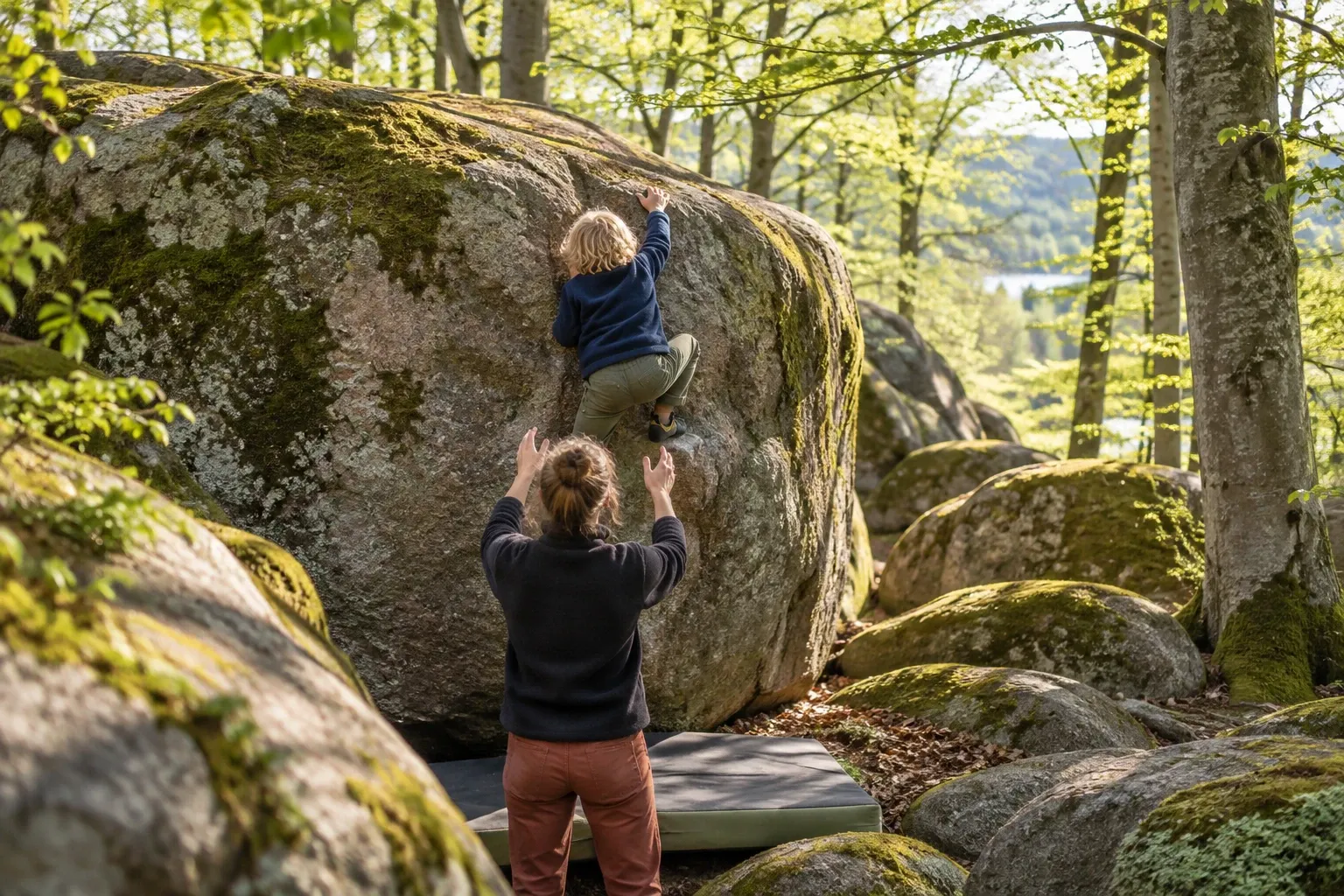
Allemansrätten applies to children exactly as to adults, and bouldering is the easiest way in. Start on low problems with crash pads and an adult spotting. The federation’s equipment advice for bouldering is one or more pads (paddor) to cushion the fall.
For rope climbing, a club try-out session (prova på) is the low-risk first step. The federation says Konsumentverket, the consumer agency, expects organised try-outs to be safe arrangements led by competent instructors. Non-members taking part in a try-out run by a federation club are covered by the federation’s accident insurance. Indoors, the federation’s standardised belay licences are grönt kort (green card) for top-rope belaying and rött kort (red card) for lead.
For fixed-cable climbing with children, where a 40 kg minimum weight applies, see our via ferrata guide.
Safety, insurance and rescue
The federation is frank that there is no safe climbing: small mistakes can have serious consequences, and outdoors all the responsibility is yours. According to the federation, a landowner can never be held responsible for an accident on their crag. Its practical rules:
- Wear a helmet for all outdoor rope climbing.
- Use only UIAA- or CE-marked gear that is in date; soft gear ages and hardware can be damaged in falls.
- Know your position: GPS coordinates make a rescue faster.
- Take a course with an instructor the federation has authorised before you go outdoors.
In an emergency, call 112. Rescue by the police or rescue services sends no bill to the person rescued, but healthcare afterwards can cost money; see who pays for a rescue in Sweden. Check that your travel insurance covers climbing. If you stay longer, joining a Swedish club brings the federation’s accident insurance, which covers outdoor climbing.
Practical information
| What | Detail |
|---|---|
| Permit or crag fee | None: climbing is free under allemansrätten (checked 2026-10-15) |
| Kjugekull and Kullaberg | No entry fee stated by the county board (checked 2026-10-15) |
| Club membership with accident insurance | Set by each club, not published centrally (checked 2026-10-15) |
| Where to check closures | Svenska Klätterförbundet’s Accessdatabasen, per crag |
| Main closure season | Spring to midsummer; some crags to 1 August |
| Moose hunt | From 1 September in the north, 8 October elsewhere; a few crags close |
| Ice climbing on Njupeskär | 1 December–31 March |
| Bolting a new route | Landowner permission; county board notification if nature may change noticeably, then a six-week wait |
| Emergency | 112; rescue itself is not billed |
FAQ
Is rock climbing allowed in Sweden without a permit?
Yes. Climbing and bouldering on existing routes are part of allemansrätten, the right of public access, so there is no permit or crag fee. You must not damage rock or vegetation, and you must leave if birds are nesting nearby. National parks and nature reserves can restrict or ban climbing, so check each area’s rules and the federation’s access database first.
Where is the best bouldering in Sweden?
Kjugekull, a nature reserve near Kristianstad in north-east Skåne, is described by the county board as one of Sweden’s best bouldering areas, with granite blocks spread through forest and pasture. Some marked boulders and potholes are protected and off-limits. Climbers also recommend the granite around Gothenburg, Bohuslän and Västervik. Bring crash pads, and brush off your chalk.
Are climbing areas in Sweden closed for nesting birds?
Many are, mostly from early spring into summer. Some closures are legally binding, such as bird protection areas or Kullaberg’s zones closed 1 March to 15 July. Others are voluntary club stops that can run to 1 August. The federation’s access database lists each crag’s status. If birds give alarm calls, leave even where nothing is posted.
Can I place bolts on a new route in Sweden?
Not on your own initiative. Drilling bolts and clearing vegetation are not covered by allemansrätten, so you need the landowner’s permission. If the work may noticeably change the rock or nature, the Environmental Code requires notifying the county board, and you must wait at least six weeks. Talk to the local club first; clubs follow an agreed bolting policy.
Is climbing allowed in Swedish national parks?
It depends on the park. Each national park has its own binding regulations: Söderåsen bans rock climbing throughout, while Fulufjället allows ice climbing on Njupeskär from December to March. Nature reserves vary in the same way: Kjugekull permits bouldering except on marked blocks. Read the county board’s page for the specific area before you go.
Can kids go bouldering outdoors in Sweden?
Yes, and allemansrätten applies to them like anyone else. Start on low problems with crash pads and an adult spotting. For rope climbing, a try-out session run by a federation club is the safest first step: the federation’s insurance covers non-member participants, and organised try-outs are expected to be led by competent instructors.
Related guides
- Allemansrätten explained — the right your climbing rests on, and its limits
- Via ferrata in Sweden — fixed-cable climbing and the 40 kg rule for children
- Kullaberg — the sea-cliff reserve and its spring closures
- Söderåsen National Park — why the cliffs are off-limits to climbers
- Who pays for a rescue in Sweden — what 112 costs, and what it doesn’t
Facts verified 2026-10-15. Sources: Naturvårdsverket, Sveriges riksdag (Miljöbalken, artskyddsförordningen, kulturmiljölagen), Länsstyrelsen Skåne, Svenska Klätterförbundet — full register in this topic’s source file. Found something outdated? Tell us and we’ll fix it.