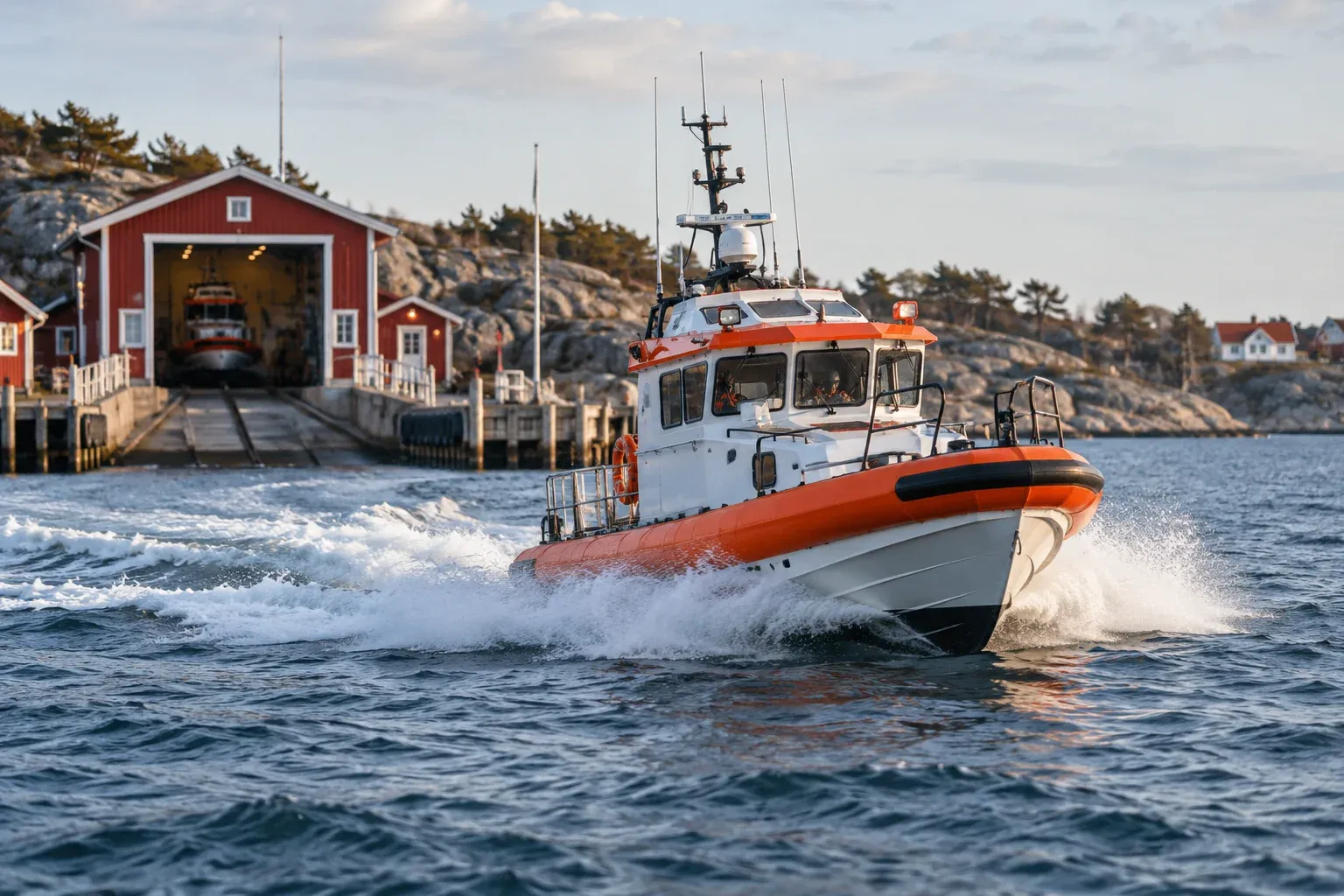
If you come from a country where a mountain rescue arrives with an invoice, Sweden works differently. Here is who actually comes when you call 112, and exactly where “free” stops.
When you need this
- You are planning a mountain hike or an archipelago paddle and wonder whether a rescue would ruin you
- You hesitate to call because rescue is billed where you come from
- Someone is exhausted or lightly hurt and you can’t tell whether it is a rescue or a ride home
- Your boat’s engine has died, but nobody is in danger
- An ambulance or helicopter took you to hospital and the bill has arrived
Who comes when you call 112
Sweden’s Civil Protection Act, lag (2003:778) om skydd mot olyckor, splits rescue between the municipalities and the state. The municipal fire and rescue service (räddningstjänsten) does everything the state has not been given. The state carries four kinds of rescue, and a government ordinance names who leads each one.
| Situation | Who leads | Who often does the work |
|---|---|---|
| House fire, road accident, someone in a lake or river | The municipality’s fire and rescue service | Municipal rescue crews |
| Injured, ill or missing in the mountains | Police (fjällräddning) | About 400 volunteer mountain rescuers, police helicopters |
| Missing person elsewhere, such as a berry picker in the forest | Police | Police |
| People in distress at sea, or on Vänern, Vättern or Mälaren | Sjöfartsverket’s JRCC (sjöräddning) | Sea Rescue Society volunteers and other units |
| Aircraft in distress | Sjöfartsverket’s JRCC | As above |
The lake detail surprises people: only Sweden’s three biggest lakes count as “sea”. On every other lake, river, canal or harbour, the municipal rescue service comes. You don’t need to know any of this to call, because SOS Alarm routes the 112 call. Saying fjällräddning (mountain rescue) or sjöräddning (sea rescue) just gets it there faster.
Volunteers carry much of the load. The Swedish Sea Rescue Society (Sjöräddningssällskapet, SSRS) is a non-profit that takes no state grants, aims to leave the quay within 15 minutes, and says it takes part in about 90 percent of all sea rescue in Sweden. When the JRCC calls them out to people in danger, their boats act as a public rescue resource.
Why the rescue itself is free
We searched the full consolidated text of the Civil Protection Act, as amended up to the end of 2025. Its cost chapter covers payments between municipalities and the state, compensation to people who helped, and compensation to owners whose equipment was used. No section charges the person who was rescued.
Police mountain rescuers put it in practical terms: need is never weighed against what it costs the individual. A Jämtland coordinator said it plainly in 2020. What a private helicopter would cost “is nothing we can weigh in”.
The Act does put two duties on you instead. Anyone who discovers a fire or an accident endangering life or health must, if possible, warn those in danger and call for help. And anyone who turns 18 to 65 during the year can be ordered to help in a rescue, as far as knowledge, health and strength allow, with reasonable compensation.
There is one cost in the Act, and it falls on property owners. If a watch is needed after a fire to stop it flaring up again and the owner doesn’t arrange one, the incident commander can arrange it at the owner’s or user’s expense.
Where the costs begin: healthcare
“Free rescue” does not mean “free evacuation”. Once rescuers hand you over to an ambulance or an ambulance helicopter, you are in the healthcare system, and each of Sweden’s 21 regions bills for that under its own rules.
| Who you are | What the ambulance costs you |
|---|---|
| EU/EEA/Swiss visitor with a physical EHIC, UK visitor with a GHIC, Nordic resident, or resident of a convention country | The region’s ordinary patient fee per journey, counted toward the annual fee ceiling; young people and people aged 85 and over usually pay nothing |
| Everyone else without an agreement or card | The actual cost from the region’s price list, for the transport and the treatment |
In one region checked, the same per-journey fee covers both road ambulance and ambulance helicopter. Two regions checked both exempt young people up to 19 and people aged 85 and over, with different extras. We don’t publish the amounts, because each region sets its own and revises them every year.
The expensive trap is paperwork. Without a valid card or certificate shown at the time, the region can’t reclaim the cost from Swedish social insurance, so it bills you instead. Carry the plastic card, and read our EHIC and GHIC guide. If you are from outside the EU, the rescue costs you nothing but the hospital trip can cost a lot, which is the real case for travel insurance.
Not in danger? Then it is not a rescue
The Act only allows a public rescue when it is justified by the need for a quick response, what is at stake, the cost and the circumstances. Tired legs don’t qualify.
Police in northern Sweden describe the calls: hikers who are not in an emergency but want help getting down. Police can put them in touch with a helicopter operator, “but they pay for that trip themselves”. Commercial helicopter prices are not regulated, so we publish none.
The decision belongs to the police duty officer, not to you. If you are injured, ill, lost or the weather has turned dangerous, call 112 and let them decide. If you are simply exhausted, plan your own way out. See mountain safety in Sweden for help phones and route planning.
At sea: rescue versus a tow
Two very different services share the same orange boats.
- Rescue mission: acute danger to life, such as someone in the water, a sinking boat or a serious grounding. It is coordinated by the JRCC and not billed to the people rescued.
- Preventive call-out (förebyggande utryckning): engine failure, a light grounding or a sudden change in the weather, when nobody is in danger yet. SSRS offers this to members only, and members’ fees waive the society’s legal right to a salvage reward.
SSRS publishes no terms for non-members in a non-urgent situation. So if nobody is in danger, ask about cost before you accept a tow, from anyone. If the situation is acute or you are unsure, it is always 112 or VHF channel 16, call sign Sweden Rescue, distress signal MAYDAY. The JRCC monitors channel 16 around the clock.
Skippers have a duty too. You must help people in distress at sea and assist a rescue, as long as it doesn’t seriously endanger your own boat or crew. More on boats in our boating guide.
One exception for buildings: automatic fire alarms
Hotels, offices and some rental buildings have automatic fire alarms connected straight to the rescue service. Under the building’s alarm agreement, the municipality can charge the alarm holder a fee for an unnecessary alarm, and each municipality sets its own fee. That bill goes to the owner or operator under their contract, not under the rescue law.
Practical information
| Item | Who pays | Notes |
|---|---|---|
| Calling 112 | Free | Routed by SOS Alarm |
| Fire and rescue, mountain rescue, missing-person search, sea and air rescue | No charge to the person rescued | No rule in the Civil Protection Act bills the rescued |
| Ambulance or ambulance helicopter, entitled visitor | Regional patient fee per journey | Amount set by each region, revised yearly |
| Ambulance and treatment, no entitlement | Actual cost from the region’s price list | Travel insurance is the fix |
| Helicopter when not in distress | You, at a commercial price | Unregulated; police can give a contact |
| SSRS non-urgent help | Free to members | Membership fee set yearly |
| Watch after a fire, if not arranged | The property owner or user | Civil Protection Act |
| Unnecessary automatic fire alarm | The alarm holder | Fee set by each municipality |
| Mountain rescues, 1 Jan to 17 Jun 2026 | 127 operations | Jämtland 54, Norrbotten 39, Västerbotten 22, Dalarna 12 |
FAQ
Do you have to pay for mountain rescue in Sweden?
No. Mountain rescue is run by the police with volunteer rescuers, and the Civil Protection Act contains no rule charging the person rescued; its cost chapter covers payments between public bodies and volunteers. Police say need is never weighed against cost. You pay only if you are not in danger and order a helicopter yourself, or for healthcare afterwards.
Does sea rescue cost anything in Sweden?
A rescue when people are in danger is a state operation coordinated by Sjöfartsverket’s JRCC, and no rule charges the rescued. The volunteer Sea Rescue Society takes part in most operations. Non-urgent help, such as a tow after engine failure on a calm day, is a member benefit; non-members should ask about cost before accepting.
Will I get a bill if the fire brigade comes?
Not for the rescue itself: the Civil Protection Act puts no charge on the person rescued. Two exceptions affect property owners: if a watch is needed after a fire and the owner does not arrange it, it is done at the owner’s expense, and buildings with automatic fire alarms can be charged for unnecessary alarms under their alarm agreement.
Is an ambulance free in Sweden?
No. Ambulance care is healthcare, billed by the region. Visitors entitled to Swedish-rate care, through an EHIC, GHIC, Nordic residence or a convention country, pay the regional patient fee, and some groups such as young people and people over 85 are exempt. Everyone else pays the actual cost from the region’s price list.
Who pays for a helicopter rescue in Sweden?
If police launch a mountain rescue and use a helicopter, the person rescued is not charged for the rescue. An ambulance helicopter is healthcare, charged like a road ambulance. A helicopter you order because you are tired or stuck but not in danger is a private purchase from a commercial operator at your own cost.
Should I hesitate to call 112 because of cost?
No. The call is free and the rescue is not billed to you. The only costs that may follow are healthcare fees, which apply whether you call or not, and private transport you choose yourself. Police mountain rescuers say private cost is never part of the decision, so neither should it be part of yours.
Who searches for a missing person in Sweden?
The police. The Civil Protection Act makes the state responsible for searching for people who have disappeared in circumstances that suggest danger to life or serious risk to health, and the ordinance assigns that to the police, at sea to the JRCC. Like other rescue operations, the search is not billed to the missing person or the family.
Related guides
- 112 and Sweden’s emergency numbers: how to make the call and what to say
- Mountain safety in Sweden: help phones, markings and planning so you never need the helicopter
- Lost in the forest: what to do while the police search for you
- Travel insurance for Sweden: the ambulance and repatriation bill that rescue doesn’t cover
- Healthcare for visitors: patient fees, regions and the reservnummer
Facts verified 2026-10-06. Sources: Sveriges riksdag (Civil Protection Act and ordinance), Polismyndigheten, Sjöfartsverket, Sjöräddningssällskapet, Västra Götalandsregionen, Region Värmland, Ydre kommun — full register in this topic’s source file. Found something outdated? Tell us and we’ll fix it.