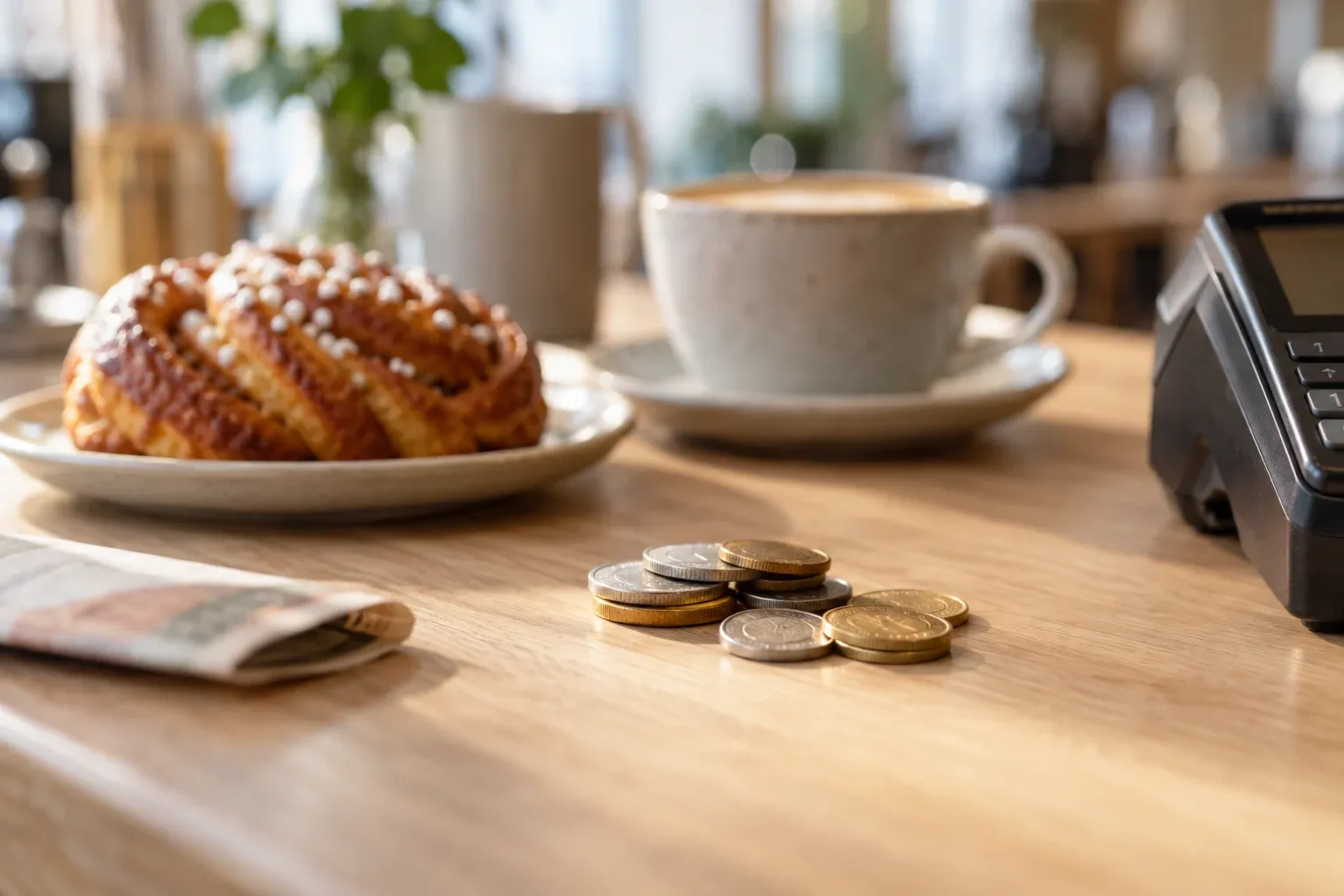
The price tag says 47,50 kr, you hand over a 50 kr note and get 2 kr back. Nobody short-changed you. Here is the rule behind it, why your card pays the exact price instead, and which Swedish coins are still worth carrying.
When you need this
You’re paying cash at a market stall or a staffed grocery till and the cashier asks for a round number. A receipt has a line called öresavrundning (öre rounding). Your card statement shows 47,30 kr while a friend who paid cash for the same thing was charged 47 kr. Or you’ve found a handful of Swedish coins from a trip years ago and want to know whether they’re still money.
The rule is identical for tourists, residents and EU citizens. Nothing in it depends on who is paying.
Why the öre coins disappeared
The Swedish krona (plural kronor, written kr or SEK) is divided into 100 öre, and the law still says so. Prices, per-kilo prices, fuel prices and receipts are written with two decimals. Only the coins are gone, removed one by one as they became too small to bother with:
| Coin | Last day as legal tender |
|---|---|
| 1 and 2 öre | 30 June 1972 |
| 5 and 25 öre | 30 June 1985 |
| 10 öre | 30 September 1992 |
| 50 öre | 30 September 2010 |
The 50-öre coin was the last to go. The Riksbank, Sweden’s central bank, proposed scrapping it because use had fallen and surveys showed most people no longer saw a need for it; retailers and banks agreed. The Riksdag, Sweden’s parliament, decided in 2009. Since 30 September 2010, the smallest Swedish coin has been 1 krona.
The rounding rule
A currency whose smallest coin is one krona can’t settle a cash bill of 47,30 kr exactly. A statute from 1970, lagen om avrundning av vissa öresbelopp (the act on rounding certain öre amounts), settles it. Since 1 October 2010 its rule is:
- The amount to be paid is rounded to the nearest whole krona.
- Endings of 1–49 öre are rounded down.
- Endings of 50–99 öre are rounded up.
Note that it’s the amount to be paid, the total, that gets rounded, not each item. Two items at 9,50 kr cost 19 kr in cash, not 20 kr.
| Total on the till | You pay in cash | Difference |
|---|---|---|
| 47,00 kr | 47 kr | 0 |
| 47,30 kr | 47 kr | 30 öre in your favor |
| 47,49 kr | 47 kr | 49 öre in your favor |
| 47,50 kr | 48 kr | 50 öre to the shop |
| 47,90 kr | 48 kr | 10 öre to the shop |
The most any single cash payment can move is 50 öre. Over many purchases the ups and downs tend to cancel out. A common misunderstanding is worth correcting here: the rule isn’t a Riksbank regulation. It’s a Riksdag statute; the Riksbank proposed the 2010 change and parliament passed it.
Cards: why you pay the exact price
Pay by card or phone wallet and you’re normally charged the exact öre amount on the price tag. When the Riksbank proposed dropping the 50-öre coin, it said plainly that electronic payments, for instance by card, would not be affected.
Here’s the wrinkle almost every explanation misses. The statute itself doesn’t say “cash”. Its first section applies the rule to all kinds of payment in Swedish currency, unless something else has been expressly agreed or can be considered agreed. So the everyday “only cash is rounded” rule rests on the Riksbank’s stated intent and on the fact that a card terminal shows you an exact amount, which you accept, rather than on a line in the law.
That gap has been tested in practice. In 2010, Dagens Industri reported that H&M, Apoteket and Medstop were rounding card totals to whole kronor; the retail trade body Svensk Handel responded that the purchase sum should only be rounded for cash. We found no evidence that card rounding is common today, and no Swedish court ruling or consumer-agency guidance on it either. If a card charge looks rounded to you, ask at the till. Calling it “illegal” would go further than the sources do.
For more on paying by card, including why you should always choose kronor at the terminal, see using cards in Sweden and dynamic currency conversion.
Which coins are valid
Four coins are legal tender, plus commemorative coins in other values:
| Coin | Status |
|---|---|
| 1 krona | Valid (current design from the 2015–2017 changeover) |
| 2 kronor | Valid (current design from the 2015–2017 changeover) |
| 5 kronor | Valid (current design from the 2015–2017 changeover) |
| 10 kronor | Valid, including the older design |
| Any öre coin | Invalid since 2010 at the latest |
The 2 kr coin surprises people, because older guides list only 1, 5 and 10 kr. It’s current legal tender.
You’ll meet these coins less often than you might think. Riksbank figures for 2026 show only 5% of Swedes paying cash at their most recent purchase, and most businesses may refuse cash altogether by posting card-only terms. Since 1 July 2026, grocery stores and pharmacies with a staffed checkout must accept cash for small payments, but only up to 25 coins in one payment. The rounding rule applies there like anywhere else. Our guide to paying with cash in Sweden covers where cash still works.
Old coins
If you have coins from an earlier trip, check them before you pack them:
- Old 1, 2 and 5 kr coins became invalid after 30 June 2017. Banks accepted them for deposit until 31 August 2017. After that, in the Riksbank’s words, the coins have no value.
- The older 10 kr coin was not part of the 2017 change and still works.
- 50-öre coins have had no legal value since 30 September 2010.
Neither banks nor the Riksbank exchange invalid coins. The Riksbank says they can be treated as scrap metal and recycled, and it refers questions about collector value to coin dealers. Its powers to redeem money that is no longer legal tender are limited by law to cases with special reasons.
Leftover valid coins on your last day? A staffed grocery till is the easiest place to spend them, keeping to 25 coins or fewer.
Reading Swedish prices
Swedish price notation trips up visitors more than the rounding does:
| You see | It means |
|---|---|
| 23,90 kr | 23 kronor 90 öre (the comma is the decimal sign) |
| 25:- | exactly 25 kronor, no öre |
| öresavrundning –0,30 | 30 öre rounded off your cash total |
| öresavrundning +0,10 | 10 öre added to reach a whole krona |
The öre price is the real price. Cash payers settle a rounded total, sometimes a little less, sometimes a little more. For per-kilo and comparison prices on shelf labels, see reading Swedish price labels.
Practical information
| Item | Detail |
|---|---|
| Smallest coin | 1 krona |
| Valid coins | 1, 2, 5 and 10 kr |
| Cash rounding | Total to nearest krona: 1–49 öre down, 50–99 öre up |
| Maximum rounding per cash payment | Up to 0,49 kr down or 0,50 kr up (checked 2026-10-14) |
| Card or phone payment | Exact öre amount in normal practice (checked 2026-10-14) |
| Exchanging invalid coins | Not possible at banks or the Riksbank (checked 2026-10-14) |
| Coin limit at grocery stores and pharmacies | Up to 25 coins per payment must be accepted |
| Swedes paying cash at their latest purchase | 5% (Riksbank, checked 2026-10-14) |
FAQ
Why are there no öre coins in Sweden?
Because nobody used them. The Riksbank proposed scrapping the 50-öre coin after surveys showed falling use and a majority of the public saw no need for it, and retailers and banks agreed. The Riksdag decided in 2009, and the coin stopped being legal tender after 30 September 2010. The smaller öre coins had already gone between 1972 and 1992.
How does rounding work when I pay cash in Sweden?
The total you are to pay is rounded to the nearest whole krona: endings of 1 to 49 öre go down and 50 to 99 öre go up. A 47.49 kr total costs 47 kr in cash, a 47.50 kr total costs 48 kr. The rule is in a Riksdag statute and applies to the total, not each item.
Is a card payment in Sweden rounded too?
Normally not. Card and phone payments are charged to the exact öre, and the Riksbank said when it abolished the 50-öre coin that card payments would not be affected. The statute’s wording is broader than cash, so this rests on practice and the exact amount you accept at the terminal. Some chains were reported rounding card totals in 2010.
Is the öre still used in Sweden?
Yes, as a unit of account. The law still divides the krona into 100 öre, and prices, receipts, per-kilo prices and card charges are written with two decimals, using a comma: 23,90 kr. Only the coins are gone. That is why price tags show öre but the cashier asks for a round number when you pay with notes and coins.
What Swedish coins are valid today?
Four: 1, 2, 5 and 10 kronor, plus commemorative coins. The 1, 2 and 5 kr coins were replaced in the 2015–2017 changeover; the older versions became invalid after 30 June 2017. The older 10 kr coin was kept and is still legal tender. Any öre coin, including the 50-öre, has had no legal value since 2010.
Can I exchange old Swedish coins?
No. The Riksbank does not redeem invalid coins, and banks stopped accepting the old 1, 2 and 5 kr coins after 31 August 2017. The Riksbank says they can be treated as scrap metal and sent for recycling, and it refers questions about collector value to coin dealers. The same applies to every öre coin.
Related guides
- Can you pay with cash in Sweden? — where cash still works, and the 2026 grocery-and-pharmacy duty
- Using credit and debit cards in Sweden — the way to pay the exact öre price
- Money in Sweden — the whole picture: cards, cash, Swish and currency
- Tipping in Sweden — rounding up as a tip, the voluntary kind
- Reading Swedish price labels — öre, per-kilo and comparison prices
Facts verified 2026-10-14. Sources: Sveriges riksdag (Lag 1970:1029 om avrundning av vissa öresbelopp, Lag 2022:1568 om Sveriges riksbank, Lag 2026:769, betänkande 2008/09:FiU37), Sveriges Riksbank and Realtid — full register in this topic’s source file. This is general information, not legal advice. Found something outdated? Tell us and we’ll fix it.