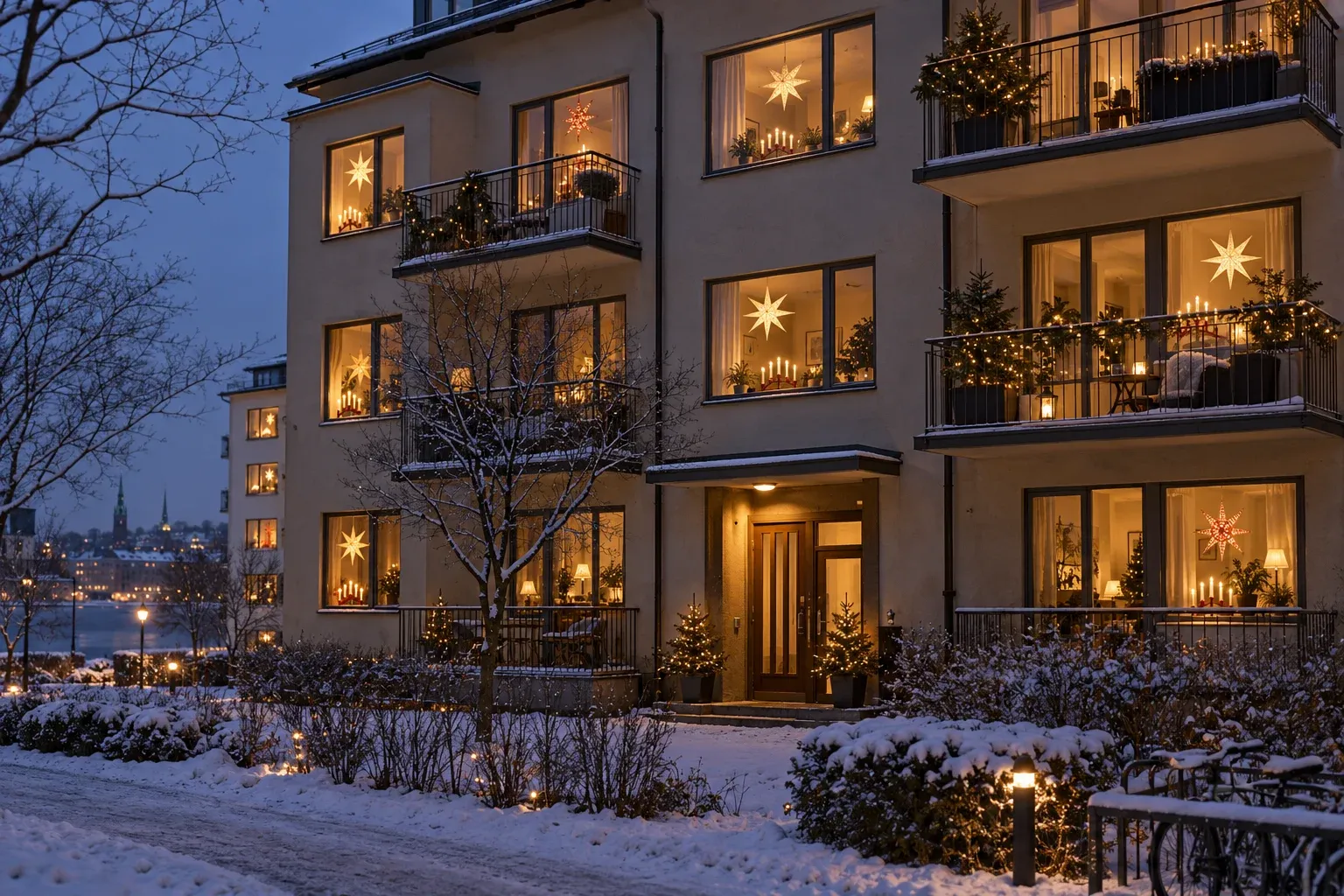
On the first Sunday of Advent, Sweden’s windows light up almost overnight. Here are the dates, where the candlesticks and stars came from, what to eat and watch, and the one safety habit worth adopting.
When you need this
- You will be in Sweden between late November and Christmas
- You are staying in a Swedish home, cabin or rental and see candles everywhere
- You wonder why every window shows the same triangle of lights and a star
- You want to attend a first-of-Advent church service
- You are travelling with children and want to follow the SVT julkalender
- You want to know where to buy glögg and what is alcoholic
Advent dates 2026 and 2027
Advent (Latin for “arrival”) is the church season covering the four Sundays before Christmas Eve. In Sweden it is the switch that turns on the whole Christmas season: decorations go up, the first candle is lit, and gingerbread and glögg appear.
| Advent Sunday | 2026 | 2027 |
|---|---|---|
| First Sunday of Advent (första advent) | 29 November | 28 November |
| Second | 6 December | 5 December |
| Third | 13 December (also Lucia) | 12 December |
| Fourth | 20 December | 19 December |
Advent does not start on 1 December. That is when Advent calendars and SVT’s children’s julkalender begin, whatever date the first Advent Sunday falls on. In 2026, the third Advent Sunday coincides with Lucia.
The Advent Sundays are ordinary Sundays in law. Every Sunday is a public holiday in Sweden, but there is no special Advent holiday, so life runs as on any other Sunday.
The four candles and the window lights
Two objects share the name adventsljusstake (Advent candlestick), and you will see both:
| Where | What it is | How it is used |
|---|---|---|
| On the table | A holder with four candles | One more candle lit each Advent Sunday, until all four burn on the fourth |
| In the window | An electric candlestick, usually seven lights in a triangle | Switched on from the first Sunday of Advent |
| In the window | A paper Advent star (adventsstjärna) with a light inside | Hung from the first Sunday of Advent |
The window custom is national: you will see the same triangle of lights and paper stars from Skåne in the south to Lapland. In the far north, Advent coincides with polar night, so the lights burn through most of the day. Walk a residential street at dusk on the first Advent weekend and you can watch the windows come on.
Where the star and the candlestick came from
The common story is that both came from Germany. Half of that is true.
The paper Advent star originated in Herrnhut, Germany, in the 1880s. The Swedish word adventsstjärna is first recorded in 1923, and the stars became common in Sweden in the 1930s, according to Nordiska museet, Sweden’s museum of cultural history. The four-candle Advent holder is likewise German-derived.
The electric seven-light candlestick is Swedish. Oscar Andersson, who worked at Philips in Gothenburg, built the first one in 1934. It went on sale in 1937, and the first 3,000 sold out; his prototypes are now in Nordiska museet’s collection. So the triangle of lights in nearly every Swedish window is a home-grown idea, not an import.
Calendars and SVT’s julkalender
The printed Advent calendar (adventskalender) also came from Germany: the first appeared there in the early 1900s, and calendars with opening doors and pictures followed in the 1920s.
Sweden’s bigger countdown is on television. SVT’s julkalender is a children’s drama in 24 episodes, one a day from 1 December to Christmas Eve. It grew from a Sveriges Radio idea of 1957 and has run on SVT every year since 1960.
| Fact | 2026 |
|---|---|
| Title | Den ofrivillige tomten (“The Reluctant Santa”) |
| Lead | Hampus Nessvold |
| Episodes | 24, 1–24 December |
| Abroad | SVT holds world rights until 31 December |
That last line matters if you leave Sweden before Christmas. Unlike Kalle Anka on Christmas Eve, which is blocked outside Sweden, the julkalender can be streamed on SVT Play from abroad until 31 December. Watching it with children is an easy way into what Swedish kids talk about every December morning.
Glögg, gingerbread and saffron buns
The taste of Advent is glögg (mulled spiced wine or juice), pepparkakor (gingerbread biscuits) and the lussekatt (saffron bun), usually all at once.
- Glögg is sweetened wine or juice spiced with cardamom, cinnamon, cloves and ginger, served hot with raisins and almonds. Spiced wine has been drunk in Sweden since the Middle Ages, though it was not originally a Christmas drink.
- Pepparkakor have been eaten in Sweden since the Middle Ages and widely baked at home since the 1800s.
- Lussekatter are tied to Advent, Lucia and Christmas together; see Swedish fika for where they fit.
Where you buy glögg depends on its strength. Alcohol-free glögg is sold in ordinary grocery shops. Alcoholic glögg, like any drink above 3.5% alcohol, can only be bought to take away at Systembolaget, the state retail monopoly; check Systembolaget’s opening hours in December. At Christmas markets and restaurants, alcoholic glögg is served only where the organiser holds a serving licence.
Church on the first Sunday of Advent
For the Church of Sweden, the first Sunday of Advent is the start of the church year. Churches are decorated in violet, and congregations sing Hosianna, the hymn that marks the day. Services are open and free, and each parish sets its own times and Advent concerts.
For a visitor, a first-of-Advent service is an atmospheric way to see the season begin.
Candles and fire safety
This is the part worth taking seriously. The dark months bring the most home fires in Sweden: about 40% of the year’s fires happen between November and February, according to figures from the civil defence agency reported by TV4. SOS Alarm, Sweden’s emergency call operator, has counted about 1,400 fire calls in a typical December and January, 18% more than the rest of the year.
Live candles (levande ljus) are the risk everyone thinks of, but not the only one: in an SOS Alarm survey, 81% named candles as the main cause of Christmas fires and only 4% named cooking, which is a leading cause. The advice from Brandskyddsföreningen, the Swedish Fire Protection Association:
| Do | Don’t |
|---|---|
| Use non-flammable holders on a stable surface | Leave a live candle burning in an empty room |
| Keep candles away from curtains and the TV | Crowd tea lights together on one tray |
| Check cords and plugs of old electric candlesticks | Half-unscrew a bulb to switch one off; use the switch or plug |
| Use outdoor torches (marschaller) outdoors only | Put out a marschall with water or snow |
Test the smoke alarm. MCF (Myndigheten för civilt försvar) advises testing your smoke alarm (brandvarnare) once a month and on Brandvarnardagen, 1 December — not first Advent, as is often said. New homes built since 1999 must have smoke alarms; older homes are covered by a recommendation. In a rental or cabin, find the alarm and press its test button on arrival.
Practical information
| Item | Detail |
|---|---|
| First Sunday of Advent | 29 November 2026; 28 November 2027 |
| SVT julkalender 2026 | Den ofrivillige tomten, 1–24 December; free on SVT and SVT Play; streamable abroad until 31 December |
| Advent church services | Open, no ticket; times per parish |
| Alcoholic glögg to take away | Systembolaget only; price per product |
| Alcohol-free glögg | Ordinary grocery shops |
| Smoke alarm day | 1 December (MCF); MCF also offers a free SMS reminder service |
FAQ
When does Advent start in Sweden?
On the first Sunday of Advent, the fourth Sunday before Christmas Eve. In 2026 that is Sunday 29 November, followed by 6, 13 and 20 December. In 2027 it is Sunday 28 November. Advent calendars and SVT’s children’s julkalender start on 1 December regardless of where the first Advent Sunday falls.
Why do Swedes put candlesticks and stars in their windows?
It is a 1930s custom that stuck. The paper Advent star came from Herrnhut in Germany and became common in Sweden in the 1930s. The electric seven-light candlestick was invented in 1934 by Oscar Andersson at Philips in Gothenburg and launched in 1937. Today both go up on the first Sunday of Advent.
What is the Swedish Advent candlestick?
Two things share the name adventsljusstake. Indoors, a holder with four candles gets one more lit each Advent Sunday, until all four burn on the fourth. In windows, the electric version usually has seven lights in a triangle. Most households use the electric one in windows, because it is safe near curtains.
What is the SVT julkalender?
A children’s drama series in 24 episodes, one a day from 1 December to Christmas Eve, broadcast by SVT every year since 1960. The 2026 calendar is Den ofrivillige tomten, starring Hampus Nessvold. SVT says it holds the rights to show it worldwide until 31 December, so it can be streamed from abroad.
Where can I buy glögg in Sweden?
Alcohol-free glögg is sold in ordinary grocery shops. Alcoholic glögg, like any drink above 3.5% alcohol, can only be bought to take away at Systembolaget, the state-owned retail monopoly. At Christmas markets and restaurants, alcoholic glögg is only served where the organiser holds a serving licence. Serve it warm with raisins and almonds.
Are live candles dangerous in Swedish homes at Advent?
They are the season’s best-known fire risk, though cooking causes many home fires too. Use non-flammable holders on a stable surface, keep candles away from curtains, never leave them burning unattended, and do not crowd tea lights on one tray. MCF recommends testing your smoke alarm monthly and on Brandvarnardagen, 1 December.
Is the first Sunday of Advent a public holiday?
Every Sunday is a public holiday under Swedish law, so the Advent Sundays are too, but there is no special Advent holiday. Life runs as on any other Sunday. In church, the first Sunday of Advent starts the church year with the hymn Hosianna.
Related guides
- Swedish Christmas traditions — the whole season from Advent to 13 January and what closes when
- Lucia in Sweden — the candlelit procession on the third Advent Sunday in 2026
- Christmas markets in Sweden — which markets run on the Advent weekends
- Sweden in December — daylight, dates and closures for the whole month
- Tjugondag Knut — when the candlesticks and the tree finally come down
Facts verified 2026-10-06. Sources: Nordiska museet, Svenska kyrkan, SVT, Isof, MCF (Myndigheten för civilt försvar), Brandskyddsföreningen, SOS Alarm and Sveriges riksdag — full register in this topic’s source file. Found something outdated? Tell us and we’ll fix it.