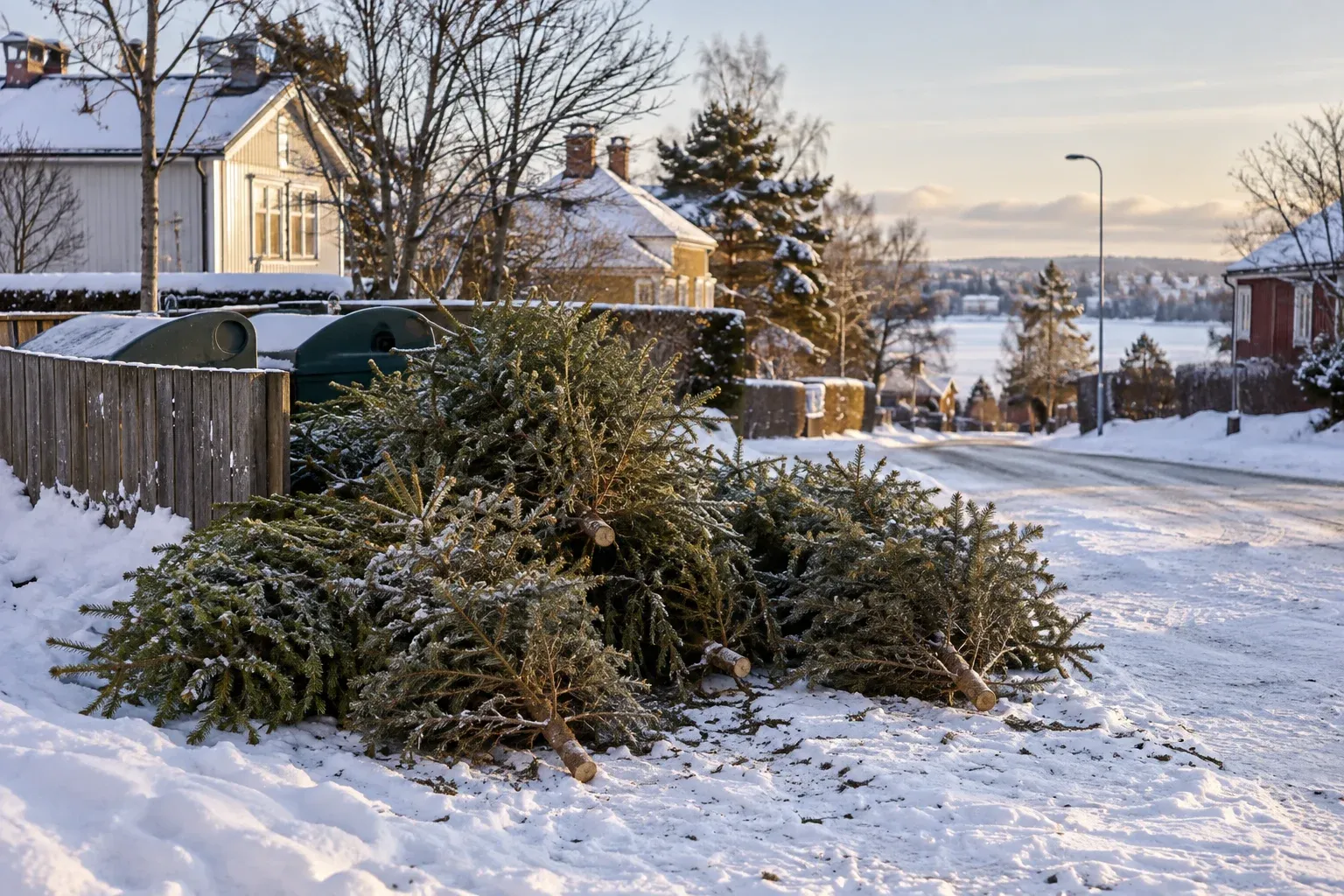
Swedes keep Christmas going a week longer than most of Europe, then end it with a party and a tree on the pavement. Here is where 13 January comes from, what happens at a tree-stripping party, and what the date means for your plans.
When you need this
- You are in Sweden in early or mid January and see trees dumped by bins
- You are invited to a julgransplundring and wonder what happens there
- You want to know whether 13 January closes anything
- You rented a home with a real Christmas tree and must dispose of it
- You see “Knut” on 13 January in a Swedish calendar
Why 13 January
Tjugondag Knut means “twentieth day Knut”. Nordiska museet, Sweden’s museum of cultural history, puts it plainly: on 13 January, twenty days after Christmas Eve, Christmas is over. The old sayings have Knut “dancing Christmas out” or “sweeping Christmas out”.
The date is a 17th-century change. In older Nordic and European tradition, Christmas ended on Epiphany, 6 January. In the late 1600s the celebration was extended by a week, and in 1680 the day of Knut was moved from 7 to 13 January.
| Year / date | What happened |
|---|---|
| 7 January 1131 | Knut Lavard, a Danish duke, is murdered; he is later made a saint |
| Until the late 1600s | Christmas ends on Epiphany, 6 January |
| 1680 | Knut’s day moves from 7 to 13 January; Christmas is extended by a week |
| 1800s | The julgransplundring spreads from bourgeois homes |
| Today | 13 January is Knut’s name day and the formal end of Christmas |
SVT notes that the Knut in question may instead be Knut Lavard’s uncle, Knut the Holy; Nordiska museet and the Institute for Language and Folklore (Isof) name Knut Lavard. Either way, 13 January is still the name day of Knut in the Swedish almanac, so if you know a Knut, congratulate him. Our guide to Swedish name days explains the custom.
Epiphany vs tjugondag Knut
This is the part that matters for your plans. The two January dates look similar but are treated completely differently in law.
| Epiphany (trettondedag jul) | Tjugondag Knut | |
|---|---|---|
| Date | 6 January | 13 January |
| Public holiday? | Yes, under Lag (1989:253) | No |
| Systembolaget | Closed | Normal hours |
| Shops, offices, transport | Holiday hours | Ordinary weekday |
| In 2027 | Wednesday | Wednesday |
The statute on public holidays lists trettondedag jul and has no entry for 13 January. So Knut is an ordinary working and school day. Epiphany, a week earlier, is the date that catches visitors: it is a full public holiday and Systembolaget, the state alcohol retailer, is closed. See Swedish public holidays and Systembolaget hours for the full calendar.
In practice, a Nordiska museet ethnologist told SVT, Swedes already wind Christmas down at Epiphany, when work and school resume. Many households take the tree down then. The 13th is the traditional end, not a compulsory one.
The julgransplundring
A julgransplundring — literally “Christmas-tree plundering” — is the party that ends Christmas. The tree is stripped of its sweets and decorations, everyone sings and dances around it one last time, and then it is carried out of the house.
Nordiska museet traces the custom to 19th-century bourgeois homes. It peaked in the post-war decades, and today it centers on children and sweets. If you are invited:
- Bring the children; it is largely a children’s party
- Expect singing and a ring dance round the tree
- Expect the tree to leave the house at the end
- Do not expect a formal dinner or an adults’ drinks party
Knutsmasso in Uppland
In a few towns in Uppland, north of Stockholm, 13 January is still a public carnival called Knutsmasso. Levande kulturarv, Sweden’s inventory of living heritage, describes well-attended celebrations in Gimo every year, with children’s games, a street parade of decorated carts, street vendors and prizes for the best costumes. Österbybruk and Östhammar hold similar dress-up events.
The dressing up has older roots. Isof records knutsgubbar, masked visitors who went from farm to farm on Knut in some regions, and Levande kulturarv names Uppland, Värmland and Östergötland as the areas where dress-up customs were strongest. If you are in northern Uppland on 13 January, Gimo’s carnival is a public street event.
Getting rid of the tree
In January the practical question is the tree. A real Christmas tree is garden waste, not household rubbish, and municipalities or their waste companies run their own collection.
- Strip it completely. Remove baubles, tinsel, glitter and any plastic bag. Stockholm’s waste company says leftovers damage its chipping machinery.
- Find this season’s drop-off points. Search julgransinsamling plus the municipality’s name. Points are temporary and change every year.
- Or take it to a recycling centre (återvinningscentral, ÅVC). In Gothenburg the tree goes in the container for clean branches (rent ris); Stockholm’s centers take trees year-round.
- In an apartment building, ask the property owner (fastighetsägare) where trees go; buildings arrange their own collection.
Do not put the tree in the household bin or by the packaging-recycling containers. Our guide to recycling in Sweden covers the rest of the sorting system.
Practical information
| Item | Detail |
|---|---|
| Tjugondag Knut 2027 | Wednesday 13 January — ordinary weekday |
| Epiphany 2027 | Wednesday 6 January — public holiday, Systembolaget closed |
| Stockholm tree drop-off points | 25 December 2025 – 31 January 2026 in the latest published season; check again each December |
| Stockholm recycling centers | Take trees year-round, ordinary hours |
| Gothenburg recycling centers | Tree goes in the clean-branches (rent ris) container |
| Cost of handing in a tree | Part of the municipal waste service; no household fee stated |
| Knutsmasso | 13 January in Gimo, Uppland; public street carnival |
FAQ
What is tjugondag Knut?
Tjugondag Knut is 13 January, the traditional end of the Swedish Christmas, twenty days after Christmas Eve. Families strip the Christmas tree and throw it out, sometimes with a party called a julgransplundring where children dance around the tree one last time. It is also the name day of Knut. It is not a public holiday, so the day runs normally.
Why does Christmas in Sweden end on 13 January?
In older tradition Christmas ended on Epiphany, 6 January. In the late 1600s the celebration was extended by a week, and in 1680 the day of Knut Lavard, a Danish duke murdered on 7 January 1131, was moved to 13 January. Since then Knut has closed the season, with sayings that he dances or sweeps Christmas out.
Is 13 January a public holiday in Sweden?
No. The Swedish public-holiday law lists Epiphany, 6 January, but not 13 January. Shops, offices, schools, public transport and Systembolaget run as on any weekday. Epiphany is the date that catches visitors: it is a full public holiday and Systembolaget is closed. In 2027, Epiphany and tjugondag Knut both fall on a Wednesday.
What happens at a julgransplundring?
A julgransplundring, literally “Christmas-tree plundering”, is a party where the tree is stripped of its sweets and decorations, people sing and dance around it a last time, and the tree is carried out. The custom comes from 19th-century bourgeois homes and today centers on children and sweets. It marks the formal end of Christmas, although many households take the tree down earlier.
How do I get rid of a Christmas tree in Sweden?
Remove all decorations, glitter and bags, then use your municipality’s tree drop-off points or a recycling center, where trees go with clean garden waste. Stockholm opened drop-off points from 25 December to 31 January in the 2025–26 season. In an apartment building, ask the property owner where trees go.
What is Knutsmasso?
Knutsmasso is a carnival-style celebration of 13 January in parts of Uppland. In Gimo it draws large crowds every year with children’s games, a street parade of decorated carts, street vendors and prizes for the best costumes. Österbybruk and Östhammar hold similar dress-up events. It grew from older customs of dressing up and visiting neighbors on Knut.
Related guides
- Swedish Christmas traditions — the whole season, from Advent to Knut
- Swedish public holidays — why Epiphany closes things and Knut does not
- Sweden in winter — weather, darkness and the January calendar
- Swedish name days — why every Knut gets congratulated on 13 January
- Recycling in Sweden — where garden waste and packaging go
Facts verified 2026-10-06. Sources: Nordiska museet, Isof, Levande kulturarv, Sveriges riksdag, SVT, Stockholm Vatten och Avfall, Göteborgs Stad, Systembolaget — full register in this topic’s source file. Found something outdated? Tell us and we’ll fix it.