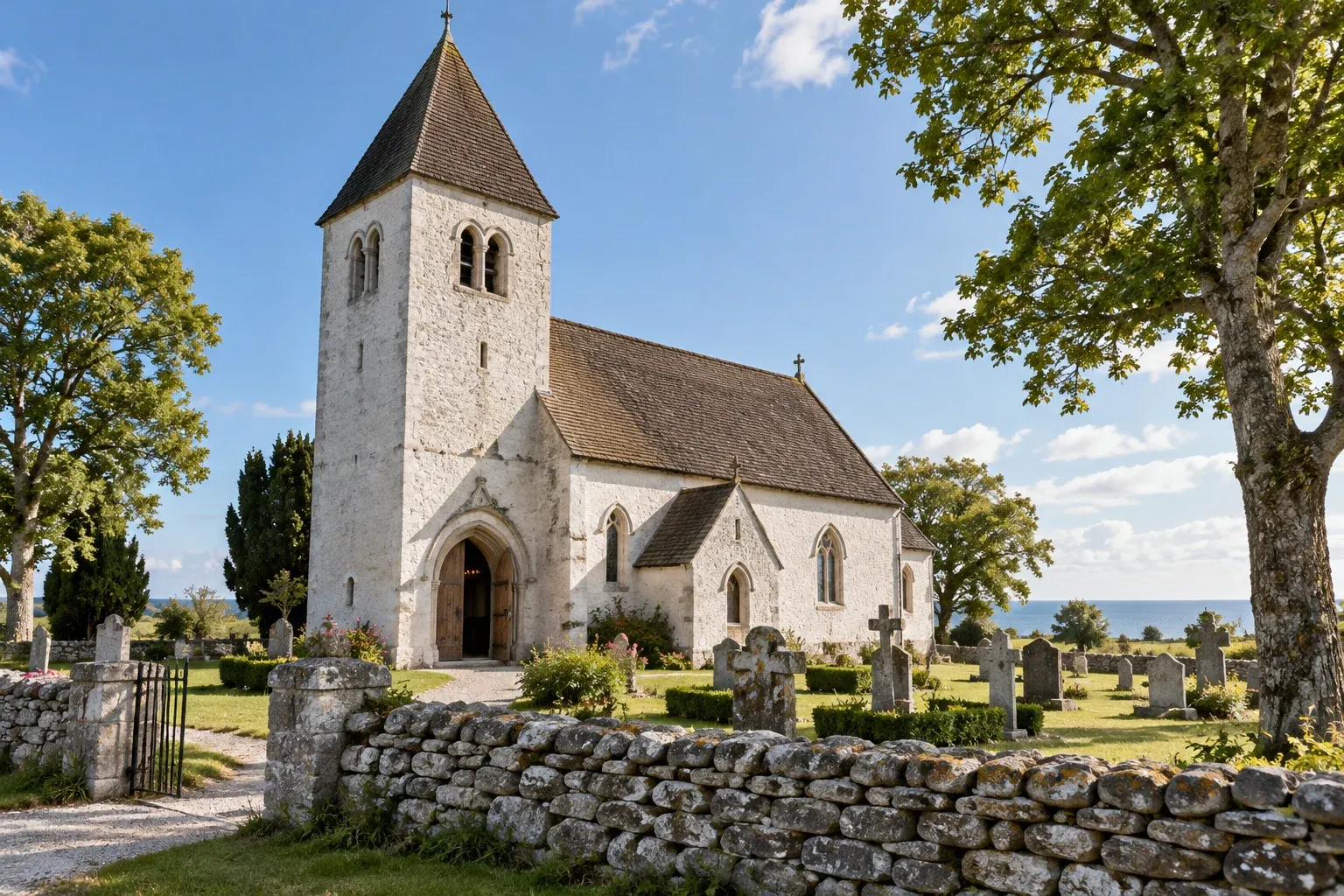
Half of Swedes still belong to the Church of Sweden, a quarter-century after it stopped being the state church, and its buildings are often the oldest in town. Here is what that means when you want to walk in, hear a concert or understand your Swedish friend’s tax statement.
When you need this
You pass a medieval church in the countryside and the door is open. You see konsert or musik i kyrkan (music in the church) on a notice board. You are in Sweden over Advent, Lucia, Christmas or Easter and want to attend a service, or you have moved here and found kyrkoavgift on your tax statement. Gotland, Uppsala and Luleå’s Gammelstad, where churches are the main sights, all come back to the same few rules.
What the Church of Sweden is
Svenska kyrkan, the Church of Sweden, is an evangelical-Lutheran faith community made up of parishes and dioceses. Swedish law calls it an “open folk church” with national coverage. It was the state church until 1 January 2000, when the Act on the Church of Sweden took effect and it became a faith community in its own right.
Separation did not cut every tie. The state still pays the church compensation for the heritage upkeep of its churches. Church buildings consecrated before 2000 are protected by the Historic Environment Act, and churches built before 1940 cannot be significantly altered without the county board’s permission, down to the interior, the fixed furnishings and the paint colours.
Why half of Swedes are still members
At the end of 2025 the church had 5,365,542 members, 50.7% of the population. That is down from 51.4% a year earlier and 95.2% in 1973. If you have read “about 60%” or “most Swedes belong to the state church”, the figure is several years old. At the current pace, membership may drop below half in the next annual figure, published each March.
| Year | Members | Share of population |
|---|---|---|
| 1973 | 7,754,784 | 95.2% |
| 2024 | 5,426,053 | 51.4% |
| 2025 | 5,365,542 | 50.7% |
The church names three reasons for the decline: older members dying without as many new baptisms, immigration growing the population, and people leaving. Since 1996 no one is born into membership. Parents choose baptism instead, and 2025’s baptisms equalled 42.6% of babies born.
Life rites keep the church close even to people who rarely attend: in 2025, 63.3% of funerals and 26.6% of weddings in Sweden followed Church of Sweden order. The church is also the country’s biggest choir organiser, with around 4,100 choirs and some 82,000 singers, and services drew 10.9 million visits in 2025.
Other faiths are smaller but visible, especially in cities. The state supports a range of other faith communities through the agency MUCF, which counted 550,750 people served by them in 2024. The Roman Catholic Church was the largest, at 130,751.
Church fee and burial fee
These two fees confuse newcomers, because only one depends on membership.
| Fee | Who pays | 2026 level |
|---|---|---|
| Kyrkoavgift (church fee) | Church of Sweden members only | Set by each parish; about 1.06% of taxable earned income on average |
| Begravningsavgift (burial fee) | Everyone registered in Sweden with income, member or not | 0.292%; Stockholm 0.07%, Tranås 0.285% |
| Either fee | Tourists and others not registered in Sweden | Nothing |
The church fee is required by law for members and collected with income tax. Levels vary: the average on Gotland, including the burial fee, is 1.90% against 1.32% nationally. In Stockholm and Tranås the municipality, not the church, runs burials, which is why their burial fee differs. You can even join the church without being registered in Sweden, by applying to any parish.
Visiting a church
The Church of Sweden’s parishes own about 3,400 churches, the country’s largest single body of cultural heritage. The church stresses that they are working buildings, not museums. Most that are open let you walk in, but there is no single rule, and a church that is “open” can close at short notice for a wedding, funeral or baptism. Check the parish calendar or the free Kyrkguiden app before a long trip.
Two famous examples show the range. Uppsala Cathedral charges no entry fee, and runs English tours daily in summer and monthly the rest of the year. Storkyrkan, Stockholm Cathedral in Gamla stan, charges adults for sightseeing, with free entry under 18 and a reduced fee for Church of Sweden members.
In summer many churches keep extra opening hours, some with a café. Look for sommarkyrka (summer church) or vägkyrka, a roadside church easy to reach by car, with a daily prayer, simple refreshments and a toilet.
Services anyone can attend
The church says a service is always open to everyone, and every parish holds one on Sundays, often on other days too. You do not need to be a member or a believer. Uppsala Cathedral’s main service is at 11:00 on Sundays and holidays. Sit at the back if you are unsure, keep your phone silent, and treat the collection (kollekt) as voluntary.
Christmas is the easiest time to try one. Many parishes hold julbön (a Christmas prayer service) on Christmas Eve, a midnight mass, and julotta early on Christmas morning; see our Swedish Christmas traditions guide. If you would rather watch from your hotel, SVT broadcasts a service every Sunday and Sveriges Radio airs Gudstjänsten.
Concerts: free or ticketed
Church concerts are everywhere in Sweden, and many cost nothing. One parish in Dalarna puts it plainly: when it arranges a concert itself, entry is always free, with a voluntary collection for its music or a named cause. Sofia Church in Stockholm holds a free concert at 16:00 every Saturday that is not a public holiday.
Big seasonal concerts at Advent, Lucia and Christmas, and visiting ensembles, are more often ticketed or need a reserved seat. Malmö’s parishes say most of their Lucia concerts are free but some need a ticket or booking. Our Lucia guide covers which December concerts sell out.
Photos, bags and etiquette
House rules are set by each church, but the ones we checked agree on the basics:
- No photographing or filming during services and concerts. Private photos of the building are fine at other times.
- Ask before publishing pictures of people (Storkyrkan); Uppsala Cathedral bans photographing individuals altogether.
- Large bags, backpacks, strollers and suitcases are not allowed into Storkyrkan’s church room.
- No food, drink or pets in Uppsala Cathedral.
- No wandering round Uppsala Cathedral during Sunday high mass, 11:00 to about 12:30.
There is no published dress code in any of these churches; ordinary clean clothes are fine. For everyday Swedish manners beyond the church door, see our Swedish etiquette guide.
Churches worth the detour
- Gotland: Visby diocese has 92 medieval churches, all on one island, in 39 parishes. Visby’s church ruins are separate sights; see our Gotland and Visby guide.
- Gammelstad, Luleå: Sweden’s largest and best-preserved church town, 405 cottages around a 1400s stone church, a World Heritage site since 1996. The cottages are now used mainly around confirmation at Midsummer. See our Luleå guide.
- Uppsala Cathedral: free entry and English tours; see our Uppsala guide.
Practical information
| What | Detail |
|---|---|
| Ordinary services | Free, open to all; every parish on Sundays |
| Parish concerts | Commonly free entry with a voluntary collection |
| Uppsala Cathedral | Free entry; no sightseeing during Sunday high mass 11:00–about 12:30 |
| Storkyrkan, Stockholm | Adult sightseeing fee, free under 18, reduced for members; 09:30–17:00, summer (1 June–13 September) 09:00–18:00 |
| Church fee 2026 | About 1.06% of taxable earned income on average, members only |
| Burial fee 2026 | 0.292% for all registered taxpayers; Stockholm 0.07%, Tranås 0.285% |
| Membership | 50.7% of the population at the end of 2025; next figure each March |
| Finding churches and concerts | Kyrkguiden app (free); parish calendar on svenskakyrkan.se |
FAQ
Are churches in Sweden free to visit?
Mostly, yes. The Church of Sweden’s roughly 3,400 churches are working parish churches, and those that are open usually let you in without a ticket; Uppsala Cathedral charges nothing. A few big-city churches charge sightseers: Stockholm’s Storkyrkan has an adult fee, free under 18. Services are always free. Opening hours vary, and ceremonies close churches to sightseers.
Can tourists attend a church service in Sweden?
Yes. The Church of Sweden says a service is always open to everyone, and every parish holds one on Sundays, often on other days too. You do not need to be a member, a Lutheran or a believer. Sit at the back if you are unsure, keep your phone silent, and do not photograph during the service. The collection is voluntary.
Are church concerts in Sweden free?
Many are. Parishes commonly give their own concerts with free entry and a voluntary collection, and some churches run free weekly series, such as Sofia Church in Stockholm every Saturday at 16:00. Big seasonal concerts, at Advent, Lucia and Christmas, and visiting ensembles are more often ticketed. The parish page or the Kyrkguiden app says which.
What percentage of Swedes belong to the Church of Sweden?
At the end of 2025, 50.7% of the population, or 5,365,542 people. That is down from 51.4% a year earlier and 95.2% in 1973. Since 1996 no one is born into membership; it comes through baptism, and 2025’s baptisms equalled 42.6% of babies born. The church publishes each year’s figure in March.
Do Swedes pay church tax?
Members pay a church fee, not a tax: about 1.06% of taxable earned income on average in 2026, set by each parish and collected with income tax. Everyone registered in Sweden with income also pays a burial fee, 0.292% in 2026, member or not. Tourists and other visitors not registered in Sweden pay neither.
Is the Church of Sweden still a state church?
No. The Act on the Church of Sweden took effect on 1 January 2000 and made it a faith community separate from the state. A law still describes it as an evangelical-Lutheran open folk church, and the state still pays compensation for the heritage upkeep of its protected churches.
Can I take photos inside Swedish churches?
Usually, yes, for private use, outside services and concerts. Stockholm’s Storkyrkan allows considerate private photography but not during masses and concerts, and asks consent before publishing pictures of people. Uppsala Cathedral bans photographing services, concerts and individual people. Rules are set by each church, so look for a sign at the door.
Related guides
- Swedish Christmas traditions — julotta and the rest of the season’s services.
- Lucia in Sweden — which Lucia concerts are free and which sell out.
- All Saints’ Day in Sweden — candles on graves in the churchyards each November.
- UNESCO World Heritage sites in Sweden — Gammelstad, Visby and the rest.
- Swedish taxes and welfare — where the church and burial fees fit in.
Facts verified 2026-10-05. Sources: Svenska kyrkan and its parishes and dioceses, Sveriges riksdag, Skatteverket, SCB, Länsstyrelsen Norrbotten, Riksantikvarieämbetet and MUCF — full register in this topic’s source file. Found something outdated? Tell us and we’ll fix it.