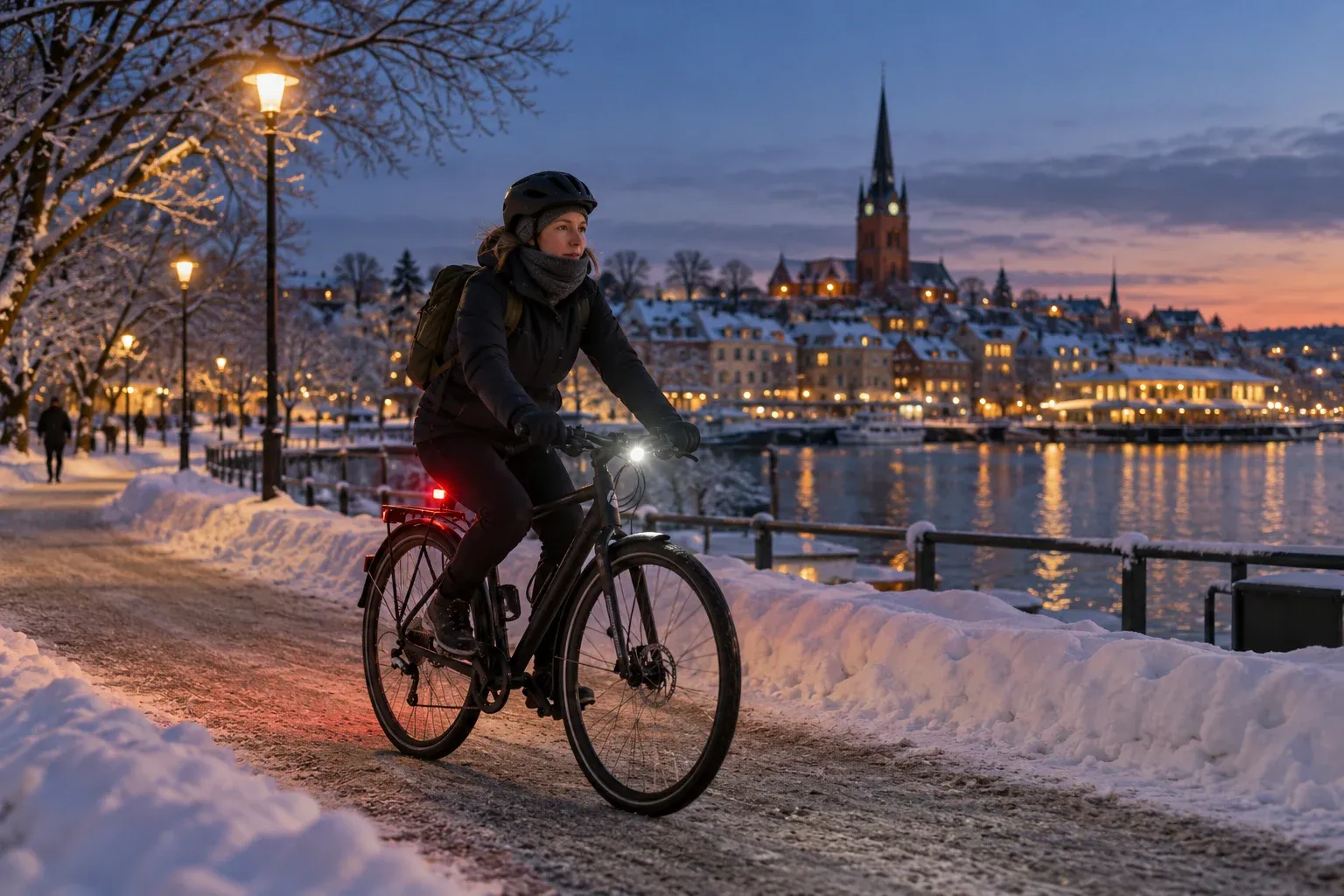
Swedes don’t put the bike away in November. About 13 percent of people in Stockholm ride at least once a week in winter. The law barely changes with the season; the darkness, the ice and the plow schedule do.
When you need this
You’re studying, working or staying a while in a Swedish city between October and April, and the bike is how you get around. Maybe you’re wondering whether to buy studded tyres, or whether they’re even allowed before a certain date. Or the cycle path is under 10 cm of snow, the road beside it is plowed, and you want to know which one you’re allowed to use. This page covers what changes in winter; the all-year rulebook is in our guide to cycling rules in Sweden.
Studded tyres: legal, not required
Here’s the part most English pages get wrong. Sweden’s well-known tyre dates are car rules:
| Rule | Applies to | Bicycles? |
|---|---|---|
| Winter tyres required 1 Dec–31 Mar in winter conditions | Cars, light trucks, light buses and their trailers | No |
| Studded tyres allowed 1 Oct–15 Apr | Tyres for cars and the trailers they tow | No |
| Stud bans on named streets in Stockholm, Gothenburg, Uppsala | Motor vehicles (Stockholm lists bikes as exempt) | No |
The winter-tyre duty in the traffic ordinance (trafikförordningen) lists cars, light trucks, light buses, tractors converted from cars and their trailers. Bicycles aren’t on the list. The stud season sits in a Transportstyrelsen regulation whose scope is tyres for cars and their trailers, so studs on a bike are legal in any month. Transportstyrelsen’s bicycle equipment rules set no tyre requirement at all.
The city stud bans don’t catch you either. Stockholm’s ban streets (Hornsgatan, Fleminggatan and part of Kungsgatan) list bicycles among the exemptions. Gothenburg says outright that a bike with studs may be ridden where the ban for motor vehicles applies, and that goes for e-bikes too. Uppsala’s bans cover motor vehicles only. For the car side of all this, see our guide to winter tyres for cars.
Legal is not the same as necessary, though. Trafikverket, the Swedish Transport Administration, recommends studded tyres (dubbdäck) if you ride regularly in winter, because they grip much better on ice and packed snow. VTI, the national road and transport research institute, tested studded and ordinary bike tyres on ice and found the studded ones gave clearly better braking stability and shorter braking distances.
Two findings from the same research are worth knowing before you shop:
- More studs don’t automatically mean more grip. Rubber compound and stud design mattered as much, and grip varied widely between studded models.
- Pressure matters. Correct tyre pressure was needed for studded tyres to perform as designed.
Lights, reflectors and helmets in the dark
In December, the far south of Sweden gets about seven hours of daylight, and north of the Arctic Circle the sun doesn’t rise at all for weeks; in Kiruna the polar night lasts about 27 days. Most winter commutes happen in the dark, so the lights rule is the one you’ll actually use. More on the darkness in our polar night guide.
| Equipment | When required |
|---|---|
| Brake and bell | Always |
| Front light, white or yellow, visible at 300 m | In darkness |
| Rear light, red, visible at 300 m | In darkness |
| Red reflector at the back, white at the front | In darkness |
| White or orange-yellow side reflectors | In darkness |
| Helmet | Riders under 15, and any passenger under 15 |
Lights aren’t required in daylight or when you’re walking the bike. When you ride on a road, the prescribed lights must be switched on. Riding without them after dark is a 500 kr on-the-spot fine. Trafikverket also suggests extra reflectors or a reflective vest (reflexväst) on top.
Helmets are compulsory only under 15, and a rider carrying a child under 15 must make sure the child wears one. Adults have no legal duty. Many winter riders choose one anyway, since VTI notes most injured cyclists are hurt in single-bicycle crashes and slipperiness is one of the most common causes.
Which bike paths get plowed, and how fast
Each road keeper clears its own paths: Trafikverket the state ones, the municipality the town ones. Many towns put main cycle routes at or near the top of the snow-clearing order. You can check who keeps a given path in the national road database NVDB, linked from Trafikverket.
| Keeper | Cycle-path standard |
|---|---|
| Trafikverket, state paths (Stockholm County: about 175 km) | Starts at about 2 cm; normally done within about 4 hours of starting; sweep-salts nearly a third |
| Umeå | Priority cycle and foot paths start at 3–5 cm by day, done within 5 hours; priority streets wait for 4–10 cm |
| Gothenburg | Cycle lanes from 2 cm, salted; grit instead at −5 °C or colder |
| Uppsala | High-priority cycle paths and lanes within 4 hours, same as bus streets |
| Malmö | Cross-city cycle highways (supercykelstråk) are the top cycle priority for winter 2026/2027 |
That’s a priority, not a promise. Trafikverket says its contractors can’t clear everywhere at once, heavy snow can build up between passes, and deciding whether to leave the bike at home on a bad day is your responsibility as a road user. Malmö and Uppsala publish maps of prioritised cycle paths. The full picture of who plows what is in our guide to snow clearing in Sweden.
When the cycle path is buried in snow
The duty to use the cycle path (cykelbana) where one exists has no snow exception. What the traffic ordinance does give you is this: if you’re 15 or older, you may ride on the carriageway instead, with special care, where the speed limit is 50 km/h or lower or where the road suits your destination better.
The pavement is not the fallback. Only children up to the year they turn eight may ride there, and only where there’s no cycle path, even if the pavement is cleared and the path isn’t. If you’d rather walk that stretch, our guide to walking on icy sidewalks covers grips and gravel.
Ice, cold and what to wear
The surprises are mostly about ice, not snow:
- Frozen ground is slippery above zero. Trafikverket warns that ground frost (tjäle) can make the surface slick even when the air is above freezing.
- Salt has a floor. Trafikverket says sweep-salting (sopsaltning) keeps paths essentially bare down to about −6 °C; Gothenburg switches its cycle lanes to grit at −5 °C or colder. A route that’s bare at −2 °C can be icy at −8 °C.
- Weather turns within a day. Check the forecast before the ride home, and leave the bike if an SMHI weather warning is out.
Trafikverket’s clothing advice is simple: dress in layers and protect your hands and feet properly. Lobster mittens or handlebar pogies, a thin hat under the helmet and ski goggles in snowfall are common local choices. Salt and grit wear out chains and parts, so rinse the bike now and then. And if you ride an e-bike, expect less range in the cold; keeping the battery indoors overnight helps. For a full kit list, see packing for a Swedish winter.
Rental bikes in winter
Malmö by Bike says its system is open all year and around the clock. Stockholm’s rental bikes are run by Bolt and Voi under city permits, and the city doesn’t publish a winter pause, so check the app before you count on one. Some smaller towns take e-scooters off the streets when snow comes. Don’t assume a rental bike has studded tyres. Details on operators are in our guide to e-scooters and city bikes.
Mistakes to avoid
- Believing studs are illegal before 1 October. That’s the car rule; bikes have no season.
- Riding on the pavement because the path is unplowed. Use the road with care where the limit is 50 km/h or lower.
- Trusting a salted path in hard frost. Below about −5 °C, salt gives way to grit.
- Leaving lights at home on an afternoon ride and getting caught by darkness at 15:00.
- Letting studded-tyre pressure drift, which costs grip.
Practical information
| Item | Detail |
|---|---|
| Fine: no lights after dark | 500 kr (checked 2026-10-06) |
| Fine: child passenger under 15 without a helmet | 500 kr, on the rider (checked 2026-10-06) |
| Studded bike tyres | Legal in any month; not required; prices vary by model |
| Winter standby | Uppsala 15 Oct–30 Apr; Malmö 29 Oct 2026–1 Apr 2027 |
| Rental bikes | Priced per operator in the app |
| Cleared cycle paths | Free to use |
FAQ
Are studded bike tyres legal in Sweden?
Yes, at any time of year. Sweden’s studded-tyre window of 1 October to 15 April applies to cars and the trailers they tow, not to bicycles. The stud-ban streets in Stockholm, Gothenburg and Uppsala do not apply to bicycles either. Trafikverket recommends studded tyres if you cycle regularly in winter, because they grip much better on ice.
Do I need winter tyres on my bike in Sweden?
No. The legal winter-tyre duty from 1 December to 31 March covers cars, light trucks, light buses and their trailers, and the bicycle equipment rules set no tyre requirement. It is still a good idea: VTI found studded bike tyres give clearly better braking stability and shorter braking distances on ice than ordinary tyres.
What lights do I need on a bike in Sweden in winter?
In darkness you need a front light showing white or yellow and a rear light showing red, both visible at 300 metres, plus a red rear reflector, a white front reflector and white or orange-yellow side reflectors. Riding without lights costs a 500 kr fine. In December that can mean from mid-afternoon in much of the country.
Can I ride on the road if the bike path is not plowed?
If you are 15 or older, yes, with special care, where the speed limit is 50 km/h or lower or where the road suits your destination better. The traffic ordinance has no snow exception to the cycle-path duty, so that is the legal route onto a plowed street. Riding on the pavement is allowed only for children up to the year they turn eight.
Are bike paths cleared of snow in Sweden?
Yes, and often early. Trafikverket starts on state cycle paths at about 2 cm and normally finishes within about four hours. Umeå starts on priority cycle routes at 3 to 5 cm, before priority streets, and Gothenburg starts its cycle lanes at 2 cm and salts them. Minor and park paths may wait longer or not be cleared at all.
Can I rent a city bike in Sweden in winter?
Often. Malmö by Bike says its system is open all year and around the clock. Stockholm’s rental bikes are run by Bolt and Voi under city permits, and the city does not publish a winter pause, so check the app. Some smaller towns take e-scooters off the streets when snow comes. Don’t assume a rental bike has studded tyres.
Do I have to wear a helmet when cycling in winter?
Only if you are under 15, the same as the rest of the year; a rider carrying a child under 15 must also make sure the child wears one. Adults have no legal duty. Because most injured cyclists are hurt in single-bicycle crashes and ice is a common cause, many winter riders choose to wear one anyway.
Related guides
- Cycling rules in Sweden — the all-year rulebook, crossings and fines
- Snow clearing in Sweden — who plows roads, streets and paths, and how fast
- Winter tyres for cars — the stud dates people confuse with bike rules
- Walking on icy sidewalks — for the days the bike stays home
- E-scooters and city bikes — operators and how renting works
Facts verified 2026-10-06. Sources: Sveriges Riksdag (trafikförordningen), Transportstyrelsen, Trafikverket, VTI, Åklagarmyndigheten, the cities of Stockholm, Gothenburg, Uppsala, Umeå and Malmö, and SMHI — full register in this topic’s source file. Found something outdated? Tell us and we’ll fix it.