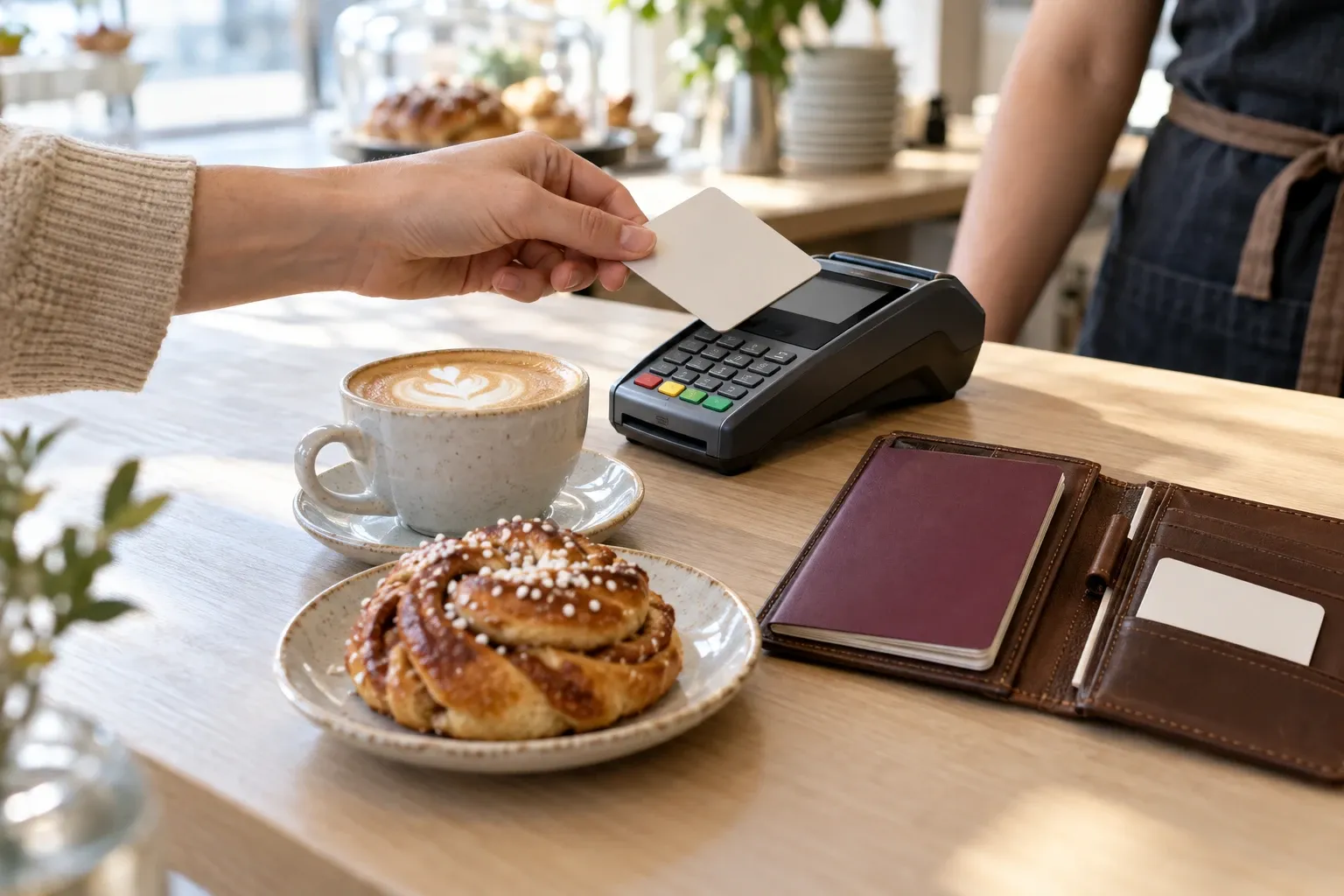
A travel card is fine for Swedish coffee, metro rides and groceries. It’s the car-rental desk, the fuel pump and a card that can’t hold kronor that cause trouble. Here’s where each type works, where it fails, and what the law says about your balance.
When you need this
You’re deciding whether a prepaid travel-money card is worth buying for Sweden. Or you already use a multi-currency app card and want to know if it holds up here. Or a rental desk, hotel or fuel pump has just declined your prepaid card, or your balance looks lower than your spending explains. This page answers those questions. For card acceptance in general, see using credit and debit cards in Sweden.
Two kinds of travel card (and one false friend)
“Travel card” covers two different products, and they behave differently:
| Prepaid travel-money card | Multi-currency account card | |
|---|---|---|
| How it works | Loaded in advance, spends only what is on it | An account holding several currency balances, converted in an app |
| Currencies | A fixed list chosen by the issuer | Usually many, converted on demand |
| What it legally is | Usually electronic money (e-money) | E-money, or a bank account if the provider is a bank |
| At a Swedish till | A Visa or Mastercard like any other | A Visa or Mastercard like any other |
The false friend: in Sweden, a reskort or SL Access card is a transit travel card for buses and trains, not a payment card. And a kontantkort is a prepaid SIM. Neither has anything to do with travel money.
Where a travel card works fine
Sweden is about as card-friendly as a country gets: Riksbanken’s Payment Report 2026 records 92% of in-store purchases made by card. A prepaid or multi-currency Visa or Mastercard is just another card at a shop till, a café, a ticket machine or an ATM.
On Stockholm’s SL network, you can tap a payment card or phone at the gate. Each traveller needs their own payment card, and a card and its phone version count as different cards, so tap the same one for the whole journey.
For cash, use a Bankomat, the banks’ shared ATM network. Bankomat charges no fee of its own, but caps each withdrawal for card issuers that are not its customers (the limit is in the table below). More in our guide to ATMs in Sweden.
The one thing no travel card can do is Swish, the Swedish phone-payment system. It needs a Swedish bank account and Swedish BankID. See why Swish is out of reach for visitors.
Where it fails: three weak points
1. A card that can’t hold kronor
A card that holds SEK pays Swedish bills from that balance, with no conversion. A card that can’t hold SEK converts every purchase, and the margin can be steep. One Australian travel-money card, for example, lists ten loadable currencies without SEK and adds a margin of several percent on top of the Mastercard rate when you spend a currency you haven’t loaded. An Irish post-office currency card, by contrast, includes SEK among its 15 currencies. Check the issuer’s currency list for SEK before you load a cent.
2. Holds on a small balance
Fuel pumps, hotels and rental desks reserve more than the bill, because they don’t know the final amount yet. On a credit card that’s an annoyance. On a prepaid card, it comes out of a small fixed balance.
- Fuel pumps reserve a fixed amount of a couple of thousand kronor. If your card can’t cover that, the bank should reserve what’s available, and you can fill for that amount minus 5 kr.
- Hotels reserve the room cost and sometimes a margin at check-in.
- Rental desks reserve a deposit larger than the estimated rental cost.
A hold isn’t a charge, and a vanished hold isn’t the end of it either. On a non-SEK balance, the final amount can differ from the hold because the exchange rate moves between authorisation and settlement. Our guide to card holds and deposits explains the mechanism.
3. The car-rental desk
This is where prepaid cards most often fail. Swedish consumer guidance says a rental company reserves an amount on your debit or credit card whatever insurance you buy, but it doesn’t say which cards a company must accept. That’s up to each company. One large international rental chain’s Swedish station pages refuse any card marked “prepaid” or “debit card”. Another company’s Swedish terms accept only a physical card with chip and PIN, and say digital cards aren’t accepted.
Some companies take debit cards at some stations or for some car classes, so check the terms before you book. The safe default is a credit card in the main driver’s name. See renting a car in Sweden.
Fees that hide in travel cards
The costs of a travel card come from the card itself, and from one choice at the terminal (current examples are in Practical information):
- Conversion margins when you spend a currency the card doesn’t hold (the SEK problem above).
- Weekend surcharges. Some multi-currency providers add a mark-up to conversions when currency markets are closed. One large provider charged this on its free plan in 2025. Convert to SEK on a weekday if yours does this.
- Inactivity and closure fees. The same Australian card charges a monthly fee after 12 months unused, and a fee to close it or withdraw the balance.
- Your home currency at the terminal. If a card machine or ATM offers to charge you in your home currency, refuse. That’s dynamic currency conversion, and it adds a merchant-side mark-up even when your card already holds SEK. EU rules make the terminal show that mark-up over the ECB rate before you pay. Full story: always pay in kronor.
Is the money safe?
Mostly, but it isn’t a bank deposit. Most prepaid cards and many multi-currency accounts are electronic money. Sweden’s E-money Act shows what that means, and EU e-money rules work the same way elsewhere:
- The issuer must safeguard your money: keep it separate from its own assets, or cover it with insurance or a guarantee from an unrelated insurer or bank.
- You can redeem your balance at face value at any time.
- The issuer may not pay interest on it.
Safeguarding isn’t deposit insurance. The UK regulator says funds held by payments and e-money firms aren’t directly covered by its deposit-compensation scheme; if a firm fails, you wait for an insolvency process, which can take time and deduct costs. Stricter UK safeguarding rules took effect on 7 May 2026, but they don’t change that. If your provider is itself a licensed bank, its deposit rules apply instead; its terms say which it is.
In practice: keep the balance to what the trip needs.
One more check: some card families recommended in older guides have closed. One Australian issuer’s Cash Passport cards are no longer valid. Make sure your card is still issued and active before you rely on it.
After the trip: leftover balance
You can spend it next time, convert it in the app, or ask the issuer to pay it out. Under the e-money rules, a redemption fee is allowed only if the contract states it, and only to cover the issuer’s reasonable costs; after the contract ends, only once more than a year has passed. Ask what redemption costs before you close the card.
So which card should you bring?
| Situation in Sweden | Prepaid card | Multi-currency card | Ordinary credit card |
|---|---|---|---|
| Shops, cafés, restaurants | Works | Works | Works |
| Transit tap-to-pay | Works as a Visa/Mastercard | Works | Works |
| ATM cash | Works; per-withdrawal cap | Works; per-withdrawal cap | Works |
| Fuel pump hold | Risky on a small balance | Fine if funded | Fine |
| Hotel check-in hold | Risky on a small balance | Fine if funded | Fine |
| Car-rental deposit | Often refused | Often refused if debit or prepaid | The safe choice |
| Swish | No | No | No |
The pattern: a travel card is a good second card and a handy budgeting tool, as long as it holds SEK. Sweden’s consumer bureau advises carrying more than one card on a trip anyway. Keep a credit card for the rental desk and the big holds.
Practical information
| Item | Amount or rule | Checked |
|---|---|---|
| Spending a currency not loaded (one Australian travel-money card) | Mastercard rate + 5.95% | 2026-10-15 |
| Inactivity and closure fees (same card) | AU$4 a month after 12 months unused; AU$10 to close or withdraw | 2026-10-15 |
| Weekend conversion surcharge (one large provider’s free plan) | 1% (paid plans 0–0.5%), reported February 2025 | 2026-10-15 |
| Dynamic currency conversion mark-up | 2.4–4.13% over the ECB rate in a 2021 Swedish test | 2026-10-15 |
| Fuel-pump hold | 1,800 kr industry standard since May 2025; up to 2,000 kr at one chain | 2026-10-15 |
| Rental-car hold | In one company’s Swedish terms, the estimated cost + 2,000 kr | 2026-10-15 |
| Bankomat | No fee of its own; 2,000 kr per withdrawal for non-customer issuers | 2026-10-15 |
| E-money redemption | Face value; any fee must be in the contract and cover only reasonable costs | 2026-10-15 |
FAQ
Do prepaid travel cards work in Sweden?
Yes, for everyday paying. A prepaid Visa or Mastercard is a card like any other at a Swedish till, ticket machine or transit gate, and most purchases here are made by card. The weak points are car-rental desks, which often refuse prepaid cards, and large holds at fuel pumps and hotels, which can lock up a small balance until they clear.
Should my travel card hold Swedish kronor?
Yes, if you can choose. A card holding SEK pays Swedish bills from that balance without converting. A card that cannot hold SEK converts every purchase, sometimes at a steep margin: one Australian travel-money card adds several percent to the Mastercard rate for currencies you have not loaded. Check the issuer’s currency list for SEK before you load money.
Can I rent a car in Sweden with a prepaid card?
Often not. Rental companies reserve a deposit on your card, and each company decides which cards it accepts. One large international chain’s Swedish station pages refuse cards marked prepaid or debit, and another company’s Swedish terms require the physical card with chip and PIN. Bring a credit card in the main driver’s name, and check the company’s terms before you book.
Is money on a prepaid or multi-currency card safe?
Mostly, but it is not a bank deposit. Most such cards are electronic money, which the issuer must keep separate from its own assets or insure. The UK regulator says these funds are not directly covered by its deposit-compensation scheme, so a failure means waiting for an insolvency process. Keep the balance to what the trip needs, and check whether your provider is a bank.
Can I use Swish with a travel card or app?
No. Swish, the Swedish phone-payment system, is tied to a Swedish bank account and Swedish BankID, so no foreign card, prepaid card or multi-currency app can join it. When a Swede asks you to Swish them money, pay by card where the seller accepts it, or settle a shared bill another way.
What happens to money left on the card after my trip?
You can spend it later, convert it in the app, or ask the issuer to redeem it. EU-based e-money issuers must pay out the balance at face value on request; a fee is allowed only if the contract states it and covers reasonable costs. Some cards charge closure fees, and some charge monthly inactivity fees after a year unused.
Related guides
- Using credit and debit cards in Sweden — acceptance, PIN prompts and the Amex gap.
- Always pay in kronor — why the home-currency offer costs you, and what the law requires.
- Card holds and deposits — why holds happen and how long they last.
- Renting a car in Sweden — card and deposit rules before you book.
- Paying friends back without Swish — settling shared bills as a visitor.
Facts verified 2026-10-15. Sources: Sveriges riksdag (E-money Act), the UK Financial Conduct Authority, Konsumentverket, Konsumenternas Bank- och finansbyrå, Sveriges Riksbank, Bankomat, and card issuers’ and rental companies’ own published terms — full register in this topic’s source file. Found something outdated? Tell us and we’ll fix it.