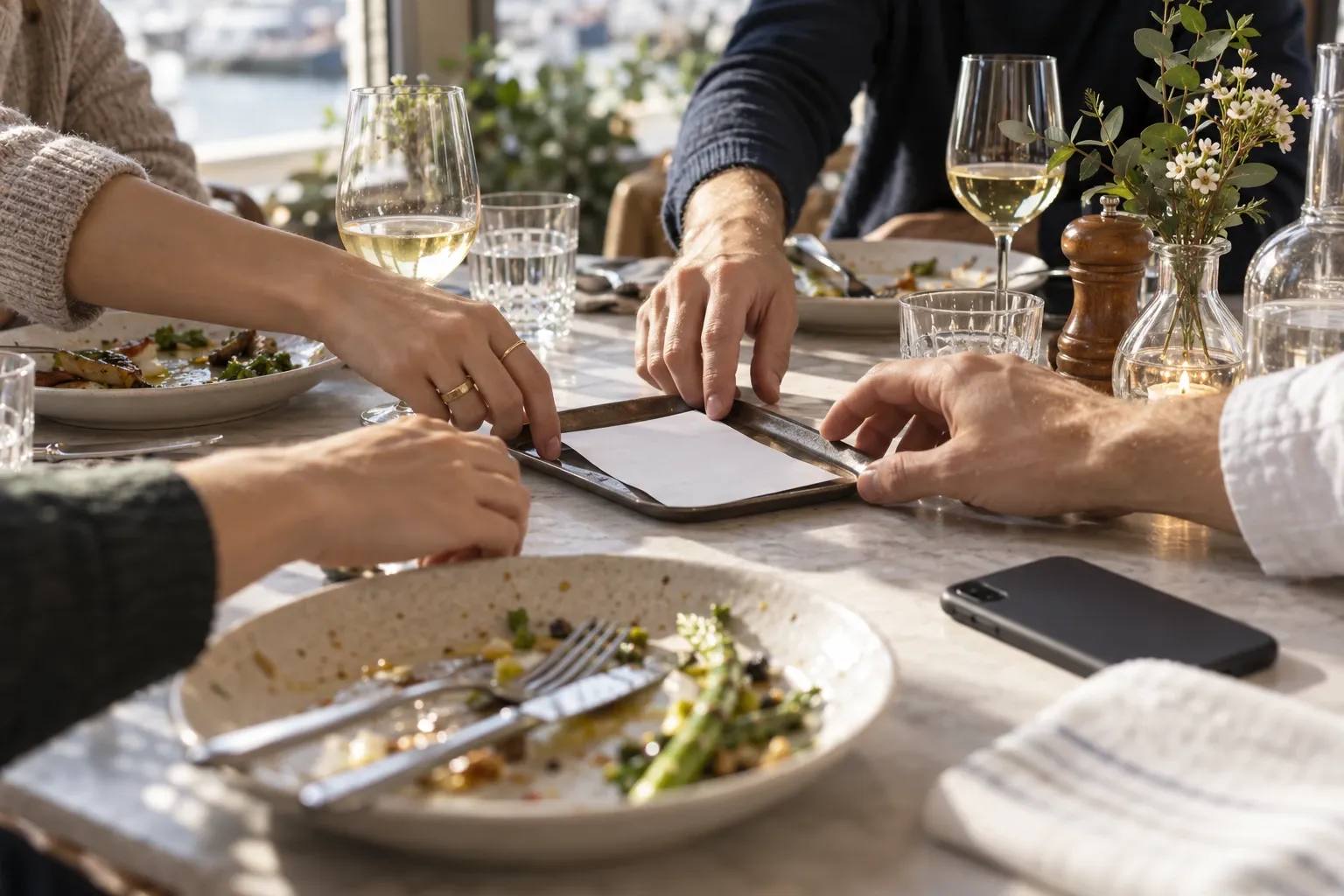
Swedes settle shared costs by phone in seconds, and you can’t join in. You don’t need to. Here is how to pay your share at the table, during the trip and after you get home, without overpaying in fees.
When you need this
- Swedish friends are splitting the restaurant bill and everyone reaches for their phone.
- A friend or host paid for your concert ticket, groceries or ferry and wants your share.
- You’re sharing a rented cabin, car or boat with Swedes and need to settle up.
- You’re home again and still owe someone in Sweden money, or they owe you.
Why Swish can’t help, and won’t soon
Swish is the app Swedes use to send each other money from their phones. In the Riksbank’s 2025 survey, 91% of Swedes had used it in the previous month. The usual Swedish way to split anything is that one person pays and the others “swish” their share (swisha is a verb).
A visitor can’t take part in either direction. Swish needs a Swedish bank account and Mobile BankID, and Mobile BankID needs a Swedish personnummer (personal identity number). That means you can’t send a share, and a Swede can’t Swish you a refund. The only foreign phone numbers Swish accepts are Finnish ones, and those still need a Swedish bank account behind them. The full story is in why Swish doesn’t work for tourists.
You may have read that Europe’s mobile payment apps are being linked so people can pay each other across borders. That work is real, but Sweden isn’t part of it. In January 2026 the Riksbank, Sweden’s central bank, wrote that neither Swish nor any other Swedish actor takes part. In March 2026 it was still urging Swish’s owner to work towards a link. So for now you settle the old-fashioned ways, which work fine.
| Situation | Best way to settle |
|---|---|
| Restaurant or bar bill | Pay separately by card at the table |
| Shared costs during a trip | Take turns paying by card; keep a note |
| Small leftover balance | Cash in kronor, if your friend is happy with that |
| Larger balance after the trip | Standard bank transfer to your friend’s IBAN |
| A Swede owes you | Give them your IBAN and BIC for a standard euro transfer |
At the table: pay separately
Asking to split is normal in Sweden. Friends and dates usually each pay their own share unless someone says jag bjuder (“my treat”); see splitting the bill and Swedish equality habits. When you ask for the bill, say “Kan vi betala separat?” (“Can we pay separately?”). Staff routinely run a separate card payment for each person.
One thing to watch at the terminal: if it offers to charge you in your home currency, choose kronor (SEK). EU rules make the terminal show its mark-up over the European Central Bank rate before you accept. That mark-up is money you don’t need to pay, and it makes your share dearer than everyone else’s. The details are in why you should always pay in kronor.
During the trip: take turns, and cash
Sharing a cabin, a car or a week of groceries is where visitors end up owing money. The neat solution is to make sure you don’t. Volunteer to pay the big shared items by card: the ferry tickets, the supermarket run, the fuel. The Swedes can Swish each other for the rest, and the balance often comes out close to even. Keep a simple note of who paid what, and round to even figures. Nobody chases odd kronor among friends.
Cash is a fine way to settle a small balance between friends. Ask first, though. Many Swedes rarely use cash any more and may prefer that you pay the next shared bill instead. Leftover kronor at the end of a trip are the easiest way to clear a last small debt. For how much cash is worth carrying at all, see cash in Sweden.
Two things not to do. Don’t promise to “Swish you later” from your foreign phone, because it won’t work. And don’t hand your card details or anyone’s BankID login to a helpful stranger who offers to “set you up” with Swish. It can’t work for a visitor, and BankID is a personal identity document.
After the trip: a bank transfer that costs almost nothing
If you still owe money when you get home, an ordinary bank transfer is the answer, and inside Europe it’s cheaper than most people expect.
Ask your friend for their IBAN and their bank’s BIC. Their bank must give them both, and they appear in the banking app under account details. Ask them to read the IBAN from the app. A Swedish clearingnummer (branch number) plus account number isn’t enough for a payment from abroad.
From an EU or EEA account, send a standard euro (SEPA) transfer. EU law sets the price: a cross-border euro transfer may cost no more than a domestic transfer of the same value. Sweden has extended the same rule to kronor. On the receiving side, your friend’s bank may charge no more than for a domestic payment. In practice, the large Swedish banks charge no fixed fees at either end for a standard euro transfer.
What the rule doesn’t cover is currency conversion. Your friend’s bank turns the euros into kronor at its own rate, and that margin is the real cost. If you send kronor instead, your own bank does the converting. Either way, online banking must show the estimated conversion charge and the amount your friend will receive before you confirm.
Three ways to make it cost more than it should:
- Ticking “express” or “urgent”. Fast international transfers carry a large fixed fee at the big Swedish banks, while a standard euro transfer has none. That changes from 9 January 2027, when Swedish banks must charge no more for instant euro transfers than for standard ones.
- Sending your home currency from another EEA country (Danish or Norwegian kroner, zloty and so on). Large Swedish banks usually charge a receiving fee unless the money arrives in euro or kronor.
- Getting the IBAN wrong. Read it back to your friend before sending. Swedish banks only have to offer the EU name check for euro transfers from 9 July 2027.
From outside the EEA (for example the UK or the US), use an international transfer and choose the option where you pay all the fees. Otherwise deductions come off the amount and your friend receives less than you sent. Large Swedish banks also charge a fixed fee for receiving payments from outside the EEA. If you and your friend already use the same international money app, a transfer between users there is often cheaper. A Riksbank study found some non-bank providers close to the G20 cost targets, which the big Swedish banks missed.
When a Swede owes you
The same rules work in reverse. Give your friend your IBAN, your bank’s BIC, your full name and your address. If you bank in the EEA, ask for a standard euro transfer rather than an express one.
Give them a day. Some Swedish banks switch off international payments for customers who haven’t made one in a year, and switching them back on can take 24 hours. That isn’t your friend stalling, just their bank.
Nordic visitors
If you’re Danish, Norwegian or Finnish, you may use a mobile payment app that sends money across Nordic borders. It does reach Sweden, but few Swedes have it. The Riksbank counted about 70,000 Swedish users at the end of 2024, and not all Swedish banks support it. Ask, but expect to fall back on a bank transfer. Norway and Iceland are in the EEA, so the standard euro transfer works the same way from there.
Practical information
| Item | Amount or rule |
|---|---|
| Swish for a visitor | Not available (needs a Swedish bank account and BankID) |
| Standard euro transfer from the EU/EEA to a Swedish IBAN | No more than a domestic transfer by law; no fixed fee at large Swedish banks (price lists, Nov 2024) |
| Euro to kronor conversion | The receiving bank’s margin, shown before you confirm an online transfer |
| Express international transfer from a large Swedish bank | 350 kr fixed fee (Nov 2024) |
| Standard transfer from Sweden to outside the EEA | 50 kr sender fee, plus a likely receiving fee abroad (Nov 2024) |
| Receiving from outside the EEA at a large Swedish bank | 50 kr fixed fee (Nov 2024) |
| Instant euro transfers in Sweden | Receiving and fee parity with standard transfers from 9 January 2027; sending from 9 July 2027 |
| Paying separately by card at a restaurant | Free; your own bank’s foreign-card terms apply |
FAQ
Can a Swedish friend Swish me money?
No. Receiving Swish needs the same things as sending it: a Swedish bank account and Mobile BankID, which in turn needs a Swedish personnummer. A visitor has none of these. If a Swede owes you money, give them your IBAN, your bank’s BIC and your name, and ask for a standard euro transfer, or settle in cash before you leave.
How do I pay a Swedish friend back after my trip?
Ask for their IBAN and their bank’s BIC, which they can read from their banking app. From an EU or EEA account, send a standard euro transfer: by law it costs no more than a domestic one, and their bank may not charge more than for a domestic payment. Their bank converts the euros into kronor at its own rate.
Does it cost anything to send euros to a Swedish bank account?
A standard euro transfer from the EU or EEA carries no fixed fee at either end in the usual case, because fees must match domestic transfers. The cost is the currency margin when the euros become kronor. Express transfers and payments from outside the EEA are different: large Swedish banks charged fixed fees of 50 to 350 kr in 2024.
Is it rude to pay my share in cash?
No. Between friends, kronor in cash are a normal way to settle, and nobody expects a visitor to have Swish. Ask first, because many Swedes seldom use cash and may prefer that you pay the next shared bill by card instead. Round figures are fine; nobody chases odd kronor among friends.
Can restaurants in Sweden split the bill?
Yes. Asking to pay separately is ordinary in Sweden, and staff routinely run separate card payments for each person at the table. Say “Kan vi betala separat?” when you ask for the bill. When the terminal offers your home currency, choose kronor, because the alternative adds a conversion mark-up that the screen must show you.
Will Swish work with European payment apps soon?
Not yet. Several European mobile-payment apps are linking up for cross-border payments, but in January 2026 the Riksbank said neither Swish nor any other Swedish actor was taking part. In March 2026 it was still urging Swish’s owner to work towards a link. For now, settle by card, cash or bank transfer.
Related guides
- Swish for tourists — why the app is closed to visitors and the other places it gets in the way.
- Splitting the bill and everyday equality — who pays, and what jag bjuder means.
- Always pay in kronor — the terminal question that makes your share dearer if you get it wrong.
- Using cards in Sweden — the card that does for you what Swish does for Swedes.
- Prepaid and multi-currency travel cards — when a second card or account is worth having.
Facts verified 2026-10-15. Sources: Sveriges Riksbank, European Central Bank, EU Regulation 2021/1230, Sveriges Riksdag (Lag 2002:598), Nordea, SEB, Swedbank, Swish — full register in this topic’s source file. Found something outdated? Tell us and we’ll fix it.