Hotels, fuel pumps, rental desks and EV chargers in Sweden all hold money on your card before they charge it. Here is what a hold is, what the law actually requires, how each type works, and who to call when one won’t go away.
When you need this
Your banking app shows a large amount “reserved” after a fill-up that cost a fraction of that. A hotel wants to “take your card” for a room you prepaid online. A car-rental desk asks for a credit card, or refuses the card on your phone. Or it’s three days after check-out and the money still hasn’t come back. If you’re travelling on a debit card or a tight budget, read this before the trip, because several holds can overlap.
What a card hold is, and what it isn’t
A hold is a reservation that your own bank places on your card when a merchant asks it to cover a payment whose final size isn’t known yet. A hotel stay with a minibar, a tank of fuel, a car that might come back damaged, an EV charging session: each has an open-ended bill.
The money doesn’t leave your account, but you can’t spend it until the hold is either swapped for the real charge or released. In Swedish banking apps it appears as a reserverat belopp (reserved amount). A hold is not a fee and not a purchase. At a fuel station, for example, the station never receives the hold, only the price of the fuel you took.
What Swedish and EU law actually says
Within the EU and EEA, holds are regulated. Sweden’s Payment Services Act (lag om betaltjänster, chapter 5, section 27) implements article 75 of the EU’s second Payment Services Directive. It says two things:
- Your bank may reserve money only to cover that transaction, and only if you approved the exact amount reserved.
- Your bank must release the reserved money as soon as possible once it receives the exact amount or the final payment.
That’s all. No Swedish or EU statute sets a number of days. The “three to five bank days” you’ll read everywhere is consumer guidance, and “up to 30 days” comes from card-network rules and rental terms. Neither is law. UK banks follow a near-identical rule. Cards issued elsewhere follow your card agreement and home law.
| Layer | Who sets it | What it decides |
|---|---|---|
| The law (EU/EEA, UK) | Statute | You approve the exact amount; your bank releases it as soon as possible |
| Card-network rules | Visa, Mastercard | When pumps must hold; how long an authorisation stays valid |
| Merchant terms | Hotel, rental company, station | How much is held, which cards are accepted |
| Your bank’s systems | Your card issuer | How fast the hold disappears in practice |
There’s also a refund right. If the final charge exceeds what you could reasonably have expected, you can ask your bank for a full refund within eight weeks of the debit, and it must refund or explain within ten bank days. The Swedish act excludes this right when either bank is outside the EEA.
A new EU Payment Services Regulation will eventually replace these rules. It reached a final compromise text in April 2026, but as of October 2026 it isn’t adopted or in force.
Fuel pumps
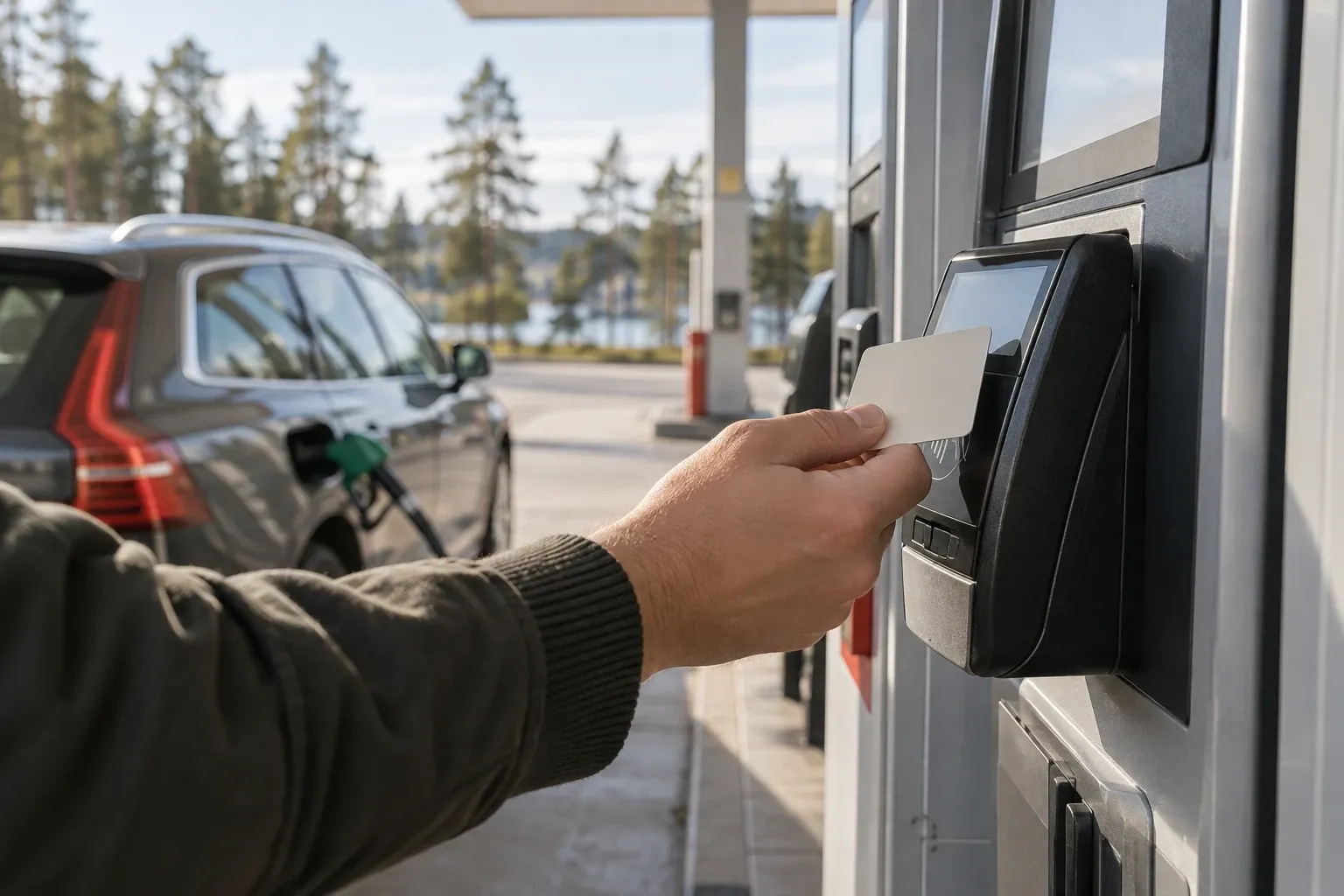
At an unmanned pump, card-network rules make your bank reserve a fixed sum before the fuel flows. The hold isn’t a station policy or Swedish law. Once you finish, the bank should swap it for the real price, usually within minutes.
Two things catch visitors. First, the full hold has to be available up front, even for a small fill. If you have less, the bank may reserve what’s there, and you can fill for that amount. Second, the hold also caps the fill: if the pump stops before the tank is full, start a new payment. Our guide to paying at Swedish fuel stations has the full sequence and the pump labels.
Hotels
Hotels commonly reserve the cost of the room plus, sometimes, a margin for the minibar and room service. Swedish consumer guidance says the hold should normally end when you pay the final bill and check out, and in any case after about three to five bank days.
If you prepaid online, ask at check-in whether a hold is still being taken and for how much. You’re entitled to approve the exact amount. Late-cancellation and no-show fees are a different thing: they are charges under your booking terms, not holds. See no-show and cancellation fees and our guide to Swedish hotels.
Rental cars
Konsumentverket, the Swedish consumer agency, says a rental company will reserve an amount on your debit or credit card whatever insurance you buy. The amount follows the company’s own rules, so check that it matches your contract.
Rental holds are the biggest and slowest you’ll meet. One major rental company’s Swedish terms, read for this guide, illustrate the structure:
- The hold is at least the estimated rental cost plus a fixed margin, and can be raised.
- Extending the rental can trigger a new hold.
- The authorised sum stays reserved for 3 to 30 bank days, depending on your bank.
- Only the physical card you booked with is accepted. Digital cards are refused, and so can the rental be.
- Some companies take a deposit as an actual payment that is refunded on return. A refund is a new transaction, so the hold-release rule doesn’t cover it.
Rental companies often want a credit card for this. A rental company may also not take money from your card or deposit for damage without giving you a chance to dispute it. For insurance and damage disputes, see rental insurance and disputing charges.
EV chargers and other self-service payments
Card-payment EV chargers work like fuel pumps: a temporary amount is reserved when you start, and you pay only for the energy used. The operator sets the size. See EV charging in Sweden. For kiosks and code-based check-in, see self check-in hotels.
Budgeting for holds: debit or credit?
On a debit card, a hold freezes your own money. On a credit card, it uses up your limit. Two fuel holds and a hotel hold on the same day can lock up several thousand kronor. If your next card payment then gets declined, that’s usually why.
Swedish consumer guidance suggests a credit card for travel, and points out the extra protection it gives. In practice:
- Use a credit card for the big holds (rental, hotels) and a debit card for daily spending.
- Carry two cards on different networks, ideally one Visa and one Mastercard.
- Add up the holds that overlap on your heaviest day, and check your limit or balance covers them plus your spending.
- Say “kronor” if a desk terminal offers your home currency. Conversion by the merchant’s provider usually costs more, and that applies to the hold as well.
When a hold won’t go away
Your bank controls the release, so who to call depends on where the hold came from:
| Hold from | Wait | Then |
|---|---|---|
| Fuel pump | 3–5 days | Your card-issuing bank first, then the station chain |
| Hotel | 3–5 bank days after check-out | Ask the hotel to confirm the final amount was sent, then your bank |
| Rental company | As the contract says, up to several weeks | Ask the company to confirm the return was settled, then your bank |
| A hold larger than you agreed | Now | Ask the merchant to correct it, and raise it with your bank |
Quote the hold amount from your receipt or the screen, and keep the final receipt.
After the hold: late charges and currency differences
A hold that has disappeared from your banking app has only expired. The merchant can still charge the card afterwards, and Swedish card issuers and payment providers both say so. Card-network rules let hotel and rental authorisations stay valid for up to about a month, against about a week for most others. Damage, fuel or extras can be billed after you’ve flown home, so check your statement for eight weeks.
On a card in another currency, the hold and the final charge are converted at different moments, often days apart. The exchange rate moves in between, so a small difference up or down is normal. A large gap suggests the amount was converted by the merchant, not your bank.
Practical information
| Item | Detail (checked 2026-10-14) |
|---|---|
| Fuel-pump hold | Industry standard 1,800 kr per payment since May 2025; up to 2,000 kr at one chain, 1,500 kr at another operator |
| Hotel hold | Room cost plus sometimes a margin for extras; set by each hotel |
| Rental-car hold | Set by each company; one major company’s Swedish terms: at least the estimated rental cost plus 2,000 kr |
| EV-charger hold | Temporary amount set by the operator; only energy used is charged |
| Release, by law | As soon as possible after the final amount arrives (no day count) |
| Release, in practice | Fuel: usually minutes. Hotels and rentals: about 3–5 bank days (consumer guidance); one rental’s terms: 3–30 bank days |
| Refund request window | 8 weeks from the debit (EEA-issued cards) |
| Cost of the hold itself | 0 kr |
FAQ
Why did my hotel in Sweden block money on my card?
That is a hold, or reserved amount, placed at check-in because your final bill is not yet known: the room plus sometimes a margin for minibar and room service. It is not a charge. Under EU rules you must agree to the exact amount, and it should normally end when you pay and check out, or within about three to five bank days.
How long does a card hold last in Sweden?
The law sets no day count: your bank must release the hold as soon as possible once it receives the final amount. Fuel holds usually clear within minutes. Swedish consumer guidance says hotel and rental holds should end at check-out or return, or within about three to five bank days. One rental company’s terms warn of 3 to 30 bank days, depending on your bank.
Can I use a debit card for a rental car deposit in Sweden?
Sometimes. Konsumentverket says the company will reserve an amount on your debit or credit card whatever insurance you buy, but rental companies often want a credit card. On a debit card the deposit freezes your own money, possibly for weeks. Check the company’s card policy before booking, and bring the physical card you booked with.
Why does it look like I was charged twice at a Swedish petrol station?
Because the pump hold and the real charge can both show for a while. Card-scheme rules make your bank reserve a fixed amount before fuel flows; afterwards the hold should be swapped for the price of the fuel. The station never receives the hold. If it is still there after three to five days, contact your card-issuing bank.
The hold disappeared. Can the merchant still charge me?
Yes. A hold that drops off your banking app has only expired; the merchant can still send the charge afterwards. Swedish card issuers and payment providers both say so. Hotels and rental companies may also bill extras, fuel or damage after the trip, so keep receipts and check your statement for a couple of months.
Can a hotel or rental company hold more than I agreed to?
Not lawfully in the EU or EEA. Sweden’s Payment Services Act lets your bank reserve funds only if you approved the exact amount, and only to cover that transaction. If a hold is larger than you agreed, ask the merchant for a correction and raise it with your bank. Cards from outside the EEA and the UK follow your card agreement instead.
Why is the final charge different from the hold on my foreign card?
On a card in another currency, the hold and the final charge are converted at different moments, often days apart, and the exchange rate moves in between. The final amount can be a little higher or lower than the hold. A larger gap may mean the merchant converted the amount itself, so choose kronor at the terminal.
Related guides
- Paying at Swedish fuel stations — the pump sequence, the hold cap and which nozzle to use.
- Swedish hotels explained — check-in, registration and what the desk expects.
- Rental insurance and disputing charges — what to do when a damage charge follows the deposit.
- Pay in kronor, not your home currency — why a converted hold costs more.
- Travel cards for Sweden — choosing a card that handles holds well.
Facts verified 2026-10-14. Sources: Sveriges riksdag (Lag 2010:751 om betaltjänster), European Banking Authority, legislation.gov.uk, Konsumenternas Bank- och finansbyrå, Konsumentverket / ECC Sweden, card issuers’ and operators’ published terms — full register in this topic’s source file. Found something outdated? Tell us and we’ll fix it.