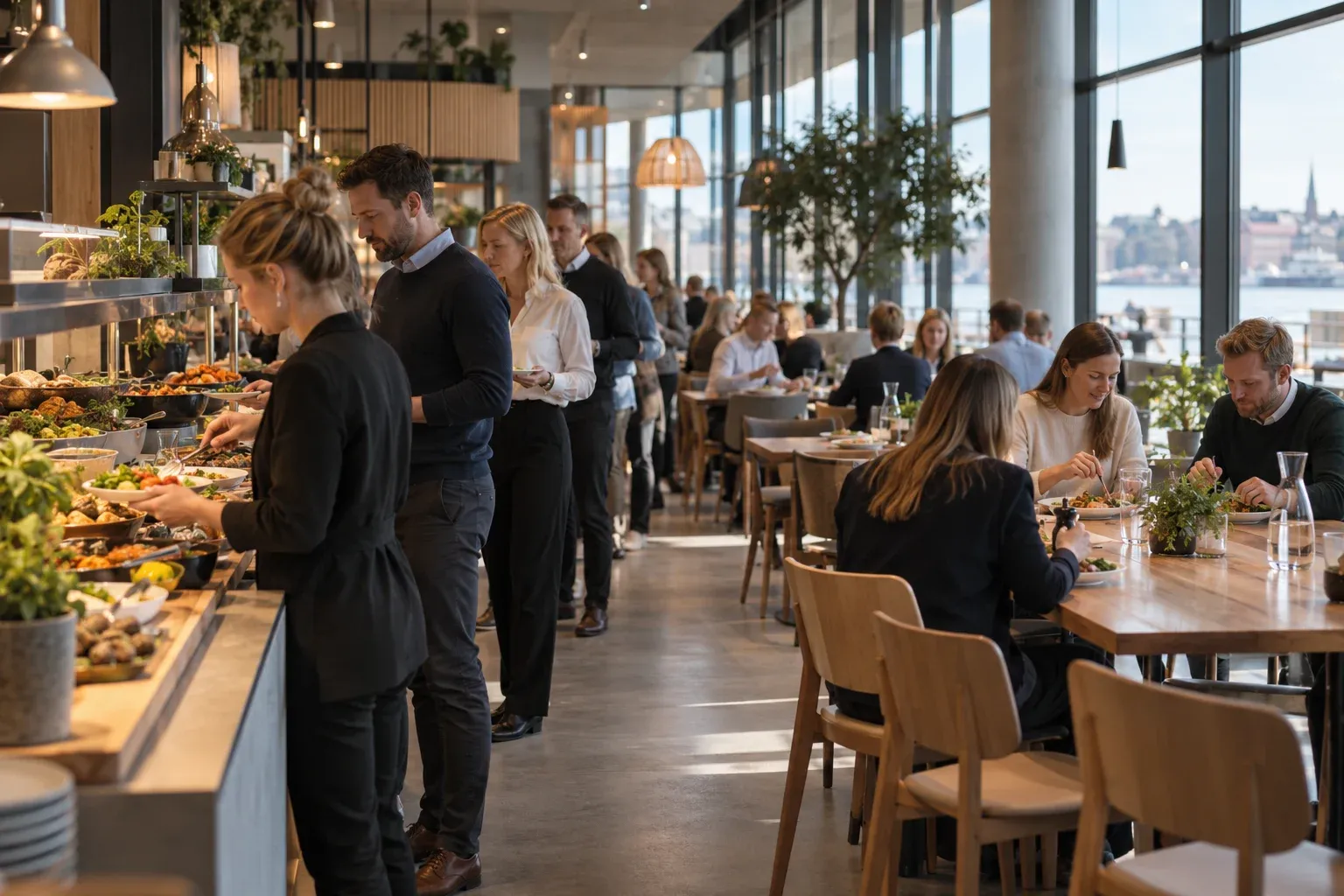
Sweden runs on an earlier clock than most of Europe, and meals are where you notice it first. Here is when Swedes actually eat, why, and how to plan a day of eating around it without missing lunch or finding the kitchen closed.
When you need this
You’re planning a sightseeing day and wondering when to stop for food. You walked into a restaurant at 14:30 and the lunch board had already been wiped. A Swedish colleague invited you to dinner at 17:30, or you’re in a small town at 21:30 looking for a hot meal. Or you’ve just moved here and your child’s school serves lunch before noon.
The Swedish meal clock
The best evidence comes from Statistics Sweden (SCB), whose time-use diaries record what people are doing at each moment of the day. The latest survey that recorded clock times, from 2010/11, found clear weekday peaks. The newer 2021 study measured time spent on activities rather than when they happen, and SCB has no further survey planned.
| Meal | Weekday peak (SCB) | What it means for you |
|---|---|---|
| Breakfast (frukost) | Around 07:00 | The day starts early |
| Lunch | Around 12:00 | Restaurants are busiest at noon |
| Dinner (middag) | Around 18:00 | Home dinner invitations are often 17:30–18:00 |
SCB also found that these peaks had not moved since the early 1990s. Its second finding matters just as much: Sweden has no single fixed meal hour. Eating is spread as an even band from early morning to about 21:00, and people eat when it fits their day. In France, by comparison, almost 60% of women and over 60% of men were eating lunch at one moment between 12:00 and 13:00, with a second peak for the evening meal around 20:00.
In other words, the early clock is a tendency, not a rule. No law sets adult meal times or restaurant kitchen hours. Custom, working hours and school schedules set the clock.
Why lunch comes so early
Lunch is the most synchronized Swedish meal, and SCB gives the reason: employers often set the lunch hour. Visit Stockholm gives the visitor version: lunch is normally eaten between 11:00 and 13:00, though many restaurants serve it until 14:00 or 15:00.
Two other forces pull lunch forward:
- The working day starts early. The Working Hours Act says nobody may work more than five hours in a row without a break, so someone who starts at 07:00 stops by noon.
- Some places start even earlier. One Region Stockholm hospital restaurant, open to anyone, serves lunch from 10:30.
The weekday lunch window is also when restaurant food is cheapest. The fixed-price dagens lunch (“today’s lunch”) is covered in our dagens lunch guide. The rule that matters here is timing: after the window closes, the kitchen switches to the evening menu, and you pay evening prices for much the same food.
On Thursdays, many restaurants put pea soup and pancakes on the lunch board. It’s a tradition listed in Sweden’s national inventory of living heritage, so expect fewer other choices that day.
Dinner: earlier at home, kitchen times out
At home, dinner peaks around 18:00, and many families eat somewhere between 17:00 and 19:00. If you’re invited for 18:00, the meal is planned for then. Our guide to dinner at a Swedish home covers the rest of the evening.
Restaurants serve later, but there’s one trap: the venue’s hours are not the kitchen’s. Nationalmuseum’s restaurant in Stockholm, for example, is open 11:00–17:00, but its kitchen closes at 15:00 on most days. Look for the separate kitchen time, köket stänger (“the kitchen closes”), on the venue’s own page.
The bar is no guide either. Under the Alcohol Act, restaurants may serve alcohol from 11:00 until 01:00 unless the municipality sets other hours, so a pub can be open long after the chef has gone home. Kitchens in the big cities stay open later, but it varies by venue. In smaller towns, order dinner by 20:00–21:00 to be safe. Our opening hours guide has the wider picture.
Fika, mellis and the gaps between meals
An early lunch and an 18:00 dinner leave a long afternoon, and Swedes fill it with fika, a coffee break with something to eat. Sweden’s intangible-heritage inventory describes a workplace tradition of two breaks a day, one in the morning and one in the afternoon, taken together in a shared room. Cafés serve fika all day; our fika guide covers what to order.
Mellis is everyday Swedish for mellanmål, the snack between meals. Above all it means the afternoon snack that bridges an early school lunch and dinner. Adults use the word too, for anything from a banana to a sandwich.
Children and school lunch
Children set much of the household rhythm, and here the rules are firm.
| What | Status | Detail |
|---|---|---|
| Free school lunch | Law | The Education Act says pupils in compulsory school shall be offered nutritious school meals free of charge |
| Which meal | Agency interpretation | The requirement has been read as covering lunch only |
| Lunch time | National guideline | Fixed times between 11:00 and 13:00, at least 25 minutes at the table |
| Afternoon snack | Practice | After-school centers (fritidshem) usually serve one |
| Breakfast at school | Varies | 16% of municipalities served it at all schools 3–5 days a week (2024) |
The 25-minute minimum is new. Livsmedelsverket, the Swedish Food Agency, added it to its 2026 national school-meal guidelines after a review of the research. In practice, the number of seats in the school dining room is often the limiting factor, so some schools fit lunch times to the room rather than the pupils. Upper secondary school (gymnasium) is not covered by the compulsory-school free-meal provision; whether lunch is free there is the school provider’s decision.
For visiting families, matching the Swedish pattern of lunch at 11:00–12:00, a mellis and dinner around 17:00–18:00 keeps children fed when restaurant hours are short.
Weekends, summer and holidays
- Weekends run later and looser. SCB found a clearer rise in eating around 18:00 at weekends, and in cities weekend brunch fills the late morning.
- Weekend lunch exists but is not the weekday deal. Museum restaurants are a good bet; one regional museum bistro serves lunch 11:30–15:00 on Saturdays and Sundays.
- July is the holiday month. Many restaurants close, and business-district lunch places empty out.
- Summer evenings stay light, so 21:00 feels early. Kitchen hours do not stretch to match.
- Christmas, Midsummer and New Year’s Eve have their main meals on the eve, and many restaurants close or serve set menus.
Note that SCB’s meal-time charts cover September to May, so they describe the working year, not the summer holiday.
Mistakes to avoid
- Planning lunch for 14:00 “like at home.” That is the end of service. Eat at 11:30–12:30, or at 13:00 to miss the noon rush.
- Booking a 20:30 dinner in a small town. The kitchen may already be closing. Book 18:00–19:00.
- Reading “open until” as “serving food until.” Check the kitchen time.
- Treating 17:30 as too early for dinner. For a Swedish family it is normal.
- Thinking fika replaces lunch. Fika is a coffee break; the meal is lunch.
Practical information
| Situation | Typical timing | Status |
|---|---|---|
| Breakfast peak | Around 07:00 on weekdays | Statistics (SCB 2010/11) |
| Lunch | Mostly 11:00–13:00; restaurant lunch roughly 11:00–14:00, some to 15:00 | Practice |
| Earliest lunch seen | 10:30 at a hospital restaurant open to all | Practice |
| School lunch | Between 11:00 and 13:00, at least 25 minutes at the table | Guideline (2026) |
| Fika | Mid-morning and mid-afternoon at workplaces | Practice |
| Home dinner | Peak around 18:00; many families 17:00–19:00 | Statistics / practice |
| Restaurant dinner, small towns | Order by 20:00–21:00 | Practice |
| Alcohol service | 11:00–01:00 unless the municipality sets other hours | Law |
| Lunch prices | See our eating out guide for the dated national band | — |
FAQ
What time do Swedes eat dinner?
Early by southern European standards. Statistics Sweden’s time-use diaries found weekday dinner peaking around 18:00, and that this had not moved since the early 1990s. Many families eat between about 17:00 and 19:00, and a dinner invitation for 18:00 means the meal is planned for then. Restaurants serve later, but kitchens outside the big cities often close by 21:00.
What time is lunch in Sweden?
Mostly between 11:00 and 13:00, with the peak around noon. Restaurants run the weekday dagens lunch roughly 11:00–14:00, and many serve until 14:00 or 15:00, but popular dishes run out and the cheap menu ends with the window. Schools aim for 11:00–13:00 too, and some hospital restaurants open for lunch as early as 10:30.
Why do Swedes eat lunch so early?
Mainly because the working day starts early and is organized that way. Statistics Sweden notes that employers often set the lunch hour, and the Working Hours Act requires a break before anyone works more than five hours in a row, so someone starting at 07:00 breaks by noon. Schools schedule lunch from 11:00, and cramped school dining rooms push some sittings even earlier.
How late can you get dinner at a Swedish restaurant?
Later in the big cities than elsewhere, but set by each venue; in smaller towns, order by 20:00–21:00 to be safe. Bars may serve alcohol until 01:00 by default, but that says nothing about the kitchen. Look for the separate kitchen time on the venue’s own page: a museum restaurant open to 17:00 may stop cooking at 15:00.
Do Swedish children get free school lunch?
Yes, in compulsory school. The Education Act says pupils shall be offered nutritious school meals free of charge, which has been interpreted as lunch. Livsmedelsverket’s 2026 guidelines say each pupil should eat at a fixed time between 11:00 and 13:00, with at least 25 minutes at the table. Breakfast and afternoon snacks are up to each school or after-school center.
What is mellis?
Mellis is everyday Swedish for mellanmål, the snack between meals — above all the afternoon snack that bridges an early school lunch and dinner. After-school centers (fritidshem) usually serve one in the afternoon, and the national guidelines advise against sweets or buns for it. Adults use the word too, for anything from a banana to a sandwich in the mid-afternoon.
When is fika?
At no fixed hour. Sweden’s heritage inventory describes a workplace tradition of two coffee breaks a day, one in the morning and one in the afternoon, taken together in a shared room. Cafés serve fika all day, and at home coffee is offered whenever guests arrive. For a visitor, an afternoon fika is the natural bridge between an early lunch and an 18:00 dinner.
Related guides
- Dagens lunch: what the weekday lunch deal includes and how to order it
- Eating out in Sweden: prices, tipping and the lunch-versus-dinner gap
- Swedish fika: the coffee break that bridges lunch and dinner
- Dinner at a Swedish home: what happens after the 18:00 invitation
- Opening hours in Sweden: what is open when, from shops to Systembolaget
Facts verified 2026-10-06. Sources: Statistics Sweden (SCB), Livsmedelsverket (the Swedish Food Agency), Sveriges riksdag (Education Act, Working Hours Act, Alcohol Act), Levande kulturarv, Visit Stockholm and venues’ own pages — full register in this topic’s source file. Found something outdated? Tell us and we’ll fix it.