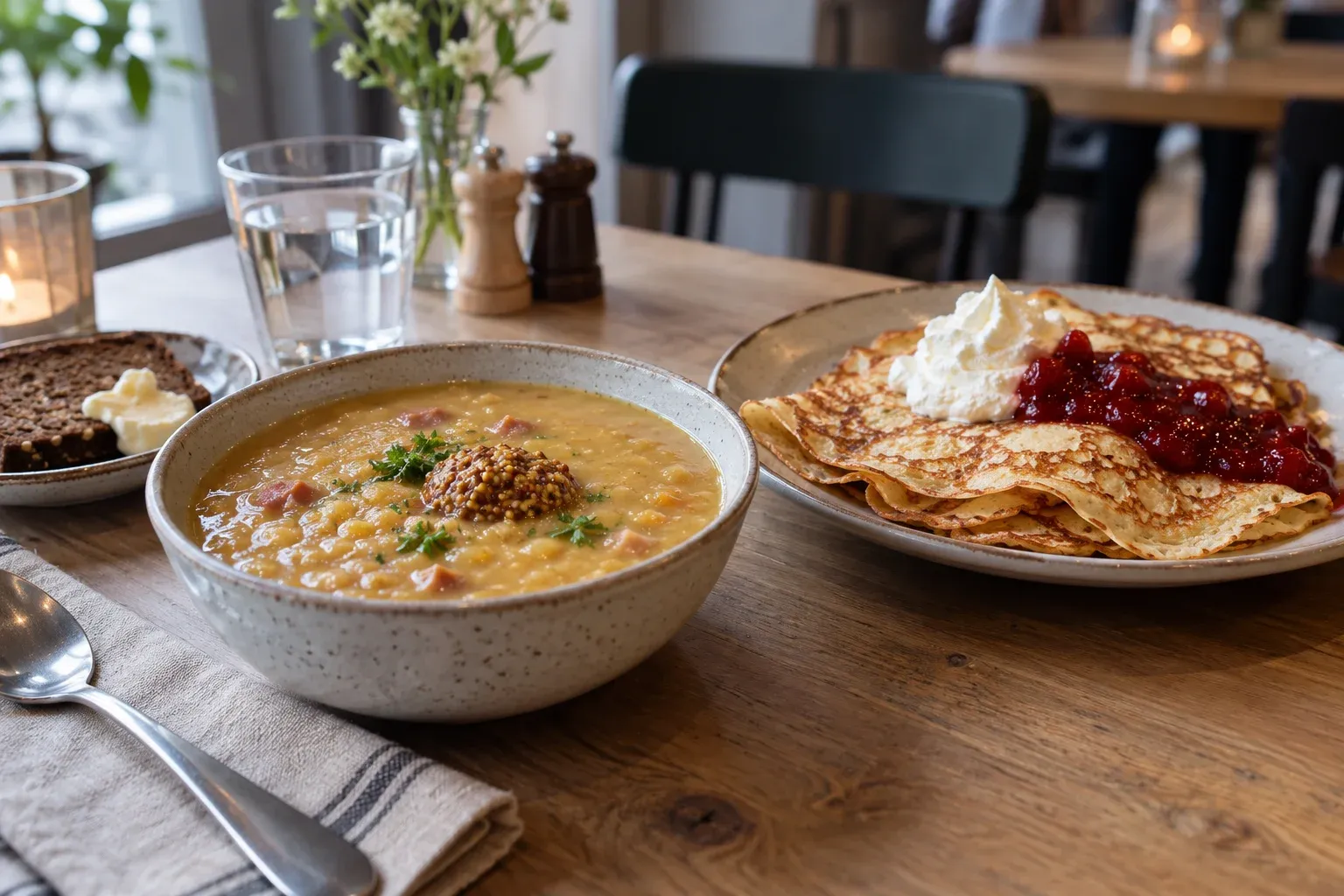
Walk into a Swedish lunch restaurant on a Thursday and the board will likely say ärtsoppa och pannkakor. Here is what you are ordering, why it lands on Thursdays, and what to check if you avoid pork or have allergies.
When you need this
You’re reading a lunch board on a Thursday and two Swedish words keep coming up. You’re vegetarian, avoid pork, or have a mustard, egg, milk or wheat allergy, and pea soup is the dish of the day. Or a Swedish host, society or regiment has invited you to a Thursday meal and someone is warming up a bottle of punsch.
What’s on the plate
Thursday pea soup is two courses, not one dish. Sweden’s national inventory of intangible cultural heritage, Levande kulturarv, lists it as a living tradition practised across the whole country.
| Course | What it is | Typically served with |
|---|---|---|
| Ärtsoppa (pea soup) | Dried yellow peas cooked with rimmat fläsk (lightly salted pork), onion, marjoram or thyme, sometimes ginger | Mustard (senap); many add crispbread with a strong cheese |
| Pannkakor (pancakes) | Thin, crêpe-style tunnpannkakor of egg, milk and wheat flour | Jam (sylt) and whipped cream (vispgrädde) |
| Varm punsch (optional) | Hot arrack-based liqueur | Mainly at societies, student nations and some restaurants |
The pork may be cooked in the soup or served on the side. In recent decades the pancakes have mostly been the dessert course, and whipped cream is the newest addition of all.
Why Thursday?
Honest answer: nobody knows for certain. Peas with pork have been a Swedish staple since the Middle Ages, and the heritage inventory says the Thursday link is just as old. Its oldest written example is from 1625, when residents of the hospital in Västerås got cabbage or peas with pork every Thursday.
The explanation you’ll read everywhere is Catholic fasting: Friday was a fast day, so you ate heartily on Thursday. The inventory’s English page calls this “probably” the origin. Its Swedish page, revised in August 2026, describes the medieval Thursday link without giving that reason at all. So treat the fasting story as a likely explanation, not a documented fact.
The extras came much later:
- Pancakes joined in the late 1700s, when white-flour-and-egg pancakes were still a luxury food for the well-off.
- Hot punsch arrived with arrack, which the Swedish East India Company brought to Sweden in the mid-1700s. Bourgeois gentlemen began drinking it with pea soup in the 1800s, and officers’ messes and student societies kept the habit alive.
Where you’ll meet it
Lunch restaurants. This is where most visitors meet it. Many restaurants serve pea soup and pancakes on Thursdays as part of the weekday lunch deal, often in place of one of the usual dishes, and it is usually one of the cheapest things on the board. It’s not universal, though: city places with international menus often skip it. Check the posted weekly menu. Our dagens lunch guide explains how the lunch deal works.
The military. Pea soup is the backbone of Swedish military food history: dried peas travel well, keep for a long time and cook in bulk in field kitchens. The heritage inventory says Thursday pea soup is still common in the armed forces. In 2011, soldiers’ complaints about Thursday soup disappearing from the menu helped end a catering contract.
Schools. Less so than before. The inventory describes Thursday pea soup as common school food “not long ago”. Today each municipality or school sets its own menu.
Supermarkets. Every grocery store sells dried Swedish yellow peas, and ready-made pea soup comes in cans and vacuum-packed tubes. Canned pea soup keeps a long time, and the heritage entry itself recommends it as pantry stock.
Pork, mustard and allergens
The soup looks like a legume dish, so visitors often assume it’s vegetarian. By default it isn’t.
| If you… | What to know | What to do |
|---|---|---|
| Are vegetarian or vegan, or avoid pork | Traditional ärtsoppa is cooked with pork or in pork stock | Look for vegetarisk ärtsoppa, ask, or order the vegetarian dish on the board |
| Have a mustard allergy | Mustard is the standard condiment and one of the 14 allergens regulated by EU law | Skip the jar and ask whether any has gone into the soup |
| Have an egg, milk or wheat allergy | The pancakes contain all three | Skip the pancakes unless the restaurant says otherwise |
| Are unsure | Restaurants must provide allergen information for food they serve unpackaged | Ask staff for the written allergen information |
Leaving out the pork is easy, and historically it was common when pork was scarce or too expensive. In a restaurant, the easier route is the separate vegetarian dish on the board; see our guide to vegan and vegetarian Sweden, and our food allergies guide for how to ask.
Punsch: the optional extra
Punsch is a Swedish liqueur based on arrack. Svensk Punsch is a protected EU geographical indication, so the name is reserved for products that meet its specification. Around 1900, Swedes drank more than five million liters of it a year.
Drinking it hot with Thursday pea soup is now the exception rather than the rule. You’ll meet it mainly at society dinners, student nations and some restaurants. Two legal points follow:
- A restaurant may serve punsch only if it holds an alcohol serving permit (serveringstillstånd).
- To buy a bottle, go to Systembolaget, the state monopoly: drinks above 3.5% alcohol aren’t sold in supermarkets. See our Systembolaget guide.
It is a spirit drink like any other, so don’t drive after it.
How to eat it like a Swede
- Stir mustard into the soup. That’s how most Swedes eat it; some add a pinch more marjoram.
- Add crispbread and strong cheese on the side if they’re on offer.
- Spread jam on the pancake, add whipped cream, then roll or fold it.
- Don’t call it a festival. It’s weekly, everyday food with no special day attached.
Practical information
| What | Detail |
|---|---|
| When | Thursdays, year-round; lunch is mostly 11:00–13:00 (see Swedish meal times) |
| Where | Weekday lunch restaurants, canteens, military messes, homes; nationwide |
| Price | Part of the day’s lunch price; varies by town and venue (see dagens lunch) |
| Vegetarian? | Not by default; look for vegetarisk ärtsoppa |
| Allergens to ask about | Mustard (condiment), egg, milk, wheat (pancakes) |
| Allergen information | Free, and required by law for unpackaged food |
| Punsch | Restaurants with a serving permit; bottles only at Systembolaget |
| Summer | Many lunch restaurants close for part of July, so fewer places serve it |
| Cook it yourself | Dried yellow peas in every supermarket; soak overnight, follow the pack |
FAQ
Why do Swedes eat pea soup on Thursdays?
Nobody knows for certain. Peas with pork have been a Thursday meal since the Middle Ages, and a 1625 hospital ordinance in Västerås gave residents cabbage or peas with pork every Thursday. The usual explanation is Catholic fasting on Fridays: you ate heartily the day before. Sweden’s heritage inventory calls that probable, and its newest Swedish text no longer states it.
Is Swedish pea soup vegetarian?
Not by default. Traditional ärtsoppa is cooked with lightly salted pork or in pork stock, so it is neither vegetarian nor vegan unless the menu says vegetarisk. Leaving out the pork is easy and was common in poorer times. In a restaurant, ask, or order the separate vegetarian dish on the board.
What do you eat with Swedish pea soup?
Mustard, stirred in, is the standard condiment, and many Swedes add crispbread with a strong cheese. After the soup come thin pancakes with jam and whipped cream, usually as the dessert course. The pork may be served in the soup or on the side. Hot punsch, an arrack-based liqueur, appears mainly at societies and special dinners.
What is punsch, and do you drink it with pea soup?
Punsch is a Swedish liqueur based on arrack, a spirit introduced by the Swedish East India Company in the 1700s. Svensk Punsch is a protected EU name. Drinking it hot with Thursday pea soup is a 19th-century custom kept alive in officers’ messes, student nations and some restaurants. Bottles are sold only at Systembolaget.
Where can I eat pea soup and pancakes in Sweden?
At weekday lunch restaurants on Thursdays, where it is usually one of the cheapest dishes on the board. Not every restaurant serves it, and city places with international menus often skip it, so look at the posted weekly menu. Workplace canteens, cafeterias and military messes keep the custom too. Out of season, canned soup is in every supermarket.
Do Swedish schools and the army still serve pea soup on Thursdays?
The army does: the heritage inventory says Thursday pea soup is still common in the military, and in 2011 soldiers’ complaints about missing Thursday soup helped end a catering contract. Schools are different. The inventory says it was common school food “not long ago”; today each municipality or school sets its own menu.
Related guides
- Dagens lunch: how the weekday lunch deal that serves the soup works
- Swedish food guide: the rest of everyday husmanskost and the food calendar
- Vegan and vegetarian Sweden: eating plant-based when the classic contains pork
- Food allergies in Sweden: how to ask about mustard, egg, milk and wheat
- Swedish drinking culture: where punsch and toasts fit in
Facts verified 2026-10-06. Sources: Levande kulturarv (Isof, Nordiska museet, Riksantikvarieämbetet), Livsmedelsverket, Sveriges riksdag (Alcohol Act), the EU food-information regulation, SLU and The Local — full register in this topic’s source file. Found something outdated? Tell us and we’ll fix it.