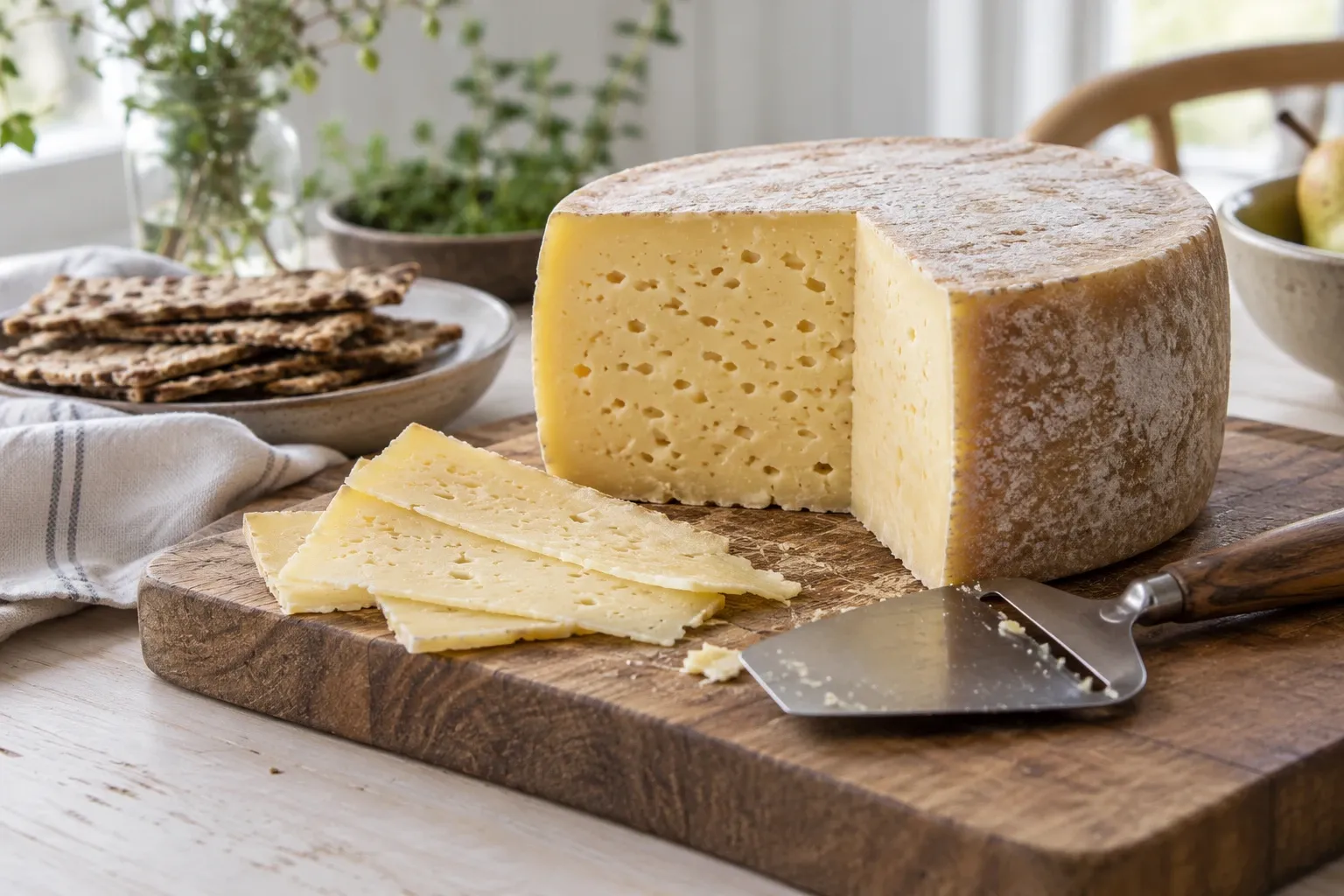
Swedish cheese is one style done many ways: firm, aged and full of tiny holes. Here’s what to taste, which names are legally protected and which are only brands, why the Burträsk detour no longer works, and what you can safely eat and pack.
When you need this
You’re facing a hotel breakfast buffet with four yellow cheeses and a flat metal slicer. Someone has asked you to “bring the Västerbotten” to an August crayfish party. You’re driving through Västerbotten and wondering whether the cheese village is worth a detour. Or you want a food souvenir and need to know whether it will survive the trip home, and whether it’s safe if you’re pregnant or lactose-intolerant.
The Swedish style: aged and small-holed
Sweden’s cheese identity is a texture, grynpipig: aged rennet cheese with many small, irregular holes. The Board of Agriculture calls aged grynpipig hard cheese unique to Sweden. The tradition goes back to the 1200s, and the texture appears in a recipe from 1743.
You’ll mostly meet it at breakfast, cut thin with an osthyvel (cheese slicer) and laid on bread or crispbread. The slicer, incidentally, isn’t Swedish. A Norwegian, Thor Bjørklund, patented it in 1925. Keep the top of the cheese flat rather than carving a slope; see our guide to the Swedish breakfast table.
Labels tell you two useful things:
| On the label | Meaning |
|---|---|
| lagrad / extra lagrad | aged / extra-aged; flavour builds slowly with time |
| a percentage | fat content (Svecia, for example, is made at 17–33 %) |
| Från Sverige | a voluntary, private origin mark, not a state guarantee |
For Svecia, the classic everyday version, Sweden’s farm-dairy association recommends at least six months of ageing.
Västerbottensost: the cheese from Burträsk
Västerbottensost is the strong end of the family and the most famous Swedish cheese. Everything below about how it’s made comes from its producer, so read it as the producer’s account.
- Origin: a recipe created in 1872 by a dairymaid, Ulrika Eleonora Lindström, and still kept secret.
- Place: made in one dairy only, in Burträsk, a village in Skellefteå municipality in Västerbotten. It was once sold as Burträskost.
- Ageing: at least 14 months. Each batch is graded from a drilled core on a nine-point scale before release.
- Size: 18-kilo wheels, from pasteurised milk, about 10 litres of milk per kilo of cheese.
- Mark: a crowned “W” branded on the rind since the early 1900s.
The producer describes the taste as a blend of sweet, salty, bitter and umami. Most Swedes meet it in August, on the table at the crayfish party and baked into a savoury pie. In 2022 the producer began calling it Nationalosten, the national cheese. That’s a marketing title the company gave itself, not an official status.
Can you visit Burträsk?
Not the way older guides suggest. The Västerbottensost visitor centre has been closed to the public since 31 March 2025. The producer ended the café operator’s lease and said the visitor operation would stay shut for at least a year while it reviewed it. The exhibition still exists, but only for the company’s own guests.
We found no announcement of a public reopening as of October 2026, yet many food features and listings still show summer opening hours. Check the producer’s official channels before you plan a day around it. If you’re in the area anyway, our Skellefteå guide covers the nearest city.
Protected names and trademarks
“Protected” is used loosely in English coverage of Swedish cheese, so here’s the legal picture. The EU runs two schemes that matter here. A PDO (skyddad ursprungsbeteckning, SUB) requires every stage of production to happen in the area. A PGI (skyddad geografisk beteckning, SGB) requires at least one stage there.
On the Board of Agriculture’s June 2026 list, four Swedish cheeses carry EU protection:
| Name | Scheme | What it is |
|---|---|---|
| Svecia | PGI, 1997 (Sweden’s first protected food) | Classic small-holed hard cheese from Swedish milk, made almost anywhere except the far north and west |
| Wrångebäcksost | PDO, 2022 | Organic hard cheese aged at least nine months, from Guldkroken, a narrow strip around Hjo between Lake Vättern and Hökensås |
| Sörmlands Ädel | PGI, 2023 | Organic blue cheese from Södermanland, matured 4–12 months |
| Kaffeost | PDO, 2025 | Fresh, squeaky “coffee cheese” from cow, goat or reindeer milk, made in the six northernmost provinces |
Västerbottensost isn’t on that list. It’s a registered trademark of the dairy that makes it, so “made only in Burträsk” is the owner’s own choice, not EU law. The same goes for the everyday names Präst, Herrgård and Grevé. They’re trademarks, sold in 2018 to a company formed by three Swedish dairies, which is why similar cheeses from other dairies carry other names.
Two others are in the queue or in doubt. Hälsingeostkaka, a baked curd cake from Hälsingland, is pending as a PGI. A white cellar-aged goat cheese from Jämtland has had an application filed, according to the Board of Agriculture, but it isn’t on the 2026 list, so treat it as unprotected for now.
Where to taste it
- Breakfast, anywhere: the hard-cheese family is a year-round staple. Try a young and an extra-aged one side by side.
- The crayfish party, August–September: Västerbottensost on the table and in the pie. See how a crayfish party works.
- The north: kaffeost, cubes dropped into the cup with hot coffee poured over. Our coffee guide explains the ritual.
- Around Hjo and in Södermanland: look for Wrångebäcksost and Sörmlands Ädel at cheese counters.
- A summer-pasture farm: Sweden’s fäbodar made butter, cheese and messmör on their summer grazing. Fäbod culture joined UNESCO’s list of intangible cultural heritage on 3 December 2024, and about 300 fäbodar are still active. Each summer the counties hold a Fäbodveckan (fäbod week) with open farms, in 2026 from 29 June to 5 July in Västernorrland and the other fäbod counties. Programmes vary by farm; see farm stays in Sweden.
Pregnancy and lactose
Livsmedelsverket, the Swedish Food Agency, makes this simple:
| Cheese | Pregnant | Lactose-intolerant |
|---|---|---|
| Hard cheese you can slice, incl. Västerbottensost, Svecia, Präst | Safe, even from unpasteurised milk (too dry for listeria) | Naturally lactose-free |
| Blue and smear-ripened cheese, incl. Sörmlands Ädel | Avoid, pasteurised or not | Check the pack |
| Fresh cheese from unpasteurised milk | Avoid | Check the pack |
| Mesost / messmör (brown whey cheese and spread) | See our pregnancy guide | High in lactose: avoid |
Fresh farm cheese, including kaffeost, may be made from unpasteurised milk, so ask before eating it if you’re pregnant. For more, see our guides to lactose-free eating and pregnancy travel in Sweden.
Taking cheese home
- Within the EU and EEA: cheese for your own use travels freely.
- Great Britain: don’t pack it. Personal imports of dairy from the EU have been banned since 12 April 2025, packaged or not, and the controls were still in force in October 2026. Cheese is seized at the border.
- United States: U.S. Customs admits “certain cheeses”. Declare all food on arrival.
- Hand luggage: a wedge of hard cheese isn’t a liquid. Soft cheese in tubes or tubs counts as a spread, so over 100 ml it goes in checked baggage.
Farm-shop cheese follows the same rules.
Practical information
| Item | Detail (checked 2026-10-15) |
|---|---|
| Västerbottensost visitor centre, Burträsk | Closed to the public since 31 March 2025; no reopening announced |
| Hard cheese in shops | Sold by weight; compare the per-kilo price (jämförpris) on the shelf label |
| Protected Swedish cheeses | Svecia, Wrångebäcksost, Sörmlands Ädel, Kaffeost |
| Fäbodveckan 2026 | 29 June – 5 July (Västernorrland and other fäbod counties); programmes per farm |
| Crayfish-party season | From early August into September |
| Cheese to Great Britain | Banned since 12 April 2025; seized at the border |
| Tube or tub cheese in hand luggage | Max 100 ml per container |
FAQ
What is Västerbottensost?
Västerbottensost is an aged, small-holed hard cheese from northern Sweden. Its producer says it has been made in the village of Burträsk since 1872, to a secret recipe, in 18-kilo wheels matured for at least 14 months. It tastes strong, salty and slightly bitter, and is the classic cheese of the August crayfish party, often baked into a pie.
Can you visit the Västerbottensost dairy in Burträsk?
Not as a member of the public in 2026. The producer closed its visitor centre to the public on 31 March 2025 for at least a year, while it reviewed the visitor operation; the exhibition stays for the company’s own guests. We found no reopening announcement as of October 2026. Check the producer’s official channels before making the trip.
Is Västerbottensost a protected EU name?
No. Västerbottensost is a registered trademark of the dairy that makes it, and it is not on the Swedish list of EU-protected or pending food names. The protected Swedish cheeses are Svecia and Sörmlands Ädel, both protected geographical indications, and Wrångebäcksost and Kaffeost, both protected designations of origin.
Which Swedish cheese should I try first?
Start with an aged, small-holed hard cheese, the style the Board of Agriculture calls unique to Sweden: Svecia, Präst or Herrgård at breakfast, then Västerbottensost for the strong end. Up north, try kaffeost in coffee. For something rarer, look for Wrångebäcksost or the blue Sörmlands Ädel at a cheese counter.
Is Swedish cheese safe in pregnancy?
Hard cheese is, even when made from unpasteurised milk, because it is too dry for listeria to grow; that covers Västerbottensost and the everyday slicing cheeses. Avoid blue and smear-ripened cheeses, pasteurised or not, and fresh cheeses made from unpasteurised milk. Ask about the milk before eating farm-made fresh cheese such as kaffeost.
Is Swedish hard cheese lactose-free?
Yes. Hard cheese is naturally lactose-free, and Livsmedelsverket accepts a laktosfri label on it without testing. The exception on the same shelf is the brown whey cheese and whey spread, mesost and messmör, which are boiled down from whey and contain a lot of lactose. Read the pack if you are sensitive.
Can I take Swedish cheese home?
Within the EU and EEA, yes: cheese for your own use travels freely. To Great Britain, no: personal imports of EU dairy have been banned since April 2025 and still were in October 2026. The United States admits certain cheeses if you declare them. Tube cheese over 100 ml cannot go in hand luggage.
Related guides
- Swedish groceries worth trying — the rest of the shelf: messmör, kaviar, crispbread.
- The Swedish crayfish party — where Västerbottensost is eaten most.
- Coffee in Sweden — kaffeost and the coffee habit it belongs to.
- The Swedish breakfast — the table where you’ll meet the cheese slicer.
- Farm shops in Sweden — buying farm cheese, and the Great Britain packing rule.
Facts verified 2026-10-15. Sources: Jordbruksverket (Smaka Sverige), Livsmedelsverket, Länsstyrelsen Dalarna and Västernorrland, GOV.UK/DEFRA, U.S. Customs and Border Protection, Transportstyrelsen and the producer’s own statements — full register in this topic’s source file. Found something outdated? Tell us and we’ll fix it.