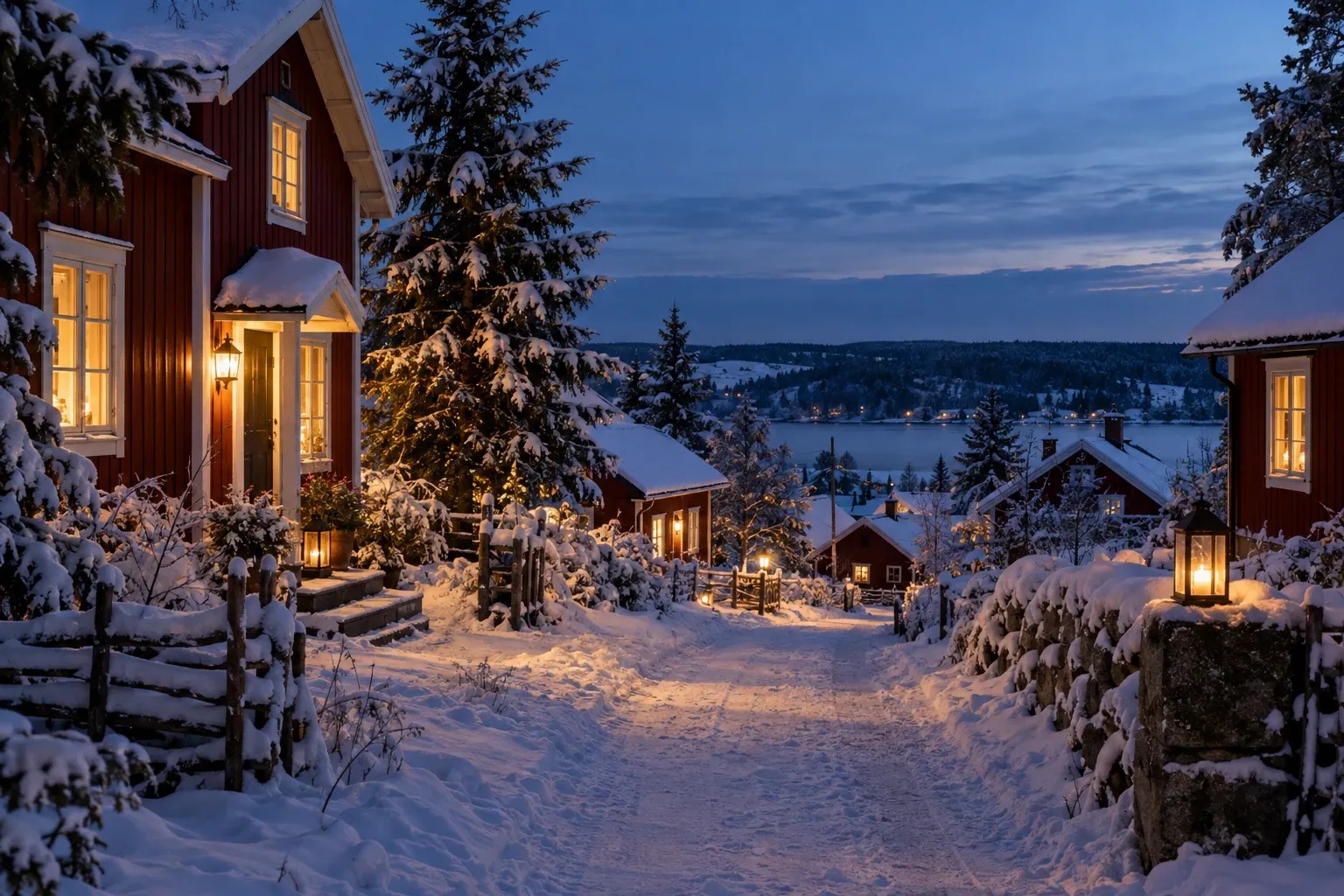
A Swedish winter is not one thing. Malmö in January and Kiruna in January are about 17 degrees apart, and one has seven-hour days while the other has none. Here is what each is really like, what stays open, and which dates change your plans.
When you need this
You’re choosing between a winter city break and a Lapland trip. You’ve booked December travel and wonder what will be open over Christmas. You want the northern lights, a ski week or simply your first real snow. Or you’re renting a car between December and March. This page gives you the overview and sends you to the detailed guide for each part.
Two winters, 17 degrees apart
SMHI, Sweden’s national weather agency, gives these normal January means for 1991–2020:
| Where | Normal January mean | What it feels like |
|---|---|---|
| Falsterbo, southern tip of Skåne | +1.8 °C | Grey, damp cold around zero; rain and slush as often as snow |
| Randijaur, central Lapland | −15.1 °C | Deep, dry cold and lasting snow |
| Record low 1991–2020 | −49.0 °C, Karesuando, January 1999 | The far end of what the north can do |
The south (Skåne and the southern coasts) often gets a wet winter rather than a white one. Expect slush, rain and ice that thaws and refreezes.
Stockholm, central Sweden and the Bothnian coast are colder and snowier than the far south. Locals wear ice grips and a warm hat every day.
Inner Norrland and Lapland are the winter people picture: January normals down to about −15 °C, snow that stays, long distances between services and reindeer on the roads.
Wind makes any of it worse. SMHI’s own example: −10 °C in a light 2 m/s breeze feels like −14 °C on bare skin. What to wear for each region is in what to pack for a Swedish winter, and month-by-month detail is in Sweden’s weather by month.
How dark it gets
In southernmost Sweden the day varies between about 7 and 17 hours over the year. At midwinter that means roughly seven hours of daylight, and SMHI points out that dawn and dusk are usually fairly light too.
North of about 66.5° N the sun does not rise at all around the solstice. In Kiruna this polar night (polarnatt) lasts about 27 days. It is not pitch black, though: twilight still gives a few hours of grey-blue light around midday. More in our guide to the polar night.
The practical effect: plan outdoor time around the middle of the day, and keep museums, cafés and indoor culture for the dark afternoons. Fika helps here. Coffee and something sweet with other people is Sweden’s everyday indoor ritual, and from around the turn of the year bakeries sell semlor, cream buns, until Shrove Tuesday (9 February in 2027). See fika.
What’s open and what isn’t
Sweden does not shut for winter. Roads are ploughed in a fixed priority order, night trains run to Lapland all winter, and shops, museums, trains and homes are heated towards 20–23 °C. You will spend a lot of time taking layers off.
What changes is the calendar:
| What | In winter |
|---|---|
| STF mountain huts (fjällstugor) | Winter season only from late February to about the turn of April and May; outside it, just a spartan emergency room |
| STF mountain stations | Late February to late April or early May |
| Stockholm archipelago boats | In ice, an ice timetable (istidtabell): fewer, slower departures, some of them bookable only in advance |
| Lapland night train | Runs all winter; winter berths are the most sought after of the year |
Don’t book a mountain ski tour in January expecting the huts to be open. Details in STF mountain huts.
Christmas and New Year: the days that close Sweden
Most visitors plan around 25 December. In Sweden the day that matters is Christmas Eve, 24 December (julafton). It is when families celebrate, and it closes more of the country than Christmas Day, even though the law does not make it a public holiday.
| Date (2026–27) | Status | What to expect |
|---|---|---|
| Late November–Christmas | — | Restaurant julbord (Christmas buffet) season; book ahead |
| Sun 13 December | Not a holiday | Lucia processions in schools, churches and workplaces |
| Thu 24 December, Christmas Eve | Not a public holiday | Shops run half days; Systembolaget closed |
| Fri 25 and Sat 26 December | Public holidays | Systembolaget closed |
| Thu 31 December, New Year’s Eve | Not a public holiday | Short hours; Systembolaget closes at 15:00 |
| Fri 1 and Wed 6 January | Public holidays | Systembolaget closed |
Systembolaget, the state alcohol retailer, is shut over Christmas, so buy before 24 December; it extends its hours on the days before each holiday. Some restaurants and hotels do open on Christmas Eve, but they are the exception and book early. Full rules in Swedish public holidays, the food in julbord, and the procession in Lucia.
Winter activities
The northern lights. Go north and look up when it is dark and clear. In the Kiruna area the aurora season runs from about September to March. Clouds sit lower than the aurora and block it, and the most active displays often come between 21:00 and 23:00. The Swedish Institute of Space Physics (IRF) offers a free app, IRF Aurora Alert, that notifies you in real time when there is aurora over Kiruna. More in northern lights in Sweden.
Skiing and the mountains. The mountain winter season starts in late February, when STF’s huts and stations open, and runs into April. Winter routes are marked with red crosses on poles. January in the mountains is dark and cold; February to April brings long, bright days, so pack sunglasses against snow glare. See skiing in Sweden and cross-country skiing.
Dog sledding and other northern excursions are covered in their own guides: dog sledding and snowmobile tours.
Getting around in winter
Driving. Winter tyres are compulsory from 1 December to 31 March when there are winter road conditions, and that includes foreign cars. The duty does not apply on a bare, dry road. Busy roads are ploughed first. Snow can still stop traffic, and not only in the north: in January 2024 the E22 in Skåne was blocked for almost two days. In the mountains, the E10 between Björkliden and Riksgränsen has run for days as a convoy behind a plough. Carry a scraper, blankets and a charged phone. Full guide: winter driving in Sweden and winter tyre rules.
The night train. State-procured night trains run from Stockholm to Narvik via Kiruna and Abisko all winter. From 13 December 2026 the cars are expected to run through to Narvik again without a change. Book early. See the night train to Lapland.
Warnings. SMHI issues weather warnings at three levels: yellow (some risk), orange (danger to the public) and red (great danger). They are regional, so the same snowfall can trigger a warning in a southern city and nothing in the north. SMHI’s strong wind-chill warning comes at a mean wind of at least 10 m/s and an effective temperature of −28 °C or lower, when the risk of frostbite is great. How warnings reach you: emergency alerts in Sweden.
Mistakes to avoid
Warning: Falls, not traffic, are the main winter injury for people on foot. Trafikverket says nine in ten seriously injured pedestrians have fallen, and slipping is the most common cause. Wear boots with grip and add ice grips (broddar).
- Walking dark roads in dark clothes. A driver on dipped beam sees you at 20–30 m; with a reflector, at about 125 m. Reflectors are advised for pedestrians, not required, but wear one anyway.
- Planning around 25 December instead of Christmas Eve.
- Packing a Lapland kit for Stockholm, or the other way round.
- Assuming the archipelago runs a summer timetable.
- Booking the Lapland night train late in aurora and ski season.
- Reading a yellow SMHI warning as severe, or an orange one as routine.
- Underestimating cold. Hypothermia kills about 30–45 people a year in Sweden. What to do: cold risks.
Practical information
| Item | Detail |
|---|---|
| January normal, far south | +1.8 °C (Falsterbo, SMHI 1991–2020) |
| January normal, central Lapland | −15.1 °C (Randijaur) |
| Midwinter daylight, far south | About 7 hours |
| Polar night, Kiruna | About 27 days around the solstice |
| Winter-tyre period | 1 December–31 March, in winter conditions |
| Mountain huts, winter season | Late February–turn of April/May |
| Systembolaget closed | 24–26 December (2026: to the 27th), 1 and 6 January; 15:00 close on 31 December |
| SMHI forecasts and warnings | Free |
| IRF Aurora Alert app | Free (iPhone and Android) |
| Ice grips and reflectors | Low-cost everyday items, sold in ordinary shops |
FAQ
Is Sweden worth visiting in winter?
Yes, if you pick the right winter. The south offers city breaks, julbord season and Lucia in grey weather around zero. The north offers snow, skiing, northern lights and polar night, in January normals down to about −15 °C. Late February to April brings long, bright days in the mountains. Decide which you want before you book.
How cold is Sweden in winter?
It depends on the region. SMHI’s normal January mean for 1991–2020 is +1.8 °C at Falsterbo on the southern tip and −15.1 °C at Randijaur in central Lapland. Wind makes it feel colder (−10 °C in a light breeze feels like −14 °C), and SMHI issues a strong wind-chill warning when the effective temperature reaches −28 °C with a mean wind of at least 10 m/s.
How many hours of daylight does Sweden have in winter?
Few. In southernmost Sweden the day is about seven hours long at midwinter, and SMHI notes that dawn and dusk are usually fairly light. North of the Arctic Circle the sun does not rise at all around the solstice: about 27 days in Kiruna, although twilight gives a few hours of grey light each day.
Is Sweden closed at Christmas?
Largely, on 24 December. Christmas Eve is the main Swedish celebration, although it is not a public holiday in law: shops run half days and Systembolaget is closed from 24 to 26 December (in 2026 also on Sunday the 27th; buy by Wednesday 23 December). Christmas Day and Boxing Day are public holidays. Buy what you need by 23 December and book any Christmas Eve restaurant early.
When can you see the northern lights in Sweden?
In the far north, from about September to March, whenever it is dark and the sky is clear, because clouds block the view. In the Kiruna area the most active displays often come between 21:00 and 23:00. The Swedish Institute of Space Physics offers a free app that alerts you in real time to aurora over Kiruna.
Can you drive in Sweden in winter?
Yes. Roads stay open and are ploughed in priority order, busy roads first. Winter tyres are compulsory from 1 December to 31 March in winter conditions, including on foreign cars. Carry a scraper, blankets and a charged phone, and check SMHI’s warnings: heavy snow can block even southern motorways and mountain roads can run in convoys.
Are the Swedish mountains open for skiing in winter?
Yes, with a late start for touring. STF’s mountain huts and stations open for the winter season in late February and close around the turn of April and May, and winter routes are marked with red crosses on poles. January is dark and cold in the mountains; February to April is the main ski-touring season.
Related guides
- What to pack for a Swedish winter — the layers, ice grips and reflector this page keeps mentioning
- Sweden’s weather by month — if you’re still choosing when to go
- Swedish public holidays — every closure day, not just Christmas
- The night train to Lapland — the classic way north in winter
- Cold risks: hypothermia and frostbite — what to do when cold becomes an injury
Facts verified 2026-09-24. Sources: SMHI, Trafikverket, Transportstyrelsen, Krisinformation.se, Sveriges Riksdag, Systembolaget, Svenska Turistföreningen, Institutet för rymdfysik, Nordiska museet — full register in this topic’s source file. Found something outdated? Tell us and we’ll fix it.