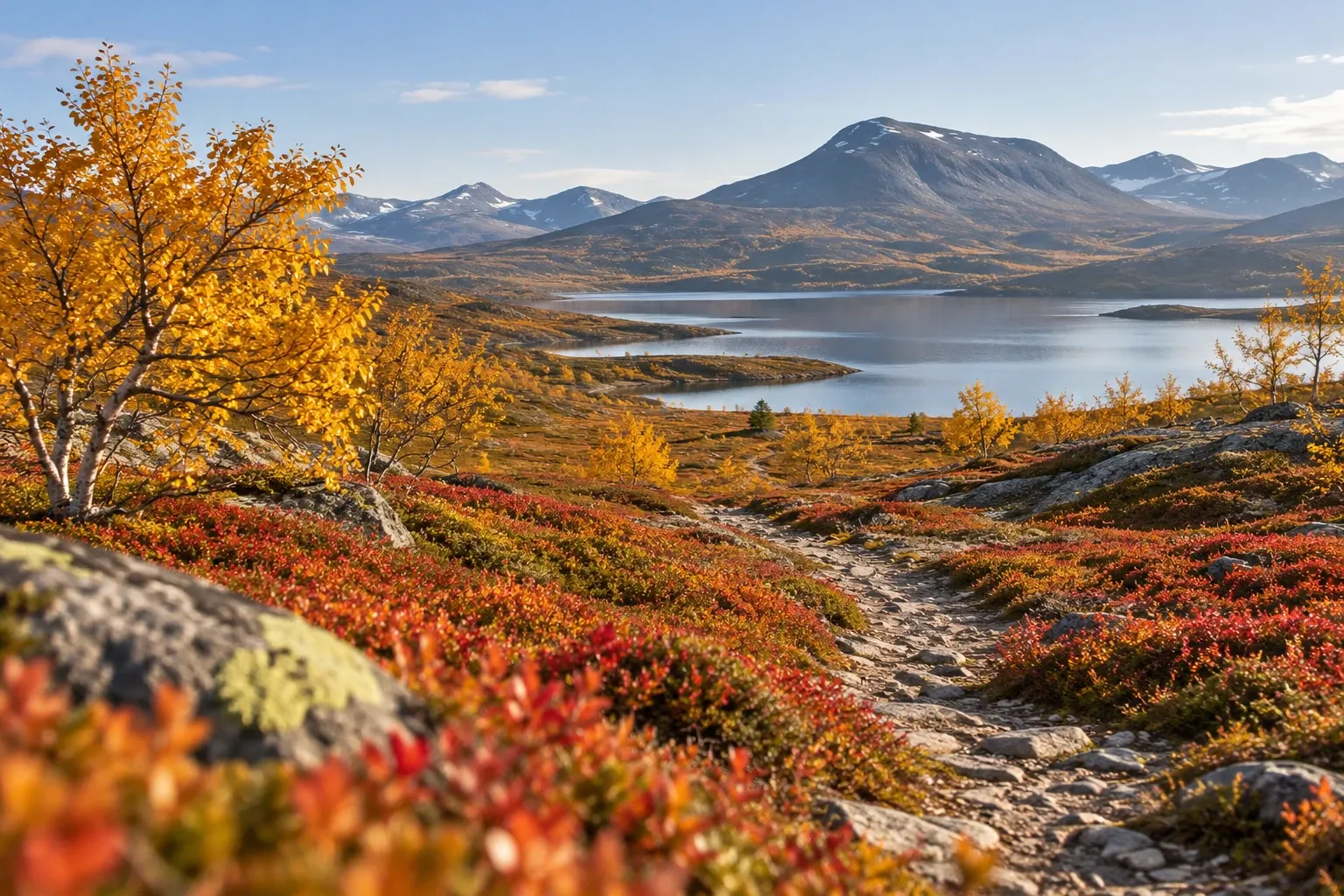
September splits Sweden in two. Lapland is already in autumn, with colored fells, first frost and the return of the northern lights, while Stockholm and Skåne are still in late summer. Here’s what that means for packing, hiking and timing.
When you need this
You’re weighing August against September or October and want to know what actually changes. Maybe you’re planning a fell hike or a fall-colors trip to Lapland or Jämtland, or you want aurora without midwinter cold. Or you’ll be walking in a northern forest after 1 September and have heard the hunters are out. This page covers the month itself. For September to November together, see Sweden in autumn.
North and south: two climates in one month
SMHI, the national weather agency, says autumn has begun when the daily mean temperature stays between 0 °C and 10 °C for five days in a row. On the 1991–2020 normals that happens about 24 August at Kiruna and 11 September at Östersund, but not until 4 October in Stockholm and 12 October in Lund. So a September trip can start in late summer and end in autumn, depending only on how far north you go.
| Station | September mean | September rain | October mean |
|---|---|---|---|
| Lund (Skåne) | 14.0 °C | 61 mm | 9.3 °C |
| Stockholm | 13.1 °C | 53 mm | 7.7 °C |
| Östersund (Frösön) | 9.2 °C | 46 mm | 3.6 °C |
| Kiruna | 6.0 °C | 52 mm | −0.9 °C |
SMHI normals, 1991–2020. These are 24-hour means, so nights run colder.
The practical upshot: Kiruna’s September is closer to Stockholm’s October than to Stockholm’s September. Pack layers and rain gear whatever your route. If Lapland is on the itinerary, pack for frost too: SMHI says the first snow cover forms on the high fells in September. For all twelve months, see Sweden’s weather month by month.
Days shorten fast. In mid-September, Malmö, Stockholm and Kiruna all get between about 12¾ and 13¼ hours of daylight. Around the equinox, day length in the far north shrinks by more than ten minutes a day. Clocks stay on summer time all month; they go back on 31 October 2027 (see time in Sweden).
Ruska: when the fells turn red and gold
Ruska is the Finnish word for the autumn color season. Around Abisko the Sámi call it ruski, which Swedish Lapland’s tourism organisation translates as “the season of beautiful colours”. The plain Swedish word is höstfärger (autumn colors).
The timing comes from the mountains themselves. The Vindelfjällen nature reserve describes early September on the fell as the time of first frost and autumn colors, when the first snow can also fall at altitude. That is weeks ahead of the southern woods, which color from October as autumn moves south.
A word of caution about dates. Much English coverage borrows a “peak week” from Finnish Lapland. We found no official peak week for the Swedish fells, so plan for early September, as far north and as high as you can, and keep your dates flexible. The ruska guide goes deeper on where to go.
Mountain hiking: the season closes in steps
Early September may be the best fell-hiking window of the year. Mosquito numbers have dropped clearly by August, the peak crowds of late July and early August are gone, and the colors are out. The catch is that the season ends during the month, and not on one date:
- STF’s mountain huts and stations, run by the Swedish Tourist Association, close their summer season in mid- to late September. The date varies by area. Some huts keep a spartan safety room open after closing.
- Visitor centers wind down. Naturum Abisko, the county board’s visitor center, ran shorter autumn hours in September 2026 and closed for the season before the end of the month.
- Seasonal buses in the Kiruna area, including the line to Abisko and Riksgränsen and the Nikkaluokta bus, run a summer season from June to September.
So a late-September Kungsleden plan needs either a tent or a check of each hut’s closing date. Details on booking and hut life are in STF mountain huts, and the park itself in Abisko National Park. Whatever the date, pack for frost and possible snow at altitude.
The moose hunt: north only, with a pause
The moose hunt (älgjakt) is the one September fact that catches visitors out, and it applies only to part of the country. Under the national Hunting Ordinance, it opens on 1 September in Norrbotten, Västerbotten, Jämtland and Västernorrland and in listed municipalities of Värmland, Dalarna and Gävleborg. Everywhere else it waits until 8 October. Both seasons run to 31 January.
County boards may pause the northern hunt for up to 14 days during the rut. Jämtland and Västerbotten have decided pauses that cover late September in 2027 too (dates below). Norrbotten works differently: its 2026/27 decision had no rut pause, but the hunt in Kiruna’s mountain area ran only until 11 October.
What it means for you:
- You may still walk. Allemansrätten, the right of public access, applies during hunts. A Jakt pågår (hunt in progress) sign does not close the forest.
- Be visible. County boards advise clothing that makes you easy to see, ideally a reflective vest, and making yourself known if you meet hunters.
- Time it. Most hunters are out in the first two weeks, so early September in the north is the busiest stretch. The rut pause and the south are quieter.
Hiking during the hunting season covers dogs, signs and what to do when you meet a hunting party.
Northern lights: the season reopens
September brings dark nights back to Lapland. The Kiruna-area season runs from September to March, and researchers at the Swedish Institute of Space Physics say aurora can be seen there from late August. The most active displays often come between 21:00 and 23:00.
September is the mildest month of that season, with a normal mean of 6.0 °C at Kiruna. That makes it the easiest time to combine fall colors by day with aurora by night. You still need a clear sky; see northern lights in Sweden for forecasts and where to watch.
Berries, mushrooms and the last crayfish
September is harvest month in the forest. Lingonberries ripen in August and September, and chanterelle finds peak around mid-September (week 37), with funnel chanterelles running on into November. Picking for yourself is free under allemansrätten, the same as walking.
One firm rule: never eat a mushroom unless you are completely certain it is edible. Mushroom picking covers look-alikes and what to do after a mistake; berry picking covers where and when. Ticks are still active, since SVA, the national veterinary institute, gives March–November as the main season, so check yourself after every walk (ticks in Sweden).
The kräftskiva, the crayfish party, starts in early August and usually runs well into September. See the crayfish party if you are invited to one.
Cities, the archipelago and September events
Sweden has no public holiday in September. The statutory list has nothing between Midsummer in June and All Saints’ Day in late October or early November, so no day closes the country. The autumn school holiday is not until week 44.
What does change is the summer tempo:
- The Stockholm archipelago enters its low season in mid-September. Waxholmsbolaget’s autumn timetable is built around school and work travel, and some late-summer outer-line trips end. An SL ticket valid 30 days or longer then covers every Waxholmsbolaget line; see Stockholm archipelago ferries.
- Museums move to winter hours. The Vasa Museum, for example, opens 10:00–17:00 from September instead of its longer summer hours.
September also has a handful of big public events:
| Event | Where | When |
|---|---|---|
| Bokmässan (Gothenburg Book Fair) | Gothenburg | Late September, Thursday to Sunday |
| Lidingöloppet, 30 km cross-country race | Lidingö, near Stockholm | Last weekend of September |
| Skördefest (harvest festival) | Across Öland | Last weekend of September |
| Kulturnatten (culture night) | Uppsala | A September Saturday in 2026 |
Lidingöloppet is the running leg of En Svensk Klassiker. Uppsala’s culture night was mostly free in 2026; see Kulturnatten and museum nights. Exact 2027 dates are in the table below.
Practical information
| Item | Detail (checked 2026-10-14) |
|---|---|
| Moose hunt, north | Opens 1 September |
| Moose hunt, rest of Sweden | Opens 8 October |
| Rut pause, Jämtland and Västerbotten | 26 September–9 October 2027 |
| Norrbotten (Kiruna mountain area) | 2026 example: hunt 1 September–11 October, no pause |
| STF mountain huts and stations | Close mid- to late September; varies by hut |
| Naturum Abisko | 2026 example: autumn hours 1–26 September, Tuesday–Saturday; 2027 not yet published |
| Kiruna-area seasonal buses | Summer season June–September |
| Archipelago low season | SL tickets of 30 days or longer valid on all Waxholmsbolaget lines from 14 September |
| Vasa Museum, September–May | 10:00–17:00, Wednesdays until 20:00 |
| Bokmässan 2027 | 23–26 September, Svenska Mässan, Gothenburg |
| Lidingöloppet 2027 | Last weekend of September (25–26 September); the 30 km sold out at 18,000 entrants in 2026, so enter early |
| Skördefest, Öland | 2026 edition: 24–27 September; 2027 date not yet published |
| Kulturnatten, Uppsala | 2026 edition: 12 September, most items free; 2027 date not yet published |
| Clocks back | 31 October 2027 |
| Public holidays in September | None |
FAQ
Is September a good time to visit Sweden?
Yes, if you want quiet trails, fall colors and lower demand than July. Mosquitoes have dropped off by August, the fells color in early September, berries and mushrooms peak, and aurora returns in Lapland. The trade-offs: mountain huts close in mid- to late September, days shorten fast, and the north is colder than many visitors expect.
When is ruska in Sweden?
In early September in the mountains. The Vindelfjällen reserve describes frost and autumn colors on the fell in early September, together with the first snow at altitude. Ruska is the Finnish name; the Sámi around Abisko call it ruski. Southern forests color weeks later, since meteorological autumn reaches Stockholm only around 4 October on average.
What is the weather like in Sweden in September?
It depends on latitude. SMHI’s 1991–2020 normal September mean is 14.0 °C in Lund, 13.1 °C in Stockholm, 9.2 °C at Östersund and 6.0 °C at Kiruna, with roughly 50–60 mm of rain. Meteorological autumn has already reached Kiruna and arrives in Östersund mid-month, and the first snow can settle on the high fells.
Can I hike in the Swedish mountains in September?
Yes, and early September is one of the best times: colors, no mosquitoes, fewer people. Plan around closing dates, because STF’s huts and mountain stations end their summer season in mid- to late September, varying by area. Pack for frost and possible snow at altitude, and check that seasonal buses still run on your dates.
Can you see the northern lights in Sweden in September?
Yes, in the far north. The Kiruna-area season runs from September to March, and IRF researchers say aurora can appear there from late August. You need darkness and a clear sky; the most active displays often come between 21:00 and 23:00. Kiruna’s normal September mean of 6.0 °C makes it the mildest month of the season.
Is it safe to hike during the moose hunt in September?
Yes, with care. The hunt opens on 1 September in the north only; allemansrätten still applies and a “Jakt pågår” sign does not close the forest. County boards advise visible clothing, ideally a reflective vest, and making yourself known to hunters. Jämtland and Västerbotten pause the hunt for the rut from 26 September to 9 October.
What events are on in Sweden in September?
The Gothenburg Book Fair runs 23–26 September 2027. The last weekend of September brings the Lidingöloppet cross-country race near Stockholm and Öland’s harvest festival, and crayfish parties carry on into the month. Uppsala’s Kulturnatten was held on 12 September in 2026. Sweden has no public holiday in September, so nothing closes by law.
Related guides
- Sweden in autumn — September to November in one view, including the clock change and All Saints’ Day.
- Ruska: autumn colors in the Swedish mountains — where to see the fells turn and how to time it.
- Hiking during the hunting season — what to wear and do when the moose hunt is on.
- Northern lights in Sweden — forecasts, places and the September start of the season.
- Sweden in August — the month before, with warmer lakes and the last of the summer timetables.
Facts verified 2026-10-14. Sources: SMHI, Sveriges Riksdag (Jaktförordning 1987:905, Lag 1989:253), Länsstyrelsen (Jämtland, Västerbotten, Norrbotten, Stockholm), Naturvårdsverket, SVA, STF, Waxholmsbolaget, Vasamuseet, Swedish Lapland, Kiruna Lappland, Bokmässan, Lidingöloppet, Öland tourism, Uppsala University — full register in this topic’s source file. Found something outdated? Tell us and we’ll fix it.