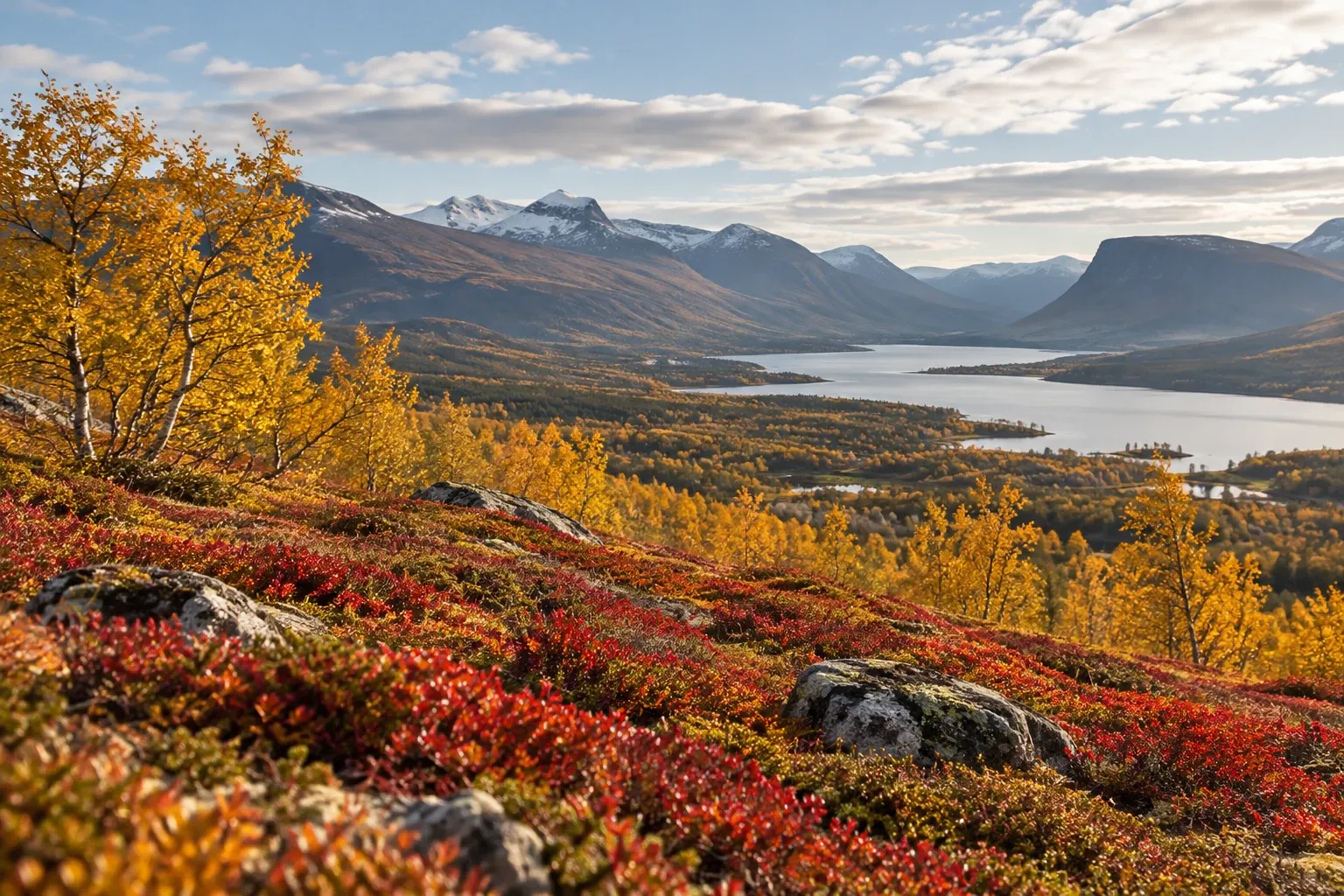
For a few weeks each year the Swedish fells turn gold and red. Here is what the colors are made of, why nobody can promise you a peak week, where to see them without a car, and what closes around you while you do.
When you need this
You’re planning a September hike or photo trip to Lapland or Jämtland and want to hit the colors. You’ve seen a Finnish “peak week” online and wonder whether it applies in Sweden. Or you want fall colors and the first northern lights in one trip, and need to know which huts, buses and visitor centers will still be open.
What ruska is: yellow birch, red ground
Ruska is the Finnish word for the autumn color season on the northern fells. The Sámi around Abisko call it ruski, “the season of beautiful colours”, in the words of the Swedish Lapland tourism organisation. Swedes mostly just say höstfärger, autumn colors.
Don’t expect New England. NASA’s Earth Observatory points out that in Scandinavia and northern Europe yellows dominate and reds are rare: northern Europe has just four tree species that turn red, against 89 in North America. The Swedish fell display is built in layers:
| Layer | Plant | Autumn color |
|---|---|---|
| Birch belt above the conifers | Fjällbjörk, mountain birch (a subspecies of downy birch) | Yellow to gold |
| Ground in the birch forest and on the open fell | Dvärgbjörk, dwarf birch | Strong red |
| Lower valleys and conifer forest | Birch along streams among spruce and pine | Yellow, later in the season |
The mountain birch forms the subalpine belt above the conifer line, and Naturvårdsverket, the Swedish Environmental Protection Agency, treats it as its own habitat. Dwarf birch, with small round leaves, grows in that forest and above the tree line, and turns a strong red. An old Finnish forest-research booklet even reads the red in some birch leaves as dwarf-birch genes in the mountain birch, although Naturvårdsverket simply classes it as a subspecies of downy birch.
When it comes — and why nobody can promise a date
In a normal year the color reaches the fells in early September. The managers of the Vindelfjällen reserve describe frost and autumn colors on the fell then, together with the first snow at altitude. On SMHI’s 1991–2020 normals, meteorological autumn — five days in a row with a daily mean below 10 °C — arrives about 24 August at Kiruna but only about 4 October in Stockholm and 12 October in Lund.
The catch is that “normal” hides big swings, and the last three seasons show it:
- 2024: at the high-fell station Tarfala autumn normally arrives in the first ten days of August, but that year no SMHI station could register autumn before 16 August, something not seen in about 40 years of digitised data.
- 2026: autumn reached several mountain stations on 1 August, the earliest date the definition allows. Five of them, including Tarfala, Stekenjokk and Sylarna, went straight from spring to autumn with no meteorological summer at all.
No Swedish authority publishes a ruska forecast or a peak week. The “second week of September, about ten days” you’ll find online comes from Visit Finland and describes northern Finland — and Visit Finland itself says it varies from year to year. Sunny, calm weather keeps leaves on longer; wind strips them early. The useful tool is SMHI’s free season-arrival map: from August it shows when autumn temperatures have reached the mountain stations, and color follows the first frosts.
From the high fell down to the valleys
Color starts where it is coldest — on the open fell and the upper birch belt — and the lower slopes follow. NASA’s satellite image of hilly terrain in northern Lapland on 10 October 2016 still showed birch forests in the stream valleys in yellow, with snow on some hills. NASA’s own caption speaks of yellow forests for a few weeks each October — it is describing those valleys, not the open fell.
In practice: early September is the window for the high-fell red-and-gold; the yellow valley birch lower down comes later, and in 2016 was still showing on 10 October. By October the high fells are past their colors, and Kiruna’s October normal is −0.9 °C.
Where to see ruska in Sweden
| Area | Why go | Season notes |
|---|---|---|
| Abisko and Torneträsk, northern Lapland | Mountain-birch forest above the lake; Kungsleden starts here; train stop inside the national park | Autumn at Kiruna about 24 August on average; naturum Abisko kept autumn hours to 26 September in 2026 |
| Vindelfjällen, southern Lapland | Frost, colors and first snow on the fell in early September | Huts open to about mid-September |
| Jämtland fells around Sylarna | The Jämtland Triangle stations stay open late | Sylarna and Blåhammaren open to 26 September in 2027 |
Abisko National Park is the easiest base if you don’t drive, and the Swedish Lapland tourism story about an autumn hike there describes a mountain-birch forest “alive with colours” above Torneträsk.
Getting there without a car
The train stops at Abisko Turiststation, opposite STF’s mountain station and inside the national park. Since 13 April 2026 one passenger train a day runs each way past Abisko, and travellers from Stockholm currently change at Boden; SJ expects through sleeper cars to return from 13 December 2026. Seasonal buses — line 91 Kiruna–Abisko–Riksgränsen and the Nikkaluokta bus — run June–September only. The full chain is in our guide to reaching the fjäll by public transport and the night train to Lapland.
The color weeks are the closing weeks
Ruska coincides with the end of the mountain summer season. STF, the Swedish Tourist Association, says its mountain huts and stations stay open until mid- or late September, and dates vary by hut. After closing, many keep only a small säkerhetsrum, a safety room for emergencies. In 2026, naturum Abisko, the visitor center, ran autumn hours 1–26 September, Tuesday–Saturday.
So check each hut on STF’s hut pages before you book a late-September route, and carry a tent if your trip runs past the closing dates.
Sharing the fell: hunters and reindeer
You are not alone on the autumn fell. Ptarmigan season opens 25 August in the mountain counties, and the moose hunt on 1 September in the north; the south waits until 8 October. Allemansrätten, the right of public access, still applies: you may walk and pick berries, and a Jakt pågår (hunt in progress) sign does not close the area. County boards advise visible clothing, ideally a reflective vest. In Jämtland the moose hunt pauses for the rut from 26 September to 9 October through 2027/28. More in hiking during hunting season.
Autumn is also reindeer-gathering time. Jämtland’s county board names gathering for calf marking, slaughter or moves as sensitive periods, and disturbing reindeer or herding is against the law. Give herds and herders a wide berth.
Weather and safety
Frost and the first snow can arrive at altitude in early September, and SMHI says the first snow cover on the high fells forms in September. Fjällsäkerhetsrådet, the Mountain Safety Council, warns that mountain weather can change fast, so pack warm layers and rain gear. Help phones in huts and shelters stay accessible even out of season. See mountain safety in the Swedish fjäll.
The upside: STF says mosquito numbers drop clearly in August, so the color weeks are largely bite-free.
Photographing ruska
- Leave the drone in the bag in national parks. Abisko’s regulations forbid landing aircraft, which the national-parks site reads as including drones. Tents and fires are also limited to designated places there. Rules elsewhere: photography and drone rules.
- Stay out after dark. The Kiruna-area aurora season starts in September, with the most active displays often between 21:00 and 23:00 — see northern lights in Sweden.
- Pick as you go. Lingonberries ripen in August–September, and berry picking is allowed under allemansrätten and inside Abisko National Park.
Autumn colors in southern Sweden
There’s no fell ruska in the south, but there is a later broadleaf display. Autumn reaches Lund about 12 October on average, and the national-parks site describes Söderåsen’s beech forest as glowing in warm colors in autumn. Think mid-October, not September.
Practical information
| Item | Detail |
|---|---|
| Normal start on the fells | Early September (2026: autumn on some fells from 1 August; 2024: not before 16 August anywhere) |
| Live signal | SMHI season-arrival map (autumn view), free |
| STF huts and stations | Open to mid- or late September; varies by hut |
| Sylarna / Blåhammaren, Jämtland | Open to 26 September 2027 |
| naturum Abisko | 2026 autumn hours 1–26 September, Tue–Sat 9:00–17:00; 2027 not yet published |
| Line 91 and Nikkaluokta bus | Summer season June–September |
| Train past Abisko | One a day each way since 13 April 2026 |
| Hunting | Ptarmigan from 25 August; moose from 1 September (north), 8 October (south) |
| Cost of walking and berry picking | Free under allemansrätten |
| Huts, trains, buses | Prices vary by operator and year — check the operator |
FAQ
When is ruska in Sweden?
Usually early September on the fells, when the first frost turns mountain birch yellow and dwarf birch red. It moves from year to year: in 2026 autumn reached several mountain stations on 1 August, while in 2024 it could not start anywhere before 16 August. Lower valleys color later, and southern woods only in October.
Where is the best place to see ruska in Sweden?
The open birch belt of the northern fells. Abisko is the easiest base: the train stops inside the national park, and the mountain-birch forest around Torneträsk colors early. Kungsleden runs from there. Vindelfjällen in southern Lapland and the Jämtland fells around Sylarna are alternatives, with huts open into September.
What does ruska mean?
Ruska is the Finnish word for the autumn color season on the northern fells. The Sámi around Abisko say ruski, described by the regional tourism organisation as “the season of beautiful colours”. Swedes usually just say höstfärger, autumn colors. On the Swedish side it means yellow mountain birch over red dwarf shrubs, not the red maples of North America.
Can I hike Kungsleden during ruska?
Yes, and early September is one of the best times: colors, few mosquitoes and quieter trails. Plan around closing dates, because STF’s huts and stations end their season in mid- to late September and the dates vary by hut. Carry a tent and winter-capable layers for a late-September trip, since frost and snow can arrive at altitude.
Can I see ruska and the northern lights on the same trip?
Yes, in September in northern Lapland. The Kiruna area’s aurora season starts in September, so the color weeks are also the first dark weeks. You need a clear sky; the most active displays often come between 21:00 and 23:00. Abisko works for both, with a train stop inside the national park.
Is it safe to hike in the mountains during ruska?
Yes, with preparation. Hunters are out: ptarmigan from 25 August and moose from 1 September in the north, so wear something visible. Allemansrätten still applies. The bigger risk is weather — frost and first snow can come in early September and conditions change fast. After huts close, only small safety rooms remain open.
Where can I see autumn colors in southern Sweden?
In the broadleaf woods, from about mid-October. Meteorological autumn reaches Stockholm around 4 October and Lund around 12 October on average. Söderåsen National Park in Skåne, a beech-forest ridge, is described by the national-parks site as glowing in warm colors in autumn. It is a different, later display from the fell ruska.
Related guides
- Sweden in September — the whole month around the colors: weather, events and the moose hunt.
- Abisko National Park — the easiest ruska base, with its park rules in full.
- Reaching the fjäll by public transport — trains, seasonal buses and through tickets to the trailheads.
- STF mountain huts — how huts work and when they close.
- Mountain safety in the Swedish fjäll — what to carry when September weather turns.
Facts verified 2026-10-15. Sources: SMHI, Naturvårdsverket, Länsstyrelsen Norrbotten, Jämtland and Västerbotten, Sveriges Riksdag (jaktförordningen 1987:905), Fjällsäkerhetsrådet, STF, NASA Earth Observatory, Visit Sweden, Visit Finland — full register in this topic’s source file. Found something outdated? Tell us and we’ll fix it.