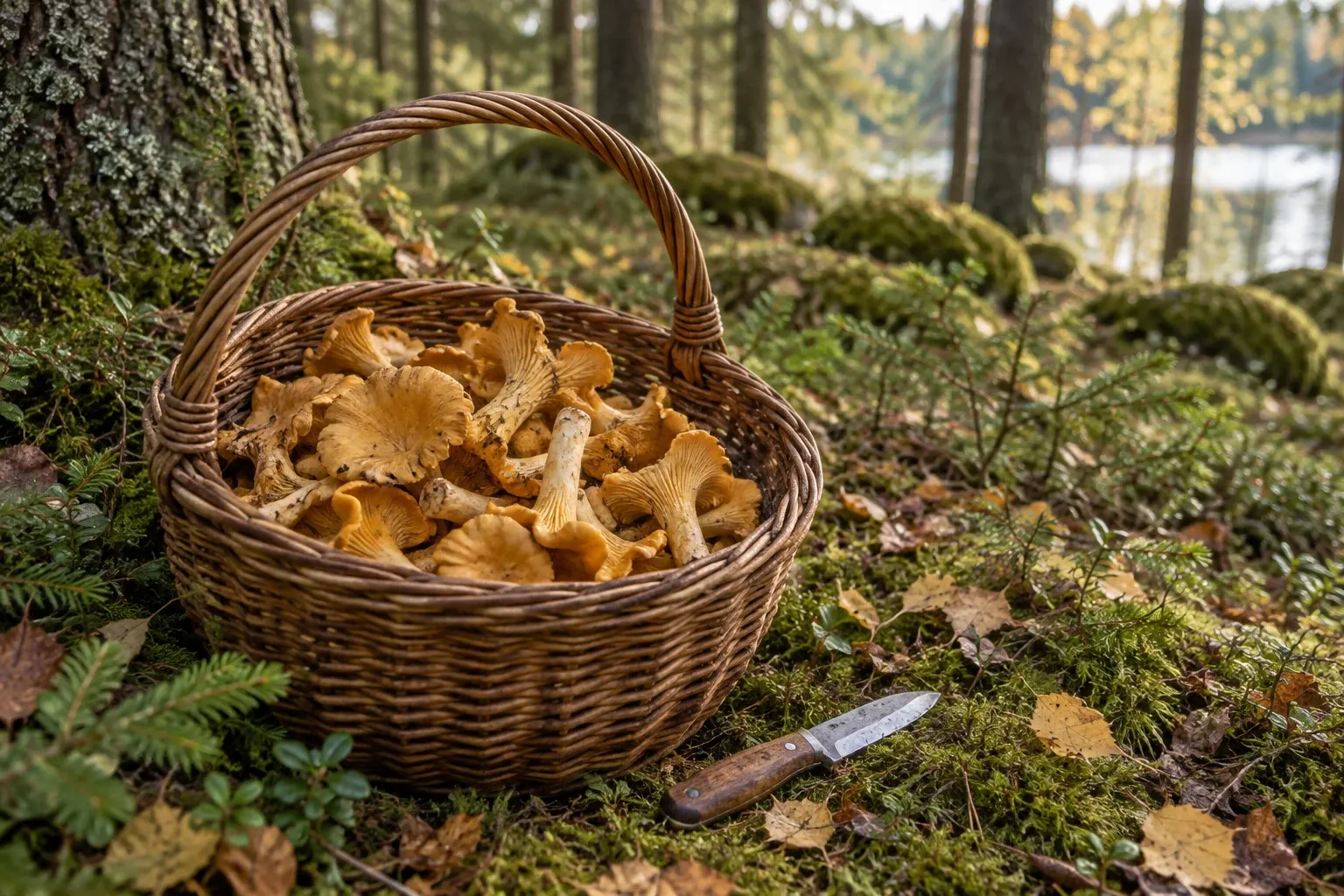
The law makes mushroom picking in Sweden easy. The forest floor makes it serious. Here is what you may pick, the three species that can kill you, what to do if a meal goes wrong, and what changes on 1 November 2026.
When you need this
It’s late September, which is the peak of the season. It has rained, and the spruce forest is full of mushrooms. Maybe you pick mushrooms at home and wonder if your knowledge carries over. Maybe you’ve found brown, funnel-shaped mushrooms in the moss and think they’re trattkantareller. Or someone in your group ate wild mushrooms yesterday and now feels ill. That last case has its own section below.
What you may pick, and where
Picking mushrooms falls under allemansrätten, the right of public access (see our guide to allemansrätten). Anyone may pick ground-growing edible mushrooms on land they don’t own, free and without asking. The only written duty is to show consideration and care in nature.
| Situation | Can you pick? |
|---|---|
| Ground-growing mushrooms in forest, including private forest | Yes, without asking |
| Chanterelles and porcini in most nature reserves | Yes, unless the reserve’s rules say otherwise |
| Fungi growing on trees, such as bracket fungi, in a reserve | As a rule, no |
| Anything taken from a living tree | No |
| Gardens, house plots, cultivated land | No |
| A protected species | No, anywhere |
| Selling what you picked yourself | Yes; tax-free up to 12,500 kr a year |
Nature-reserve regulations (föreskrifter) are binding, and a few reserves restrict picking further. Check the sign at the boundary. Park legally and walk in: driving into the terrain on snow-free ground is banned nationwide.
Selling is covered in more detail in our berry-picking guide. The same 12,500 kr tax-free limit applies to wild mushrooms, berries and cones you picked yourself. It doesn’t cover picking you’re paid to do or sales that are part of a business.
The deadly three
Giftinformationscentralen (the Swedish Poisons Information Centre) names three of the most poisonous fungi in Swedish nature. Confusing an edible mushroom with a poisonous one is the most common cause of mushroom poisoning. It happens every year.
| Species | Swedish | Confused with | Damages | Symptoms start |
|---|---|---|---|---|
| Destroying angel | vit flugsvamp | Champignons, grisettes, parasols | Liver and gut lining; can be life-threatening | 8–24 hours |
| Death cap | lömsk flugsvamp | Champignons, grisettes, parasols | Liver and gut lining; can be life-threatening | 8–24 hours |
| Deadly webcap | toppig giftspindling | Funnel chanterelles | Kidneys; severe cases are permanent | Usually 2–7 days |
The delay is the danger. With these species you can feel completely fine for hours or days after the meal. Don’t wait for symptoms before you call.
Funnel chanterelle or deadly webcap? This is the look-alike to know about in September to November. Both grow in acidic, mossy spruce forest. Sweden’s mushroom advisers report that webcaps have turned up in baskets of funnel chanterelles.
- Funnel chanterelle (trattkantarell): deeply funneled cap, blunt, sparse, branched ridges underneath, hollow yellowish stem.
- Deadly webcap (toppig giftspindling): pointed, dull reddish-brown to yellow-brown cap, true thick reddish-brown gills, and a brown stem with yellow bands.
That is not an identification key, just the reason to pick one mushroom at a time. Giftinformationscentralen’s beginner rule catches several of the worst species: never eat white mushrooms with white gills, nor brown mushrooms with brown gills.
Other species to know:
- Stenmurkla (false morel): Livsmedelsverket (the Swedish Food Agency) advises against eating it at all. Some of the toxin survives parboiling and drying.
- Grå bläcksvamp (common ink cap): combined with alcohol, it causes an Antabuse-type reaction.
Your home knowledge doesn’t transfer. Look-alikes differ from continent to continent. Treat every Swedish mushroom as unknown until you’re certain.
How to pick safely
- Pick only species you already know with certainty. Learn new ones a few at a time.
- Pick each mushroom whole, one at a time, so the base of the stem is visible for identification. Don’t rake up handfuls.
- Use a basket or paper bag, not plastic, and clean off soil and damaged parts in the forest.
- When in doubt, have a knowledgeable person check. That’s Giftinformationscentralen’s own advice. There’s no public mushroom-checking service in Sweden. The private association of mushroom advisers (svampkonsulenter) lists about 200 people you can hire for courses and excursions. A guided tour is the fastest way to learn.
- Never taste a raw mushroom, especially with children nearby.
- Cook every wild mushroom thoroughly, and soon. Raw or undercooked mushrooms cause nausea, vomiting and diarrhea, and spoiled ones add bacterial food poisoning.
- Keep leftovers and a photo of what you cooked. If anyone gets ill, the mushroom can be identified.
Treat a phone app or a photo posted in a group as a hint, not a final check. The official advice is a knowledgeable person and a modern, up-to-date guidebook. Giftinformationscentralen also has a mushroom brochure in more than 30 languages, worth downloading before you go.
If someone ate the wrong mushroom
| Situation | What to do |
|---|---|
| Seriously ill, or life-threatening | Call 112 and ask for giftinformation (poison information) |
| Not acute, but you suspect a mistake | Call Giftinformationscentralen on 010-456 67 00, day or night |
| Either way | Keep the mushroom or leftovers for identification |
| Feeling fine after eating a suspect species | Call anyway. Symptoms come hours or days late |
For the most dangerous species, Giftinformationscentralen says a taste no bigger than a sugar cube needs no action. More than that, or a meal, needs a call right away, and hospital care may follow. That is triage advice for worried parents, not permission to taste.
It’s peak season, and Giftinformationscentralen currently warns of longer waiting times on its phone line. If the situation is life-threatening, don’t wait on hold. Call 112. Our guides to 112 and Sweden’s emergency numbers and getting sick in Sweden cover what happens next.
Protected fungi: 5 today, 26 from 1 November
Until 31 October 2026, five fungi are protected (fridlysta). One of them is lion’s mane (igelkottstaggsvamp), a prized edible.
On 1 November 2026 an amendment to the Species Protection Ordinance (SFS 2026:1504) takes effect, and the list grows to 26 fungi. Three get strict protection and 23 enhanced protection. For all of them it is forbidden to deliberately pick, dig up, remove or damage them. Most are bracket fungi (tickor) and tooth fungi (taggsvampar). Lion’s mane stays protected; doftticka drops off.
No common edible mushroom is on the list. Chanterelles, funnel chanterelles and porcini are not protected. A landowner can’t give you permission to pick a protected fungus. Only a county board dispensation can. The simple rule: leave fungi on trees alone. Our berry-picking guide explains the new protection tiers for plants.
Cesium and cooking
In 1986 the Chernobyl accident spread radioactive cesium over parts of Sweden. The heaviest fallout landed on southern and central Norrland, from northern Uppland and Västmanland up to Västerbotten. Levels were highest around Gävle, Sundsvall and Härnösand. Many pages still tell you to avoid mushrooms there.
The current official position is calmer. In Livsmedelsverket’s survey of samples sent in by the public in late 2023, only two of 33 mushroom samples exceeded 1,500 Bq/kg, the limit for mushrooms sold. Both came from the fallout area. In January 2025 the agency concluded that you can eat mushrooms throughout Sweden without health risk from cesium.
If you’ll eat a lot of mushrooms from the fallout area, the agency’s advice still applies:
- Sandsopp (velvet bolete) and rimsskivling (gypsy mushroom) take up more cesium than other species. Choose others.
- Parboiling and pouring away the water cuts cesium by up to 80 percent.
When and where to go
The main season is late summer and autumn. Chanterelle reports pick up in July and usually peak around mid-September. Funnel chanterelles follow from September to November and can still be picked after a light frost. Mushrooms tend to appear about a week after heavy rain.
The season overlaps the autumn moose hunt in much of the country, so wear bright clothing near hunting ground (see hiking during hunting season). Ticks live in the same habitat, so check yourself afterward (see ticks in Sweden).
Practical information
| Item | Detail |
|---|---|
| Cost of picking | 0 kr, free under allemansrätten |
| Emergency / serious poisoning | 112, ask for giftinformation |
| Poison advice line | 010-456 67 00, 24/7 for acute poisonings, free |
| Tax-free selling limit | 12,500 kr per person per tax year (own wild picking) |
| Protected fungi | 5 until 31 October 2026; 26 from 1 November 2026 (SFS 2026:1504) |
| Cesium limit for mushrooms sold | 1,500 Bq/kg |
| Mushroom courses and excursions | Price set by each adviser |
| Vehicles | Stay on roads and legal parking |
FAQ
Can you pick mushrooms anywhere in Sweden?
On most land, yes, including private forest, without asking. Allemansrätten covers ground-growing edible mushrooms. Stay out of gardens, house plots and cultivated land, and follow nature-reserve signs: most reserves allow chanterelles and porcini but not fungi growing on trees. Protected species are off limits everywhere, and from 1 November 2026 there are 26 of them.
What is the most dangerous mushroom in Sweden?
Giftinformationscentralen names three of the most poisonous: destroying angel (vit flugsvamp), death cap (lömsk flugsvamp) and deadly webcap (toppig giftspindling). The first two damage the liver, with symptoms after 8–24 hours; the webcap damages the kidneys, usually 2–7 days later. The delay is what makes them deadly. People confuse all three with edible species every year.
How do I tell funnel chanterelles from deadly webcap?
Pick one by one and check each. Funnel chanterelles have a hollow yellowish stem and blunt, branched ridges under a deeply funneled cap. Deadly webcap has true reddish-brown gills, a pointed cap and yellow bands on the stem. Both grow in mossy spruce forest, which is how webcaps end up in baskets. If you are not certain, do not eat it.
What should I do if someone ate a poisonous mushroom?
If the person is seriously ill, call 112 and ask for poison information. Otherwise call Giftinformationscentralen on 010-456 67 00, day or night. Call as soon as you suspect a mistake — do not wait for symptoms, which come hours or days late with the deadliest species. Keep any leftover mushroom so it can be identified.
Is there a place in Sweden to get my mushrooms checked?
No public service does it. Giftinformationscentralen advises letting a knowledgeable person check or clean your mushrooms, but that person is someone you find. About 200 trained mushroom advisers (svampkonsulenter) offer paid courses and excursions and hold mushroom exhibitions; a guided excursion is the practical way for a visitor to get a check.
Are Swedish mushrooms still radioactive from Chernobyl?
Only slightly, in some areas. Livsmedelsverket’s 2023 survey found two of 33 mushroom samples above 1,500 Bq/kg, both from the fallout area in central Norrland, and the agency judges mushrooms safe to eat throughout Sweden. Heavy eaters there can avoid velvet bolete and gypsy mushroom, or parboil and discard the water.
Can I sell mushrooms I pick in Sweden?
Yes. Income from selling wild mushrooms, berries and cones you picked yourself is tax-free up to 12,500 kronor per person per tax year under the Income Tax Act. It does not cover picking you are paid to do for someone else, or sales within a business. False morel may only be sold parboiled by established methods.
Related guides
- Berry picking in Sweden: the same right, the tax rule and the new protected-species tiers
- Allemansrätten explained: where the right to pick starts and stops
- 112 and Sweden’s emergency numbers: how the call works, including poison information
- Getting sick in Sweden: where to go if a meal goes wrong
- Ticks in Sweden: they live exactly where the mushrooms grow
Facts verified 2026-09-24. Sources: Sveriges Riksdag, Regeringen, Naturvårdsverket, Länsstyrelsen, Skatteverket (via verksamt.se), Giftinformationscentralen, Livsmedelsverket, SOS Alarm and Svampkonsulenternas Riksförbund. Full register in this topic’s source file. Found something outdated? Tell us and we’ll fix it.