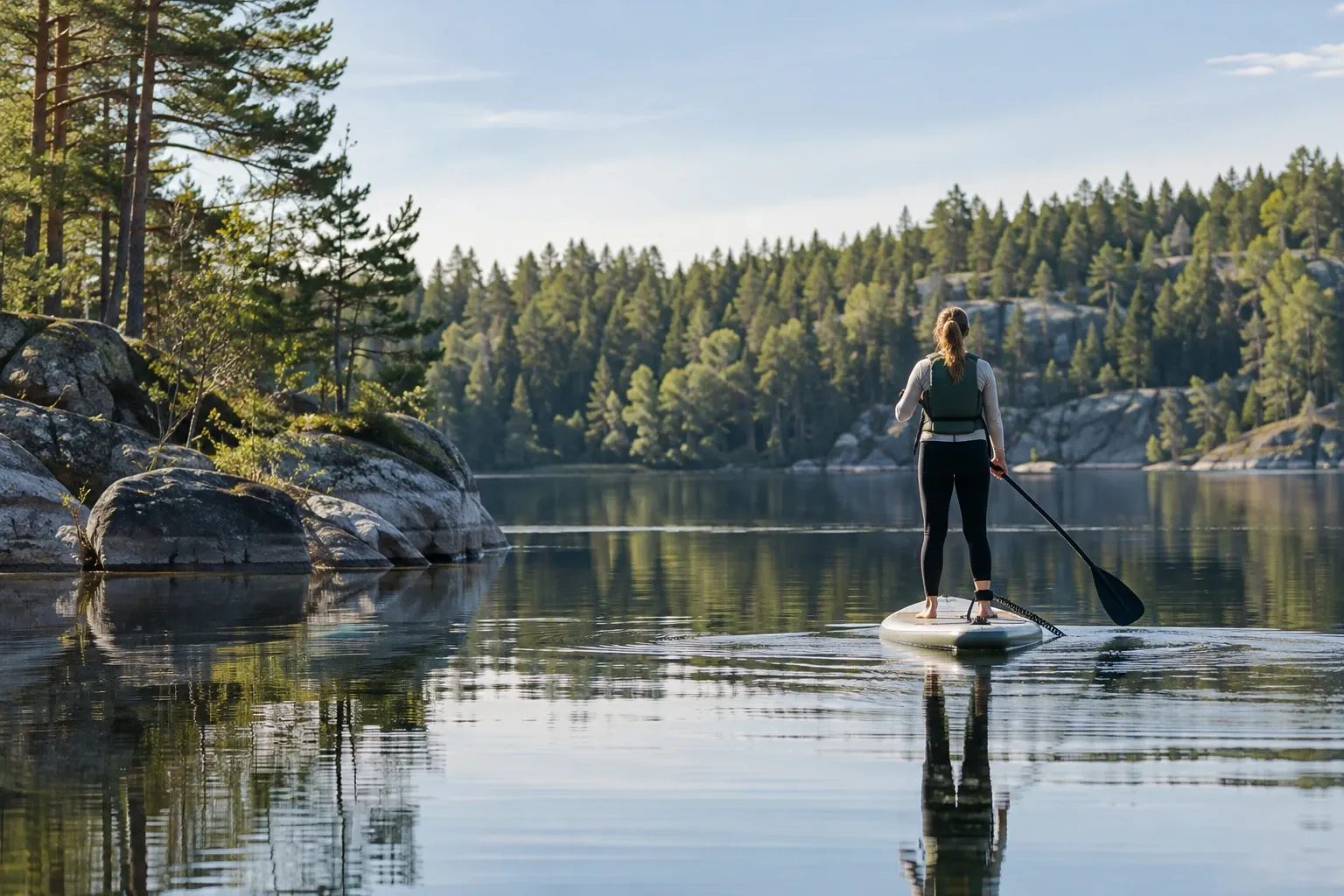
Sweden is easy on paddleboarders: no permit, no registration and thousands of lakes. It is hard on a standing paddler caught by offshore wind in cold water. Here are the rules that exist, the ones that don’t, and the habits that keep a trip uneventful.
When you need this
- You are about to rent a board at a lake beach or in a city and have never paddled in Sweden.
- You are bringing your own inflatable board and wondering whether you need a permit.
- The forecast shows wind blowing from the land out towards open water.
- You plan to paddle in the Stockholm archipelago, near a nature reserve or past bird islets.
- You are paddling with children or non-swimmers, or want to camp a night on a SUP trip.
This page is about what is different when you are standing on a board. For kayak routes and fairways in the Stockholm archipelago, read kayaking in the Stockholm archipelago; for multi-day lake trips with campsite cards, read canoeing in Värmland and Dalsland.
No licence, but a board is a vessel
Sweden has no SUP licence, no registration and no national fee. Paddling, landing on a shore that is not part of someone’s garden, and staying a night or two ashore all fall under allemansrätten, the right of public access, on the same terms as a canoe. Naturvårdsverket’s guidance for paddlers applies, and there is no minimum distance rule to houses — the test is whether you disturb the people living there. See allemansrätten for the full picture.
In Sweden, stand-up paddling (ståpaddling) is a branch of Svenska Kanotförbundet, the national canoe federation. It describes SUP as a sport for lakes, sheltered sea water, streams and rivers that needs only knee-deep open water. The federation also counts tent trips by board as part of Swedish outdoor life.
The legal side has one thing visitors miss: in law, a board is not a toy.
| Point | What it means | Type |
|---|---|---|
| The collision regulations define a vessel (fartyg) as any craft used or able to be used for transport on water | Your board falls under the definition | law |
| Vessels under 20 m may not impede ships confined to a narrow fairway, or cross so as to hinder them | Get out of the way of ferries; never linger in a channel | law |
| Keep right; cross fairways at right angles, at a narrow point, ideally as a group | Transportstyrelsen’s advice for paddlers | guidance |
| Nämdöskärgården national park names “SUP-bräda” among the craft banned from its most sensitive zones | The county board treats boards as vessels too | law |
| After dark, keep a white light at hand | The rule for vessels under oars; the paddling brochure applies it to paddlers | law / guidance |
The numbers back this up. Transportstyrelsen’s boating survey, run every five years, counted SUP, surf, kite and foil boards as leisure boats for the first time in 2025 and estimated about 140,600 of them, 12.3% of all seaworthy leisure craft. Older pages that call SUP “new in Sweden” are out of date.
Alcohol. The Maritime Code’s 0.2 per mille limit covers vessels capable of 15 knots or at least 10 m long, which a board is not. A separate paragraph makes it an offence for anyone on any vessel to be so affected that they cannot perform a safety-critical task. The official advice is simpler: don’t paddle after drinking at all, because alcohol hurts balance and how long you last in cold water.
Life jacket and leash
There is no general legal duty to wear a life jacket on a leisure craft in Sweden. The advice is unanimous anyway. Svenska Kanotförbundet’s rule for SUP is “never paddle without a life jacket and a leash”. Transportstyrelsen says a life jacket should be CE-marked, the right size and buttoned. Children and non-swimming adults should wear a rescue vest (räddningsväst) with a collar that holds the head up.
Why it matters: almost half of those who drowned after falling out of a boat would have survived with a life jacket, according to studies cited by the civil-defence agency’s information service. Putting one on in the water after a fall is hard, and fine motor control goes quickly even in water that feels warm. Transportstyrelsen’s 2025 survey suggests boards are where the habit is weakest: life jackets for everyone aboard on 79% of all boats, but 61% in the category made up mainly of jet skis, SUP and surf boards.
| Kit | Swedish advice | Why |
|---|---|---|
| Life jacket (flytväst) | CE-marked, right size, buttoned, worn — not strapped to the board | You cannot put it on once you are in the water |
| Rescue vest (räddningsväst) | For children and non-swimmers | The collar turns the face up |
| Inflatable life jacket | Advised against for paddling | In the way once inflated; auto-inflating ones need re-arming after every activation |
| Ankle leash (fångrem) | Always, except in rapids | Without it the board can blow away after a fall |
The one leash exception. The canoe federation says the only time to consider paddling without a leash is in strongly flowing water and rapids, where a leash can snag on something underwater and hold you there.
Wind: the risk that catches visitors
Standing up, your body is a sail. Wind from the land pushes a paddler out towards open water, waves build with distance from the shore, and the way back is straight into it. Transportstyrelsen’s paddling brochure advises against crossing open water with the wind behind you for exactly this reason. The canoe federation’s beginner rule turns it into a habit: start into the wind or current, so the way home is downwind.
- Read the forecast for direction and gusts. SMHI notes that gusts are often much stronger than the mean wind. See SMHI weather warnings for what yellow, orange and red mean.
- Check what is happening now. On the coast, Sjöfartsverket’s ViVa service shows measured wind from over 90 stations.
- Read the beach. On guarded beaches, an orange windsock is the lifeguards’ offshore-wind warning; Ängelholm explains it with the instruction not to use inflatable floating toys.
- Stay ashore in thunder. Sudden wind shifts and hard gusts are common in thunderstorms.
Cold water, even in July
Transportstyrelsen’s brochure is blunt: water below 25 °C is a real risk, and below 15 °C the risk of serious hypothermia is imminent. Southern Swedish sea water reaches about 20 °C at its warmest in summer. In winter it ranges from about 6 °C in the west to freezing in the north and east, and the Baltic is slow to warm up again in spring. Falling into cold water can trigger the gasp reflex, which can drown a person within seconds, and hands stop working first.
Dress for the water temperature, not the air: a wetsuit or drysuit in spring and autumn, and a dry change of clothes in a waterproof bag year-round. Practise climbing back on in shallow water: get back on near the middle of the board, keep low, then stand. More on what cold does to the body in cold risks and hypothermia.
Where you can’t paddle
Allemansrätten opens most water, but three kinds of rule close parts of it, and all three are binding.
| Area | What is closed | When |
|---|---|---|
| Bird- and seal-protection areas (fågel-/sälskyddsområde) | Landing, and in many areas craft within 100 m of the shore | A closed season set per area; most commonly 1 April–15 July for birds |
| Nämdöskärgården national park, off Värmdö (2025) | Every vessel, “boat, kayak, SUP board and the like”, in some especially sensitive zones; tenting limited to two nights in one place in most of the park | Zone bans already apply; separate sea-traffic rules were not yet in force on 15 October 2026 |
| Nature reserves (naturreservat) | Landing, fires, tenting or mooring, depending on each reserve’s regulations | Check the county board’s page |
Signs for bird areas are yellow or red-and-yellow, but they can be missed on the far side of an island, so check the chart or the county board’s map before you paddle. Quiet craft surprise nesting birds easily in spring and early summer; give them a wide berth even outside closed areas. Landing permission from a landowner does not lift a reserve or bird-protection ban. The details for islets are in landing rules on islands and skerries, and for reserves in nature reserves.
Where boards meet surf or kite zones on the west coast and in Skåne, read surfing in Sweden. Paddlers are low on the water and hard to see from other boats, especially against the light, so wear bright colours and paddle near the shore, where larger boats cannot go.
Renting or bringing a board
Renting. In many places a board, paddle and life jacket are rented as a set. Svenska Kanotförbundet lists about 90 approved rental centres (Godkänd Kanotcentral) checked for how they handle safety and information. The federation recommends a short course or introduction at a local canoe or SUP club, even for a sport it calls fairly harmless with common sense. Being able to swim is the practical entry requirement.
Bringing your own. Most boards sold today are inflatable, and the federation says one is enough for recreation and easy exercise paddling. For a camping trip, choose a stable board that can carry luggage. Before moving a board to a new lake, empty, wash and dry it: Svenska Kanotförbundet asks paddlers to do this to avoid spreading disease and invasive species.
Whichever you use, carry a phone in a waterproof case and tell someone ashore your route and when you will be back. In an emergency call 112, which also reaches sea rescue; see 112 and Sweden’s emergency numbers.
Practical information
| Item | Detail |
|---|---|
| Licence, registration, fee | None for SUP (checked 2026-10-15) |
| Board rental | Varies by place, season and hours; life jacket often included (checked 2026-10-15) |
| Courses and introductions | Prices set by each club or rental centre (checked 2026-10-15) |
| Boards in Sweden | About 140,600 SUP, surf, kite and foil boards; 12.3% of seaworthy leisure craft (Transportstyrelsen survey estimate, published September 2025) |
| Approved rental centres | About 90 Godkänd Kanotcentral (Svenska Kanotförbundet, checked 2026-10-15) |
| Drink limit | 0.2 per mille only for vessels capable of 15 knots or ≥10 m; impairment offence on any vessel |
| Water-temperature thresholds | Below 25 °C a real risk; below 15 °C imminent risk of serious hypothermia (Transportstyrelsen brochure) |
| Bird-area closed season | Set per area; most commonly 1 April–15 July |
| Emergency | 112 (sea rescue included); VHF channel 16 |
FAQ
Do I need a licence to paddleboard in Sweden?
No. Sweden has no SUP licence, registration or national fee. Paddling on lakes, rivers and the sea, landing on shores that are not someone’s garden, and staying a night or two are covered by allemansrätten. What you must respect are the regulations of nature reserves, national parks and bird- or seal-protection areas, which can close water or shores in season.
Do you have to wear a life jacket on a paddleboard in Sweden?
There is no general legal requirement, but Transportstyrelsen and the canoe federation both say to wear a CE-marked life jacket in the right size, buttoned, every time. Children and non-swimmers should wear a rescue vest with a collar. Almost half of those who drowned after falling from a boat would have survived with one.
Do I need a leash on a SUP?
Yes, in almost all conditions. The canoe federation says never to paddle without a life jacket and an ankle leash, because a board can blow away from you after a fall. The one exception it names is strongly flowing water and rapids, where a leash can snag on something underwater and hold you.
Can I paddleboard anywhere in Sweden?
Almost. Allemansrätten covers lakes, rivers and the sea, but bird- and seal-protection areas close shores and often the water within 100 m in season, and some zones of Nämdöskärgården national park ban every craft, SUP boards included. Ship fairways are legal but dangerous; cross them quickly and at right angles.
Is offshore wind really dangerous on a SUP?
Yes. Standing up, your body works like a sail, and wind from the land pushes you towards open water where waves build. Transportstyrelsen advises against paddling across open water with the wind behind you. Start upwind so the return is downwind, and stay ashore when the wind blows off the beach.
When is the water warm enough for SUP in Sweden?
Southern sea water reaches about 20 °C at its warmest in summer, and much less in the north and in spring. Transportstyrelsen’s paddling brochure calls water under 25 °C a real risk and under 15 °C an imminent risk of serious hypothermia. Dress for the water temperature, and in spring or autumn wear a wetsuit or drysuit.
Can I drink alcohol and paddleboard in Sweden?
The Maritime Code’s 0.2 per mille limit covers vessels capable of 15 knots or at least 10 m long, so it does not apply to a board by its terms. Being so affected that you cannot act safely is a separate offence on any vessel. Official advice is not to paddle after drinking at all: alcohol worsens balance and cold tolerance.
Related guides
- Kayaking in the Stockholm archipelago — routes, fairways and the Nämdö national park in detail.
- Swimming safety and life jackets in Sweden — rescue vests, drowning first aid and guarded beaches.
- Islands and skerries: landing rules — how bird-protection areas work before you go ashore.
- Canoeing in Värmland and Dalsland — multi-day lake trips with campsites and area cards.
- Cold risks: hypothermia basics — what happens after a fall into cold water.
Facts verified 15 October 2026. Sources: Transportstyrelsen, Länsstyrelsen Stockholm, Naturvårdsverket, SMHI, Sveriges riksdag, Svenska Kanotförbundet, Sjöräddningssällskapet — full register in this topic’s source file. Found something outdated? Tell us and we’ll fix it.