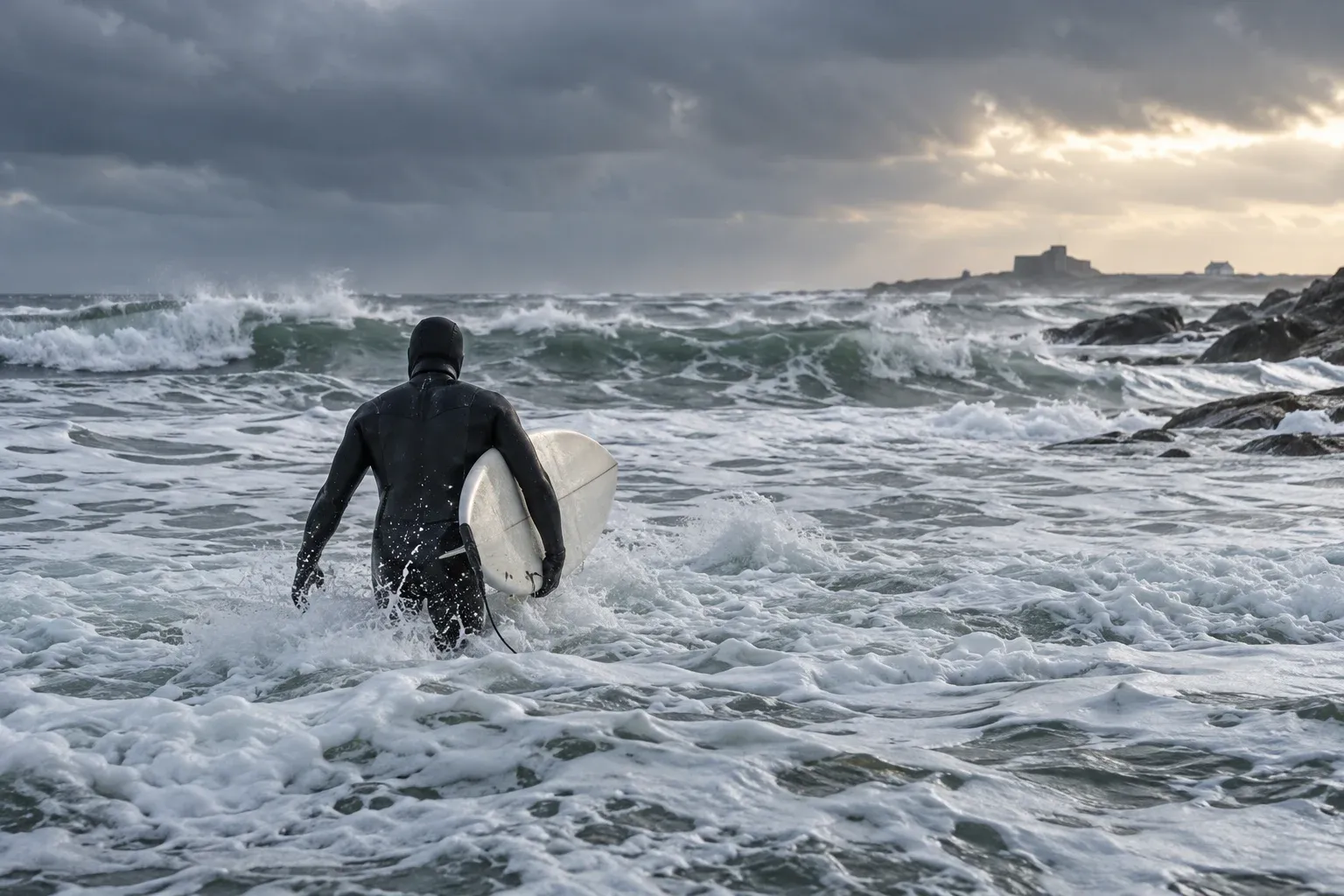
Sweden does have surf, and a real surf culture to go with it. But the waves follow the wind, not the calendar. Pick the coast that matches today’s forecast, dress for near-freezing water, and you’ll find rideable waves an hour from Stockholm or Gothenburg.
When you need this
You surf at home and wonder whether a board is worth bringing. Maybe you’re in Varberg, Gothenburg or Stockholm in October and the forecast says hård vind (strong wind). Or you kitesurf and want to know where you’re allowed to launch. This page covers where the waves are, when they come and what rules apply. For the beaches themselves, see our guide to Swedish beaches.
Why Swedish waves are different
Sweden has no open-ocean coastline. The Kattegat and Skagerrak in the west and the Baltic in the east are enclosed seas, so no long-period swell rolls in from storms far away. Every rideable wave is made by local wind blowing across open water. How big it gets depends on how strong the wind is and how long a stretch of sea (the fetch) it blows over. SMHI, the national weather service, notes that the fetch is longest along the northern west coast.
What that means in practice: the waves arrive with the wind and leave with it. Varberg Municipality says waves build up quickly in onshore wind at Apelviken. A session is often a few hours on the day a front passes, not a week of steady swell. Turn up the morning after the storm and the sea may already be flat.
The main spots
Two spots dominate, one on each coast.
Apelviken is a horseshoe-shaped sandy bay just south of Varberg on the west coast. The municipality calls it Sweden’s No. 1 surfing beach. It’s also the easiest place to start: there’s camping, car parks with toilets and showers, and a surf centre with courses, rental and changing rooms. Surfers, windsurfers and kitesurfers share the bay. For the town around it, see our Halland coast and Varberg guide.
Torö Stenstrand is a white-pebble beach in Nynäshamn Municipality, south of Stockholm, inside the Ören nature reserve (naturreservat). The municipality calls it the east coast’s obvious surf beach with an established surf culture. Wind, wave and kite surfers use it all year whenever the wind allows.
| Coast | Spots | Wind that works | Notes |
|---|---|---|---|
| West coast (Halland) | Apelviken (Varberg), Halmstad area | W–NW at Apelviken | Sandy, best equipped, shared with kite and windsurf |
| Skåne north-west | Mölle (Kullaberg) | Storm-specific | Boulders; rarely works |
| Skåne south-east (Österlen) | Knäbäckshusen and nearby beaches | Winter windswell | Shallow, small waves |
| Stockholm region | Torö Stenstrand (Nynäshamn) | S–E | Pebble beach in a nature reserve; the most-surfed east-coast spot |
| Gotland | East-coast bays | Baltic windswell | Small waves; ferry needed |
The wind directions for Torö and the smaller spots come from surf guides, not official sources, so treat them as a starting point. Svenska Surfförbundet, the Swedish surfing federation, covers wave surfing and SUP and lists five member clubs: in Halmstad, Salusand, Stockholm, Varberg and Österlen. A club session is a good way in if you’re staying a while.
When to go
The main season runs from autumn to early spring, when low-pressure systems bring strong wind. Surf guides name December to March as the core. High-pressure summers are usually flat. They aren’t always, though: SMHI’s highest wave of 2023, 8.2 m at Brofjorden, came in early July, and SMHI itself called that very unusual.
Storm peaks are big. SMHI measured a significant wave height of 5.3 m at Väderöarna in the Kattegat in February 2023, and storm Babet that October caused extensive beach erosion. The day of the storm is for experts; the hours as it eases are when most people surf.
Reading the forecast
The forecast is your surf report. Read the wind first, then the waves.
SMHI gives wind in metres per second, not km/h. Multiply by 3.6 for km/h, or by about 2 for knots. Our guide to Swedish units has the full conversion.
| SMHI term | m/s | Roughly km/h |
|---|---|---|
| frisk vind (fresh wind) | 8.0–13.8 | 29–50 |
| hård vind (strong wind; gale at sea) | 13.9–24.4 | 50–88 |
| storm | 24.5–32.6 | 88–117 |
Then check the direction against the spot. Apelviken works best in west to north-west wind and works from south round to north-north-west. Torö faces the open Baltic to the south, so surfers look for southerly to easterly wind. SMHI also makes wave forecasts with its SWAN model, and surf-forecast apps add spot-level detail. For storm warnings, see SMHI weather warnings.
Cold water and safety
The water is the hard part. SMHI’s example day in late February had a sea temperature of about 6 °C in the west and freezing point in the north and east. The Baltic cools slowly but steadily; the west coast rarely gets as cold. Even in summer, upwelling can drop the temperature by about 10 °C when wind pushes the warm surface water away, most of all in Hanöbukten and around Gotland.
For autumn and winter you need a thick winter wetsuit with boots, gloves and a hood. Surf guides recommend about 7 mm in midwinter. Without them, a session ends in minutes.
Cold-water shock is the real danger. Sjöräddningssällskapet, the Swedish sea rescue society, warns that the gasp reflex on sudden immersion can drown a person within seconds, and that your hands stop working first. In winter, a lost board means a rescue, not a swim back. Never surf alone, and tell someone onshore when you’ll be out. Our cold safety guide covers cold-water shock in depth.
Waves also bring currents. Simrishamn Municipality describes rip currents (utströmmar) as strong flows where water pushed up the beach runs back out to sea. Look for calmer water between the breakers; if you’re caught, don’t fight it, swim along the beach out of it. Varberg specifically warns that Apelviken and Kåsa can have treacherous currents in wind, which is exactly when the surf is up. More in our water safety guide.
In an emergency at sea, call 112 and ask for sjöräddning (sea rescue). JRCC in Gothenburg coordinates sea rescue for the whole country.
Kitesurfing and windsurfing rules
Wave surfing needs no permit or fee on the public beaches covered here. Kites and windsails face more rules, and they come mainly from the county administrative board (Länsstyrelsen), not the beach. Inside a protected area, these regulations override the right of public access (allemansrätten).
At Apelviken the municipal rule is simple: every kiteboarder, windsurfer and surfer must keep a safe distance from swimmers. Elsewhere, two kinds of protected area can close the water:
| Protection | Example | What is banned | When |
|---|---|---|---|
| Nature reserve regulations | Falsterbo peninsula sea reserve, Skåne (2010 decision) | Windsurfing, kitesurfing, water skiing, jet skis | All year in some zones; 1 March–1 July in another |
| Bird-protection area (fågelskyddsområde) | Norra and Södra Ören off Falkenberg, Halland (2020 decision) | Being inside the area at Norra Ören; landing on Södra Ören | 1 March–31 July |
The Ören decision shows how these zones are drawn with kites in mind. It is enough for your board to be outside the line, and the boundary sits further out on the west side because kites mostly fly in westerly wind and stretch towards land. Zones are revised: Falsterbo’s 2010 decision itself reopened parts of Stenudden after surfers asked. So check the current map on the Länsstyrelsen site before launching. Our guide to nature reserves explains how reserve rules work.
Neither decision names wave surfing on a board without a kite. Bird-protection bans in the example are seasonal, so the same water may be open from August to February.
Mistakes to avoid
- Expecting summer surf. Calm summers rarely give waves.
- Arriving the day after the storm. The windswell fades within hours.
- Packing a summer wetsuit for an autumn trip.
- Reading wind strength but not direction. The wrong direction means no waves at your spot.
- Kiting inside a reserve or bird zone without checking the map.
- Surfing alone in winter.
Practical information
| Item | What to know |
|---|---|
| Surfing on public beaches | No fee or permit |
| Lessons and rental | At the Apelviken surf centre; prices vary by season |
| Parking at Apelviken | Several car parks with toilets and showers; check charges on site |
| Clubs | Halmstad, Salusand, Stockholm, Varberg, Österlen; fees set by each club |
| Winter wetsuit | Thick suit plus boots, gloves and hood; about 7 mm in midwinter per surf guides |
| Seasonal closures (examples) | Falsterbo sea reserve 1 March–1 July; Ören bird area 1 March–31 July |
| Emergency at sea | 112, ask for sea rescue |
FAQ
Can you surf in Sweden?
Yes, but the waves are windswell from local storms rather than ocean swell, so they come and go with the wind. The best-known spots are Apelviken in Varberg on the west coast and Torö Stenstrand south of Stockholm. Expect the best surf from autumn to early spring and plan around the forecast, not the calendar.
Where is the best surfing in Sweden?
Apelviken, a sandy bay just south of Varberg, is called Sweden’s number one surfing beach by the municipality and has a surf centre with lessons and rental. On the east coast, Torö Stenstrand in Nynäshamn is the established spot. Mölle and Österlen in Skåne and Gotland’s east coast also get waves in the right storms.
When is the surf season in Sweden?
Mainly autumn to early spring, when low-pressure systems bring strong wind; surf guides name December to March as the core. Summer is usually flat, though storms can happen: SMHI measured the highest wave of 2023 in early July. Because waves fade within hours of the wind dropping, check the forecast daily.
How thick a wetsuit do I need for surfing in Sweden?
For autumn and winter, a thick winter wetsuit plus boots, gloves and a hood; surf guides recommend about 7 mm in midwinter. SMHI’s example day in late February had sea temperatures of about 6 °C in the west and freezing point in the north and east. Cold-water shock is the main danger, so never surf alone.
Is kitesurfing allowed in Sweden?
Generally yes, and Apelviken and Torö are popular kite spots. But nature reserves and bird-protection areas can ban it. Falsterbo’s sea reserve bans kitesurfing and windsurfing all year in some zones and from 1 March to 1 July in others, and Falkenberg’s Ören islets close from 1 March to 31 July. Check Länsstyrelsen’s map first.
How do I read a Swedish wind forecast for surfing?
SMHI gives wind in metres per second. Multiply by 3.6 for km/h or by about 2 for knots. Fresh wind is 8.0 to 13.8 m/s and strong wind starts at 13.9 m/s, which is a gale at sea. Then check the direction: Apelviken works best in west to north-west wind.
Are there rip currents at Swedish beaches?
Yes, on open beaches with breaking waves. Simrishamn describes rip currents as strong flows where water is pushed back out to sea; look for calmer water between the breakers. Do not swim against one; swim along the beach out of it. Varberg warns of treacherous currents at Apelviken and Kåsa in wind.
Related guides
- Halland coast and Varberg — the town, beaches and trains around Apelviken
- Water safety in Sweden — rip currents, drowning and helping someone safely
- Cold safety — what cold-water shock does and how to prepare
- Swedish units — reading wind in m/s and other local units
- Nature reserves — why reserve rules can close a beach to kites
Facts verified 2026-10-06. Sources: Varberg and Nynäshamn municipalities, Länsstyrelsen Halland and Skåne, SMHI, Simrishamn Municipality, Sjöräddningssällskapet, Sjöfartsverket and Svenska Surfförbundet — full register in this topic’s source file. Found something outdated? Tell us and we’ll fix it.