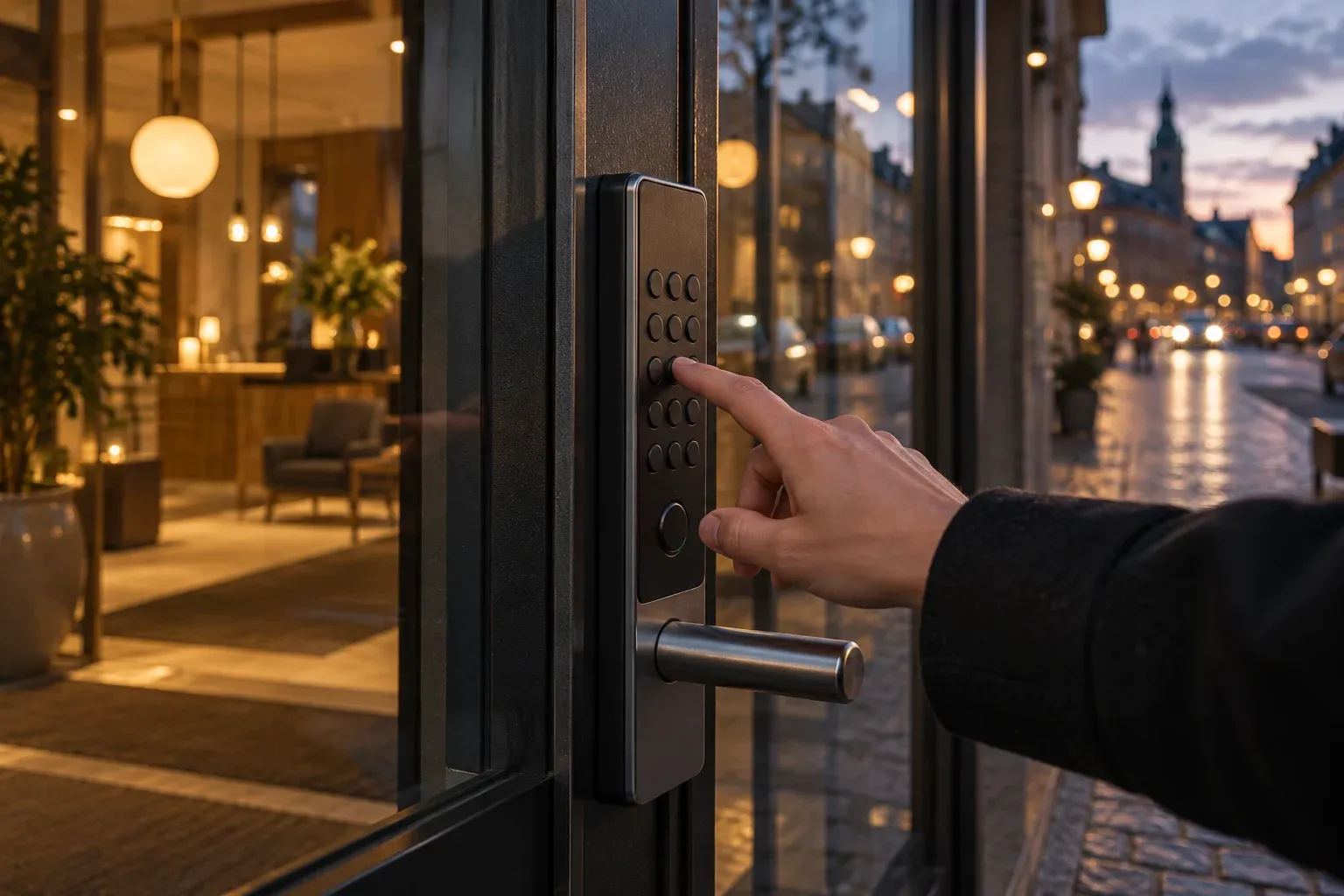
Hotels with no reception are ordinary in Sweden now. They work smoothly almost every time, and when they fail it is usually for one of a few predictable reasons. Here is how the system works, how to stop it failing, and what your rights are if it does.
When you need this
Your confirmation says “no reception” or “code sent on the day of arrival”. Maybe you land after the latest check-in time, or you have a UK SIM and plan to keep mobile data off. Or you’re already standing at a keypad that won’t open, wondering whether to call the hotel or the booking site.
How self check-in works
You book online, fill in a pre-check-in form, and receive access by one of these routes:
| Access method | How it reaches you | Typical failure |
|---|---|---|
| Door code | SMS and/or email | Wrong phone number, email in spam |
| Check-in link or app key | Email or app | Needs data or Wi-Fi |
| Lobby kiosk | On arrival, with booking number and card | Card refused, PIN unknown |
| Key box (nyckelbox) | Code sent before arrival | Common at small hostels outside reception hours |
The format is accepted by the European star scheme Sweden uses: at the lower star levels a 24-hour self check-in option can stand in for a staffed desk, and only five stars requires a 24-hour reception. Apartment-hotel operators such as Forenom run code-locked buildings where the room number and key code are released only once the guest details are on the booking and the check-in time has come.
That last detail matters. The code often does not exist until arrival day, and an unfinished pre-check-in can hold it back.
The ID step doesn’t disappear
The reception desk goes; the law stays. Every guest who is not a Swedish citizen — Nordic and EU citizens included — must complete a personally signed registreringskort (registration card) and prove identity with valid ID. This applies to any commercial overnight letting, staffed or not. Police regulations set what the card records: name, date of birth, home address, arrival and departure dates and ID details, kept for three months.
Unstaffed hotels usually move this into the online pre-check-in or an ID scan at a kiosk. So pack your passport or national ID card exactly as you would for a staffed hotel.
The building is regulated too. An unstaffed hotel with five or more rooms or nine or more guests must be registered with the police under the hotel act in force since 2025, and its escape routes must be marked so they are visible from every room door. Only remote unstaffed huts open to the public and simple campsite cabins fall outside the act.
Making sure the code reaches you
Most failures are delivery failures, not lock failures.
- Texts don’t need mobile data. With roaming on and network coverage, an SMS code arrives even with data switched off. Codes by email or app need data or Wi-Fi.
- EU and EEA SIMs receive texts in Sweden at home prices under the EU roaming rules. UK and other SIMs follow their own operator’s rates; see EU roaming in Sweden and, if your phone won’t cooperate, SIM cards and eSIMs.
- Use the international format for your phone number (+44, +49, +31…). A local-format number is the classic reason a code never arrives.
- Keep roaming on even if you keep data off. Switching roaming off entirely blocks the text too.
Before you travel: step by step
- Read the arrival section before you book: access method, latest arrival time, staffed hours if any, and an out-of-hours phone number.
- Complete the online pre-check-in early, including the ID step if asked.
- Check the phone number and email on the booking.
- Screenshot everything — confirmation, address, instructions, phone number — and keep it offline.
- Bring the card you booked with and know its PIN. Swedish self-service terminals often want chip and PIN rather than contactless; see cards in Sweden.
- Have the code in hand before your last train or flight. In the mountains or on remote islands, get it before you lose signal.
If you arrive early, the room number may not exist yet. Leave your bags in a luggage locker rather than waiting in a corridor.
Locked out: what to do on the night
- Check the basics: spam folder, the phone number on the booking, roaming on.
- Call the out-of-hours number in your confirmation.
- Call the booking platform’s support if you booked through one; it may help you find another room.
- Document everything: timestamped photos of the door and keypad, screenshots of messages, a log of calls.
- If you must pay for another room or a taxi, keep every receipt. Konsumentverket says costs caused by a defect can be claimed afterwards.
Summer, event weekends and winter nights are when this hurts most: fewer free rooms, higher prices, and cold. Charge your phone and save the number before you set off.
Your rights afterwards
Here is the uncomfortable part: Sweden has no dedicated law on hotel stays. A 2011 government memorandum proposed one, and a 2017 parliamentary motion asked for airline-style compensation for guests turned away at night; neither became law. There is no fixed compensation amount.
What you do have is your booking terms plus the general principles Konsumentverket, the Swedish Consumer Agency, applies:
| If… | You may claim | Status |
|---|---|---|
| The hotel can’t fix the problem promptly | A price reduction (prisavdrag) | guidance |
| The defect is serious | To cancel (häva köpet) and get your money back | guidance |
| The problem cost you money | Damages for those costs, e.g. a replacement room | guidance |
| You want to cancel a dated booking in advance | Only what the terms allow — no 14-day cooling-off right | law |
Complain in writing, quickly. Konsumentverket says you must complain as soon as possible after discovering a fault.
Complain to the right party. Booked through a platform? The contract for the stay is normally with the hotel, and platforms generally accept limited responsibility for it. Your terms name who is responsible; send the claim there.
Escalate if refused. For a hotel in Sweden, Allmänna reklamationsnämnden (ARN, the National Board for Consumer Disputes) reviews disputes between consumers and businesses. ARN’s decisions are recommendations, so a business can decline to follow one. If you live elsewhere in the EU, Iceland or Norway, the European Consumer Centre in your home country helps free of charge with disputes against a trader in Sweden.
Paid by credit card? Konsumentverket notes you can direct the same claim at the card issuer. That rule comes from Swedish consumer-credit law; with a card issued abroad, ask your issuer about a chargeback. A private host letting a flat is not a business, so ARN can’t help there; see renting a stuga.
Practical information
| Item | Detail |
|---|---|
| ID at check-in | Passport or national ID for all non-Swedish guests, also at unstaffed hotels |
| Receiving the code by SMS on an EU/EEA SIM | Home price (usually free) |
| ARN filing fee | 150 kr, not refunded |
| ARN minimum claim for a hotel dispute | 1,500 kr, filed within one year of your first complaint |
| European Consumer Centre (EU/EEA residents) | Free |
| Cooling-off right for dated bookings | None |
| Room rates and card holds | Set by each hotel; not published here |
FAQ
How does self check-in work at Swedish hotels?
You book online, complete a pre-check-in form with your details and often ID, and receive a door code, link or app key by SMS, email or app, frequently on arrival day. Some hotels use a kiosk in the lobby instead. Non-Swedish guests still register with valid ID by law; the desk is replaced by a form or a scan.
What do I do if my door code doesn’t arrive or doesn’t work?
Check spam, the phone number on the booking and that roaming is on. Then call the out-of-hours number in your confirmation, and the booking platform’s support. Record every attempt, photograph the door and keypad, and keep receipts if you must pay for another room; Konsumentverket says costs caused by a defect can be claimed afterwards.
Do I need my passport at a hotel with no reception?
Yes, if you are not a Swedish citizen. Swedish law requires every foreign guest, EU and Nordic citizens included, to complete a personally signed registration card and prove identity with valid ID. Unstaffed hotels usually collect this through an online pre-check-in or an ID scan at a kiosk, so have your passport or national ID card ready before arrival.
Will I get the door code without mobile data?
By text message, yes, as long as roaming is on and the phone has network coverage: texts do not need mobile data. Codes sent by email or app need data or Wi-Fi. EU and EEA SIMs receive texts in Sweden at home prices; UK and other SIMs follow their own operator’s roaming rates, so check before you travel.
Is the hotel or the booking platform responsible if I can’t get in?
Usually the hotel. Konsumentverket says the contract for the stay is normally with the accommodation, and booking platforms generally accept only limited responsibility for it. Your booking terms name the responsible party; send your complaint and any claim there. The platform’s support can still help you find another room on the night.
Can I get compensation if I’m locked out of a Swedish hotel?
Possibly, but no fixed amount exists. Sweden has no airline-style compensation rule for hotels. Under Konsumentverket’s guidance you can claim a price reduction or refund and the extra costs the problem caused. If a Swedish hotel refuses, ARN can review claims of at least 1,500 kr; the fee is 150 kr.
Can I arrive late at night at a self check-in hotel?
Usually yes; that is the point of self check-in. But read the booking: some hotels set a latest arrival time, release codes only from check-in time, or need your details first. Save the out-of-hours number offline and make sure the code has reached you before you board your last train or flight.
Related guides
- What to expect at Swedish hotels — card holds, registration and why there’s no tourist tax
- EU roaming in Sweden — whether your SIM receives the code at home prices
- Hostels and STF — where key boxes cover short reception hours
- Cards in Sweden — why unmanned terminals ask for your PIN
- Renting a stuga — key handovers and private hosts
Facts verified 2026-10-01. Sources: Konsumentverket, Sveriges riksdag (Aliens Ordinance, hotel act, Distance Contracts Act), Polismyndigheten, Allmänna reklamationsnämnden, European Commission (ECC-Net, Your Europe), Hotelstars Union, Forenom — full register in this topic’s source file. Found something outdated? Tell us and we’ll fix it.