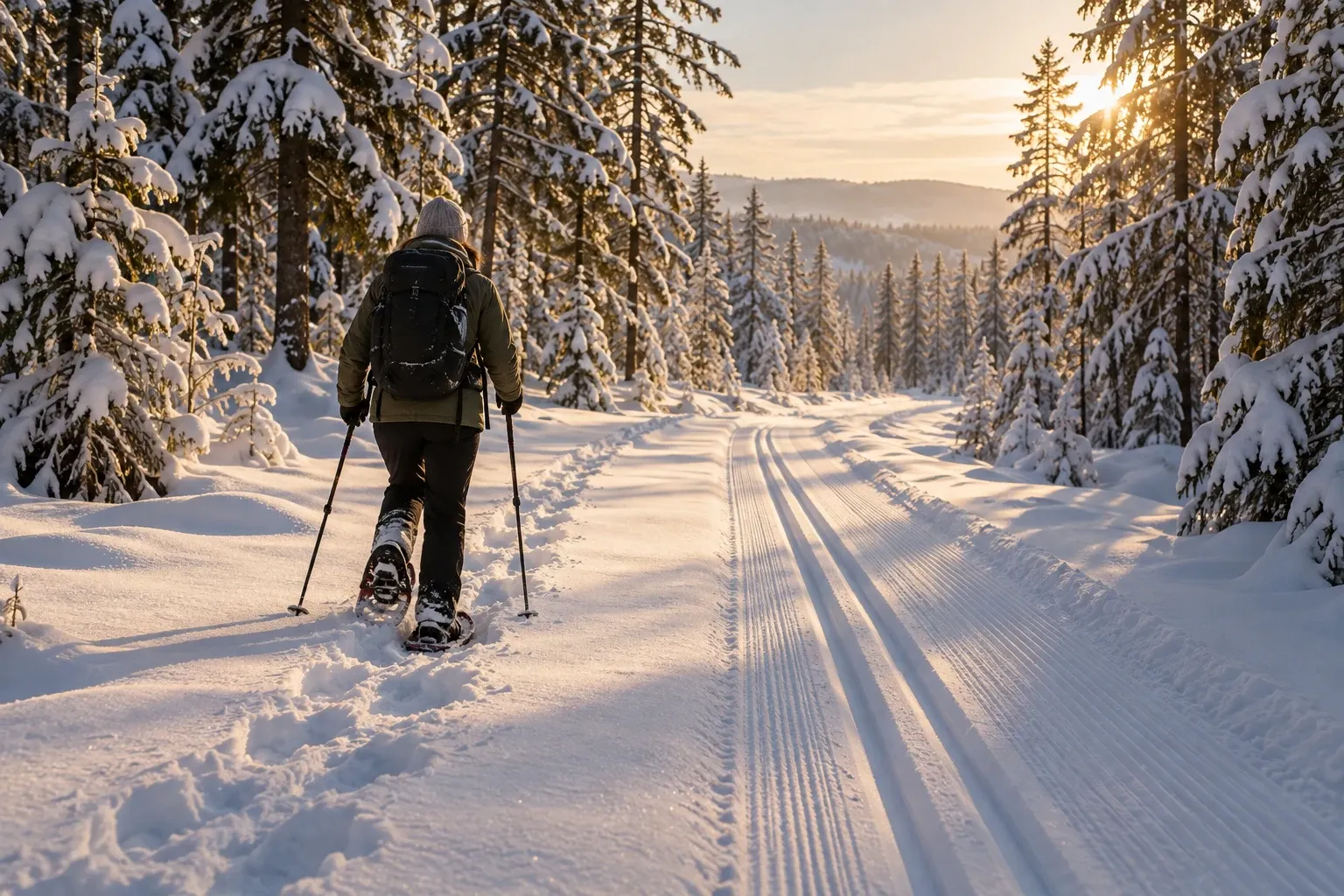
You don’t need a tour, a permit or a ticket to snowshoe in Sweden. You need snowshoes, snow, and a feel for the few places where the rules are real: ski tracks, snowmobile trails, frozen lakes, steep slopes and reindeer.
When you need this
You’re in Sweden in winter, you don’t ski, and the cleared paths feel too tame. Maybe you spotted snowshoes at a free lending library, or a tour brochure offers a snowshoe walk and you wonder whether you could just go yourself. Or you’re standing at the edge of a groomed ski track, a snowmobile trail or a white, frozen lake, and it looks like the easy way across.
Your right to walk: no permit, no fee
Snowshoes (snöskor) let you walk on deep snow where boots would sink. That makes them the easiest way into a Swedish winter forest or onto the fells for anyone without ski experience.
Sweden has no permit, fee or separate rulebook for snowshoeing. It is travel on foot, and allemansrätten, the right of public access anchored in the Swedish constitution, lets everyone move on foot across land they don’t own. The one duty that comes with it is inte störa – inte förstöra: do not disturb, do not destroy. The county board in Jämtland says it outright for the mountains: on winter trails shared with snowmobiles, skiing, snowshoeing and dog sledding are all allowed.
National parks and nature reserves can have their own regulations, so read the park page before a winter visit. Many of them treat snowshoes as standard winter kit (more on that below). The right of public access itself is explained in full in our guide to allemansrätten.
The four lines snowshoers cross without noticing
What you need to know isn’t a permit system. It’s four places with real rules, plus the reindeer:
| Where | The rule | Type |
|---|---|---|
| Groomed ski track | Never walk in it; walk beside it | Track owners’ rules |
| Snowmobile trail | Snowshoes allowed where snowmobiles are; take extra care | County board guidance |
| Snow-covered lake | Snow can hide weak ice; core ice must be 10 cm | Ice-safety council advice |
| Mountain slope | Avoid slopes steeper than 25° | Mountain-safety council advice |
| Reindeer | Disturbing them is prohibited; dogs on a lead near the mountains | Law |
Ski tracks: walk beside, never in
A groomed cross-country track looks like the perfect firm path. It isn’t yours. Svenska Skidförbundet, the national ski federation, and every municipality and resort that grooms tracks forbid walking or running in a prepared track during the snow season. Footprints wreck the grooves for every skier after you, and snowshoes leave even deeper holes than boots.
The fix is easy, because snowshoes are made for the soft snow next to the track. Walk beside it and cross quickly where you must. Our guide to cross-country skiing in Sweden has the full track etiquette, and floodlit trails covers evening walks in the dark months.
Snowmobile trails: shared, with care
Snowmobile trails (skoterled, marked by blue-and-white signs showing a snowmobile) are different. Länsstyrelsen Jämtland states that along winter trails where snowmobiles are allowed, skiing, snowshoeing and dog sledding are allowed too, and everyone must take extra care and show consideration.
In Jämtland’s regulated mountain areas, the trail is 3 m wide on each side of the poles. Snowmobiles may run only on well snow-covered ground, and only until 19 April (2 May on some northern trails). Other counties set their own dates. In practice: walk at the edge and listen. You share the trail by right, but you don’t have it to yourself.
Frozen lakes: snow hides the danger
This is where snowshoers are most exposed. Issäkerhetsrådet, Sweden’s ice-safety council, is blunt about snow-covered ice:
- Snow on the ice does not mean the ice is safe; it can hide weak spots.
- Darker areas may be weaker ice.
- In soft footwear you can get far out on weak ice without noticing.
- Other people’s tracks prove nothing; people regularly fall through while following them.
Core ice (kärnis) should be at least 10 cm thick before you go on it, and you should never go alone. The council warns that skis spread your weight and carry you far onto weak ice, and that climbing out with skis on is nearly impossible. It doesn’t mention snowshoes, but they spread your weight the same way, so stay near the shore.
On marked mountain winter trails, lake crossings are shown with spruce twigs (ruskor) or reflector posts instead of crosses. Everywhere else, when in doubt, walk round. Before any lake crossing, read our ice safety guide.
Avalanche slopes: it’s the slope, not the sport
Avalanche risk depends on the terrain, not on whether you ski or walk. Fjällsäkerhetsrådet, the national mountain-safety council, advises avoiding slopes steeper than 25° and warns that most avalanches come the day after a heavy snowstorm. Following the marked winter trails reduces your exposure.
Naturvårdsverket publishes daily avalanche forecasts on lavinprognoser.se in winter, but only for six areas: Abisko/Riksgränsfjällen, Kebnekaisefjällen, Västra Vindelfjällen, Södra Lapplandsfjällen, Södra Jämtlandsfjällen and Västra Härjedalsfjällen. Everywhere else you judge the risk yourself, and the forecaster stresses that your choices are your responsibility. If you go off-trail in steep terrain, the council’s advice is a transceiver, shovel and probe, with companions trained to use them.
A few more mountain basics:
- Red crosses mark a route, not a safe corridor. The poles stand about 40 m apart; in a whiteout you still need map and compass.
- Leave a travel plan with someone at home, with your route and expected return, and sign hut and shelter guestbooks.
- Help phones in most mountain huts and rest shelters reach an alarm centre, even out of season. Rest shelters (rastskydd) are for breaks; overnight only in an emergency.
- Cold drains phone batteries fast, so a phone map alone is not enough. 112 works without a SIM card if any network reaches you.
Our mountain safety guide covers fjäll trips in full.
Reindeer and dogs
In reindeer herding country, disturbing reindeer and reindeer herding is prohibited by law. The county board puts it simply: reindeer have right of way, so stop and let them move off calmly or take another route, and if they run, you were too close. They are most sensitive in April–May, during calving, which is right in the heart of the snowshoe season.
Dogs must be kept on a lead in and near the mountains in any month. Everywhere else in Sweden, dogs must be kept from running loose in nature from 1 March to 20 August, so a March snowshoe walk is already leash season. More in reindeer herding land and dogs in nature.
Where and when to go
Snow decides everything, and Sweden’s snow is very uneven. SMHI’s maps (based on 1961–1990 averages) show:
| Region | Snow cover |
|---|---|
| Norrland mountains and northern Lappland | More than 200 days a year; first snow on the high fells in September, often lasting into June |
| Northernmost valleys | First snow cover usually in early October |
| Götaland coast | Under 50 days a year; in mild winters no lasting snow at all |
| Southernmost Sweden | Last snow-covered days usually in late March |
SMHI expects snow cover to shrink, so treat snowshoeing in the south as a bonus, not a plan.
Forest parks are the easy, avalanche-free start. National park pages recommend snowshoes for winter: Fulufjället lists skis, snowshoes and a marked snowmobile trail; Tiveden suggests boots or snowshoes; and Skuleskogen warns that all its trails are summer trails, so in winter you need a map and snowshoes or skis to follow them. See Skuleskogen, Tiveden and Fulufjället.
In the mountains, the core season is late February to April. The polar night is over (in Kiruna it lasts 27 days around midwinter, with only some hours of twilight), the snow is deep, and STF’s mountain huts are open for the winter season from late February to around the turn of April and May. That makes hut-to-hut trips on snowshoes possible; see STF mountain huts.
Two body hazards come with the bright spring snow and the cold. Sunlight reflected off snow can injure your eyes, so wear sunglasses. Frostbite comes quietly: white, cold patches on cheeks, nose or ears need warming at once, skin against skin. Our cold safety guide covers both frostbite and hypothermia.
Getting snowshoes
Borrow before you buy. Fritidsbanken, a network of free sports-equipment libraries, lends gear for up to 14 days at no cost. What each branch has depends on donations; the Östersund branch lists snowshoes among the gear it lends. Ask the branch first, especially in a cold snap. Our Fritidsbanken guide explains how borrowing works for visitors.
Guided outings are the other route. In the Kiruna area, aurora tours run by snowshoe as well as by car, snowmobile, dog sled or ski; what is included is set by the operator.
Practical information
| Item | Detail |
|---|---|
| Snowshoeing under allemansrätten | Free, no permit |
| Borrowing at Fritidsbanken | Free, up to 14 days; stock not guaranteed |
| Avalanche forecast | Free at lavinprognoser.se; six areas; preliminary 2026/27 start 11 December, so from about mid-December |
| Snowmobile season on Jämtland regulated trails | Until 19 April (2 May on some northern trails) |
| Dog leash period in nature | 1 March – 20 August; near the mountains all year |
| Minimum core ice | 10 cm |
| Avalanche rule of thumb | Avoid slopes steeper than 25° |
| Guided outing | Price set by the operator |
| Emergency | 112; help phones in most mountain huts and shelters |
FAQ
Do you need a permit to go snowshoeing in Sweden?
No. Snowshoeing is walking, and the right of public access lets everyone move on foot across land they do not own, free and without asking. The limits are the usual ones: do not disturb people or animals, do not damage anything, and follow any national park or reserve rules. Never walk in groomed ski tracks, which are for skiers only.
Can I snowshoe on ski tracks or snowmobile trails?
Not in groomed ski tracks: walking in them breaks Svenska Skidförbundet’s rules and every track owner’s rules, so walk beside them. Snowmobile trails are different. Länsstyrelsen Jämtland says that where snowmobiles are allowed along a winter trail, snowshoeing, skiing and dog sledding are allowed too, but everyone must take extra care. Walk at the edge and listen for traffic.
When is the snowshoeing season in Sweden?
It depends on where you are. The northern mountains have snow cover for more than 200 days a year on average, from September or October into May or June. The Götaland coast averages under 50 days and some winters get no lasting snow. For most mountain trips, late February to April is best: deep snow, the polar night is over and STF’s winter huts are open.
Where can I borrow or rent snowshoes in Sweden?
Fritidsbanken, a network of free sports-equipment libraries, lends gear for up to 14 days at no cost, and its Östersund branch lists snowshoes. Stock depends on donations, so ask the branch first, especially in a cold snap. Guided outings, such as aurora tours in the Kiruna area, include snowshoes in some packages; what is included is set by the operator.
Is it safe to snowshoe across a frozen lake?
Only if you know the ice. Issäkerhetsrådet warns that snow on the ice can hide weak spots, that other people’s tracks prove nothing, and that core ice should be at least 10 cm thick. Never go alone, and carry ice claws. On marked winter trails, lake crossings are shown with spruce twigs or reflector posts. When in doubt, walk round.
Do I need avalanche gear for snowshoeing?
Not on forest trails or flat lowland. In the mountains, avalanche risk depends on the slope, not on whether you ski or walk. Fjällsäkerhetsrådet advises avoiding slopes steeper than 25° and taking most care the day after heavy snow. Check lavinprognoser.se, which covers six areas. Off-trail in steep terrain, it advises transceiver, shovel and probe with trained companions.
Related guides
- Cross-country skiing in Sweden — the track rules snowshoers must respect, and the next step if you want to try skis.
- Mountain safety in Sweden — travel plans, help phones and weather for any winter day on the fells.
- Ice safety in Sweden — how to judge lake ice before you cross it.
- Fritidsbanken: free gear — where to borrow snowshoes without paying.
- STF mountain huts — for hut-to-hut trips in the late-winter season.
Facts verified 2026-10-15. Sources: Länsstyrelsen Jämtland, Naturvårdsverket (lavinprognoser.se, allemansrätten), Fjällsäkerhetsrådet, Issäkerhetsrådet, SMHI, 1177, Svenska Skidförbundet, Sveriges nationalparker, Fritidsbanken — full register in this topic’s source file. Found something outdated? Tell us and we’ll fix it.