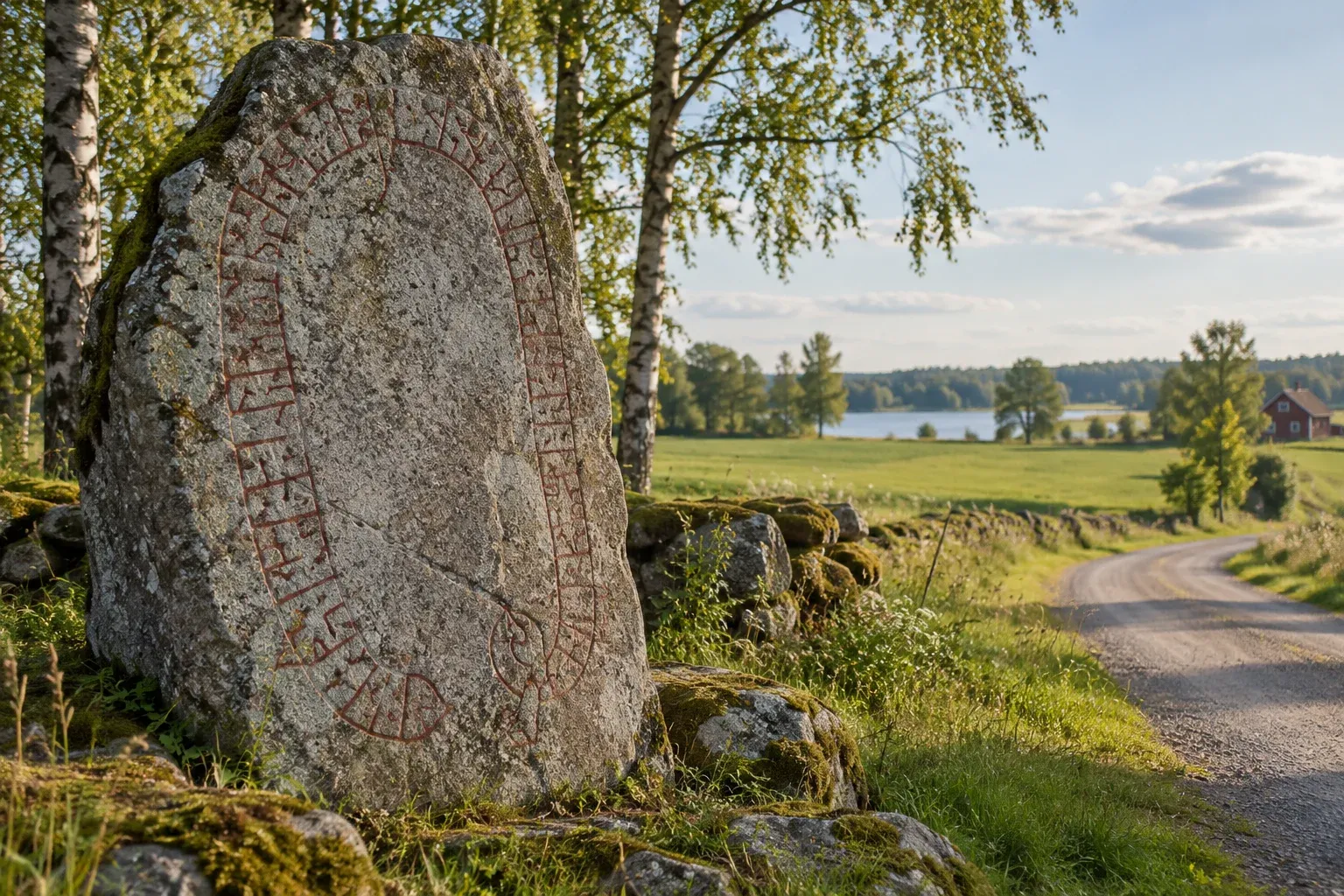
Runestones are the one thing from the Viking Age you will meet by accident: by a road, outside a church, at the edge of a field. Here is where they cluster, how to read the one in front of you, and what the law asks of you while you stand there.
When you need this
You are driving or cycling around Uppland and keep passing grey stones with carved bands. You are planning a day north of Stockholm, or a stop at Rök on the way through Östergötland. Or you are standing in front of a stone, wondering what it says, whether the red paint is original, and whether you may touch it.
How many runestones, and where
A runsten (runestone) is a raised stone carved with runes. Most Swedish ones went up in about a century, from the end of the 900s to the beginning of the 1100s, as memorials to the dead. They usually stood by roads, bridges and waterways, where as many people as possible would pass and read them. They were memorials, not gravestones, and probably also served as records of who inherited what.
No other country has as many. Denmark has about 300 from the Viking Age and Norway no more than about 50. Upplandsmuseet’s 2023 handbook counts almost 2,900 runestones in Sweden out of just under 3,400 known worldwide, counting carvings on fixed boulders and rock faces. The Swedish National Heritage Board (Riksantikvarieämbetet, RAÄ) publishes no runestone total. Its figure is more than 4,000 runic inscriptions of every kind. If you have read “about 2,500 runestones”, that number comes from older guides and a narrower definition.
| Area | Runestones |
|---|---|
| Uppland (Stockholm and Uppsala counties) | More than 1,300, the most of any province |
| Stockholm County | 852 known inscriptions in stone, 595 still out in the landscape (2017) |
| Uppsala County | 632 known inscriptions, 430 standing outdoors (2023) |
| Sigtuna | About 30 in town, at least 170 known in the municipality |
| Östergötland | About 250, many near Skänninge and on Vikbolandet, plus Rök |
Where to see them
Near Stockholm, start with Jarlabanke. This chieftain from Täby raised six stones in his own memory while he was still alive. Four stood at his bridge in Täby and announce that he “alone owned all of Täby”. A fifth stands at Vallentuna church, and the sixth is lost. In Danderyd, Norahällen (U 130) is a carved rock face by the rune carver Åsmund Kåresson. It once stood by the water and now sits far inland, because the land has risen since the Viking Age.
Sigtuna has about 30 stones in its streets, and the museum publishes a free runestone walk in English. Our Sigtuna guide covers the town and how to get there.
Rök, Östergötland. The Rök stone (Ög 136) stands outside Rök church. RAÄ calls it Sweden’s most famous runestone and the longest runic inscription there is, with more than 760 characters. It was carved in the 800s, about 200 years before most Swedish runestones, and an exhibition at the site explains it.
Adelsö, near Birka. The runestone at Hovgården’s old harbor was carved around 1070, and two more are built into the sacristy wall of Adelsö church. See Birka and Hovgården.
Skansen, Stockholm. RAÄ’s rune unit painted a runestone at Skansen in several colors to show how a multicolored stone may have looked.
Everywhere else, open Fornsök, RAÄ’s free search and map service of every registered ancient remain in Sweden. Zoom to where you are; you are rarely far from a stone in Uppland. RAÄ calls runestones excellent places to visit, especially in summer.
How to read a runestone
You do not need to learn the runes to know what a stone says.
- Find the code. Each stone has a code, often shown on its sign, such as U 379 (Uppland) or Ög 136 (Östergötland). The codes come from Sveriges runinskrifter, the national edition published since 1900.
- Look it up in Runor, RAÄ’s database of about 7,000 inscriptions, for the reading, translation and photos.
- Follow the band. The text is typically carved inside a winding band, the runslinga.
- Expect the formula. Most inscriptions name who raised the stone, the dead person and their relationship, often with a prayer. RAÄ’s example: “Halvdan had this stone raised after Joger, his brother, and Gudfrid after his son. God help his soul.”
- Look for the cross. In the busiest period, most stones carry Christian signs: a cross or a prayer for the soul.
If you do want to try the runes themselves, it helps to know which alphabet you are looking at:
| Older futhark | Younger futhark | |
|---|---|---|
| Number of runes | 24 | 16 |
| In use | From about AD 0 into the 700s | From the early 700s, through the Viking Age |
| Where you see it | Rare early inscriptions | Almost every Viking Age runestone |
The name futhark comes from the first six runes, f u þ a r k. The younger futhark had far fewer runes than the language had sounds, so one rune often stood for several. Each rune had a name and stood for the sound its name began with: the s-rune was sol (sun), the n-rune nöd (need). That is why Runor’s readings beat a rune chart from a souvenir shop.
Many stones have no sign at all. A 2017 survey of Stockholm County found information signs at only 58% of the stones still out in the landscape, and many of those were worn or vandalized. Fornsök and Runor fill the gap.
The red paint: then and now
Runestones were painted in the Viking Age. RAÄ says a finished stone was painted too: surviving fragments show the carved lines filled in red, made from iron or lead oxide, with soot for black. A stone found at Spånga church in Stockholm has traces of cinnabar, a red pigment that had to be imported.
Today’s red paint is modern conservation. The county administrative board (länsstyrelsen) orders and permits all work on runestones. A paintings conservator may touch up faded paint. Where most of it is gone, an RAÄ runologist is called in to paint the runes, because deciding what an unclear rune is takes language expertise. Whatever is added must be removable. Deep cleaning and repairs are for trained conservators.
What the law means at the stone
Every runestone is a protected ancient remain (fornlämning). The Historic Environment Act (Kulturmiljölagen) lists “raised stones and stones and rock surfaces with inscriptions” by name.
| What | Status |
|---|---|
| Looking, reading, photographing | Free, no permission needed |
| Moving, covering, altering or damaging a stone | Forbidden without a permit (law, 2 kap. 6 §) |
| Damaging one deliberately or through carelessness | Fornminnesbrott: fines or up to six months in prison; up to four years if gross (law, 2 kap. 21 §) |
| Painting the runes yourself | A crime: the county museum’s handbook warns it is fornminnesbrott and risks prosecution |
| Climbing, or leaning a bike or bag against a stone | Never, per the county museum’s handbook |
| Digging around a stone | Forbidden: you are standing on the ancient remain |
The law does not literally say “do not touch”. What it forbids is altering or damaging, which is why chalk, rubbings, paint and scraping are the problem. Do not scrape off lichen either. It is often a sign of clean air, and scraping takes the carved surface with it. Local volunteers who care for stones work with the landowner’s permission and the county museum’s rules: soft brush and tap water only, no pressure washers, metal tools or household chemicals.
Mistakes to avoid
- Calling them gravestones. They are memorials, raised by roads and crossings to be read.
- Assuming they are pagan. Most from the busiest period carry a cross or a Christian prayer.
- Assuming the red paint is ancient. It is modern, applied by specialists, though Viking Age painters used red too.
- Chalking the runes for a better photo. Wait for low, raking light instead; unpainted runes show best when the sun is low or after rain.
- Quoting “2,500 runestones”. The 2023 count is almost 2,900, with carved boulders and rock faces included.
Practical information
| Item | Cost or detail |
|---|---|
| Visiting a runestone in the landscape | Free, no ticket, no opening hours |
| Fornsök (map of ancient remains) | Free online, RAÄ |
| Runor (readings and translations) | Free online, RAÄ |
| Sigtuna runestone walk | Free PDF in English, Sigtuna Museum & Art |
| Best light | Low sun in spring and autumn, or flat light after rain |
| Winter | Snow can cover low stones and their signs |
FAQ
How many runestones are there in Sweden?
Almost 2,900, out of just under 3,400 known in the world, according to Upplandsmuseet’s 2023 count, which includes carvings on fixed boulders and rock faces. RAÄ publishes no runestone total, but says Sweden has more than 4,000 runic inscriptions of all kinds and more runestones than any other country. Uppland alone has more than 1,300.
Where can I see runestones near Stockholm?
Uppland has more than 1,300, so you rarely need to go far. Good starting points are Jarlabanke’s stones at his bridge in Täby and at Vallentuna church, the carved rock Norahällen in Danderyd, and Sigtuna, with about 30 stones in town and a free English runestone walk. Fornsök shows every registered stone on a map.
What is the Rök runestone?
The Rök stone (Ög 136) stands outside Rök church in Östergötland. RAÄ calls it Sweden’s most famous runestone and the longest runic inscription there is, with more than 760 characters. It was carved in the 800s, about 200 years before most Swedish runestones, and there is an exhibition at the site explaining it.
How do you read a runestone?
Find the code on the sign, such as U 379, and look it up in RAÄ’s Runor database for the reading and translation. On the stone, follow the band of runes. Viking Age stones use the 16-rune younger futhark, where one rune can stand for several sounds. Most say who raised the stone, for whom, and their relationship.
Can I touch, chalk or paint a runestone?
Looking and photographing are fine. Altering or damaging an ancient remain is a crime, and the county museum’s handbook warns that painting a runestone yourself is fornminnesbrott and risks prosecution. Never chalk, rub, scrape, climb or lean anything against a stone. Repainting is specialist work ordered by the county board.
Were runestones originally painted?
Yes. RAÄ says finished stones were painted in the Viking Age: fragments with original paint show the carved lines filled in red, made from iron or lead oxide, with soot for black. A stone at Spånga church in Stockholm has traces of imported cinnabar. Today’s red paint is modern conservation, not the original.
How do I find runestones near me?
Use Fornsök, RAÄ’s free search and map service, which lists all known registered ancient remains in Sweden. Zoom to where you are and look for runic inscriptions, or search by place. Many stones stand by roads and churches; in Stockholm County a 2017 survey found information signs at 58 percent of them.
Related guides
- Viking sites in Sweden — Birka, Gamla Uppsala, Sigtuna and Ales Stenar in one plan.
- Sigtuna — the town with about 30 runestones in its streets, and how to get there.
- Birka and Hovgården — the boat trip that also takes you to Adelsö’s runestones.
- Uppsala — the base for exploring Uppland’s runestone country.
- Tanum rock carvings — the other kind of ancient carving, with its own debate about red paint.
Facts verified 2026-10-06. Sources: Sveriges Riksdag (Kulturmiljölagen), Riksantikvarieämbetet, Stiftelsen Upplandsmuseet, Stockholms läns museum, Sigtuna Museum & Art, Ekerö kommun and UNESCO — full register in this topic’s source file. Found something outdated? Tell us and we’ll fix it.