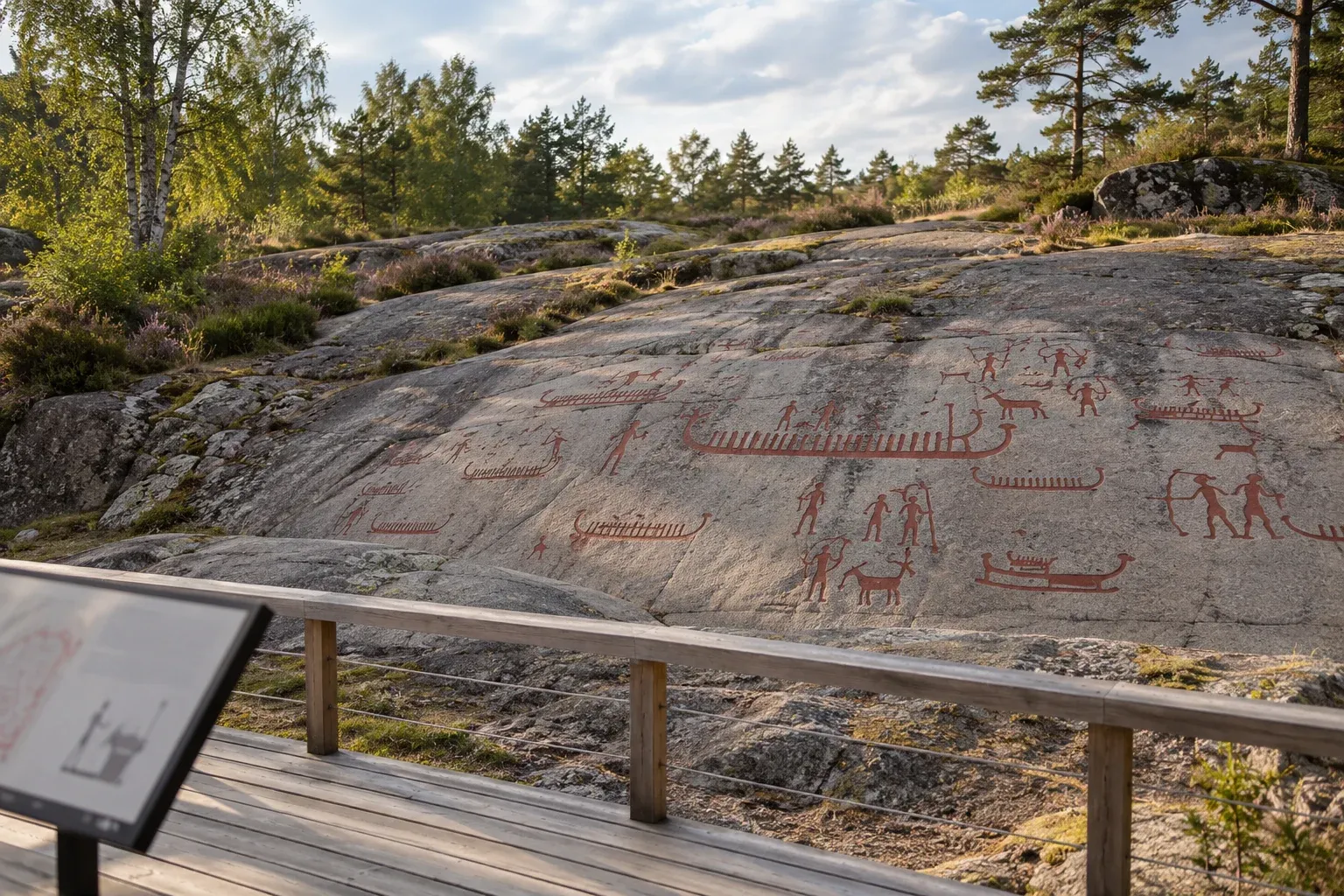
Some 3,000 years ago, people in northern Bohuslän cut ships, bulls, warriors and lovers into the granite by the sea. Here is how to see the best of them in half a day, when the light shows them, and what you must not do on the rock.
When you need this
You are driving the E6 or the Bohuslän coast and wondering whether Tanum is worth the stop. You want to go without a car, and the timetable shows no trains. Or you are travelling out of season, bringing children, a dog or a wheelchair user, and need to know what is actually open.
The four sites in one loop
The Rock Carvings in Tanum have been a UNESCO World Heritage Site since 1994. Riksantikvarieämbetet, the National Heritage Board, counts more than 350 groups of carvings in Tanum, made about 1800–500 BC. Other official counts run to 450 or 600 because they count find-spots rather than groups. The carvings were cut at the waterline; land uplift has since lifted them 25–30 m above the sea.
You do not need to find them all. Four sites have paths, information boards, free parking and toilets, and all lie within 5 km of Vitlycke museum:
| Site | From the museum | What you see | Painted? |
|---|---|---|---|
| Vitlycke | 300 m on a gravel path | A panel over 20 m long with about 500 figures, including the Brudparet (Bridal Couple) | Yes |
| Aspeberget | 700 m south | Seven panels on a 1 km trail: deep-cut bulls and boats, and eleven figures marching in a line | Mixed |
| Litsleby | 1.8 km | The Spjutguden (Spear God), a man 2.3 m tall | Yes |
| Fossum | 5 km, road 163 | About 130 figures — hunting scenes, deer, the Fossum woman — plus the unpainted Balken panel with a sun horse | Main panel yes, Balken no |
A good half-day runs in that order: the museum and Vitlycke first, then Aspeberget, Litsleby and Fossum. For a full day, add the 6 km trail via Lövåsen, Gerumshällen and Sotetorp, which starts from a car park 4 km from the museum and passes unpainted carvings and old croft ruins.
Vitlycke museum: the visitor centre
The museum is not where the carvings are; it is the visitor centre beside the Vitlycke panel, run by Region Västra Götaland. It has exhibitions and a reconstructed Bronze Age farm; the carvings themselves you reach on foot or by car.
In 2026 it opened from 1 April to 30 October and is closed from November to March. In high season (22 June – 30 August in 2026) the ticket includes a guided tour of the Vitlycke panel in Swedish or English. Everyone under 20 and students get in free. Hours and the ticket price are in the practical table below.
Why the carvings are painted red
To make them easy to see. The red is modern. Filling carvings with paint became a Scandinavian practice in the 1930s, and no trace of Bronze Age paint has ever been found, so nobody knows whether the carvers coloured them.
The debate is about the stone. Tanum’s site managers say painting “can lead to weathering” and does nothing to preserve the carvings. So Länsstyrelsen Västra Götaland, the county administrative board, is very restrictive: in principle, only carvings already painted are considered for touch-ups, and many panels are left unpainted.
That is why the experience differs from panel to panel — and why you should never add your own chalk or paint.
When the carvings look best
Painted panels read well at any hour. Unpainted ones need släpljus, raking light, that throws the grooves into shadow:
- Late afternoon: the site managers recommend visiting Balken at Fossum when the sun is lower.
- Rain: the unpainted carvings on top of Aspeberget are easier to see on a rainy day.
- Darkness: the sites are open 24/7, so bring a torch and hold it low across the rock. The museum says the carvings stand out more clearly and in more detail than by day.
- Fossum’s lights: a light installation at Balken can be switched on in the evening and lights the carvings at an angle.
Groups can also book a 1.5-hour night tour with a guide, from late July to late May, as long as the rock is free of snow and ice.
The rules: never step on the rock
The carvings are ancient monuments under the Kulturmiljölagen (Cultural Environment Act), which names rock surfaces with images and carvings explicitly. These are the rules, sorted by how binding they are:
| Rule | Status |
|---|---|
| No altering, covering or damaging an ancient monument without a permit; a breach is fornminnesbrott, with fines or up to six months in prison, four years if aggravated | Law |
| Carvings may not be stepped on (får ej beträdas) | Site rule (Länsstyrelsen) |
| Stay on paths and photograph from the platforms | Site rule (Vitlycke museum) |
| Many carvings are on private land: respect barriers, park only in marked car parks | Site rule (Länsstyrelsen) |
| Dogs welcome outdoors; only assistance dogs inside the museum | Museum rule |
Walking on, chalking or rubbing a carving is not etiquette: it risks the offence. The everyday danger is to you — wet granite and Aspeberget’s steep steps are slippery, so wear shoes with grip.
Some panels are covered: the first panel at Aspeberget from autumn to spring, and other damaged carvings permanently. The biggest find in 30 years, a panel with 22 ships at Litsleby rediscovered in April 2026, is on a private forest road, not open to visitors and being covered again.
Getting there in 2026
By car: leave the E6 at exit 105 for Tanumshede and follow the signs from Tanum church. The museum car park takes 140 cars and is free, as is parking at all four sites. Gothenburg is 136 km away, about 1 hour 40 minutes.
Without a car — read this first: Norra Bohusbanan, the railway to Strömstad, is closed for an overhead-line renewal. No trains serve Tanumshede until at least 12 December 2026. Replacement bus 38A stops at Tanumshede bus station, and line 38R also serves Tanum. Tanum municipality expects trains along the whole Strömstad–Gothenburg line again from 15 March 2027; Trafikverket says only “2027”.
From Tanumshede, the nearest bus stop to the museum is Hoghem, 500 m away; central Tanumshede is 3 km. Plan the trip with Västtrafik — see our guide to Sweden without a car.
Accessibility: Litsleby is the most accessible panel in the World Heritage site. The museum lends a wheelchair and has an adapted toilet. An E6 rest area 3.5 km south of exit 105 has a ramp to a viewpoint over the World Heritage area.
Combining Tanum with the coast
Tanum sits between two of the best stretches of the Bohuslän coast. Fjällbacka is 17 km away and Strömstad 32 km, where boats leave for the Koster islands. On our west coast road trip, Tanum is Day 4. Combine an afternoon on the coast with the carvings at sunset or after dark.
Practical information
| Item | Details |
|---|---|
| Rock carvings | Free, 24/7, all year |
| Parking | Free at the museum (140 cars) and at all four sites |
| Vitlycke museum 2026 | 1–30 April 10–16 · 1 May–31 August 10–17 · 1 September–30 October 10–16 · closed November–March |
| Museum ticket | Paid; set yearly, higher in high season when a guided tour is included; free under 20 and for students |
| Group and night tours | Bookable in Swedish or English; paid per group |
| Trains | None to Tanumshede until at least 12 December 2026 — replacement buses |
| Nearest bus stop | Hoghem, 500 m from the museum |
| By car | E6 exit 105; Gothenburg 136 km |
FAQ
Is it free to visit the Tanum rock carvings?
Yes. The carvings at the prepared sites — Vitlycke, Aspeberget, Litsleby and Fossum — are free and open around the clock, all year, and parking is free at all four. Only Vitlycke museum, the visitor centre beside the Vitlycke panel, charges admission, and everyone under 20 and students get in free. Guided group tours are booked and paid separately.
How long do you need at Tanum?
Half a day covers the essentials: Vitlycke museum and the Vitlycke panel 300 m away, then Aspeberget at 700 m, Litsleby at 1.8 km and Fossum about 5 km away, all with their own free parking. A quick stop at the Vitlycke panel alone takes under an hour. Add the 6 km Gerum trail for a full day.
Why are the rock carvings painted red?
To make them easy to see. The red is modern: filling carvings with paint became a Scandinavian practice in the 1930s, and no trace of Bronze Age paint has ever been found. Today Länsstyrelsen is very restrictive, because paint does not protect the stone and can speed up weathering; in principle only carvings already painted get touch-ups.
Can you walk on the rock carvings?
No. At the prepared sites the carvings may not be stepped on; use the paths and take photos from the platforms. The carvings are ancient monuments under the Cultural Environment Act, and altering or damaging one without a permit is the crime fornminnesbrott, punishable by fines or up to six months in prison. Chalking and rubbings put the surface at risk too.
How do I get to Tanum without a car?
By bus in 2026. Trains through Tanumshede to Strömstad are suspended until 12 December 2026, and replacement bus 38A stops at Tanumshede bus station. The nearest stop to Vitlycke museum is Hoghem, a 500 m walk; central Tanumshede is 3 km away. Trains along the whole Gothenburg–Strömstad line are expected back in 2027.
When is the best time to see the carvings?
Painted panels read well any time. Unpainted ones show best in raking light: late afternoon when the sun is low, on a rainy day when the rock is wet, or at night with a torch. Summer brings daily guided tours of the Vitlycke panel; from November to March the museum is closed and some panels are covered.
Can I see the carvings at night?
Yes. The sites are open 24/7, so you can bring your own torch and hold it low across the rock. Groups can book a 1.5-hour night tour from late July to late May, when the rock is free of snow and ice. At Fossum, a light installation at the Balken panel can be switched on in the evening.
Related guides
- Bohuslän and the west coast — where to base yourself around Tanum, with or without a car.
- West coast road trip — the coast route from Gothenburg with Tanum as Day 4.
- Smögen and Fjällbacka — the nearest coast towns, 17 km from the carvings.
- Sweden’s UNESCO World Heritage Sites — the other fourteen and how to reach them.
- Viking sites in Sweden — runestones are far younger, but the same law protects them.
Facts verified 2026-10-01. Sources: Riksantikvarieämbetet, Länsstyrelsen Västra Götaland, Vitlycke museum, Trafikverket, Tanum municipality and the Swedish Cultural Environment Act — full register in this topic’s source file. Found something outdated? Tell us and we’ll fix it.