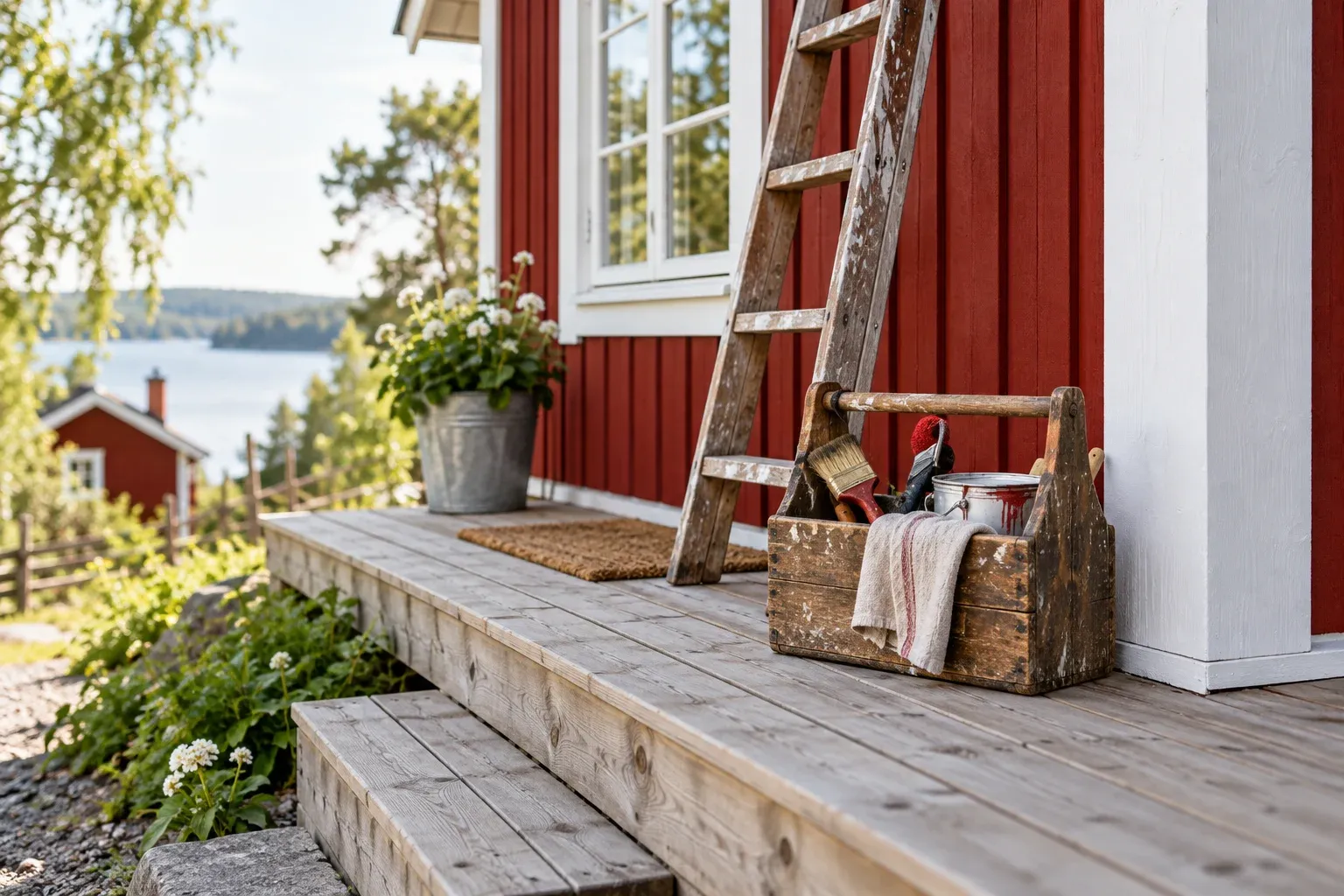
Swedish cleaners, painters and gardeners usually quote prices with a tax reduction already taken off. Here’s how that discount works, the 2026 numbers, who actually qualifies, and the two traps that send newcomers a second bill.
When you need this
- A cleaner, painter, plumber or gardener quotes you a price “after RUT” or “after ROT”
- An invoice shows a line called Skattereduktion, ROT-avdrag or RUT-avdrag
- A company asks for your personnummer (personal identity number) before doing the job
- You’re moving out and are offered a move-out clean (flyttstädning) with RUT
- You own, or are buying, a summer house in Sweden and plan repairs
- Your tax return shows an approved ROT or RUT reduction, or says you owe money back
What ROT and RUT are
The two names are acronyms. ROT stands for reparation, ombyggnad, tillbyggnad (repair, conversion, extension) and covers work on a home. RUT stands for rengöring, underhåll, tvätt (cleaning, maintenance, laundry) and covers household services. In law they’re one scheme, a tax reduction for household work, and Swedes simply say rotavdrag and rutavdrag.
RUT started on 1 July 2007 and ROT on 8 December 2008. The Riksdag’s tax committee describes the aim as raising labor supply and turning work households would otherwise do themselves into paid jobs. Cutting undeclared work in cleaning and building was part of the debate too.
2026 update: ROT is back at 30% from 1 January 2026. The 50% rate you may see online applied only to work paid between 12 May and 31 December 2025. ROT and RUT also share one cap again: 75,000 kr per person a year, of which ROT at most 50,000 kr. Pages from 2024–2025 that show separate caps are out of date.
How it works on the invoice
You almost never apply for anything yourself. Under the invoice model (fakturamodellen), the company does the paperwork:
- You give the company your personnummer or coordination number, plus the property designation for ROT work.
- The invoice separates labor, materials and travel. The company takes 30% (ROT) or 50% (RUT) off the labor part, VAT included.
- You pay the rest electronically: bank transfer, card or Swish. Never cash.
- After the work is done and paid, the company claims the difference from Skatteverket, at the latest on 31 January the following year.
- Next spring the reduction appears pre-filled in your tax return, where it’s checked against the tax you actually paid.
Two worked examples under the 2026 rules:
| Job | Labor incl. VAT | Reduction | Materials |
|---|---|---|---|
| Bathroom repair (ROT) | 20,000 kr | 6,000 kr off (30%) | Paid in full |
| Home cleaning (RUT) | 4,000 kr | 2,000 kr off (50%) | Paid in full |
If Skatteverket refuses the claim, most contracts let the company bill you the difference. That’s contract practice, not law, so read the terms on any large job.
Who qualifies
The law sets three conditions: you are 18 by the end of the year, you are taxed as a Swedish resident for at least part of that year, and you’ve paid for the work. People living abroad qualify only if their earned income is exclusively or almost exclusively Swedish, which Skatteverket reads as at least 90%. Nationality plays no role.
| You are… | ROT | RUT | Why |
|---|---|---|---|
| A tourist on holiday | No | No | Not taxed in Sweden |
| A resident with a Swedish job | Yes, if you own the home | Yes | Within the tax you pay |
| An EU citizen living and working in Sweden | Same as any resident | Same as any resident | Nationality doesn’t matter |
| A student with little Swedish income | Rarely useful | Rarely useful | No tax to set it against |
| Living abroad, owning a Swedish cottage | Only with ≥ 90% Swedish income | Same | Ownership alone isn’t enough |
| A tenant | No | Yes | ROT needs ownership; RUT doesn’t |
Being eligible isn’t the end of it. The reduction is set against your income tax, property fee and property tax for the year, and anything above that isn’t paid out. That’s why newcomers who arrive late in the year, or students living on savings, can end up repaying it. Registering as a resident is covered in our guide to folkbokföring, and the number companies ask for in the personnummer explained.
What counts and what doesn’t
RUT is a fixed list written into the statute: cleaning and move-out cleaning, laundry, snow clearing, garden work like mowing, hedges and tree felling, childcare, personal care, moving, IT help at home, repairs to white goods, furniture assembly and simple supervision of the home. It works in a home you own or rent, permanent or holiday, anywhere in the EEA.
ROT covers repair, maintenance, conversion and extension of a home you own. In a bostadsrätt (a co-op apartment) it covers only work inside the flat that you’re responsible for. For the difference between owning and renting, see bostadsrätt vs hyresrätt.
| Not covered | Detail |
|---|---|
| Materials, equipment, travel | Only labor counts |
| New builds | No ROT for a new house or free-standing building; no conversion or extension in the first five years |
| Let-out space | No ROT for the part you let; no RUT while the home is let |
| Insurance or grants | No reduction for work paid by insurance, public grants or the green-technology reduction |
| Hotels and hostels | Not a “home” in the statute |
| Excluded services | Tutoring, pet sitting, dry cleaning, beauty treatments, furniture repair, alarm installation |
The worker can’t be you or a close relative, and the company must be approved for F-tax (F-skatt), Sweden’s registration for businesses that handle their own tax.
Summer houses
This is where foreign owners get caught. A German or Dutch family that owns a Swedish fritidshus (summer house) but lives and works at home usually doesn’t qualify, because the reduction depends on being taxed in Sweden, not on owning Swedish property. The company will bill the full price. Budgeting for this is part of what a Swedish summer house really costs, and worth knowing before buying a summer house as a foreigner.
For Swedish residents it works the other way: ROT and RUT apply to a summer house they own and use, including one elsewhere in the EEA. A foreign company there needs a certificate showing equivalent tax control instead of F-tax. Why so many Swedes own and renovate one is the subject of our guide to sommarstuga culture.
The traps
Warning: A reduced invoice isn’t a guaranteed saving. If your Swedish tax is too low, Skatteverket collects the reduction back as residual tax (kvarskatt) after your return.
- Paying in cash cancels the right. Electronic payment has been a condition since 1 January 2020.
- Using last year’s rate. ROT was 50% only for payments between 12 May and 31 December 2025.
- Expecting a discount on materials or the call-out fee. Only labor counts.
- Missing the year-end. The payment date, not the invoice date, decides which year’s cap applies.
- Assuming the rules stay put. The 2027 budget follows the 13 September 2026 election and can change the rates.
Couples can each claim, so two qualifying owners have two caps. For ROT, though, together they can never get more than 30% of the total labor. A partner can also take over part of a reduction the other can’t use.
Practical information
| Item | 2026 figure |
|---|---|
| ROT rate | 30% of labor incl. VAT |
| RUT rate | 50% of labor incl. VAT |
| Combined cap per person and year | 75,000 kr |
| ROT cap within it | 50,000 kr |
| Temporary 50% ROT | Payments 12 May – 31 December 2025 only (ended) |
| Who | 18+, taxed in Sweden as a resident or with ≥ 90% Swedish income |
| Homes | EEA (Skatteverket also accepts Switzerland); not hotels or hostels |
| Payment | Electronic only |
| Company claim deadline | 31 January the following year |
Rates and caps checked 2026-10-14 against the statute and Skatteverket. We publish no hourly rates for cleaners or tradespeople; they vary by place and trade.
FAQ
How do ROT and RUT work on an invoice?
The company deducts the reduction from the labor part of the bill: 30% for ROT renovation work and 50% for RUT household services. You pay the rest electronically, and the company claims the difference from Skatteverket. Materials and travel are charged in full. The reduction then appears pre-filled in your next Swedish tax return, where it is checked against the tax you paid.
What are the ROT and RUT limits in 2026?
ROT gives 30% off labor and RUT 50%, with a combined cap of 75,000 kronor per person and year, of which ROT may be at most 50,000 kronor. The temporary 50% ROT rate applied only to work paid between 12 May and 31 December 2025. Each qualifying person has their own cap, so a couple can claim twice.
Can tourists or foreigners get RUT or ROT?
Tourists cannot: you must be 18 and taxed in Sweden as a resident, or live abroad with at least 90% of your earned income from Sweden. Nationality does not matter, so an EU citizen or anyone else who lives and pays income tax in Sweden qualifies the same way as a Swede. You also need enough Swedish tax to absorb the reduction.
I own a summer house in Sweden but live abroad. Can I use ROT?
Usually not. Owning the house is not enough: unless you are taxed as a Swedish resident or earn at least 90% of your income in Sweden, the company cannot claim the reduction for you and will bill the full price. Swedish residents can use ROT on a summer house they own and use, including one elsewhere in the EEA.
Can tenants and students use RUT?
Tenants can use RUT, for example for a move-out clean, because RUT does not require owning the home. ROT is for owners only. A student is in a different position: if you have little Swedish income, there is no tax to set the reduction against, and Skatteverket will collect it back as residual tax after the return.
What happens if I don’t have enough tax for the reduction?
The reduction cannot exceed your income tax, property fee and property tax for the year. If the company already deducted more than that, the excess is collected as residual tax after your tax return. A spouse or partner who also qualifies can take over part of a reduction you cannot use.
Why do companies ask for my personnummer?
The company’s claim to Skatteverket identifies you by personal identity number or coordination number, and for ROT also names the property or apartment. That is how Skatteverket checks your eligibility and remaining cap. Without a number to match, the claim usually fails and the company bills you the full price.
Related guides
- Filing a Swedish tax return as a newcomer — where your ROT and RUT reductions show up and get settled
- Why Swedes pay high taxes — the income tax the reduction is set against
- What a Swedish summer house really costs — where ROT fits into an owner’s budget
- Moving house in Sweden — notice periods and the move-out clean RUT helps pay for
- Coordination numbers and bank accounts — the ID a company can use if you have no personnummer
Facts verified 2026-10-14. Sources: Sveriges riksdag (Inkomstskattelag 67 kap., Lag 2009:194 on the invoice procedure, Skatteutskottet), Skatteverket, Regeringen — full register in this topic’s source file. We deliberately publish no hourly rates for cleaners or tradespeople. Found something outdated? Tell us and we’ll fix it.