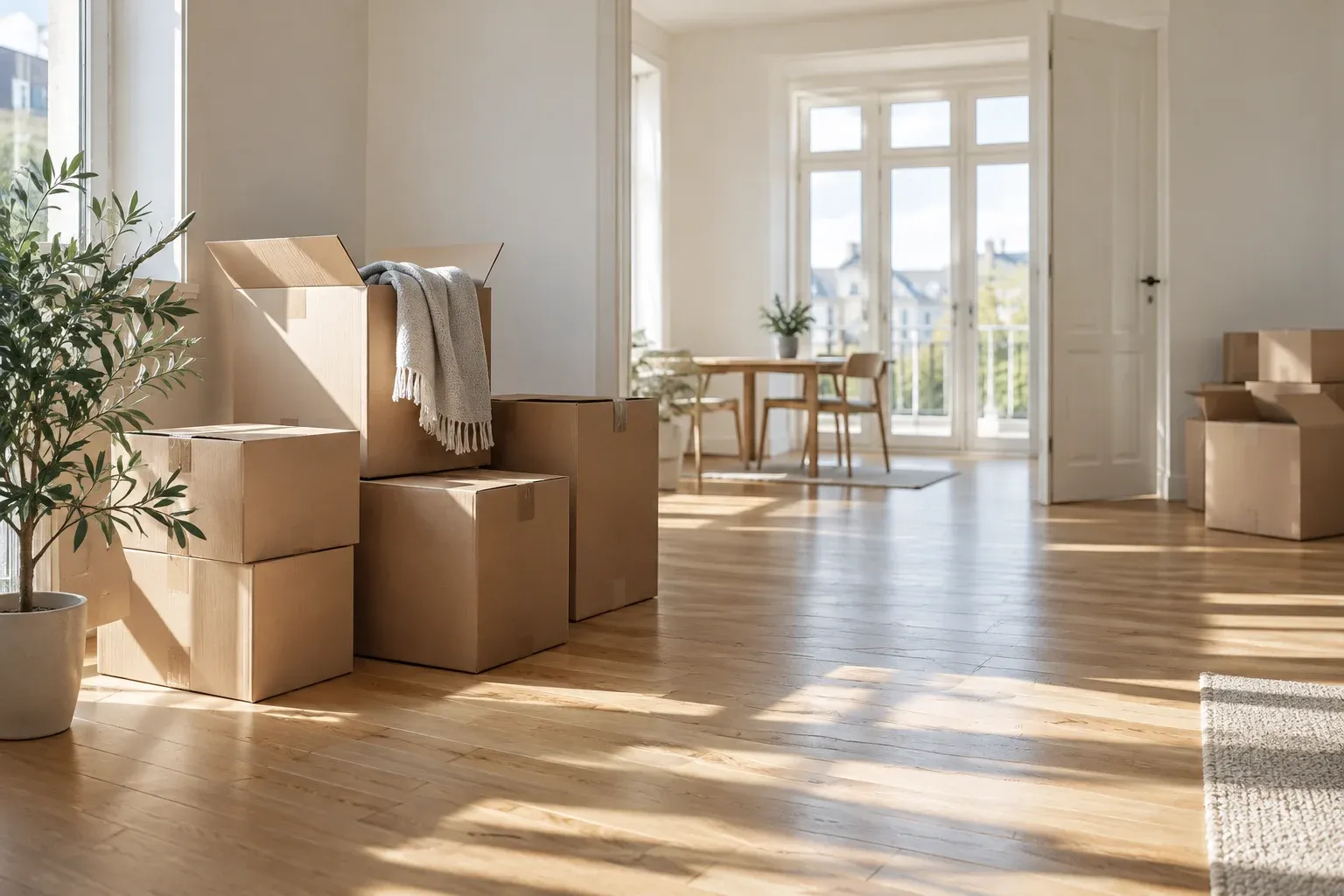
Moving in Sweden runs on four separate systems: your rental contract, the move-out clean, the population register and the tax rules for household services. None of them talks to the others, so here is each one, and the order to do them in.
When you need this
You rent a flat in Sweden and want to move, either within the country or home. Your landlord has mentioned uppsägningstid (notice period), flyttstädning (the move-out clean) or besiktning (inspection). Letters keep arriving at your old address. A cleaning or moving company has quoted you a price “after RUT”. Or an invoice for cleaning has turned up weeks after you handed back the keys.
Giving notice
The rule is generous to tenants and easy to miscount. A tenant of a rental flat can always end the lease at a month-end that falls at least three months after giving notice. That comes from the Land Code (Jordabalken, chapter 12), and no contract clause can take it away. Because the clock runs to a month-end, “three months” is really three to four:
| Notice given | Lease ends | You leave by |
|---|---|---|
| 1 March | 30 June | Noon, 1 July |
| 5 March | 30 June | Noon, 1 July |
| 1 April | 31 July | Noon, 1 August |
The last column is also law: when a lease ends you must leave by the following day and have the flat ready for the next tenant by 12 noon. If that day is a Saturday, Sunday, public holiday, Midsummer Eve, Christmas Eve or New Year’s Eve, it moves to the next weekday, unless you agree otherwise.
Private lets changed on 1 July 2026. If you rent a flat or house directly from a private owner, the new Private Letting Act (privatuthyrningslagen) now gives you the same three-month right, even on a fixed-term contract. The old 2012 act gave one month, and many websites still say so. Contracts signed under the old act before July 2026 keep its rules. For the full picture on sublets and private lets, see long-stay rentals in Sweden.
A few more rules matter:
- Put it in writing. Notice must be written once the tenancy has lasted more than three months (always, under the Private Letting Act). Oral notice only counts if the landlord confirms it in writing. The tenants’ union, Hyresgästföreningen, recommends a registered letter (rekommenderat brev).
- Short fixed terms just end. A fixed-term let of nine months or less ends on its end date without notice; one that has run longer must be ended by notice.
- Allow viewings. Once the flat is advertised, you must let it be shown at reasonable times.
The move-out clean and inspection
Flyttstädning is a Swedish institution, but no statute lists what you must clean. The law says a tenant must take good care of the flat and pays for damage caused by negligence; the tenants’ union says to leave the flat empty and cleaned, and that a landlord who finds it dirty can send you a cleaning invoice.
The union’s checklist is what landlords expect in practice:
| Room | What to do |
|---|---|
| Kitchen | Empty, defrost and switch off fridge and freezer; pull out and clean behind the cooker; clean the extractor hood and cupboards inside and out |
| Bathroom | Clean tiles, sink, bath or shower and toilet; clear the floor drain and the water traps |
| All rooms | Remove nails and hooks and repair holes; clean radiators front and back, switches and windows on both sides; vacuum and mop floors last |
| Balcony, storage, garage | Remove everything and sweep; storage and garage should be left completely empty |
Plan six to eight hours for an ordinary flat. Then photograph or film every room, because those pictures are your evidence later.
If there is an inspection, read the report before you sign it: no statute regulates how inspections are done, and a signature can read as acceptance of the listed defects. Hired a cleaning firm? You are still responsible to the landlord. The union suggests walking through the flat with the firm before you hand in the keys, so they can fix gaps while you still have access.
Warning: claims don’t end at the handover. Under both the Land Code and the Private Letting Act, a landlord (or tenant) has two years from the day the tenant moved out to bring a claim from the tenancy. Keep your photos and the inspection report that long. Ordinary wear is not your cost.
Things you leave behind become the landlord’s if you don’t collect them within three months of being asked, or six months of leaving. For bulky items, see recycling centres and bulky waste.
Reporting your new address
If you are registered in Sweden (folkbokförd), reporting a move is a legal duty, not a courtesy. You must tell Skatteverket, the Swedish Tax Agency, within one week of moving. It is free.
- Use the e-service Flyttanmälan, which needs an e-ID such as BankID, or paper form SKV 7845 if you have none.
- Report before you move or at the latest a week after.
- Have your four-digit apartment number (lägenhetsnummer) ready; it is in your contract. See Swedish addresses explained.
- Report children who move with you; a guardian does that.
The law lists what the report contains: your personnummer or coordination number, the date, the new address and how long it will apply, the property designation and apartment number, and who let the flat to you. Registration can take up to two weeks, so don’t file twice.
Skatteverket then passes your address to authorities, municipalities and regions, and larger banks and insurers fetch it from the public SPAR register. Friends, clubs and smaller companies you tell yourself.
Missing the deadline can technically be punished as a population-registration offence. From 1 December 2026 the act states expressly that a minor delay in reporting a move is not punished. Leaving Sweden for good is a different report: tell Skatteverket at the latest a week before you leave (see registering your address).
Tourists aren’t registered, so they have nothing to report. People with a coordination number keep a contact address with Skatteverket, which may be abroad.
Mail forwarding
Here is the trap newcomers fall into: Skatteverket does not forward your post. Forwarding (eftersändning) is a separate, paid service you order from the company Svensk Adressändring, and it usually runs for a year. Ordering forwarding alone does not change your registered address, so you still need the flyttanmälan. Its price is set by the company; check its website when you order.
At the new address, put your name on the door and on the mailbox in the entrance, as Skatteverket asks.
Hiring movers and cleaners with RUT
Sweden’s RUT tax reduction covers both moving and move-out cleaning, because the Income Tax Act names them as household work. The firm deducts 50% of the labor cost on the invoice and claims the rest from Skatteverket. Here is what counts:
| Covered by RUT | Not covered |
|---|---|
| Packing and unpacking | The moving van and fuel |
| Loading, unloading and carrying | Boxes |
| The driver’s and movers’ time | Storage rent |
| Moves to and from short-term storage | The firm’s travel to you |
| Move-out (or move-in) cleaning | Air or sea transport; cleaning after building work |
The move must be between your homes or storage within the EU/EEA or Switzerland. You must be 18 or older and pay Swedish income tax, and the combined ROT and RUT cap is 75,000 kr per person and year. Tourists and new arrivals without Swedish tax can’t use it, so ask for a price without RUT. The full rules are in ROT and RUT tax deductions.
Choosing a mover. Konsumentverket, the consumer agency, says a moving firm must by law hold a traffic permit (yrkestrafiktillstånd); without one its insurance may not apply. You can check a permit for free in Transportstyrelsen’s e-service Kontrollera trafiktillstånd. Also know this:
- No cooling-off period. There is no legal right of withdrawal for a moving service.
- Bohag 2010. Under this agreement between Konsumentverket and the moving industry, you can cancel free of charge up to 15 days before the move. Konsumentverket treats it as good practice even for firms outside it.
- Price overrun. The price may be exceeded by at most 15%, or what you agreed.
- Pay afterwards. Paying after the move lets you withhold payment if something goes wrong or the move isn’t finished on time.
Moving step by step
- Check which law your contract falls under, then give written notice three months before a month-end.
- Book movers and cleaners early, with written offers; check the mover’s traffic permit.
- Report the move to Skatteverket, before you move or within a week after.
- Order mail forwarding if you want it.
- Check electricity and internet with your landlord, and make sure your home insurance covers the new home from moving-in day.
- Clean, or have the flat cleaned, then photograph every room.
- Attend the inspection and read the report before signing.
- Return every key, including laundry room and storage, and leave by noon the day after the lease ends.
Practical information
| Item | What to know | Checked |
|---|---|---|
| Tenant’s notice | Three months to a month-end (rental flats, and private lets since 1 July 2026) | 2026-10-14 |
| Moving-out time | By 12 noon the day after the lease ends; weekends and holidays move to the next weekday | 2026-10-14 |
| Claim deadline | Two years from moving out | 2026-10-14 |
| Flyttanmälan | Free; within one week of moving | 2026-10-14 |
| Mail forwarding | Paid; price set by Svensk Adressändring, usually a year | 2026-10-14 |
| RUT on movers and cleaning | 50% of labor; ROT and RUT cap 75,000 kr per person and year (ROT at most 50,000 kr) | 2026-10-14 |
| Mover cancellation (Bohag 2010) | Free up to 15 days before the move; overrun at most 15% | 2026-10-14 |
FAQ
How much notice do I have to give on a rental in Sweden?
Three months to a month-end. A tenant of a rental flat can always end the lease at the month-end that falls at least three months after notice, and since 1 July 2026 the same applies to private lets under the Private Letting Act. Notice given in mid-March therefore ends the lease on 30 June. A longer agreed period cannot remove this right.
Do I have to give notice in writing?
Yes, in practice. Under the Land Code notice must be written once the tenancy has lasted more than three months, and under the Private Letting Act it must always be written. A tenant’s oral notice counts only if the landlord confirms it in writing. The tenants’ union recommends sending notice by registered letter and keeping a copy.
What is flyttstädning and is it required?
Flyttstädning is the thorough clean a tenant does before handing back a flat: kitchen, appliances, bathroom drains, radiators, windows and floors, with storage emptied. No statute lists the tasks, but tenants must care for the flat, and a landlord who finds it dirty can invoice you for a cleaning firm. Expect six to eight hours of work.
How do I change my address in Sweden?
Report the move to Skatteverket in the free e-service Flyttanmälan, which needs an e-ID, or on paper form SKV 7845. Do it before you move or at the latest within a week. Include your apartment number and the children who move with you. Skatteverket passes the address to authorities, and banks and insurers pick it up from SPAR.
Does Skatteverket forward my mail?
No. Reporting a move changes your registered address, but forwarding letters from the old address is a separate paid service ordered from Svensk Adressändring, usually for a year. Ordering forwarding alone does not change your registered address, so you still need to make the flyttanmälan. Tell private contacts yourself; Skatteverket only reaches authorities and companies using SPAR.
Can I get RUT on a moving company or move-out cleaning?
Yes, if you are 18 or older and pay Swedish income tax. Packing, loading, carrying and the driver’s time qualify, as does flyttstädning; the van, fuel, boxes and storage rent do not. The firm deducts 50% of the labor cost on the invoice, within a 75,000 kr yearly cap per person. Tourists without Swedish tax cannot use it.
Can my landlord bill me for cleaning after I moved out?
Yes, if the flat was not cleaned or was damaged through negligence, though ordinary wear is not your cost. Claims arising from the tenancy must be brought within two years of moving out. Photos of the cleaned flat are your best evidence, and the tenants’ union advises reading any inspection report carefully before signing it.
Related guides
- Long-stay rentals in Sweden — sublets, private lets and the rent tribunal in depth
- Registering your address (folkbokföring) — the population register behind the flyttanmälan
- ROT and RUT tax deductions — who qualifies and how the invoice works
- Swedish addresses explained — apartment numbers, entrances and mailboxes
- Recycling centres and bulky waste — clearing out furniture before you hand back the keys
Facts verified 2026-10-14. Sources: Sveriges riksdag (Jordabalken 12 kap., Privatuthyrningslag 2026:772, Folkbokföringslag 1991:481, Inkomstskattelag 67 kap.), Skatteverket, Konsumentverket, Transportstyrelsen and Hyresgästföreningen — full register in this topic’s source file. This is general information, not legal advice. Found something outdated? Tell us and we’ll fix it.