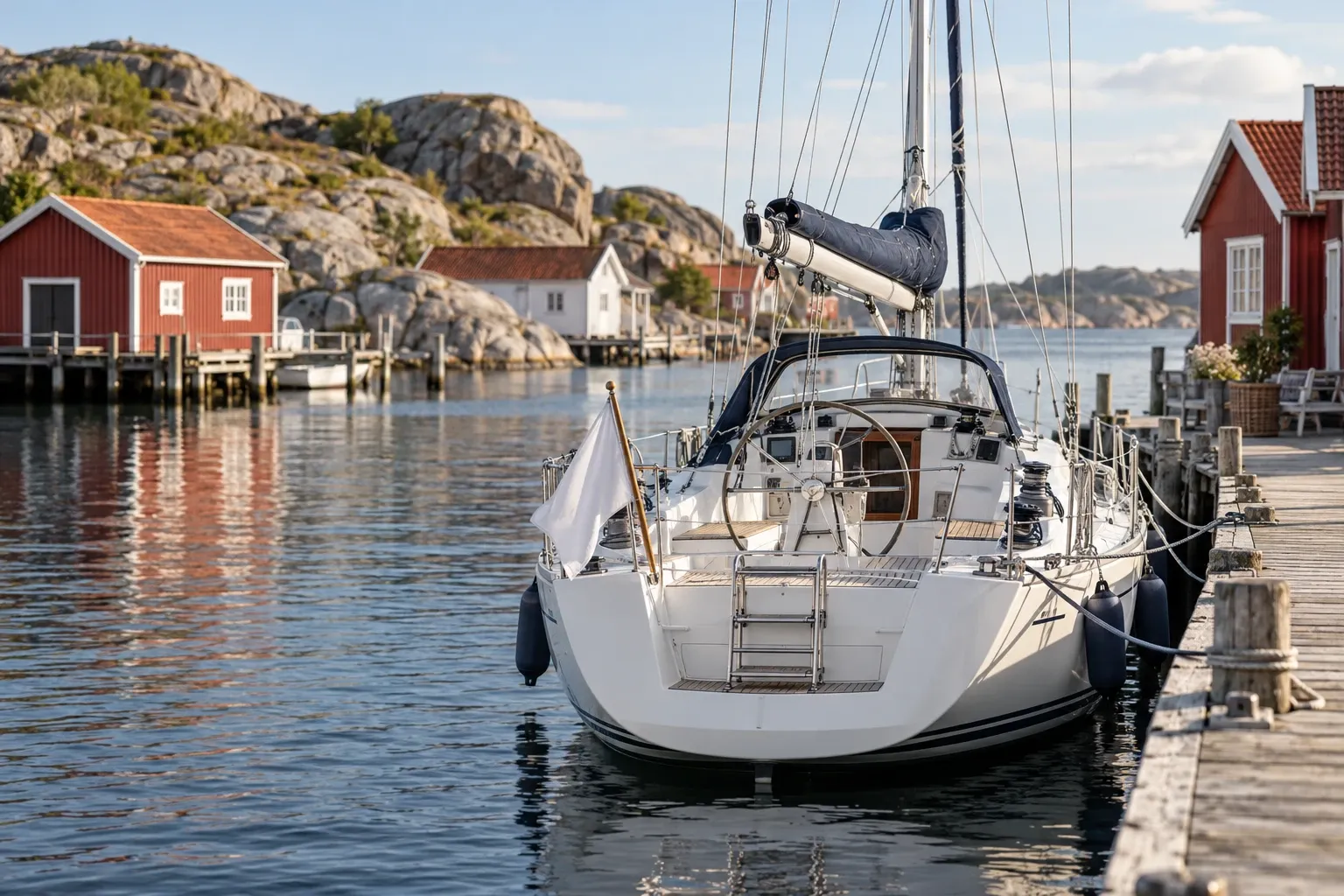
Sailing into Sweden means dealing with two borders that follow different maps: the Schengen border, run by the police, and the EU customs and tax border, run by Swedish Customs. Find your departure port on both maps and you’ll know exactly what to do.
When you need this
You’re planning a North Sea passage from the UK, or heading home from a summer in Norway with the lockers full of wine. You might be crossing from Åland, Helgoland or a Baltic EU port. Maybe you want to leave a non-EU-owned boat in Sweden over winter, or there’s a dog aboard. Or weather or a breakdown has pushed you into a harbor that isn’t on any official list.
Two borders, two maps
The border check is a Schengen matter. Polismyndigheten (the Swedish Police) runs it, and Kustbevakningen (the Coast Guard) assists at sea. It applies only when you come from, or leave for, a port outside the Schengen area.
Customs is a separate EU customs-and-tax matter run by Tullverket (Swedish Customs). This is where most skippers go wrong, because the two maps don’t line up:
| Arriving from | Border check | Customs regime | The boat itself |
|---|---|---|---|
| Denmark, Germany, Poland, Baltic states, mainland Finland | None | EU personal-use rules, no fixed limits | No formalities |
| Åland | None (Schengen) | Outside the EU tax territory: non-EU alcohol and tobacco limits | Inside the EU customs union |
| Helgoland | None (Schengen) | Outside the EU customs and tax territory | Outside the EU customs territory |
| Norway | None (Schengen) | Non-EU allowances, 20-hour rule, SEK 3,500 limit | 18-month admission for non-EU residents; EU boats need proof of Union status |
| United Kingdom and other non-Schengen ports | Crossing point, opening hours and police form | Non-EU allowances | As for Norway |
The border check covers everyone aboard, whatever the nationality of the boat or crew. One wrinkle: Polismyndigheten’s page words the trigger as “outside the EU”, while the Aliens Ordinance and the Schengen Borders Code refer to the Schengen states. Ports in EU countries outside Schengen, such as Ireland and Cyprus, fall between the two wordings, so ask the border police before you sail from one.
Arriving from outside Schengen: crossing points and the form
The external border may only be crossed at a gränsövergångsställe (border crossing point), and only during its set opening hours. The Aliens Ordinance lists the municipalities that may have crossing points. The police decide which harbors in them qualify for pleasure craft, and when each one is open.
What to do:
- Pick a crossing point for pleasure craft from Polismyndigheten’s list and check its hours. On the west coast, the usual landfalls after a North Sea passage, they include Gothenburg’s guest harbor, Lysekil, Varberg, Falkenberg and Halmstad.
- Fill in Fritidsbåtstrafik, In- och utresa, available in English as the pleasure boat entry-exit form. Send it ahead to the police or the Coast Guard, or hand it in on arrival at the latest. Contact addresses for each police region are on the opening-hours page.
- Carry a valid passport or ID card for everyone aboard. Non-EU crew are registered in the EES biometric border system at the external border. See our guide to EES border checks.
- Use the same procedure when you leave for a non-Schengen port.
In the south and east, pleasure-craft crossing points include Malmö, Trelleborg, Ystad, Simrishamn, Karlskrona, Karlshamn, Kalmar, Oskarshamn, Borgholm, Visby, Slite, Nynäshamn, Bullandö and Stockholm, plus Mem on the Göta Canal. Along the Gulf of Bothnia there are guest harbors such as Sundsvall, Luleå and Piteå.
The list changed in August 2024, and older guides haven’t caught up. In the Stockholm archipelago, Bullandö replaced Sandhamn as the pleasure-boat crossing point, and Wasahamnen and Navishamnen in central Stockholm were added. If your pilot book says “clear in at Sandhamn”, it’s out of date.
Hours vary a lot. The west and south coasts have long daily hours. The Bothnian coast is mostly weekday daytime, and Gävle and Hudiksvall open for pleasure craft only by special decision. Strömstad, the obvious harbor near the Norwegian border, is a crossing point for merchant and cruise ships but not for pleasure craft. Where an hours table says helgfri, Swedish public holidays are excluded. Midsummer Eve, Christmas Eve and New Year’s Eve count as ordinary days.
Arriving outside the hours isn’t a technicality. A foreign national who intentionally crosses the external border in a prohibited way can be fined or jailed for up to one year.
Arriving from Norway, Åland or Helgoland
Norway is in Schengen, so a boat from a Norwegian port needs no crossing point and no form. Norway is outside the EU, though, and that brings the non-EU customs allowances, per person:
- Alcohol: 1 liter of spirits or 2 liters of fortified wine, plus 4 liters of wine and 16 liters of strong beer.
- Tobacco: 200 cigarettes, or 100 cigarillos, or 50 cigars, or 250 g of tobacco.
- Other goods: free up to SEK 3,500 when you arrive by private boat; duty, VAT and other taxes above that.
The 20-hour trap: the alcohol is duty-free only if you have been abroad for at least 20 hours. After a day trip to Norway, every bottle must be declared and taxed, and the tobacco allowance falls to 40 cigarettes, 20 cigars or cigarillos, or 100 g of tobacco.
Åland is part of Finland and Schengen but sits outside the EU tax territory, which is why its shops sell tax-free. Its alcohol counts against the same small limits; see why Åland is tax-free. Helgoland is outside both the EU customs and tax territory.
Declare anything over the allowances at a Tullverket customs clearance office. With nothing to declare, there’s no customs visit. Tullverket and the Coast Guard can both board and inspect a pleasure boat, at sea or in port. Everyone aboard must answer and show documents, and the skipper must assist. Undeclared goods can be confiscated and treated as smuggling. The full tables are in our customs allowances guide.
The boat itself: 18 months, winter storage and Union status
If you live outside the EU, you can keep your private pleasure boat in Sweden or the EU for up to 18 months without charges and without notifying Tullverket, provided you use it during the stay. To count as a pleasure boat, it must be for private use, travel on its own keel and carry only supplies and personal belongings of the people aboard. The clock starts when the boat enters the EU, not Sweden, so a season in Denmark first counts. After 18 months the boat must leave the EU, though not necessarily for your home country.
You must notify Tullverket if:
- the boat will stay longer than 18 months
- you live in the EU but sail a boat registered outside it
- you plan to leave the boat in Sweden for winter storage
Laying a boat up without using it, while work such as hull cleaning or engine repairs is done, may count as inward processing, which needs a special authorisation.
EU boats have the opposite problem. If you take an EU-registered boat outside the EU customs territory, for example to Norway, the UK or international waters, you need proof that it has EU (Union) status. Otherwise you may be charged customs duty on the boat when you come back. Tullverket issues the proof when you present its Status Registration Document at a customs office and have it stamped.
Pets, cash and the crew’s own limits
Dogs and cats depend on where you sail from:
| Sailing from | What Tullverket requires |
|---|---|
| An EU country | Register online before crossing, or report at the border |
| Norway | No report needed if chipped with an EU or Norwegian pet passport |
| Iceland or Switzerland | Report at any border crossing |
| UK or other non-EU countries | Report at Arlanda or Landvetter airports only |
That last row is a dead end for a yacht sailing directly from Britain. Tullverket publishes no harbor reporting route, and an unreported animal can be refused entry. Call Tullverket before you sail. The health rules are in our guide to bringing a dog to Sweden.
Cash of EUR 10,000 or more must be declared to Tullverket. Since 1 April 2026 that applies on journeys from other EU countries too; see our cash declaration guide.
The crew’s stay is not the boat’s stay. The boat may stay 18 months, but visa-free non-EU visitors get 90 days in any 180 in the whole Schengen area. Plan the season around the 90/180-day rule.
Arriving from Denmark or Germany? Sweden’s temporary internal border controls currently run to 11 November 2026, and the police decide where checks happen. Carry passports or ID cards anyway.
When you can’t reach a crossing point
Engine failure, weather or illness can make a crossing point out of reach. Contact the Coast Guard. It decides on permission to cross the external border somewhere else or at another time, and then informs the police. The police also allow a non-crossing-point harbor in exceptional cases, but the entry form must still be filled in in advance. A boat from abroad that arrives anywhere other than a crossing point may not continue its voyage without police or Coast Guard permission. Keep a copy of the form and any permission aboard until you leave Swedish waters.
Practical information
| Item | Detail |
|---|---|
| Border check | Only to or from a non-Schengen port; no fee published |
| Form | Fritidsbåtstrafik, In- och utresa (pleasure boat entry-exit form), Polismyndigheten |
| Crossing points and hours | Polismyndigheten’s opening-hours page, per region and harbor (regime in force since 19 August 2024, reviewed April 2026) |
| Other goods from outside the EU | Free up to SEK 3,500 per person by private boat (checked 2026-10-15) |
| Alcohol over the non-EU allowance | Spirits SEK 4 customs duty plus SEK 267 excise per liter; wine SEK 1 plus SEK 41 per liter; beer SEK 3 plus SEK 23 per liter (checked 2026-10-15) |
| Boat temporary admission | Up to 18 months from EU entry, no charges, for non-EU residents |
| Cash | Declare EUR 10,000 or more |
| Tullverket | +46 771-520 520 |
| Penalty for unauthorised crossing | Fines or up to one year in prison |
FAQ
Do I need to clear customs sailing to Sweden from Denmark or Germany?
Usually not. Denmark, Germany, Poland, the Baltic states and mainland Finland are inside both Schengen and the EU tax territory, so there is no border check and no fixed alcohol limit, only personal use. You still declare cash of EUR 10,000 or more and register a dog or cat. Helgoland is the exception: it is outside the EU customs territory.
Do I have to report to border control sailing from Norway to Sweden?
No. Norway is in the Schengen area, so a boat from a Norwegian port passes no border check and needs no crossing point or entry form. Norway is outside the EU, though, so non-EU customs allowances apply: 1 liter of spirits, 4 of wine and 16 of beer, and only after at least 20 hours abroad.
Where do I clear in sailing to Sweden from the UK?
At a border crossing point designated for pleasure craft, within its opening hours. On the west coast they include Gothenburg’s guest harbor, Lysekil, Varberg, Falkenberg and Halmstad. Fill in the police form Fritidsbåtstrafik, In- och utresa and send it ahead or hand it in on arrival. Non-EU crew are registered in the EES system.
How long can a non-EU boat stay in Sweden?
Up to 18 months from entry into the EU, without charges or notifying Tullverket, if the owner lives outside the EU and the boat is used during the stay. Notify Tullverket if you exceed 18 months or lay the boat up unused for winter. The crew’s own limit is separate: visa-free visitors get 90 days in any 180.
How much alcohol can I bring on my boat from Norway or Åland?
Per person: 1 liter of spirits or 2 of fortified wine, plus 4 liters of wine and 16 of strong beer, and 200 cigarettes. The alcohol is duty-free only if you have been abroad at least 20 hours. Declare anything above at a Tullverket customs clearance office and pay duty. Åland counts as non-EU here because it is outside the EU tax territory.
Can I bring my dog on my boat to Sweden?
Yes, but the route matters. From an EU country, register the dog online before crossing. From Norway, no report is needed if it is chipped and has an EU or Norwegian pet passport. Directly from the UK or another non-EU country, Tullverket takes reports only at Arlanda and Landvetter, so call Tullverket before sailing.
What if bad weather forces me into a harbor that is not a crossing point?
Contact the Coast Guard. It decides on permission to cross the external border somewhere other than a crossing point, or outside its opening hours, when something unforeseen stops you reaching one. A boat from abroad that lands elsewhere may not continue its voyage without permission, and the entry form still has to be filled in.
Related guides
- Boating in Sweden — once you’re in: licences, speed limits, the toilet-waste ban and alcohol at the helm.
- Guest harbors in Sweden — berths, fees and pump-outs for your first night.
- Customs allowances — the full tables for alcohol, tobacco, food and medicines.
- EES border checks — what the biometric registration involves for non-EU crew.
- Sailing the Stockholm archipelago — where to go after clearing in at Bullandö or Stockholm.
Facts verified 2026-10-15. Sources: Polismyndigheten, Kustbevakningen, Tullverket, Jordbruksverket, Sveriges riksdag (Utlänningslagen 2005:716, Utlänningsförordningen 2006:97), Regeringskansliet, European Commission — full register in this topic’s source file. Found something outdated? Tell us and we’ll fix it.