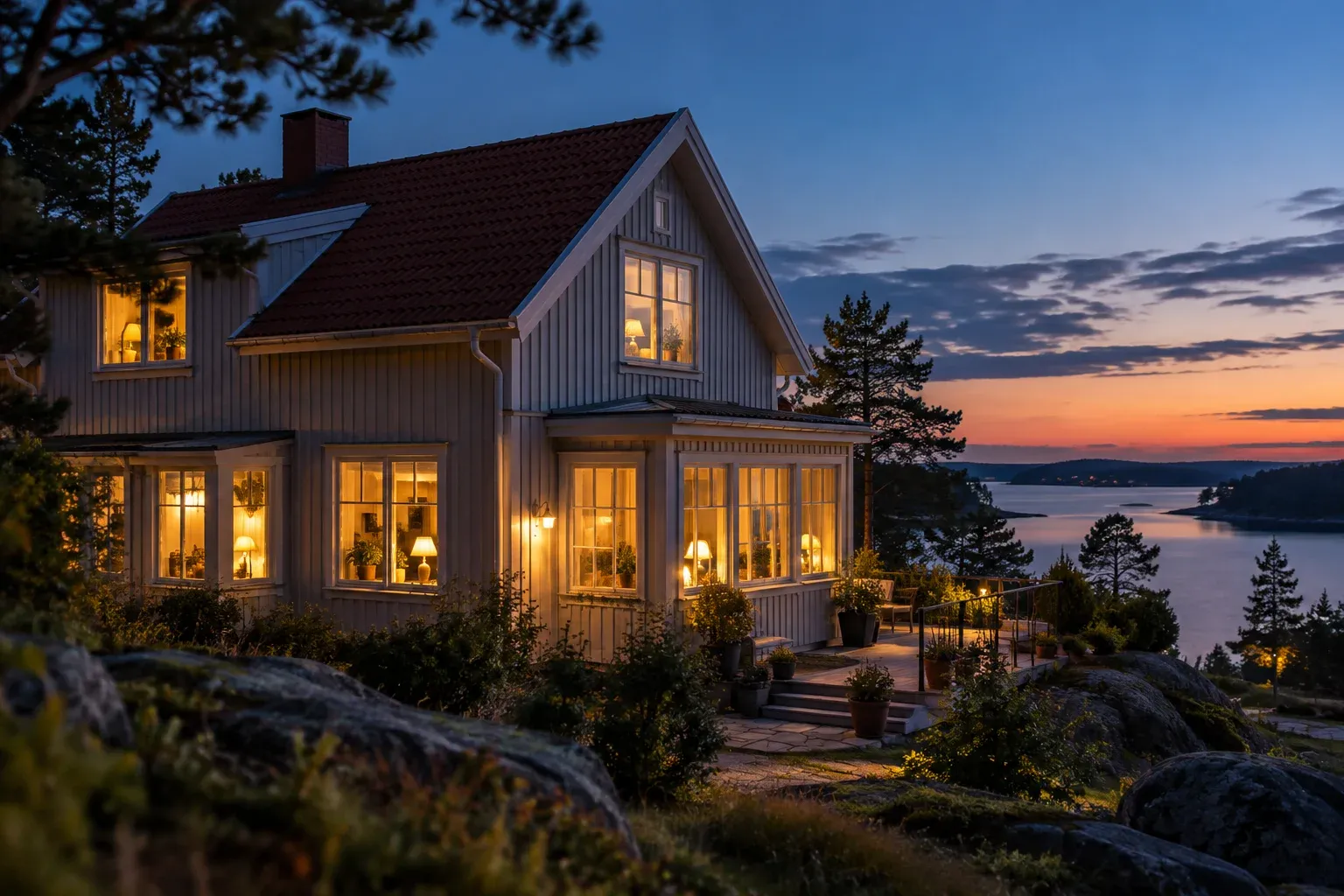
Walk through a Swedish town at dusk and you can see into half the living rooms. Here is what is actually going on in those windows, where the custom comes from, which popular explanation is a myth, and the two things a visitor should know.
When you need this
You took an evening walk through a suburb and could see people’s sofas, bookshelves and dinner tables. You noticed a small lamp glowing in nearly every window and wondered whether it means something. You read online that Sweden banned curtains in the 1600s. Or you are staying in a rental in June and want to know whether the bedroom will ever get dark.
Swedes do have curtains
Start with the premise, because it is only half true. Swedish has the full vocabulary of window textiles, and Swedish homes use them. Svenska Akademien’s dictionary defines a gardin (curtain) as a window hanging used to keep out light, to stop people seeing in, or as decoration — the same three jobs it does anywhere.
What differs is how they are used. Curtains in Swedish living rooms are often sheer and pushed to the sides. A kitchen window may have nothing but a gardinkappa, a narrow strip of fabric across the top of the window, a word recorded in Swedish since 1738. And after dark, instead of being closed off, the window is lit from inside.
| What you see | Swedish word | What it is for |
|---|---|---|
| Short fabric strip across the top | gardinkappa (or kappa) | Decoration; frames the window |
| Light curtains at the sides | gardiner | Decoration, a little privacy |
| Roller blind, often dark | rullgardin | Blocking light, mostly in bedrooms |
| Small lamp hanging or standing in the window | fönsterlampa | Light against the dark months |
So the accurate version of the question is not “why do Swedes have no curtains?” but “why do Swedes leave their windows open to view?” That has a history.
Where the custom comes from
Two sourced threads explain most of it. Neither is a complete answer, and historians argue about the weight of each.
Curtains came late to ordinary homes
For most of Sweden’s history, most Swedes lived in the countryside, and curtains were not part of a farmhouse. The Victoria and Albert Museum’s collection notes for a 19th-century Swedish curtain state that curtains were not used in Swedish peasant homes until the mid-19th century, and then always white.
Even the rich were sparing. The textile historian Viveka Hansen studied the 1758 inventory of Christinehof, a manor in Skåne in southern Sweden. The ground floor had no curtains at all, and on the floors above, nine rooms and six rooms respectively had no window hangings. Her conclusion: curtains were not seen as a necessary interior detail even in the wealthiest Swedish homes of the time. That is one manor, not a national statistic, but it fits the wider picture of a country where window textiles were a late and modest addition.
Light is scarce for half the year
The second thread is light. In the far south of Sweden, according to the national weather agency SMHI, day length varies between about 7 and 17 hours over the year. North of the Arctic Circle, Kiruna has about 27 days when the sun does not rise at all. When daylight is that short, a curtain that blocks it costs more than it does further south, and light coming from a window into a dark street is welcome rather than intrusive.
What about “Swedish openness”?
Many articles explain uncovered windows as a sign of trust, transparency or “nothing to hide”. That may be part of it, but it is interpretation. No survey or study establishing the link was found for this page, so we present it as commentary, not fact. The two documented points are the late arrival of curtains and the long dark season.
The lamp in the window
The other half of the picture is what stands in the window instead of fabric. Many Swedish homes keep a small pendant or table lamp in each window, often the same model in every window of the flat. Window lamps are a standard product category in Swedish home stores, sold for light during the dark months and a welcoming look all year.
Light in the window is an old custom. Lena Kättström Höök, a curator at Nordiska museet, Sweden’s museum of cultural history, told The Local and AFP in 2010 that the window customs date back to the 1800s. Two hundred years ago a single candle stood in the window from Christmas Eve to Christmas Day, as protection against evil forces and a greeting to people walking to church. She cited a study finding that 92% of homes lit their windows in Advent.
Advent is when the custom peaks. Nordiska museet says the Advent candlestick and the paper Advent star both have German roots and became common in Sweden in the 1930s. The electric seven-light candlestick was a Swedish invention, built at Philips in Gothenburg in 1934, and it let households leave the window lit all night without a fire risk. From the first Sunday of Advent until the end of December, most windows carry a candlestick, a star or both.
The curtain-ban myth
A story circulates online that Sweden passed a law in the 17th century banning curtains, supposedly so that neighbours and the royal guard could check that people were living within their means, and that the law is “still formally in force”.
None of the pages repeating the story cites a statute, a date or a law number, and no such law was found for this page. Swedes are free to cover their windows, and plenty do — bedrooms in particular. Treat the ban as internet folklore and don’t repeat it to Swedes; you will be corrected.
Looking, photographing and the law
An uncovered window is not an invitation. Glancing in as you walk past is unavoidable and nobody minds. Stopping to stare, pointing or lingering outside a lit window is rude, as it would be anywhere.
Photography is where the law steps in. Under the Swedish Criminal Code, Brottsbalken chapter 4 section 6 a, anyone who secretly and without permission uses a camera or other technical device to take pictures of someone who is indoors in a home commits kränkande fotografering (unlawful intrusive photography). The penalty is fines or up to two years in prison. The rule is about where the person photographed is, not where you stand, so a telephoto shot from the pavement is covered.
| Situation | Status |
|---|---|
| Walking past and glancing at a lit window | Normal |
| Stopping to stare into a home | Not illegal, but rude |
| Secretly photographing a person inside their home | Crime: fines or up to two years |
The law has two limits: no one is convicted if the photography is justifiable given its purpose and circumstances, and it does not apply to the work of public authorities. A tourist taking pictures of people in their living rooms is not covered by either.
Sleeping through light summer nights
Uncovered living-room windows do not mean uncovered bedrooms. Dark roller blinds are common in Swedish bedrooms, and 1177, Sweden’s national health information service, recommends a dark blind during the light summer months, plus a sleep mask.
It matters most in the north. In Kiruna, the midnight sun lasts about 47 days, from late May to mid-July, and further south the summer nights stay light. If you are renting a cabin or flat between May and July, ask whether the bedrooms have blackout blinds before you book, and pack a sleep mask either way. If you are moving to Sweden, a dark blind for the bedroom is worth having; for the living room, light curtains or a valance and a window lamp will make your home look like the neighbours’.
Practical information
| Question | Answer |
|---|---|
| Do Swedes have curtains? | Yes, but light, short or open; bedrooms often have dark roller blinds |
| Is there a law against curtains? | No; the “17th-century ban” cites no statute |
| Why a lamp in every window? | Light against the dark season; window lights are traced to the 1800s |
| When are windows most lit? | First Sunday of Advent to the end of December |
| Can I photograph people inside homes? | No; secret photography of someone in a home is a crime (BrB 4:6 a) |
| Daylight at midwinter, far south | About 7 hours (SMHI) |
| Polar night in Kiruna | About 27 days (SMHI) |
| Midnight sun in Kiruna | About 47 days, late May to mid-July (SMHI) |
| Light summer nights | 1177 advises a dark roller blind and a sleep mask |
FAQ
Why do Swedes not have curtains?
Most do, but they use them differently: light curtains pushed to the sides, a short valance called a gardinkappa, or nothing at all on kitchen and living-room windows. Historians point to curtains arriving late in rural homes — the mid-19th century — and to long, dark winters that make light in the window more welcome than privacy.
Is it illegal to have curtains in Sweden?
No. The story of a 17th-century law banning curtains circulates online, but none of the pages repeating it cites a statute, and we found none. Swedes are free to cover their windows, and many bedrooms have blackout blinds. The rule that does exist protects the people inside: secretly photographing someone in their home is a crime.
Why is there a lamp in every Swedish window?
Light in the window is an old custom against the winter dark, traced to the 1800s, when one Christmas candle stood in the window. Today many homes keep a small pendant or sill lamp in each window all year, and in Advent electric candlesticks and paper stars join them. One study found 92% of homes lit their windows in Advent.
Is it rude to look into Swedish windows?
Glancing as you pass is unavoidable and nobody minds. Stopping to stare, pointing or lingering outside a lit window is rude, as it would be anywhere. Taking pictures is a different matter: secretly photographing someone who is indoors in a home is the crime kränkande fotografering, punishable by fines or up to two years in prison.
How do Swedes sleep with light summer nights?
With blinds. Bedrooms commonly have a dark roller blind even when living rooms have no curtains, and Sweden’s health service 1177 recommends a dark blind in the light summer months, plus a sleep mask. North of the Arctic Circle the sun does not set for weeks; in Kiruna the midnight sun lasts about 47 days.
Should I bring curtains when moving to Sweden?
For the bedroom, a dark blind is worth having, especially in the north. Otherwise, Swedish home stores sell curtains, valances and window lamps, and many rental flats come with curtain rods but no textiles. Light curtains or a valance in the living room and a lamp in the window will make your home look like the neighbours’.
Related guides
- Advent in Sweden — why candlesticks and stars fill the windows in December
- Polar night in Sweden — the dark season behind the window lamps
- The midnight sun — why bedrooms need blackout blinds
- Why Swedish homes are so warm — triple glazing, airing and outward-opening windows
- Swedish etiquette — the wider unwritten rules for visitors
Facts verified 2026-10-14. Sources: Svenska Akademien, Riksdagen (Brottsbalken), SMHI, 1177, Nordiska museet, Victoria and Albert Museum — full register in this topic’s source file. Found something outdated? Tell us and we’ll fix it.