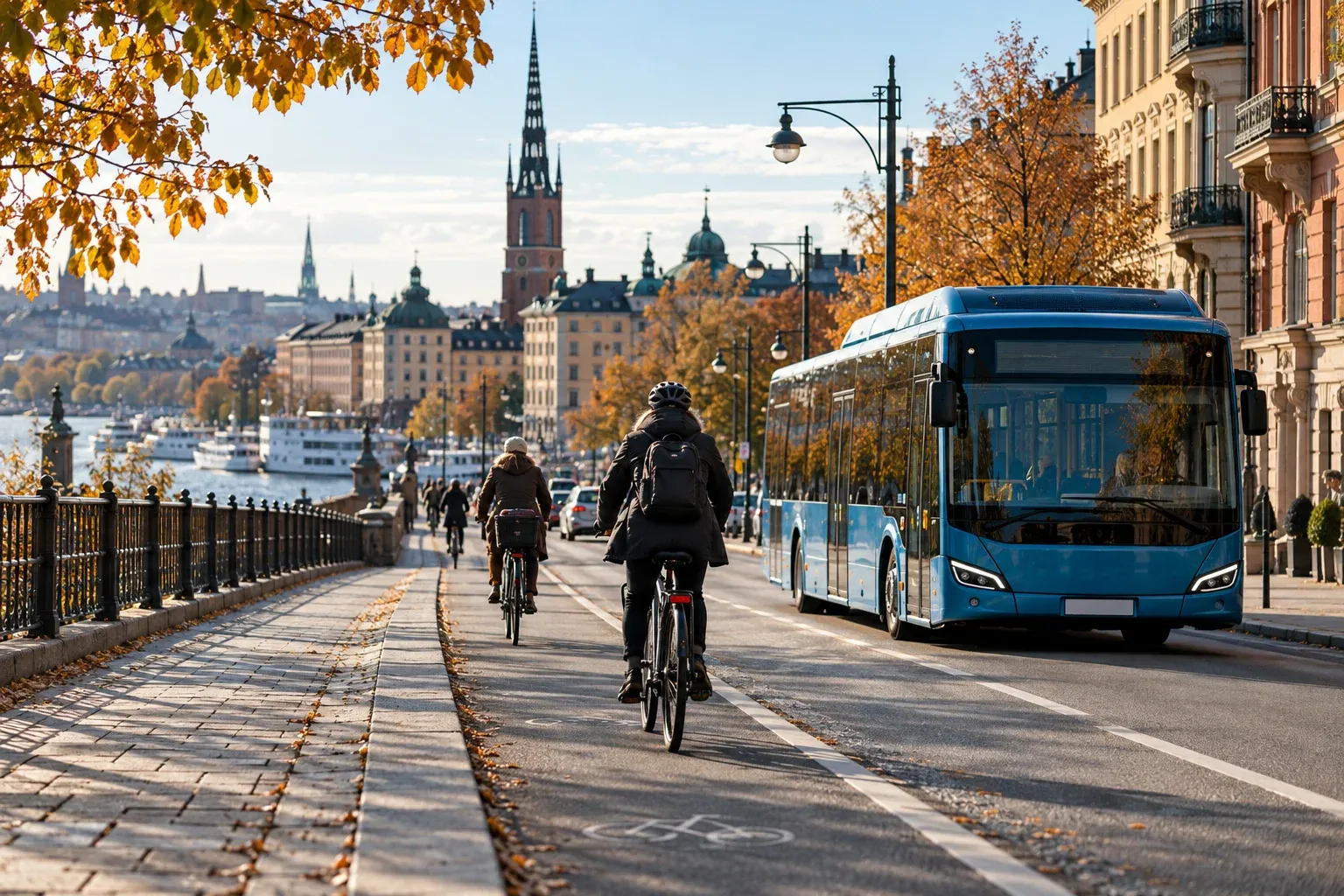
Sweden’s low-emission zones are far narrower than their reputation. Here is what each class bans, the one street where car rules apply, why Stockholm is not electric-only, and what a foreign driver has to carry.
When you need this
You are about to drive a diesel car, camper or rental into central Stockholm. You passed an E31 Miljözon sign and want to know whether it meant you. You are bringing a foreign-registered car or motorhome to Sweden. Or you read that Stockholm city centre is now “electric only” and want to know if that is true. (It isn’t, as of October 2026.)
How the system works
A miljözon (environmental zone) is an area of a built-up town where the municipality has decided, through local traffic regulations, that only cleaner vehicles may drive. Since 1 January 2020 Sweden’s traffic ordinance, trafikförordningen, has offered three classes, and the national rules fix which vehicles each class admits. A city chooses only whether to have a zone, where it goes and which class it is. Zones that existed before 2020 automatically became class 1.
Two features set Sweden apart from much of Europe. First, there is no sticker, badge or online registration, nothing like Germany’s Umweltplakette. The ordinance’s only paperwork rule is that you can prove your vehicle’s Euro class. Second, nearly every zone is class 1, which does not touch ordinary cars at all.
Don’t confuse a zone with the congestion tax. Trängselskatt is a charge every car pays to enter central Stockholm or Gothenburg; a miljözon is a ban on some vehicles and costs nothing if your vehicle qualifies. Our guide to congestion charges in Stockholm and Gothenburg covers the tax.
The three classes
| Class | Vehicles covered | Who may drive in |
|---|---|---|
| 1 | Heavy trucks and heavy buses (over 3.5 tonnes) | Vehicles first registered within the last six years (current year not counted), Euro III and better for eight years, Euro VI with no limit |
| 2 | Passenger cars, light trucks, light buses | Petrol: Euro 5 or 6. Diesel: Euro 6 |
| 3 | All of the above | Light vehicles: only electric, fuel-cell (hydrogen) and Euro 5/6 gas. Heavy vehicles: also Euro VI gas and Euro VI plug-in hybrids |
A few details matter. In class 2, diesel hybrids and diesel plug-in hybrids follow the diesel rule, so a Euro 5 diesel hybrid is shut out. In class 3, plug-in hybrid cars are not admitted at all, even though a plug-in hybrid truck or bus meeting Euro VI is. For class 1, older allowances for Euro IV and Euro V trucks ran to the end of 2016 and 2020 or eight years from first registration, so in practice an older heavy vehicle needs Euro VI or a young registration.
Each entry is marked with sign E31 Miljözon, often with a plate naming the class. The zone continues until an E32 Slut på miljözon sign, a “built-up area ends” sign or another zone sign.
Where the zones are
| Place | Class | What it means for a visitor |
|---|---|---|
| Stockholm inner city | 1 | Heavy trucks and buses only; cars unaffected |
| Hornsgatan, Södermalm (Stockholm) | 2 | Petrol cars need Euro 5, diesel cars Euro 6; in force since 15 January 2020 |
| Stockholm City, around Norrmalmstorg | 3, decided but not in force | Nothing applies as of October 2026 |
| Göteborg, Malmö, Mölndal, Uppsala, Helsingborg, Lund, Umeå | 1 | Heavy trucks and buses only |
| Everywhere else | none | No zone rules |
Hornsgatan is the only street in Sweden where car rules apply. Diesel cars there had to meet Euro 6 from 1 July 2022. If your diesel is older, simply route around Hornsgatan: Stockholm’s class 2 rules apply on that street only. We found no class 2 zone anywhere else and no class 3 zone in force.
Malmö describes its class 1 zone as restricting certain bus and truck traffic in the city centre, checks it by number plate regardless of country, and says a non-qualifying vehicle can be towed out of the zone as well as fined.
Stockholm’s class 3 zone: not in force
This is where most published information is out of date. In 2024 Stockholm decided an electric-and-gas-only class 3 zone for a block of City streets around Norrmalmstorg, including Regeringsgatan, Biblioteksgatan, Smålandsgatan and Malmskillnadsgatan. It was due to start on 31 December 2024.
It never did. The timeline:
- November–December 2024: the county administrative board, Länsstyrelsen, paused the decision on 28 November, and on 19 December Transportstyrelsen rejected the city’s appeal against the pause.
- Spring 2025: Länsstyrelsen rejected the zone on its merits; Transportstyrelsen later sent the case back.
- 19 May 2026: Länsstyrelsen revoked the zone again, finding that the city had not shown the benefits outweigh the economic consequences for the area.
- Now: the city has appealed to Transportstyrelsen, whose decision is final. No ruling had been published when we checked in October 2026.
If you are renting a plug-in hybrid for a Stockholm trip, check the city’s class 3 page before you go. If the zone is approved, signs go up and plug-in hybrid cars will not be allowed in. Our guide to renting an electric car in Sweden covers the car that passes every class.
Foreign cars and motorhomes
The rules apply to every vehicle on the street, wherever it is registered. The class 1 age rule says so in terms: it counts first registration “regardless of the country of first registration”.
What a foreign driver must do is carry proof. In a class 2 or 3 zone the law requires documents showing the engine’s emission class unless that information is in the Swedish vehicle register, and a foreign car is not. Practical options:
- Your EU-format registration certificate: field V.9 records the environmental category of the vehicle’s type approval.
- The certificate of conformity (CoC) from the manufacturer.
Swedish-registered cars, including most rentals, can be checked online at Transportstyrelsen’s vehicle lookup by registration number; the Euro class is listed under engine and environment data.
Motorhomes are passenger cars (personbil klass II) under Swedish definitions. That means class 1, the heavy-vehicle zones in eight cities, does not apply to them, while class 2 does: a diesel motorhome on Hornsgatan needs Euro 6. A motorhome registered as a truck over 3.5 tonnes falls under the class 1 age and Euro rules instead. Our guide to motorhome speed limits, weight rules and tolls explains how registration decides which rules apply, and Sweden by motorhome covers planning city stops.
Exemptions
The ordinance lets these vehicles into any zone class, with one caveat for veterans:
| Exempt vehicle | Note |
|---|---|
| Police, customs, coast guard, doctors, nurses, midwives, vets on duty | Professional use only |
| Rescue services, emergency vehicles, patient transport | Including other urgent cases |
| Färdtjänst (municipal disability transport) | |
| Vehicle with a driver or passenger holding a disabled parking permit | Written for the Swedish permit; whether a foreign blue badge counts is untested |
| Car bought or adapted with Swedish bilstöd (disability grant) | |
| Veteran vehicles 30 years or older, not in commercial use | Class 1 and 2 only, not class 3 |
| Prison transport, armed forces |
The disabled-permit point matters for visitors. Our guide to disabled parking in Sweden explains why a foreign card gives you the right to park, but the zone exemption is written for the Swedish permit.
Fines
Driving a vehicle that doesn’t qualify in a class 1, 2 or 3 zone is an on-the-spot fine in the prosecutor’s catalogue, issued to the driver. Not carrying the documents that prove your Euro class is a separate fine of the same size, even if the car itself complies. Both amounts are in the table below. For what happens when a Swedish fine reaches a foreign address, see fines from Sweden for foreign drivers.
Practical information
| Item | Detail |
|---|---|
| Entering a zone with a qualifying vehicle | Free: no sticker, badge or registration (checked 2026-10-14) |
| Fine: non-qualifying vehicle in class 1, 2 or 3 | 1,000 kr (checked 2026-10-14) |
| Fine: documents not carried | 1,000 kr (checked 2026-10-14) |
| Only class 2 zone | Hornsgatan, Stockholm |
| Class 1 cities | Stockholm, Göteborg, Malmö, Mölndal, Uppsala, Helsingborg, Lund, Umeå |
| Class 3 status | Stockholm City: revoked 19 May 2026, appeal pending at Transportstyrelsen |
| Signs | E31 Miljözon (start), E32 Slut på miljözon (end) |
| Where to check live | Transportstyrelsen and Stockholm city zone pages; Malmö stad for Malmö |
FAQ
Can I drive my car into central Stockholm?
Yes, in almost every case. Most of Stockholm’s inner city is a class 1 zone, which restricts only heavy trucks and buses. The one street with car rules is Hornsgatan on Södermalm, a class 2 zone where petrol cars need Euro 5 and diesel cars Euro 6. The planned electric-only class 3 zone in City is not in force as of October 2026.
Do foreign cars have to follow Swedish low-emission zone rules?
Yes. The rules apply to every vehicle on the street, and the class 1 age rule explicitly counts first registration in any country. Malmö says it checks by number plate whatever the country. A foreign car in a class 2 zone must also carry a document showing its Euro class, because it is not in the Swedish register.
Do I need a sticker or to register my car for Swedish environmental zones?
No. Sweden has no badge, sticker or online pre-registration for its zones, unlike Germany’s Umweltplakette. You only need a vehicle that meets the class and a document proving its Euro class, such as the registration certificate or the certificate of conformity. Websites selling a Swedish zone sticker are selling something you do not need.
Is Stockholm city centre an electric-only zone?
Not as of October 2026. Stockholm decided a class 3 zone for streets around Norrmalmstorg in 2024, first planned from 31 December 2024. It was paused, then rejected by Länsstyrelsen in spring 2025 and again on 19 May 2026. The city has appealed to Transportstyrelsen, whose ruling is final. Check the city’s class 3 page before travelling.
Can I drive a motorhome in Swedish low-emission zones?
Usually yes. A motorhome registered as a passenger car is not covered by class 1, the heavy-vehicle zones in eight cities. It is covered by class 2, so on Stockholm’s Hornsgatan a diesel motorhome needs Euro 6. A motorhome registered as a truck over 3.5 tonnes falls under class 1 age and Euro rules instead.
What is the fine for driving in a Swedish miljözon?
1,000 kr, for driving a vehicle that does not qualify in a class 1, 2 or 3 zone. Not carrying the documents that prove your vehicle’s emission class costs another 1,000 kr. These are fixed on-the-spot fines in the prosecutor’s catalogue, issued to the driver. Foreign drivers can be fined too; see our guide to Swedish fines.
Related guides
- Driving in Sweden — the rest of the rules every visiting driver needs
- Congestion charges in Stockholm and Gothenburg — the toll every car pays, zone or not
- Motorhome speed limits, weight rules and tolls — how registration decides which zone rules reach your camper
- Renting an electric car in Sweden — the car that passes every zone class
- Fines from Sweden for foreign drivers — what happens after a zone fine
Facts verified 2026-10-14. Sources: Sveriges riksdag and Regeringskansliet (trafikförordningen 1998:1276, vägmärkesförordningen 2007:90, Lag 2001:559, vägtrafikskattelag 2006:227), Transportstyrelsen, Stockholms stad, Länsstyrelsen Stockholm, Åklagarmyndigheten, Malmö stad and EUR-Lex — full register in this topic’s source file. This is general information, not legal advice. Found something outdated? Tell us and we’ll fix it.