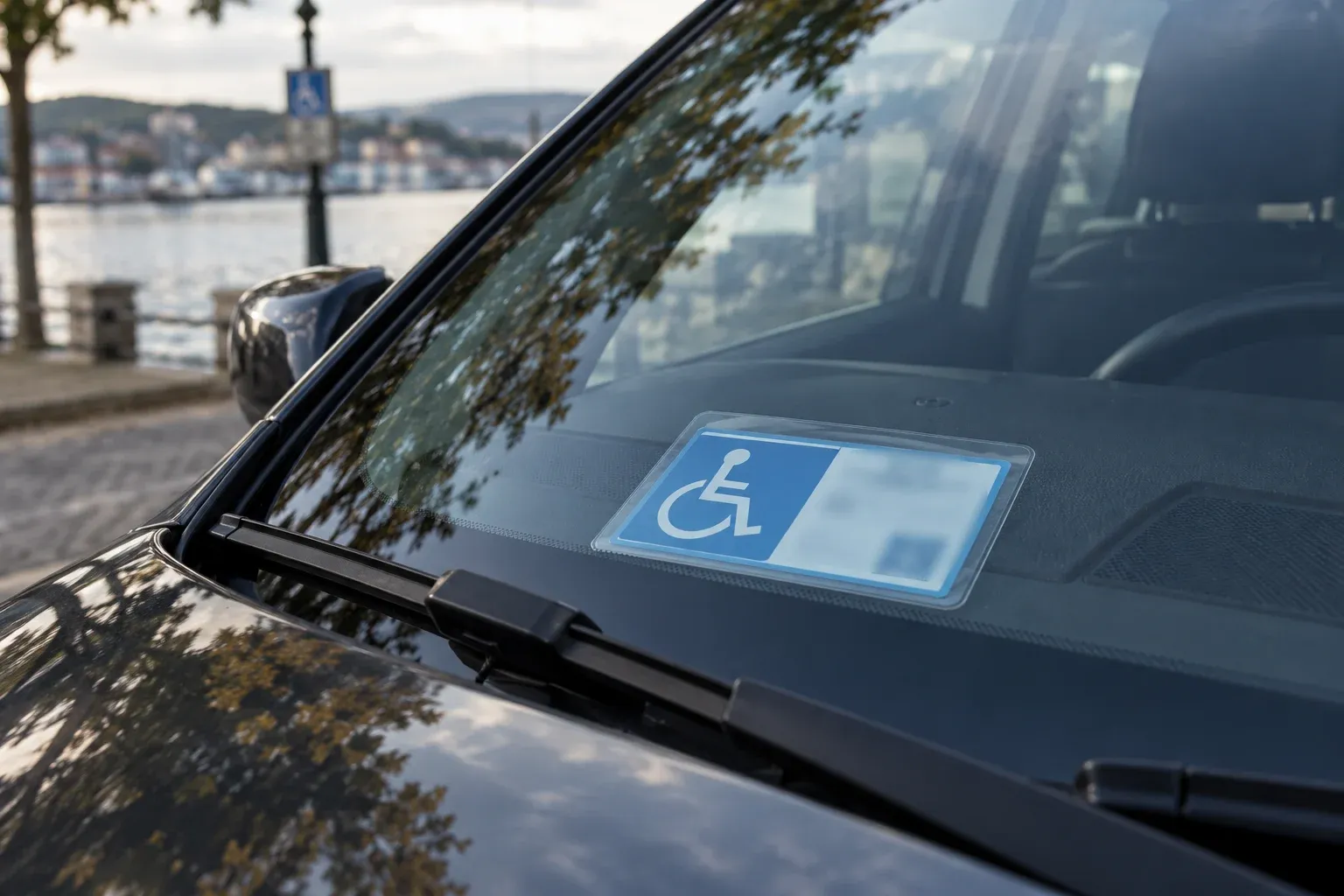
Your card from home almost certainly works in Sweden, and there’s nothing to register. The surprises are elsewhere: national no-parking zones the card never lifts, private car parks it doesn’t reach, and parking fees most cities still charge.
When you need this
You’re driving in Sweden with a disabled parking card from home, in your own car or a rental. Maybe it’s a UK Blue Badge or an American placard and you’re not sure it counts. You’re looking at a sign and working out how long you can stay, or at a parking meter wondering whether you have to pay. Or you’re a passenger who needs to be dropped right at the door.
Does my card count?
Sweden doesn’t use a list of countries. Transportstyrelsen’s regulation TSFS 2009:73 sets two rules, and your card fits one of them.
| Your card | Valid in Sweden? | Limit |
|---|---|---|
| EU-model blue card issued in an EEA country (EU plus Iceland, Liechtenstein, Norway) | Yes, the same rights as a Swedish permit | None in the rule |
| Any other card with the wheelchair symbol, written in Danish, English, French, Norwegian, Swedish or German | Yes, the same rights | Stops counting once you’ve stayed in Sweden more than a year |
| Other card in another language | Yes, if carried with a certified translation into one of those six languages | Same one-year limit |
UK Blue Badge holders: since Brexit, the UK is outside the EEA, so the EU-model rule no longer covers you. You’re covered by the second rule instead, because the badge is in English and carries the wheelchair symbol. The same goes for Swiss cards (German or French) and US or Canadian placards (English).
Attendants see the EU-model card every day and other designs rarely. If yours is different, print section 5 kap. 2 § of TSFS 2009:73 and keep it with the card.
The Swedish name for the permit is parkeringstillstånd för rörelsehindrade (often shortened to PRH). You’ll see rörelsehindrad (person with reduced mobility) on the plate under reserved-bay signs.
What the card lets you do
The rights come from the Road Traffic Ordinance, trafikförordningen 13 kap. 8 §, and they’re written against what local signs say. In Swedish law those signs express a lokal trafikföreskrift (local traffic regulation).
| Where the sign says | With the card you may park |
|---|---|
| No parking, or parking for less than 3 hours | Up to 3 hours |
| Parking for at least 3 but less than 24 hours | Up to 24 hours |
| Reserved for disabled permit holders | Yes, within any time limit on that bay’s sign |
| Pedestrian street (gågata) | Up to 3 hours |
These are ceilings. After 3 or 24 hours you’re an ordinary driver under the sign again. You may also drive onto a pedestrian street to take a disabled person to or from an address on it.
The drop-off rule needs no permit at all. A car carrying a sick or disabled person may stop or park despite local bans, bus-lane and priority-road rules and the pedestrian-street ban, if the circumstances require it and the driver takes special care. In practice the driver stops at the door, helps the passenger out, then parks legally elsewhere.
Where the card doesn’t help
The card lifts local restrictions. It doesn’t lift the national rules in the ordinance itself, and it doesn’t reach private land.
- Within 10 metres before a crossing or junction, in a bus lane, or anywhere on a priority road (huvudled, marked with a yellow diamond): still banned.
- Places reserved for a purpose or vehicle type: loading bays, taxi ranks, bus stops.
- Walking-pace zones (gångfartsområde): the three-hour right names only the pedestrian street.
- Private car parks and multi-storey garages: the owner’s signed terms decide. A supplementary plate with a company name and phone number tells you you’re on private land (tomtmark).
- Environmental zones (miljözon): the exemption is written for permits under the Swedish ordinance. Whether a foreign card carries it is untested, so don’t rely on it in an older car of your own.
Is parking free with a disabled card?
Not by default. Transportstyrelsen says the basic rule is that a parking fee must be paid, and only some municipalities waive it. The three big cities show the range:
| City | What permit holders pay |
|---|---|
| Stockholm | Pay as signed, reserved bays included. Residents can apply for a reduced annual fee tied to registered vehicles; it covers city street land only, not private land or garages |
| Gothenburg | The city’s paid street spaces are free for permit holders; not multi-storey car parks or private land. The city doesn’t say whether foreign cards get the waiver, so ask |
| Malmö | Same fee as everyone. A driver who physically can’t use any payment method can apply for an exemption, and foreign permits are accepted |
Elsewhere, check the meter, the parking app or the city’s parking page. Stockholm and Gothenburg both publish maps of reserved bays.
Displaying and using the card
Put the card at the front of the car, clearly visible and readable from outside. This isn’t a formality. Sweden’s Supreme Court upheld a fine in a case where a valid permit was in the windscreen but not clearly readable (NJA 2005 s. 20).
The card belongs to the person, not the car. A driver’s permit may be used only by its holder, and a passenger’s permit only when parking for the holder. Lending it is forbidden.
| Misuse | Consequence |
|---|---|
| No valid right, or card not visible | Municipal parking fine (felparkeringsavgift), 75–1,300 kr set by the municipality |
| Using someone else’s real card as if it were valid for you | Can be missbruk av urkund (misuse of a document): fines or up to six months in prison |
| Using a forged or copied card | Can be urkundsförfalskning (forgery) or using a forged document: up to two years in prison |
If you think a fine is wrong, pay by the deadline anyway, then contest it with the police.
Rental cars, congestion tax and bridges
Your card works in a rental car, as long as it’s carrying you. A parking fine goes to the rental firm as the owner, which charges it to you later, usually with a fee.
Congestion tax in Stockholm and Gothenburg isn’t waived just because you hold a card. A holder of a Swedish or other EEA permit can apply to Skatteverket to exempt one specific car, or two for special reasons. Without that decision the tax is charged as normal. The wording covers EEA permits only, so a UK Blue Badge or other non-EEA card doesn’t qualify. With a short rental the exemption is rarely practical, since it attaches to a particular car.
Bridge fees (Motala, Sundsvall and Skurusundet) have no disabled-permit exemption.
The European Parking Card: what changes and when
Directive (EU) 2024/2841 creates a common European Parking Card. It requires visiting card holders to get parking conditions on equal terms with the host country’s own card holders. Sweden must transpose it by 5 June 2027 and apply it from 5 June 2028. A government inquiry on how to do it reports on 15 October 2026.
Nothing changes for you on those dates in advance: today’s card works under today’s rules. Sweden already gives EEA cards the same right to park as a Swedish permit. The directive could matter most for fee waivers like Gothenburg’s, which today don’t spell out whether foreign cards qualify.
Practical information
| Item | Detail |
|---|---|
| Recognition of a foreign card | Free; no registration needed |
| Parking fees | Municipal decision: free in Gothenburg’s paid street spaces, payable as signed in Stockholm and Malmö |
| Municipal parking fine | 75–1,300 kr, set by each municipality |
| Congestion-tax exemption | Apply to Skatteverket in advance; EEA permits only, one specific car |
| Bridge fees | No permit exemption |
| European Parking Card | Transposition by 5 June 2027; applies from 5 June 2028 |
FAQ
Is my UK Blue Badge valid in Sweden?
Yes. Since Brexit the UK is outside the EEA, so the Blue Badge no longer falls under the EU-model rule. It qualifies under the second rule instead: a foreign card with the wheelchair symbol, written in English, gives the same rights as a Swedish permit. That rule stops applying once you have stayed in Sweden over a year. Display it at the front.
Is disabled parking free in Sweden?
Not by default. Fees are a municipal decision, and Transportstyrelsen says the basic rule is that you pay. Gothenburg waives fees on its paid street spaces for permit holders; Stockholm and Malmö charge as signed, reserved bays included. Check the meter, the app or the city’s parking page wherever you stop. Private car parks and garages set their own terms.
How long can I park with a disabled card in Sweden?
Up to three hours where local signs ban parking or allow less than three hours, and up to 24 hours where they allow three to 24 hours. Reserved disabled bays have whatever limit their sign shows. On a pedestrian street you get three hours. National bans, such as 10 metres before a crossing or on a priority road, still apply.
Can I use my disabled parking card in a rental car?
Yes. The card belongs to the person, not the vehicle, so it works in any car that is carrying you. Use it only when you are the driver or are being driven or picked up. Any fine goes to the rental firm as owner, which charges it to you later, usually with a fee. The congestion-tax exemption is harder: it is tied to one specific car.
Does my card exempt me from Stockholm’s congestion tax?
Not automatically. A holder of a Swedish or other EEA permit can apply to Skatteverket to exempt one specific car. Without a decision, the tax is charged as normal, and with a rental the firm passes it on. A non-EEA card, including a UK Blue Badge, isn’t covered by the statute’s wording. Bridge fees have no disabled exemption at all.
What happens if my card isn’t visible when I park?
You can be fined even if the card is valid. Sweden’s Supreme Court upheld a fine where a valid permit was in the windscreen but not clearly readable from outside. Place the card at the front of the car, face up and readable. If you think a fine is wrong, pay by the deadline anyway and contest it with the police.
Will the new European Parking Card change anything?
Not yet. Directive 2024/2841 creates a common European Parking Card and requires visitors to get the same parking conditions as local card holders. Sweden must transpose it by 5 June 2027 and apply it from 5 June 2028; a government inquiry reports on 15 October 2026. Until then your current card works under today’s rules.
Related guides
- Parking in Sweden — every other rule: signs, the P-skiva, fines and private car parks
- Accessible travel in Sweden — booking air and rail assistance for the rest of the trip
- Wheelchair-accessible Stockholm — getting around once you’ve parked
- Congestion charges in Stockholm and Gothenburg — how the permit exemption and rental billing work
- Renting a car in Sweden — how fines and charges reach you through the rental firm
Facts verified 2026-10-01. Sources: Sveriges Riksdag (statute texts), Transportstyrelsen, Skatteverket, the cities of Stockholm, Gothenburg and Malmö, Regeringen and the European Commission — full register in this topic’s source file. City parking rates are municipal decisions and are not published here; check the sign. Found something outdated? Tell us and we’ll fix it.