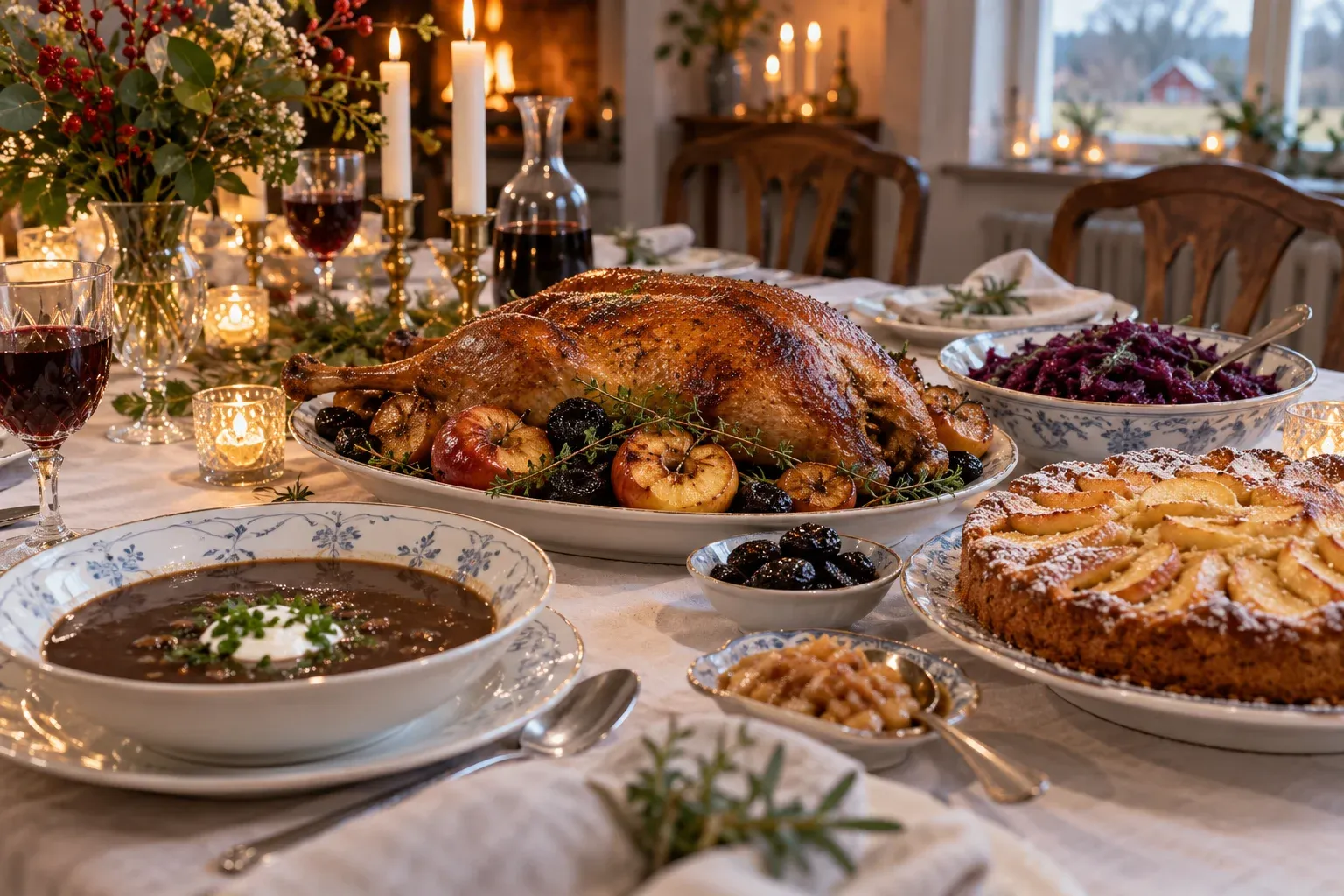
Every 10 November, southern Sweden sits down to a three-course goose dinner that starts with a black soup made of blood. Here is what is on the plate, where the custom really comes from, and how to get a seat at the table.
When you need this
You are in Skåne, Malmö or Lund in early November and see posters for gåsamiddag, goose dinner. A Swedish friend invites you to Mårten gås. You spot svartsoppa on a menu and want to know what you are ordering. Or you grew up with Martinsgans in Germany or Sint-Maarten in the Netherlands and wonder what the Swedes do with the same saint.
What is Mårten Gås?
Mårtensafton, St Martin’s Eve, falls on 10 November, the evening before St Martin’s Day. Swedes who keep the custom eat goose, so the whole occasion is usually just called Mårten gås or mårtensgås. Today it is seen as a typical Skåne custom, and Isof, the state institute for language and folklore, says it has survived mainly there.
It is a dinner, not a festival. There are no parades and nothing closes; people gather at home or book a restaurant for a long, rich evening meal.
The menu, course by course
The classic gåsamiddag has three courses, and each one is fixed by tradition.
| Course | Dish | What it is |
|---|---|---|
| Starter | Svartsoppa | Black soup made from goose blood, spiced with cloves, cognac and fortified wine |
| Main | Gåsstek | Roast goose with potatoes, gravy, red cabbage, Brussels sprouts, jelly, apples and prunes |
| Dessert | Äppelkaka | Apple cake (Nordiska museet also mentions apple pie) |
Svartsoppa is the part visitors ask about. Nordiska museet, Sweden’s state museum of cultural history, says its flavour resembles gingerbread: dark, rich and sweet-spiced. The museum also points out that today’s version is far from the soup eaten on farms long ago, since cognac, fortified wine and most of the spices were not available then.
Because the soup is made from blood and contains alcohol, anyone who avoids either for religious, health or personal reasons should ask the host or restaurant before the starter arrives. Saying so in advance is far easier than refusing a bowl at the table.
Apples turn up twice: as slices with the roast goose and again in the dessert.
Why a goose? St Martin and the European link
The day is named after Martin of Tours, a 4th-century bishop whose symbol was a goose. The legend: Martin did not want to become bishop and hid in a goose shed, but the honking geese gave him away. Isof adds, drily, that the geese were punished by ending up on the dinner table. There is a practical reason too: geese are at their fattest in late autumn.
This is a European tradition that reached Sweden late. Martinmas was one of the most important autumn festivals across much of Europe from at least the Middle Ages. Isof says the link between the goose feast and St Martin was made in France in the early Middle Ages and spread to Germany and eventually Sweden, and Nordiska museet notes older records of festive goose in Germany, France and Denmark. If you know Martinsgans from home, you already know the saint and the bird.
In the Middle Ages the Martin holiday also opened a period of fasting, so people ate richly before it.
Martin or Mårten?
The Swedish almanac splits the name across two days, which confuses even Swedes:
| Date | Name day | Who it remembers |
|---|---|---|
| 10 November | Martin | Martin Luther, born on this day in 1483 and named after St Martin |
| 11 November | Mårten | St Martin of Tours, buried on 11 November 397 |
Mårten is the Swedish-Danish form of Martin. Isof also notes that mårtensafton and mårtensgås are traditionally written in lower case, though capitals are not wrong.
How it became Skåne’s
The popular story calls this age-old Skåne farm food. The sources say otherwise.
- 1557: the oldest Swedish record, a letter from a councillor in Södermanland, near Stockholm, thanking his brother for a “St Martin’s goose”. Queen Kristina later served it at court.
- 1800s: roast goose spreads beyond the elite. Goose reaches Skåne farmers’ tables around the middle of the century, mainly in the south-west, and restaurants start serving it on St Martin’s Day.
- Mid-1800s, Stockholm: Isof dates the soup-then-goose menu to this time, and a TT news summary says it was reportedly composed by the restaurateur at Piperska Muren in Stockholm in the 1850s.
- 1900s: the dinner spreads more widely with 20th-century prosperity.
Why Skåne kept it: goose farming declined further north, while in the south geese could still graze on stubble fields and wet meadows. Isof says seeing the goose as Skåne’s own dish is only a couple of hundred years old, and names Blekinge and possibly Halland as the other regions where Mårten was mainly celebrated. In Skåne’s old village feasts, duck was common and even hen would do, and the fishermen of Kivik on Österlen held their first eel feast that night.
Is it a holiday?
No. Neither 10 nor 11 November is on Sweden’s statutory list of public holidays, so offices, shops and public transport run normally. Mårtensafton falls on a Tuesday in 2026, a Wednesday in 2027 and a Friday in 2028, so in most years a heavy three-course dinner lands on a working evening.
It also comes right after All Saints’ Day, the Saturday between 31 October and 6 November, so in some years the two weekends run back to back.
Eating it as a visitor
The dinner is strongest in Skåne. Restaurants set their own dates for the goose menu, and a single evening fills up, so check menus and book early; ask whether they serve it on more than one night. Outside southern Sweden the dinner is much less common, and a random restaurant in November will rarely have it.
If you combine the trip with Copenhagen, carry your passport or national ID card: Sweden’s internal border control on arrivals from Denmark runs until at least 11 November 2026, the day after Mårtensafton.
A bit of table talk helps. Nordiska museet records a weather saying: “If Mårten rides a sleigh, Anders rides.” Snow on 11 November means bare ground on St Andrew’s Day, 30 November, or the reverse.
Buying a goose: read the label
If you cook it yourself, the origin of the bird is on the package. Under EU rules, prepacked fresh, chilled or frozen goose meat must state:
| Label line | Means |
|---|---|
| Uppfött i: | Reared in: for poultry older than one month, the country of the last rearing period of at least one month |
| Slaktat i: | Slaughtered in |
| Batch code | Links the meat to the animals it came from |
A goose raised abroad and slaughtered in Sweden is not labelled as Swedish-reared, so read the “Uppfött i” line rather than the flag on the front. Swedish supply has long been limited: a 2010 TT report described shoppers turning to turkey, young cockerel or imported frozen geese and ducks. In a restaurant, simply ask where the goose came from.
Dessert lovers should know that the name “Skånsk spettkaka”, Skåne’s spit cake, is an EU-protected geographical indication.
Practical information
| What | Detail |
|---|---|
| Date | 10 November every year: Tuesday 2026, Wednesday 2027, Friday 2028 |
| Public holiday? | No; 10 and 11 November are ordinary days |
| Where | Mainly Skåne; also historically Blekinge and possibly Halland |
| Menu | Svartsoppa, roast goose with sides, apple cake |
| Contains | Goose blood and alcohol in the svartsoppa |
| Restaurant price | Varies by restaurant and year; not published here |
| Border control from Denmark | Until at least 11 November 2026; carry ID |
| Goose label | Look for “Uppfött i:” and “Slaktat i:” |
FAQ
What is Mårten Gås in Sweden?
It is the goose dinner eaten on Mårtensafton, 10 November, the eve of St Martin’s Day. Today it is mostly a Skåne custom. The classic menu has three courses: svartsoppa, a spiced soup made from goose blood, then roast goose with red cabbage, apples and prunes, and apple cake to finish. Nordiska museet traces Swedish records back to 1557.
What does svartsoppa taste like?
Nordiska museet says it resembles gingerbread. The black soup is made from goose blood and spiced with cloves, cognac and fortified wine, so it is rich, sweet-spiced and dark. It is served as the starter before the roast goose. Because it contains blood and alcohol, ask your host or the restaurant first if you avoid either.
Is Mårtensafton a public holiday in Sweden?
No. Neither 10 November nor St Martin’s Day on 11 November is on Sweden’s statutory list of public holidays, so offices, shops and public transport run as normal. In 2026, Mårtensafton is an ordinary Tuesday. The goose dinner is an evening meal at home or in a restaurant, not a day off.
Why do Swedes eat goose on 10 November?
Because 11 November is the feast of St Martin of Tours, whose symbol is a goose. Legend says honking geese revealed him when he hid to avoid becoming bishop. Geese are also fattest in late autumn. The custom spread from France through Germany to Sweden, where it was first recorded among the elite in the 1500s.
Is Mårten Gås the same as St Martin’s Day in Germany or the Netherlands?
It is the same saint and the same feast, St Martin’s Day on 11 November. Isof says the goose feast linked to St Martin began in France in the early Middle Ages and spread to Germany and then Sweden, and Nordiska museet notes older goose records in Germany, France and Denmark. In Sweden the custom is a dinner, mainly in Skåne, held on the eve, 10 November.
Where can I eat a goose dinner in Sweden?
Mainly in Skåne, where the tradition is strongest; Swedish restaurants have served roast goose for the occasion since the mid-1800s. Many set their own dates for the menu around 10 November, so check menus and book early. Outside southern Sweden the dinner is much less common, and you may not find it at all.
Are the geese eaten in Sweden Swedish?
Not necessarily. Swedish supply is limited, and a 2010 TT report described shoppers turning to turkey or imported frozen geese and ducks. On prepacked goose meat, EU law requires an “Uppfött i:” (reared in) and “Slaktat i:” (slaughtered in) line, so read the label. In a restaurant, ask where the goose came from.
Related guides
- Skåne — getting there, the main towns and the border check from Denmark.
- Swedish food guide — the whole food calendar, from semlor to julbord.
- All Saints’ Day in Sweden — the candle-lit weekend just before Mårten.
- Swedish name days — why Martin and Mårten get different days.
- Swedish Christmas traditions — the next big food season.
Facts verified 2026-10-06. Sources: Nordiska museet, Isof (Institutet för språk och folkminnen), Svenska Akademien, Sveriges riksdag, Livsmedelsverket, Regeringen and SVT — full register in this topic’s source file. Found something outdated? Tell us and we’ll fix it.