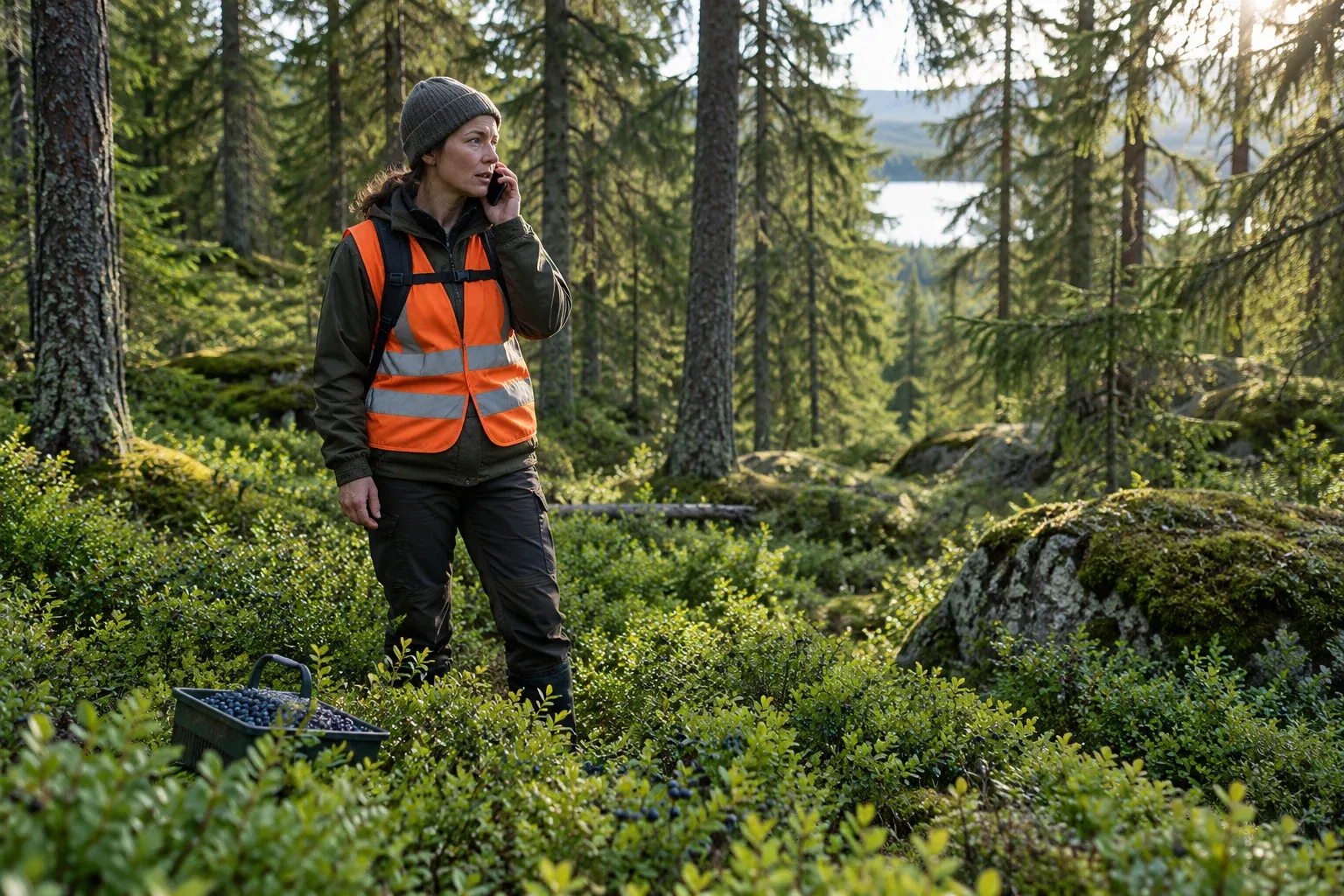
Every picking season, people walk a few hundred meters off a forest road and lose it. Here is what the Swedish police tell you to do, how your phone shows them where you are, and who comes looking.
When you need this
You are picking berries or mushrooms and no longer know which way the car is. Dusk is coming and the path has faded into spruce forest that looks the same in every direction. Or someone in your group, a child or an older relative, has not come back.
The police in northern Sweden say they handle several missing-person cases every summer and autumn when pickers get lost. Nearly all end well. Two typical 2026 cases: a berry picker in Dalarna was found by a police patrol along a county road, and a two-year-old was found alive and somewhat chilled (nedkyld) after a large search the same day.
If you are lost: five police rules
The police published this advice for berry and mushroom pickers on 31 July 2026. It is short on purpose.
| Rule | Why |
|---|---|
| Keep calm. | Panic makes you walk fast in the wrong direction. |
| Do not wait too long to call 112. | Searching is faster in daylight and before you get cold. |
| Stay on a high or open spot where you can be seen. | A clearing, bog edge or rocky knoll is visible from the air and from far away. |
| If you reach a road or larger path, stay on it. | Patrols and searchers use roads. |
| Listen for sirens and move toward the sound if you can. | Sirens mean searchers are near. |
Beyond the police list, two practical habits help. Save battery: close apps, dim the screen, keep the phone warm in an inside pocket, and answer when SOS Alarm or the police call back. And stay warm while you wait: every layer on, sit on your backpack or spruce branches, eat and drink what you brought. A clear autumn night can bring hypothermia even after a mild day — see our cold safety guide.
How 112 finds you
Since 2019, SOS Alarm has received Advanced Mobile Location (AML) from smartphones. When you call 112, the phone itself sends a satellite-based position, accurate to roughly 15 to 65 meters. Before AML, the network could only place a caller within a cell covering 500 meters to 2 kilometers.
SOS Alarm says your phone sends its position automatically whether you call through the 112 app or dial normally. The app is still worth having, because it shows your coordinates in decimal degrees (WGS84) that you can read aloud. Three catches:
- The app is only in Swedish (“I dagsläget finns appen endast på svenska”). Install it at home and find the coordinate screen once.
- Its map position is approximate, not an address. Also describe where you parked, the road name, and how long you walked.
- Without mobile data the map fails, but you can usually still call 112 wherever there is 2G or 4G coverage.
The call itself is free, from any phone, with or without a SIM. Where there is no signal at all, move to higher ground and try again; a satellite phone reaches SOS Alarm on +46 63 107 112. Our guide to how a 112 call works in Sweden covers the rest, and mobile coverage shows where the network thins out.
Who searches: police first
Swedish law is explicit. The Civil Protection Act (Lag 2003:778 om skydd mot olyckor) obliges the state to search for missing people when there is reason to fear that their life or health is in serious danger: in the mountains under chapter 4, section 1, and everywhere else under chapter 4, section 4. The ordinance makes the police responsible for both.
So a forest search is a police operation, not a fire brigade or volunteer one. In a large search the police bring in what they need. The May 2026 search for the two-year-old used:
| Resource | Role |
|---|---|
| Police | Lead the operation |
| Rescue services | Searchers and equipment |
| Helicopter and drones | Search from the air |
| Missing People volunteers | Search lines on foot |
| Mountain rescuers | Trained police volunteers |
| Armed Forces | Found the child, about 20 minutes’ walk from home |
In the mountains, the same police run mountain rescue (fjällräddning) with about 400 volunteer rescuers in about 30 units. Help phones and avalanche terrain change the advice there; read our mountain safety guide. Being searched for does not come with a bill: the Civil Protection Act contains no provision charging the person searched for. Ambulance and hospital care are a separate question, covered in who pays for rescue in Sweden.
Missing People Sweden
Missing People Sweden is a non-profit volunteer organization founded in Gothenburg in 2012. It has about 60,000 registered searchers, volunteer-led regional groups across the country, and aims to start a search within six hours. It helps relatives and police publish alerts and organizes searches on foot.
Two conditions matter:
- The disappearance must have happened in Sweden and been reported to the Swedish police. Missing People checks this before acting.
- Its help is free: it is non-profit and all participation is voluntary. Volunteers must be over 18.
So the order is always police first, through 112, then Missing People.
If someone in your group is missing
Call 112 at once; do not wait to see if they turn up. The details the police ask for are the ones their public alerts carry:
- who is missing, their age and health
- what they are wearing — color matters
- exactly where and when you last saw them
Stay reachable on the phone you called from. Once the police have the report, Missing People can be asked to help.
Before you go into the forest
The police packing list for pickers, plus a few habits:
- Phone fully charged; power bank packed
- 112 app installed; coordinate screen found once
- Offline map of the area saved — see offline maps and apps
- Told someone where you go and when you will be back
- Bright clothing or a reflective vest
- Whistle and compass
- Water and food
- Parking spot and road name noted
- Group meeting point and time agreed
- Rule agreed: lost means stop, stay, call 112
The police also advise not going alone. Teach children the same rule — stop, stay put, shout, blow the whistle — and dress them in bright colors. In autumn, hunting season adds another reason for orange; see walking in the forest during hunting season. Our berry picking guide covers the rest of the trip.
Mistakes to avoid
- Walking on “to find the road”. You leave the area where your position was recorded, and the search area grows.
- Calling a friend instead of 112. Only a 112 call sends your position to SOS Alarm and starts the official search.
- Waiting for dark. Searching at night is slower, and you face a cold night first.
- Letting the battery die before you call. No automatic position, no callback.
- Contacting Missing People before the police. They cannot act on an unreported case.
- Dark, muted clothing. Searchers look for color.
Practical information
| Item | What to know |
|---|---|
| Emergency number | 112 — free, any phone, with or without a SIM |
| Satellite phone | +46 63 107 112 (your provider’s rate) |
| Position | Sent automatically by most smartphones (AML, since 2019, about 15–65 m) |
| 112 app | Swedish only; shows WGS84 decimal coordinates |
| Who leads a search | The police (Civil Protection Act ch. 4; Ordinance ch. 4, s. 1 and 11) |
| Volunteer search | Missing People Sweden — free, only after a Swedish police report |
| Cost of a police-led search | No provision in the Act charges the person searched for |
| Busiest season | July–October, berry and mushroom picking |
FAQ
What should I do if I get lost in a forest in Sweden?
Stop walking and stay calm. Call 112 early, before dark and while the battery lasts; the call sends your position automatically. Then move to a high or open spot where you can be seen, or stay put. If you reach a road or larger path, stay on it, and walk toward sirens if you hear them. Keep warm and save battery.
Who searches for missing people in Sweden?
The police. By law the state must search for missing people whose life or health may be in serious danger, and the ordinance makes the police responsible, in the mountains and everywhere else on land. In large searches they bring in rescue services, helicopters, drones, the Armed Forces and volunteers such as Missing People and mountain rescuers.
Can 112 see where I am when I call?
Usually, yes. Since 2019 SOS Alarm has received Advanced Mobile Location from smartphones: an automatic, satellite-based position accurate to roughly 15 to 65 meters, sent whether you dial 112 directly or use the 112 app. It is not guaranteed, so also read out the coordinates the app shows and describe landmarks and where you parked.
What is Missing People Sweden?
A non-profit volunteer organization, founded in Gothenburg in 2012, with about 60,000 registered searchers and regional groups across Sweden. It helps relatives and police publish alerts and organize searches, and aims to start within six hours. It can only help when the disappearance happened in Sweden and is reported to the Swedish police. Its help is free.
Does it cost anything to be searched for in Sweden?
Calling 112 is free, and the Civil Protection Act contains no provision that bills the person searched for in a police-led search. Missing People’s volunteers are free too. Ambulance and hospital care afterwards are a separate question, covered in our guide to who pays for rescue.
Someone in my group is missing. What do I do?
Call 112 at once; do not wait to see if they turn up. Tell the operator who is missing, their age and health, what they wear and exactly where and when you last saw them. Stay reachable on the phone you called from. Once the police have the report, Missing People can be asked to help.
Related guides
- How a 112 call works in Sweden — the satellite number, real-time text and what the operator asks.
- Mountain safety — help phones, huts and avalanches, where the forest advice is not enough.
- Who pays for rescue in Sweden — what is free and where healthcare fees start.
- Berry picking in Sweden — the trip where most people get lost.
- Offline maps and apps — what to download before you lose signal.
Facts verified 2026-10-06. Sources: Swedish Police, Sveriges Riksdag (Civil Protection Act and Ordinance), SOS Alarm, PTS, Missing People Sweden — full register in this topic’s source file. Found something outdated? Tell us and we’ll fix it.