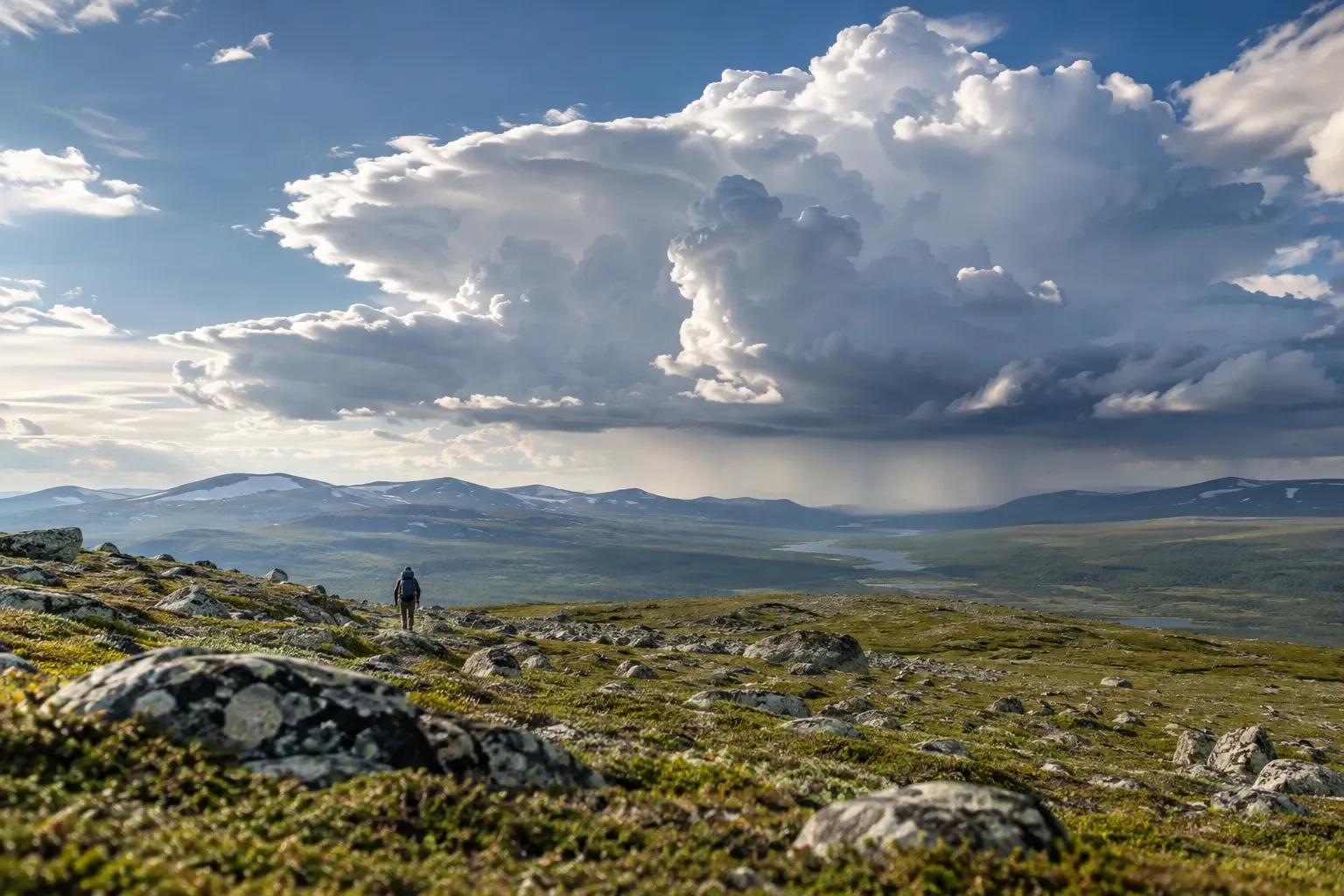
The Swedish mountains get fewer thunderstorms than anywhere else in the country. When one does arrive, though, you are standing on the most exposed ground in Sweden. This guide covers timing, terrain, the crouch debate and first aid.
When you need this
You are planning a summit day on Kebnekaise, Helags or Åreskutan in June, July or August. Or you are on a high section of trail after lunch, two hours from the next hut, and the clouds over the plateau keep getting taller. Or you just heard the first rumble and have to decide whether to push on, turn back or sit it out.
It also matters at camp. You may be pitched on open fjäll with thunder in the night forecast, or a member of your group may have been hit and you don’t know whether it’s safe to touch them. (It is.)
Our mountain safety guide covers routes, river crossings, help phones and rescue. This page covers the one hazard it leaves out: lightning.
Rare storms, exposed ground
On average Sweden gets thunder on 5–20 days a year, and the mountains get the least of it. SMHI, the national weather agency, says the northwestern fjäll gets the fewest thunder days in the country, at most four a year. Fjällsäkerhetsrådet (the Mountain Safety Council, which works under the Swedish Environmental Protection Agency) gives 1–3 days for the Lapland mountains and says it thunders on “only the odd day” a year in the Swedish fjäll.
| Area | Thunder days a year (average) |
|---|---|
| Lapland and northwestern fjäll | 1–3 (Fjällsäkerhetsrådet); at most 4 (SMHI) |
| Sweden overall | 5–20 |
| West coast, the stormiest region | locally just over 20 (SMHI); 25–30 (Fjällsäkerhetsrådet) |
The danger isn’t how often storms come. It’s where you are standing when one does. Lightning takes the shortest path to the ground, so it hits whatever sticks up above its surroundings. On the open, treeless plateau, the kalfjäll, SMHI notes that a person can be the highest point for several hundred meters around.
The southern mountains see more storms than the far north. The extreme case is Fulufjället in northwestern Dalarna: on 30–31 August 1997 it took about 700 lightning strikes in a few hours, along with an estimated 300–400 mm of rain in 24 hours.
Lightning injures people in Sweden every year but rarely kills. An SVT meteorologist estimated that five to ten people are struck a year and one or two die. Several of the fatal cases SMHI lists began as fires started by lightning. In one, three people died sheltering under a tree.
Why a warning probably won’t come
This is where many visitors get it wrong. SMHI warns for thunderstorms at yellow and orange only, and there is no red thunder warning (see SMHI weather warnings). A warning goes out only when the forecast gives at least a 50% chance of strong thunder, meaning at least 500 ground strikes an hour within 1,000 km². SMHI says plainly that single strikes can happen without any warning being issued.
In a February 2026 statement on thunder safety at events, SMHI went further:
- Yellow thunder warnings come on only a few days a year across the whole country.
- An orange thunder warning is very rare and doesn’t happen every year.
- Local thunderstorms happen far more often than warnings, and can form on the spot instead of rolling in from a distance.
- Clear weather can turn into a strong thunderstorm in under an hour.
So “no warning” doesn’t mean “no lightning.” Read the forecast for the word åska (thunder), not just the warning map, and keep watching the sky.
Timing your day
Most mountain thunderstorms run to a timetable. In the morning the sun heats the ground, warm air rises and small cumulus clouds form. Over the day they grow taller until, by afternoon, they become full thunderclouds (bymoln, cumulonimbus). Fjällsäkerhetsrådet says thunder is most common at 16–17 Swedish summer time. July has the most thunder days, followed by August and June.
That gives you three rules for a summer mountain day:
- Put summits and ridges in the morning. Start early so the exposed part is behind you before the afternoon storm builds.
- Set a turnaround time and keep it. A clear morning is exactly how the classic afternoon storm begins.
- Watch for cumulus growing upward from late morning. That is the storm building.
Frontal thunderstorms are the exception. They form along cold fronts, ignore the clock, and can last around ten hours over a large area, so they show up clearly in the forecast. Winter thunder is rare and happens mostly on the coasts.
How far away is it?
Light arrives almost instantly but sound travels about 1 km in three seconds. Count the seconds from flash to thunder and divide by three to get the distance in kilometers.
| Flash to thunder | Distance | What to do |
|---|---|---|
| Any thunder you can hear | within about 20 km | Start heading off exposed ground |
| 30 seconds | about 10 km | Be off summits and ridges |
| A few seconds | 1–2 km | Overhead: last-resort measures |
| Lightning but no thunder (kornblixt) | beyond about 20 km | Far away for now; watch it |
The US National Weather Service puts it simply: if you can hear thunder, lightning is close enough to strike you. The Swedish draft safety table for outdoor events that SMHI commented on in 2026 also treats 10 km, or 30 seconds, as the point to stop.
Caught in the open
You are on the plateau, the thunder is close and the nearest building is hours away. The aim is to stop being the highest, most exposed object around, and to keep moving toward lower ground if you can.
- Get off summits, ridges and peaks, and never head uphill with thunder about.
- Leave the water. Don’t swim, fish or stay on a lake, and move away from the shore. Lightning can strike water and pass through a swimmer.
- Stay away from lone trees, masts, poles and wire fences. A free-standing tree gets struck more easily, and current can jump from the trunk to you. Don’t shelter under a cliff overhang either.
- Spread the group out. In a tight group a strike can pass from shoulder to shoulder. Spacing out also means someone unhurt can help.
- Never lie flat. When lightning hits, the current spreads outward through the ground. Swedes call this stegspänning (step voltage). Lying down puts more of your body in its path.
- Lay down metal held close to the body. SMHI says metal objects against the body can cause burns, and Fjällsäkerhetsrådet warns against holding up an umbrella or a fishing rod. By the same logic, don’t hold trekking poles above you.
- Don’t look at close lightning at night. A very bright flash nearby can damage your eyes.
The crouch: where the advice differs
This is the honest bit. If you are caught in the open with no shelter, SMHI and Fjällsäkerhetsrådet both advise finding a hollow or a low spot, crouching down with your hands on your knees and your feet together, and waiting for the lightning to ease.
The US National Weather Service stopped recommending the crouch in 2008. In its view the crouch doesn’t give a significant level of protection. Presenting it even as a last resort also makes people slow to seek real shelter.
Our reading of the two: the crouch is something to do when the storm is overhead and you have nowhere to go. It’s no reason to stay on the plateau. If you can still move toward lower ground or a building, move. Planning is your real protection, and the crouch only matters once planning has failed.
Tents, huts and cars
| Where you are | How safe | What to do |
|---|---|---|
| Building | Usually relatively safe, not risk-free (SMHI) | Avoid radiators, wired phones and electrical equipment; don’t shower |
| Closed car | Safer than outside | Keep doors and windows shut; don’t touch the wheel or metal parts |
| Tent | Not a lightning shelter | Sit in the middle with legs drawn up (SMHI) |
| Small trail shelter (rastskydd) | Better than an open ridge; no guarantee | Use it if it’s there, but don’t count it as safe |
About the car: the rubber tires don’t protect you. A Swedish fire-safety expert and an electrical-safety inspector both called that story a myth in 2025. The protection comes from the metal body, although SMHI notes that modern cars aren’t perfect metal cages. Cars only matter at trailheads and mountain stations, but that’s often where a day hike starts and ends.
About huts: Swedish sources say only that being indoors is usually relatively safe. The US definition of safe shelter is narrower: a substantial building with wiring or plumbing, or a hard-topped metal vehicle. A small rest shelter on the trail meets neither test, so treat it as better than nothing.
If someone is struck
Don’t hesitate. A person struck by lightning carries no electrical charge. The human body doesn’t store electricity, so you can touch them and start first aid at once.
- Check that you are safe. If lightning is still striking, move yourself and the casualty somewhere less exposed when you can.
- Call 112 and ask for ambulance and mountain rescue (fjällräddning). Where there’s no signal, most rest shelters and mountain huts have help phones. Rescue in the mountains can take time, depending on weather and priorities.
- Start CPR if the person is not breathing or is breathing abnormally, and keep going until help takes over.
- Get a doctor’s check even if they seem fine. A direct strike can stop the breathing and send current through the heart. After a serious electrical injury, 1177 advises prompt medical care, and some symptoms only appear later.
One more thing to watch after the storm: lightning can start fires that smolder underground for days before breaking out. Report smoke or flames to 112.
Practical information
| Item | Detail |
|---|---|
| Thunder warnings | SMHI, yellow and orange only; a few yellow days a year nationwide |
| Live lightning and radar | SMHI lightning data and radar, free to view as open data |
| Distance rule | Seconds from flash to thunder ÷ 3 = km |
| When to move | At the first thunder you can hear |
| When to return | At least 30 minutes after the last thunder |
| Peak time | 16–17 summer time; July, then August and June |
| Emergency | 112; ask for fjällräddning. Help phones in most rest shelters and huts |
| Cost of protection | Nothing to buy: no gear makes you safe outdoors |
FAQ
Is lightning a real risk in the Swedish mountains?
Thunderstorms are rarer in the fjäll than anywhere else in Sweden — only a few days a year in the Lapland mountains. But when one comes, a hiker on open, treeless ground is often the highest point for hundreds of meters, which is exactly what lightning strikes. Few storms, high exposure: plan exposed sections for the morning and take any thunder seriously.
How far away is the thunderstorm?
Count the seconds from the flash to the thunder and divide by three: that is the distance in kilometers, because sound travels about 1 km in three seconds. Thunder carries roughly 20 km, so if you can hear it at all, the storm is close enough to strike. Thirty seconds or less means about 10 km or closer.
What should I do if I am caught on open fjäll in a thunderstorm?
Head down off summits and ridges toward lower ground, away from lakes, lone trees and fences. Spread the group out. If you cannot reach shelter, crouch in a hollow with feet together and hands on knees, and never lie flat. Swedish agencies advise the crouch; the US weather service warns it barely lowers the risk, so keep moving toward shelter if you can.
Is a tent or a mountain hut safe in a thunderstorm?
A tent is not a shelter from lightning; if you are in one, SMHI advises sitting in the middle with your legs drawn up. Being indoors in a building is usually relatively safe, though not risk-free. Small trail shelters are better than an open ridge but are not what lightning-safety guidance means by safe shelter: a substantial building or a closed car.
Do a car’s rubber tires protect you from lightning?
No. Swedish electrical-safety experts call the tire story a myth. A car does protect you, because its metal body carries the current around you, though modern cars are not perfect metal cages. Keep doors and windows shut and do not touch the steering wheel or metal parts until the storm has passed.
Is it safe to touch someone who has been struck by lightning?
Yes. The human body does not store electricity, so you can give first aid at once. Call 112. If the person is not breathing normally, start CPR and keep going until help takes over. Watch for continued lightning and move to a safer spot when you can. Anyone struck should see a doctor even if they seem fine.
How long should I wait after the storm passes?
Wait at least 30 minutes after the last thunder before returning to summits, ridges or open water. Lightning can strike well away from the storm: half of successive flashes are about 9 km apart. The 30-minute rule is US weather-service advice and also appears in the Swedish event-safety table SMHI commented on in 2026.
Related guides
- Mountain safety in the Swedish fjäll — routes, river crossings, help phones and rescue: the base guide this page extends.
- SMHI weather warnings — what yellow and orange mean for every type of warning.
- Climbing Kebnekaise — the summit day where an early start matters most.
- Rescue in Sweden: who comes and who pays — what happens after you call 112.
- Wild camping in Sweden — choosing a pitch, including on open fjäll.
Facts verified 2026-10-15. Sources: SMHI, Fjällsäkerhetsrådet, Naturvårdsverket, 1177 Vårdguiden, US National Weather Service (NOAA) — full register in this topic’s source file. Found something outdated? Tell us and we’ll fix it.