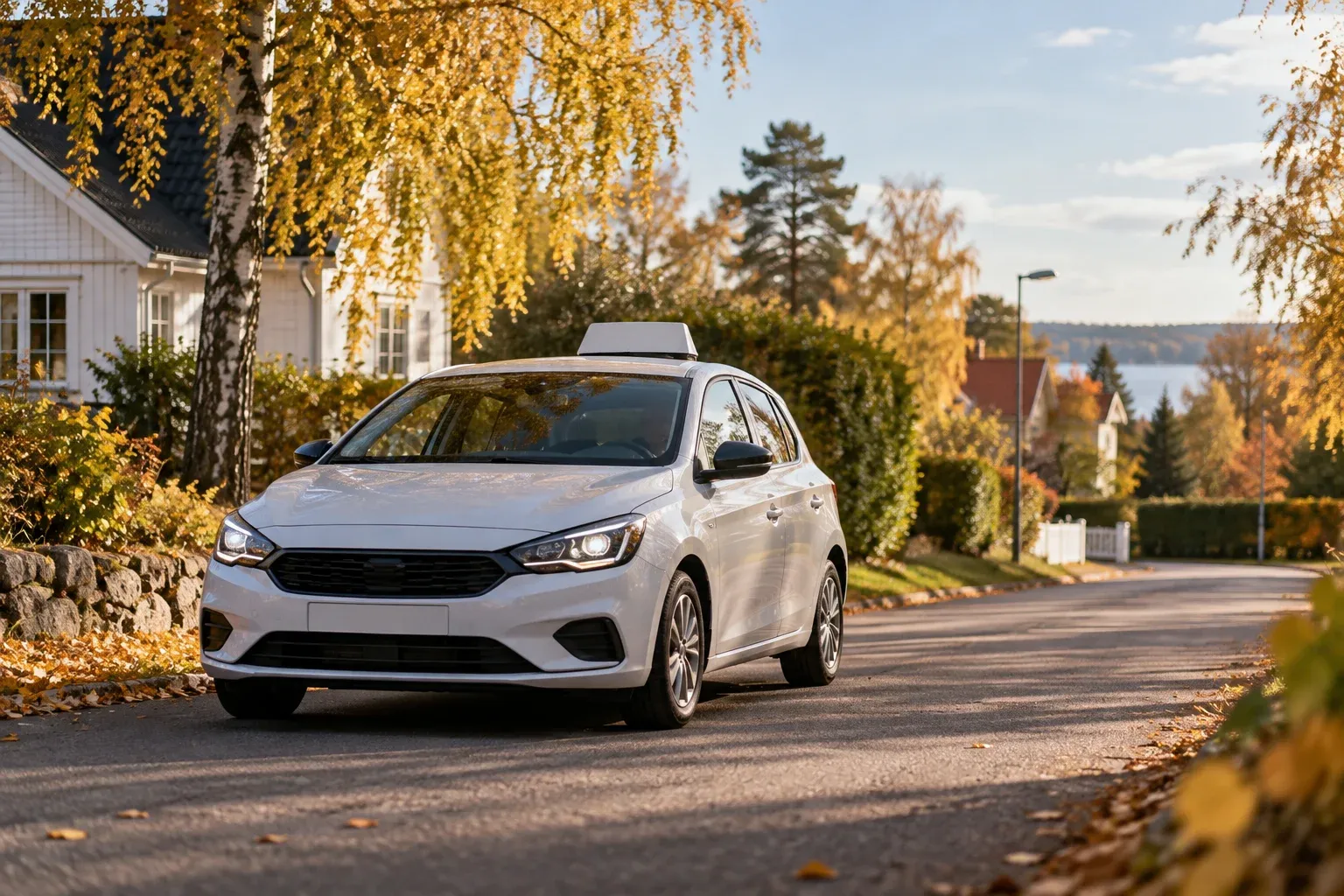
Here is how a Swedish driving licence is actually earned, who is allowed to earn one, what changed in August 2026, and which costs are fixed by the state and which depend on the driving school down the road.
When you need this
You’ve moved to Sweden on a licence from outside the EEA that can’t be exchanged, and the one-year clock is running. You’re a student here for more than six months and want to learn to drive. Your teenager will grow up in Sweden, a Swedish partner has offered to supervise you, or you’ve seen a car with an ÖVNINGSKÖRNING sign and wondered what it means. Or you’ve read about a compulsory “introduction course” and want to know if it still applies. It doesn’t.
Who runs the system
Two state agencies share the work, and knowing which does what saves a lot of wrong phone calls.
| Agency | What it does for you |
|---|---|
| Transportstyrelsen (Swedish Transport Agency) | Issues the learner’s permit, approves private supervisors, issues the licence card, handles foreign licences |
| Trafikverket (Swedish Transport Administration) | Runs the theory test and the driving test, takes bookings and fees |
All of it rests on one statute, the Driving Licence Act (körkortslagen), last amended in 2026. What surprises most foreigners is how much of the learning is done privately: a Swedish learner may practise from 16 with a parent or another approved supervisor in the family car, and many add only a few lessons at a driving school (trafikskola), because lessons are the expensive part.
Who can get a Swedish licence
This is the gate newcomers miss. A Swedish licence is issued only to someone who is permanently resident in Sweden or has been studying here for at least six months. The law defines permanent residence as living here at least 185 days in each calendar year because of personal ties, and university study does not by itself move your permanent residence. Tourists can’t earn a Swedish licence on holiday.
The other conditions are a learner’s permit, the minimum age (18 for a car), a passed driver test, and not holding a licence from another EEA country, which is exchanged instead.
If your licence is from outside the EEA, timing matters. It stops being valid once you’ve been registered as resident for more than a year, unless it was issued in the UK or the Faroe Islands. Licences from the UK, the Faroe Islands, Switzerland and Japan may, under conditions, be exchanged without tests; see exchanging a foreign driving licence. Everyone else goes through the Swedish process below, and Transportstyrelsen says it can’t grant an exemption just because you struggled to get a test slot. Start early. Registration itself is explained in our folkbokföring guide.
The steps in order
- Check you qualify: residence or six months of study, and 18 for the licence itself.
- Apply for a learner’s permit (körkortstillstånd) through Transportstyrelsen’s e-service (Swedish e-ID) or a paper form. Attach a health declaration and an eye-test certificate from an optician that is no more than two months old. The permit is free, normally takes up to four weeks, and is valid for five years.
- Choose how to learn: driving school, private practice, or a mix. Car practice is allowed from 16.
- Get a private supervisor approved if you practise outside a school.
- Complete both parts of the risk course.
- Pass the theory test at Trafikverket.
- Pass the driving test in a school or Trafikverket car.
- Receive the licence and drive on two years’ probation.
Order matters: you can’t book either test without a valid permit, and you can’t sit either test without a valid risk course.
Practising privately with a handledare
Private practice (övningskörning) is the Swedish way to get many hours behind the wheel cheaply. The supervisor, a handledare, must:
- be at least 24 years old
- have held a licence for the vehicle type for at least five of the last ten years, with a valid Swedish or other EEA licence
- apply to Transportstyrelsen and be approved as supervisor for you specifically
Approval lasts five years and lapses if the supervisor loses their licence or gets an alcolock condition. The car must carry an ÖVNINGSKÖRNING sign visible from behind, and the learner must carry valid ID on every drive. One trap: a supervisor who charges money for the lessons can be treated as an unlicensed driving school.
The risk course
Every learner, school or private, must complete a two-part risk course (riskutbildning) before either test. Only approved providers may run it, and they report your completion to Transportstyrelsen.
| Part | What it covers |
|---|---|
| Part 1 | Alcohol, drugs, fatigue and other risky behaviour |
| Part 2 | Speed, safety and driving in difficult road and weather conditions, including slippery surfaces on a skid pan (halkbana) |
The course stays valid until you get your licence, or at most five years. Part 2 is the closest most learners come to a real winter skid before driving alone; our winter driving guide explains why it matters.
The two tests
The theory test (kunskapsprov) has 70 multiple-choice questions in 50 minutes; five are unscored test questions, and 52 correct answers pass. You see the result on screen at once. It’s offered in Swedish and 15 other languages, including British English, German, Arabic and Persian, chosen when you book. If none suits you, you can apply through Trafikverket’s e-service to take it with an interpreter, who translates each question in a private room.
The driving test (körprov) takes 45 minutes and starts with a safety check of the car: lights, brakes, tyres, fluids and similar. The car must come from a driving school or Trafikverket; the family car is not allowed. In winter you’re tested in the conditions of the day, and winter-tyre rules apply to the test car as to any other (see winter tyres in Sweden).
Bring valid ID. An expired ID document is the most common reason people are turned away, and the fee is still charged. Cancel at least 24 hours ahead, or you pay the full fee; a refund for illness needs a medical certificate. Booking bots are not allowed in Trafikverket’s system, so watch for cancellations yourself.
What changed in 2026
Two changes in August 2026 make most English-language guides out of date, including Transportstyrelsen’s own English overview page.
| Change | From | What it means |
|---|---|---|
| Introduction course (introduktionsutbildning) abolished | 1 August 2026 | Private learners and supervisors no longer take a course; the supervisor still needs Transportstyrelsen’s approval |
| Theory test valid one year | Tests passed from 19 August 2026 | You have twelve months to pass the driving test; earlier passes keep four months |
Riksdagen approved the course’s abolition in April 2026, and the government said it would make getting a licence easier and cheaper. More change is coming: a new EU driving-licence directive will allow accompanied driving at 17 from 26 November 2028 and requires a digital licence by 2031 at the latest. Sweden has not yet decided how it will apply several of these options.
Probation: the first two years
A new car licence comes with a two-year probation (prövotid) from the test date. If the licence is revoked during probation, for speeding, drink-driving or similar, you need a new learner’s permit and must pass the tests again, even for a short revocation. Read our drink-driving guide before your first party season with a new licence.
Practical information
| Item | Amount or rule | Checked |
|---|---|---|
| Learner’s permit | Free; valid five years; up to about four weeks to process | 2026-10-14 |
| Supervisor approval | No fee stated; valid five years | 2026-10-14 |
| Theory test (B) | 420 kr weekdays 07:30–18:00; 520 kr evenings and weekends | 2026-10-14 |
| Driving test (B) | 1,000 kr weekdays 07:30–18:00; 1,400 kr evenings and weekends | 2026-10-14 |
| Photo at the test | 120 kr | 2026-10-14 |
| Licence fee | 375 kr; Transportstyrelsen proposes 450 kr from 1 January 2027 | 2026-10-14 |
| Eye test, risk course, lessons, test car | Set by private providers; compare locally | 2026-10-14 |
| Late cancellation or no-show | Full test fee | 2026-10-14 |
Test slots are the real bottleneck. Waiting times vary strongly by test centre and season, and summer is usually the worst, so compare locations when you book.
FAQ
How do you get a driving licence in Sweden?
Apply for a free learner’s permit from Transportstyrelsen with a health declaration and eye certificate. Practise from 16 with a driving school or an approved private supervisor, complete both parts of the risk course, then pass Trafikverket’s theory test and driving test from 18. You must be resident in Sweden or have studied here for at least six months.
Can a foreigner get a Swedish driving licence?
Yes, if you live here permanently, meaning at least 185 days a year with personal ties, or have studied here for at least six months. Tourists can’t. Holders of licences from the EEA, the UK, the Faroe Islands, Switzerland and Japan can usually exchange them instead; other non-EEA holders go through the full Swedish process.
Is the introduction course still required in Sweden?
No. The requirement for an introduction course (introduktionsutbildning) for private learners and their supervisors ended on 1 August 2026, after Riksdagen approved the change in April. The supervisor still has to apply to Transportstyrelsen and be approved for the specific learner. Pages describing the course as compulsory are out of date.
Who can be a handledare (supervisor)?
Someone aged at least 24 who has held a licence for the vehicle category for at least five of the last ten years, with a valid Swedish or other EEA licence, and no recent revocation or alcolock condition. They apply to Transportstyrelsen for approval, which lasts five years. They should not charge for supervising.
Can I take the Swedish theory test in English?
Yes. Trafikverket offers the car theory test in Swedish and 15 other languages, including British English, German, Arabic and Persian; you choose the language when booking. If none suits you, you can apply through Trafikverket’s e-service to take it with an interpreter, who translates each question in a private room.
How long is the theory test valid?
A passed theory test for a car licence taken on or after 19 August 2026 is valid for one year, so you have twelve months to pass the driving test. Tests passed before that date keep the old four-month limit. The test has 70 questions in 50 minutes, and 52 correct answers pass.
How much does a Swedish driving licence cost?
Fixed state fees are modest: the theory test is 420 kr and the driving test 1,000 kr on weekdays, plus a 120 kr photo and a 375 kr licence fee (checked 2026-10-14). The real cost is the risk course and driving-school lessons, set by private schools and varying widely, which is why Swedes practise privately.
Related guides
- Exchanging a foreign driving licence: check this first if your licence is from the EEA, the UK, Switzerland or Japan.
- Driving in Sweden: the rules of the road once you have your licence.
- Do you need an international driving permit?: driving on your home licence until you switch.
- EPA and A-tractors: the AM licence Swedish teenagers take at 15.
- Exchange students: the first two weeks: where the six-month study rule fits into student life.
Facts verified 2026-10-14. Sources: Transportstyrelsen, Trafikverket, Sveriges Riksdag (Driving Licence Act, test-fee ordinance), Regeringen — full register in this topic’s source file. This is general information, not legal advice. Found something outdated? Tell us and we’ll fix it.