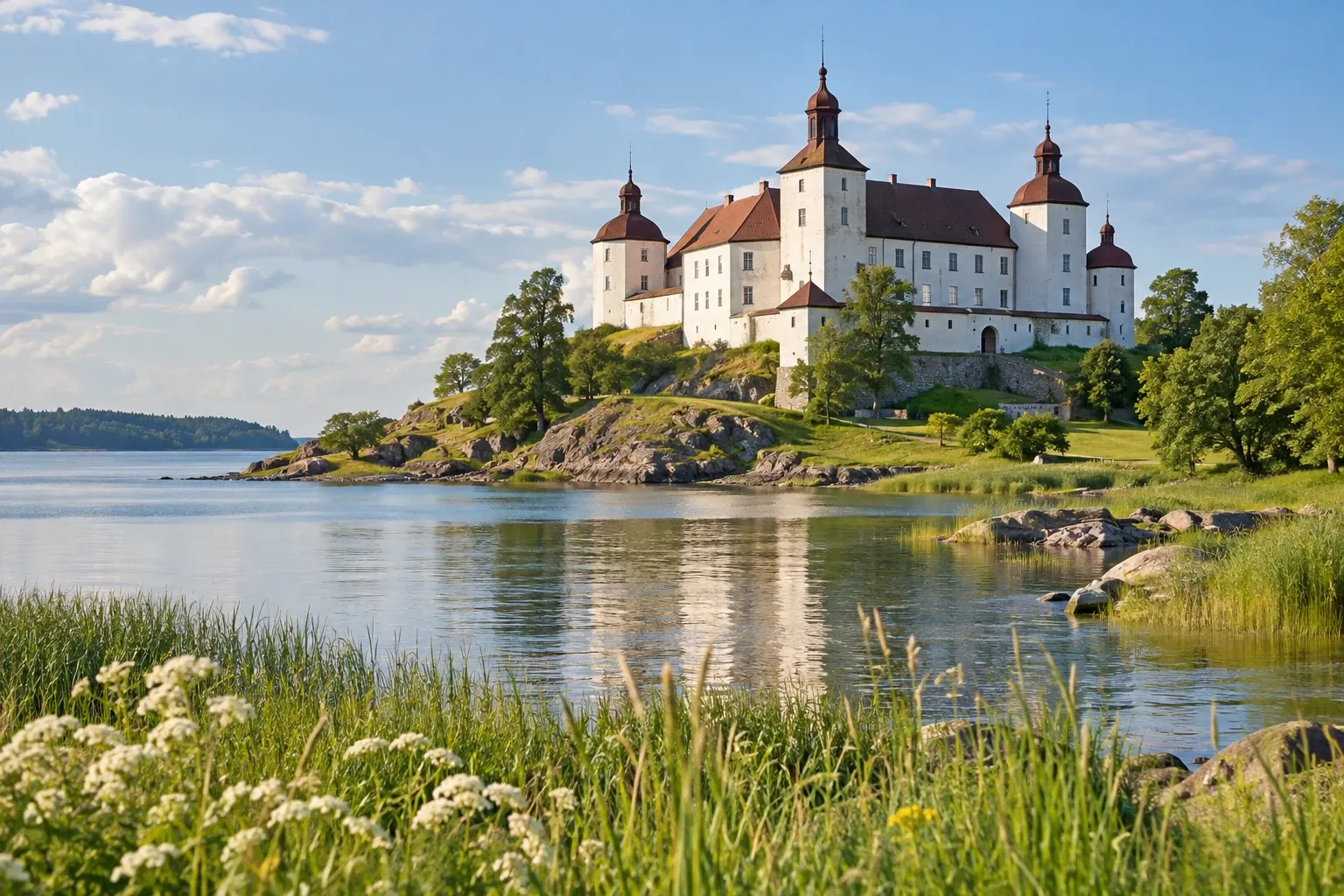
A Baroque castle on a lake peninsula and a flower-rich table mountain with its own railway sit on opposite sides of Lake Vänern’s southern bay. Here is when Läckö actually opens, how to hike Kinnekulle between train stops, and which reserve rules catch visitors out.
When you need this
You are planning a day or a weekend from Gothenburg, by train or car, and want both the castle and the mountain. Perhaps it is autumn and you are not sure you can get inside Läckö at all. Perhaps you want to walk Kinnekulle station to station, pitch a tent, bring a dog or fly a drone. Each of these has a rule worth knowing before you set off.
Kinnekulle, the flowering mountain
Kinnekulle rises about 5 km north-west of Götene, on the eastern side of the bay. It is a platåberg, a plateau or table mountain: layers of sandstone, alum shale, limestone and shale, all once seabed, under a cap of hard diabase that protected them from erosion. The top reaches about 306–307 m (the county board says 307 m above sea level). A 19 m viewing tower from 1892 stands on the summit, and on a clear day the view runs 80–90 km across Vänern. Linnaeus came through in 1746 and called it one of the most remarkable places in the kingdom.
The limestone is why it is called “the flowering mountain”. Orchids, giant oaks, beech woods and alvar, a thin-soiled limestone grassland, share the slopes. Österplana hed och vall holds the largest alvar on the Swedish mainland, and a small plant called kalknarv grows only here and on Gotland.
People have farmed the mountain for thousands of years, and it shows:
- Rock carvings: the Flyhov carvings, with over 450 figures, are the largest Bronze Age collection in Västergötland; there are more at Blomberg.
- Husaby church, with a triple west tower from the 1000s, which its parish calls Sweden’s first bishop’s church. It joined the Swedish cultural canon (Sveriges kulturkanon) in September 2025, and its 13th-century bishop’s chair is said to be Sweden’s oldest piece of furniture.
- St Sigfrid’s spring, just north-east of the church, where tradition says Olof Skötkonung, Sweden’s first Christian king, was baptized around the year 1000. The county board is careful to say “is said to have been”.
- Lasse’s cave in the Halla reserve, home to a couple who lived in it in the 1800s.
- Martorpsfallet, a waterfall over the limestone edge, at its strongest in spring.
Hiking Kinnekulle by train
This is the best way to see the mountain. The Kinnekulle railway (Kinnekullebanan) runs along the western side, with stations at Forshem, Hällekis, Råbäck, Blomberg, Trolmen and Källby. Blomberg and Råbäck stations sit right on the trail, Trolmen is a few hundred meters off, and Hällekis is about 2 km away. Walk one way, ride back.
These are request stops. To board at a small station you turn the sign on the platform so the train knows to stop. Forget it, and the train may simply pass.
| Walk | What you pass |
|---|---|
| Blomberg → Trolmen | Blomberg rock carvings, Västerplana storäng |
| Trolmen → Hällekis | Råbäck harbour and its stone-quarrying museum, Munkängarna, the big quarry; follows the light-blue Biosfärleden markers |
| Blomberg → Råbäck | The whole west side, from Västerplana storäng to Råbäck harbour |
The full Kinnekulleleden is 48 km, marked in orange, rated moderate and suited to three day stages. Shorter loops run two to five kilometers on Högkullen at the summit, about 5 km at Martorpsfallet and 6.5 km at Munkängarna; the local reserve loops are marked dark blue. For something longer, Biosfärleden runs 140 km along Vänern’s southern shore between Mariestad and Läckö. See our hiking guide for the basics.
Many cafés and lodgings on the mountain are seasonal, so an October hike may find nothing open on the trail. The viewing tower doubles as an information point with trail maps, but it is closed for the season after September.
Reserve rules: tents, fires, wild garlic
Kinnekulle’s conservation area holds 18 nature reserves and belongs to the EU’s Natura 2000 network. Allemansrätten still applies, but each reserve’s regulations are law and override it. Our guide to nature reserves in Sweden explains how that works.
| Rule | Where it applies |
|---|---|
| No camping | Västerplana storäng, Österplana hed och vall; Stora Salen from 1 May to 31 August |
| No tent where the wild garlic grows | Munkängarna |
| No picking wild garlic (ramslök) | All 18 reserves; outside them you may pick |
| Fires only at prepared fire places | The whole conservation area |
| Cycling only on roads, Kinnekulleleden and marked MTB trails | The whole conservation area |
| No breaking off stones, minerals or fossils | The reserves |
Several reserves are grazed by loose animals. Camping among them is at your own risk, and dogs belong on a lead near the herds. Elsewhere on the mountain the general wild camping rules apply, and our foraging guide covers what you may pick in the rest of Sweden.
Läckö Castle: what you see
Läckö stands at the tip of the Kållandsö peninsula, about 25 km north of Lidköping. The Skara bishop Brynolf Algotsson founded a fortified castle here in 1298. After the Reformation in 1527 it passed to the crown, and in 1615 to Jacob De la Gardie. From 1654 his son, Magnus Gabriel De la Gardie, turned it into the Baroque castle you see today, adding a fourth floor and the castle church, built 1655–1668. The state owns the castle, Statens fastighetsverk manages it, and a foundation runs the visits.
Most of the decoration dates from Magnus Gabriel’s time. Look up in the King’s Hall for the 13 ceiling angels by Johan Werner. The rooms are furnished to show the period’s style, not to reconstruct it, using objects from the state art collections managed by Nationalmuseum. Nationalmuseum also produces the Treasury of 17th-century luxury objects. The armoury of wheel-lock guns comes from Armémuseum.
Beside the castle:
- naturum Vänerskärgården – Victoriahuset, the free nature centre for Lake Vänern’s archipelago and the gateway to Djurö National Park, about thirty islands in the middle of the lake. In summer the castle runs guided boat trips there. See Swedish national parks.
- Lilla Slottsträdgården, an organic kitchen garden shaped since 1990, closed until 2027.
- A beach and a jetty with steps for swimming, and barbecue places at the guest harbours, by the car park and on the Roparudden trail.
- Summer opera in the great courtyard every July and August since 1997; 2027 is the 30th season.
When Läckö is open in 2026
Outside summer, Läckö is a guided-tour castle: you cannot wander the rooms on your own. Tours last about 40 minutes, start in the courtyard and cover the third-floor state rooms. Tickets are bought on arrival in the castle shop, and no booking is needed unless you are a group of over 20.
| 2026 period | Castle | naturum |
|---|---|---|
| 14 June–13 September | Summer ticket includes a guided tour | Open |
| 14–28 September | Tours Wed–Sun: Swedish 11:00 and 13:00, English 14:00 | Wed–Sun |
| 1 October–22 November | Tours in Swedish: Fri 14:00, Sat 11:00 and 14:00, Sun 11:00 | Fri–Sun |
| 29–31 October (half-term) | Courtyard and shop Thu 10–16, Fri 10–19, Sat 10–16; children’s activities | Open |
| 22 November–20 December | Closed; special tours bookable | Fri–Sun |
There is no English tour after 28 September. Autumn tours are in Swedish, with information sheets in other languages. The castle’s English opening-hours page still shows much of this text in Swedish, so read it carefully. The summer daily hours are no longer shown, and the 2027 season has not been published yet. Under-26s enter free all year. In summer a cheaper courtyard pass also covers the garden and shop without the castle rooms.
Access, dogs and drones
| Need | What the castle says |
|---|---|
| Wheelchair | No lift; the castle and garden have many stairs. The courtyards can be reached, up a slope. A car may drop passengers at the entrance but not park there |
| Tour route | Some stairs and narrow passages |
| naturum | Exhibition, toilets and reception on the step-free ground floor |
| Parking | Large gravel car park with disabled bays; pay by card or parking app |
| Dogs | Welcome on the grounds and terraces; not inside the castle, naturum or the inn building |
| Drones | Allowed under Transportstyrelsen’s rules, but not within 50 m of the castle or over it, and never over courtyard crowds. Military aircraft often fly low here |
Before flying, read our drone rules for Sweden; the national rules are law, the 50 m request is the castle’s own.
Getting there
- By train: trains on the Kinnekulle line run through from Gothenburg or Örebro, sometimes with a change at Herrljunga, and reach Lidköping in under two hours from Gothenburg. They continue across the mountain stations to Mariestad.
- To Läckö by bus: Västtrafik bus 132 runs from Lidköping in summer only.
- Outside summer: use närtrafik, Västtrafik’s on-demand rural service. It picks you up at an address in a defined area and drives you to a stop in the same municipality. Book by phone at least an hour ahead, within fixed time windows; it costs the same as a single ticket.
- To Husaby church: Västtrafik bus or närtrafik.
- By car: Läckö is signposted from Lidköping. On opera nights parking is limited, and the pre-booked opera bus from Lidköping is the easier option. It sells no tickets on board.
More on car-free planning in Sweden without a car.
Two UNESCO labels, no World Heritage
Kinnekulle and Läckö sit inside Vänerskärgården med Kinnekulle, a UNESCO biosphere area since 2010, covering Lidköping, Götene and Mariestad. They also lie within Platåbergens Geopark, 15 table mountains that UNESCO approved in 2022 as Sweden’s first Global Geopark. Some pages still describe the geopark as an application; that is out of date.
Neither is World Heritage. Sweden’s 15 World Heritage Sites are a separate list, covered in our UNESCO World Heritage guide. The Göta Canal starts at Sjötorp, at the northern edge of the same biosphere area.
Mistakes to avoid
- Expecting to tour Läckö’s rooms alone in October. Plan around the fixed tour times.
- Counting on an English tour after September.
- Picking wild garlic in Munkängarna. It is inside a reserve.
- Pitching a tent on Österplana hed och vall. Camping is banned there.
- Standing on a Kinnekulle platform without turning the sign.
- Taking the dog into the castle or naturum.
- Calling it World Heritage. It is a biosphere area and a geopark.
Practical information
| Item | 2026 detail (checked 2026-10-15) |
|---|---|
| Läckö guided tour, adult, 14 September–22 November | 120 kr |
| Läckö, adult, summer (14 June–13 September) | 165 kr incl. guided tour; courtyard pass 50 kr |
| Läckö guided tour, adult, 1 April–12 June | 120 kr |
| Läckö, under 26 | Free |
| Läckö groups over 20 | 100 kr low season, 130 kr summer, per person |
| Half-term children’s activities, 29–31 October | From 20 kr; most 50 kr per child |
| Läckö day parking | 60 kr (Midsummer Eve 80 kr, local club); season card 120 kr |
| naturum Vänerskärgården | Free |
| Kinnekulle reserves and trails | Free |
| Närtrafik ride | Price of a regular single ticket |
| Kinnekulle viewing tower | 2026 season ended 27 September; no fee published |
FAQ
Is Läckö Castle open in winter?
Not really. From 1 October to 22 November 2026 the castle opens only for guided tours: Friday at 14:00, Saturday at 11:00 and 14:00, and Sunday at 11:00. From 22 November to 20 December it is closed apart from special bookable tours, and the garden stays shut until 2027. The free naturum next door keeps Friday–Sunday hours.
Are there guided tours in English at Läckö Castle?
Only in season. In 2026 an English tour ran at 14:00, Wednesday to Sunday, until 28 September. From 1 October the tours are in Swedish, with information sheets in other languages. Each tour lasts about 40 minutes, covers the third-floor state rooms and is booked simply by buying a ticket in the castle shop on arrival.
How do I get to Läckö Castle without a car?
In summer, take Västtrafik bus 132 from Lidköping; the castle is about 25 km north of town on the Kållandsö peninsula. Outside summer there is no regular bus, so use Västtrafik’s on-demand närtrafik, booked by phone at least an hour ahead, or a taxi. Lidköping itself is under two hours from Gothenburg by train.
Can you hike Kinnekulle by train?
Yes. The Kinnekulle railway stops at Forshem, Hällekis, Råbäck, Blomberg, Trolmen and Källby, and Blomberg and Råbäck stations sit right on the 48 km Kinnekulleleden. Walk one way and ride back, and remember these are request stops: turn the sign on the platform so the train stops for you.
Can you camp on Kinnekulle?
In most places, yes, under allemansrätten, but the 18 nature reserves have their own rules. Camping is banned in Västerplana storäng and Österplana hed och vall, and in Stora Salen from May to August. In Munkängarna, keep off the wild garlic. Fires are allowed only at prepared fire places, and grazing animals may share your meadow.
Can I pick wild garlic on Kinnekulle?
Not inside the nature reserves. The county board bans picking wild garlic (ramsons) in all 18 reserves of the Kinnekulle conservation area, including Munkängarna, where it carpets the woodland floor in late spring. Outside the reserves you may pick it. Check the reserve signs, or the county board’s map, before filling a bag.
Is Kinnekulle a UNESCO World Heritage Site?
No. Kinnekulle and Läckö sit in the UNESCO biosphere area Vänerskärgården med Kinnekulle, named in 2010, and in Platåbergens Geopark, which UNESCO approved in 2022 as Sweden’s first Global Geopark. Both are UNESCO programmes, but neither is World Heritage, which has its own list of 15 Swedish sites.
Related guides
- Nature reserves in Sweden: why a reserve’s rules override allemansrätten.
- Wild camping in Sweden: the general tent rules behind Kinnekulle’s exceptions.
- Swedish national parks: Djurö and the other parks, and their own regulations.
- Nationalmuseum: the state collections that furnish Läckö’s rooms.
- Dalsland: the lake-and-canal province across Vänern.
Facts verified 2026-10-15. Sources: Läckö Slott, Länsstyrelsen Västra Götaland, Destination Läckö-Kinnekulle, Trafikverket, Svenska kyrkan Götene, Naturvårdsverket’s national parks site and UNRIC — full register in this topic’s source file. Times and prices are 2026 figures. Found something outdated? Tell us and we’ll fix it.