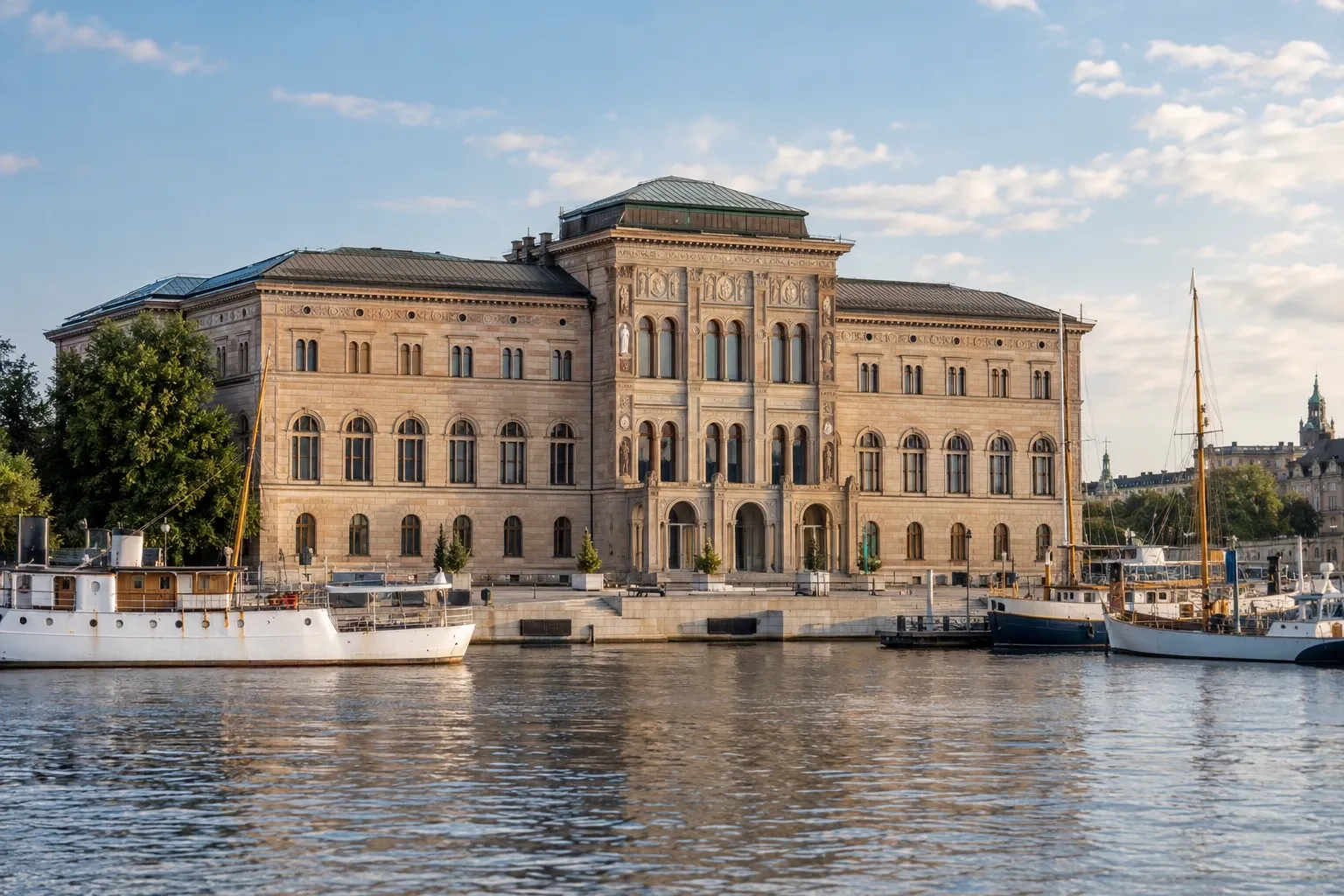
Sweden’s national art museum faces the Royal Palace across the water and easy to do well if you know three things: what it does and does not collect, when it is free, and the bag rule that now trips people up at the door.
When you need this
You have one art afternoon in Stockholm and are choosing between Nationalmuseum and Moderna Museet. Or you are planning a Thursday evening, travelling with a 19-year-old, arriving with a daypack, or visiting with a wheelchair or pushchair. And if your free day is a Monday, this guide will save you a walk to a locked door.
What is in the building
Nationalmuseum is Sweden’s museum of art and design, and also a government agency. It was founded in 1792, which the museum says makes it one of Europe’s oldest museums of fine art.
Its remit is written into an ordinance, Förordning (2007:1175): older painting, sculpture, drawing and prints, preferably from before 1900, plus portraits, applied arts, craft and design from early times to today. The museum’s own visitor page puts it the same way: paintings up to the early 20th century, design up to the present.
That line decides your afternoon:
| You want to see | Go to |
|---|---|
| Rembrandt, Goya, Renoir, Gauguin | Nationalmuseum |
| Swedish painting around 1900: Zorn, Carl Larsson | Nationalmuseum |
| Design, glass and ceramics from the 1700s to today | Nationalmuseum |
| Modern and contemporary painting | Moderna Museet, on Skeppsholmen |
Contemporary art moved out of this building into its own museum, Moderna Museet, in 1958. The two are a few minutes apart, over the bridge.
About 5,000 objects hang along a chronological route the museum calls the Timeline, with paintings, sculpture, applied arts and design side by side in each era. The museum names Rembrandt, Judith Leyster, Artemisia Gentileschi, Alexander Roslin, Goya, Renoir, Claudel, Gauguin, Anders Zorn, Carl Larsson and Pauli among the artists. Displays rotate, so there is usually something new.
How the floors run. The top floor covers the 16th century to about 1800 (galleries 1–23, ending at the Upper Stair Hall). The middle floor runs from 1800 to the present (galleries 24–35), including the Treasury. Start at the top and walk down, and you follow the timeline.
Three spaces to plan around
- The Upper Stair Hall. Carl Larsson’s Midvinterblot (Midwinter Sacrifice), two canvases measuring 6.4 × 13.6 meters, was painted for this wall as the last part of his 1896 murals. The museum trial-hung it in 1915; it was debated up to government level and refused. Private donors and foundations finally helped the museum buy it in summer 1997. It was rehung for the 2018 reopening.
- The Treasury. More than 600 of the museum’s 5,700 portrait miniatures, which it calls the world’s largest such collection, shown with jewelry, boxes and pocket watches. They range from Nicholas Hilliard’s Elizabeth I to 20th-century work.
- The free ground floor. The glass-roofed Skulpturgården (Sculpture Courtyard) and the Designdepån (Design Depot), more than 1,200 objects tracing ceramics from the 18th century onward. Both are free to enter. Our Swedish design guide covers the Depot as a design destination.
The building itself
The building on the Blasieholmen waterfront opened to the public on 15 June 1866. The Riksdag decided to build it in 1845, and the German architect Friedrich August Stüler, then also building the Neues Museum in Berlin, became head architect in 1847.
It went 150 years without a comprehensive renovation. The museum closed in spring 2013, and the National Property Board (Statens fastighetsverk), which manages the building, carried out the work. It reopened on 13 October 2018 with larger galleries and long-covered windows opened again to light and city views.
Opening hours
| Day | Hours |
|---|---|
| Monday | Closed |
| Tuesday, Wednesday, Friday–Sunday | 11:00–17:00 |
| Thursday | 11:00–20:00 |
| 24 and 25 December 2026 | Closed |
| 26 December 2026 | 11:00–17:00 |
| 31 December 2026 and 1 January 2027 | Closed |
The museum notes that hours are subject to change. Hours do not vary by season; only holidays differ. More on the Monday pattern in opening hours in Sweden.
Tickets and free entry
The rules are simple once laid out:
- Under 20: free, at any time.
- Everyone: free on Thursdays 17:00–20:00.
- Last hour before closing: half price.
- The ground floor is always free: Sculpture Courtyard, South Courtyard, Design Depot, studios, shop and restaurant.
- One ticket covers everything, the collections and all temporary exhibitions, for the whole day.
Even with free entry, you need a ticket. You collect an entrance tag at the desk and wear it in the galleries. Adults pay since free adult entry at state museums ended in the 2023 budget; older guides that still call Nationalmuseum free are out of date. Our free museums in Stockholm guide compares this Thursday slot with other museums’ free times.
The catch with Thursday evenings. The museum itself warns that free entry draws many visitors and the galleries can get crowded. In autumn 2026 Thursday evenings, from 3 September to 17 December, also bring live music and a free studio drop-in from 17:00 to 19:30. Come then for the atmosphere; come on a weekday morning to look at paintings in peace.
Bags, payment and house rules
The museum says its bag rules were changed “for safety reasons”, and this is where visitors get stopped:
- Bags and backpacks up to 40 × 20 × 25 cm, carried in your hand. Bags near that size may not be worn on your back or front; small thin bags may hang at your side. Larger bags are refused.
- The museum’s accessibility page still gives an older limit of 40 × 38 × 36 cm. Plan on the smaller size.
- Lockers are on the lower ground floor; most measure 40 × 38 × 36 cm, and staff may open them for security reasons.
- No umbrellas or ice grips in the galleries. Walking poles need rubber tips; spiked poles go in the umbrella stands on the entrance floor.
- No food or drink in the exhibitions. There is a picnic room on the lower ground floor.
- No touching the art, not even gently.
- Photos are fine for private use, without flash, selfie stick or tripod. Portrait and wedding shoots are not allowed.
Payment is by card or Swish only. Swish needs a Swedish bank account and BankID, so for most visitors that means card; see Swish for tourists. The restaurant on the ground floor stays open until closing, but its kitchen shuts at 15:00 (19:00 on Thursdays).
Getting there
The museum stands on Blasieholmen, facing the Royal Palace across the water.
| Route | How |
|---|---|
| Metro | Blue line (10, 11) to Kungsträdgården, exit “Kungsträdgården – Skärgårdsbåtar” |
| Bus | 65 to Nationalmuseum or Kungsträdgården; 2, 55 or 76 to Karl XII:s torg |
| Ferry | Djurgården ferry (SL line 82) from Slussen or Allmänna gränd to Skeppsholmen, then about 10 minutes’ walk |
| Bike | Parking next to the main entrance |
| Car | Very limited parking |
Any SL ticket is valid on line 82; tap before boarding. During the Slussen works the ferry leaves from a temporary pier on Skeppsbron. Details in our Stockholm public transport guide.
Accessibility and families
- Step-free entry: a lift to the right of the front steps takes wheelchairs, mobility scooters and prams up to the entrance; accessible parking is beside it.
- Lifts with automatic doors serve every floor.
- Loan wheelchairs and wheeled walkers are available from staff on the ground floor.
- Accessible toilets on every floor, with changing tables.
- Hearing loops in both courtyards, portable loops for tours, and a tactile map in the foyer.
- Companions and personal assistants enter free; guide and assistance dogs are welcome.
Families do well here. All children’s activities are free, the Colour! exhibition for children runs until 12 August 2029, and the Design Depot’s lower shelves are full of ceramic lions and porcelain dogs at child height. Pushchairs are allowed throughout. Bring headphones: temporary-exhibition audio tracks play in the browser with no app, over free Wi-Fi.
Beyond Stockholm
The agency also runs the Gustavsberg Porcelain Museum and shows its collections elsewhere: at Gripsholm Castle, home of the State Portrait Collection, at Läckö Castle and at Nationalmuseum Jamtli in Östersund. As of October 2026, Design for Life runs at Jamtli until 15 November 2026, and The joyful world of Stig Lindberg at Gustavsberg until 2 May 2027.
In Stockholm, To the Sea!, about 200 works on beach and seaside life with loans from the Met, the Musée d’Orsay and the National Gallery, runs until 7 February 2027.
Mistakes to avoid
- Planning a Monday. Closed.
- Expecting modern painting. That is Moderna Museet.
- Paying on a Thursday afternoon when entry is free from 17:00.
- Buying a ticket for a 19-year-old. Under-20s are free.
- Skipping the desk because entry is free. You still need a ticket.
- Wearing your backpack into the galleries.
- Bringing only cash.
Practical information
| Item | Detail |
|---|---|
| Location | Södra Blasieholmshamnen, Blasieholmen, Stockholm |
| Open | Tue–Sun 11:00–17:00, Thu to 20:00; closed Mondays |
| Adult | 160 kr |
| Last 60 minutes | 80 kr |
| Under 20 | Free (collect a ticket) |
| Everyone, Thursday 17:00–20:00 | Free |
| Ground floor, Sculpture Courtyard, Design Depot | Free |
| Groups of 10+ | 110 kr per person |
| Annual card (also valid at Gustavsberg Porcelain Museum) | 400 kr; students and under-26s 200 kr |
| Companion or personal assistant | Free |
| Payment | Card or Swish; no cash |
| Maximum bag size | 40 × 20 × 25 cm, carried by hand |
Prices from the museum’s admission page, checked 2026-10-14.
FAQ
How much does Nationalmuseum cost?
In 2026 an adult ticket costs 160 kronor, or 80 kronor in the last hour before closing. Visitors under 20 enter free, and everyone enters free on Thursdays from 17:00 to 20:00. The ground floor, with the Sculpture Courtyard and the Design Depot, is free at all times. One ticket covers the collections and all temporary exhibitions for the day.
When is Nationalmuseum free?
Every Thursday from 17:00 to 20:00 entry is free for everyone, and visitors under 20 are free at any time. You still need to collect a ticket at the desk. The ground floor, including the shop, the Sculpture Courtyard and the Design Depot, is always free. The museum warns that Thursday evenings get crowded, so pick another day for quiet viewing.
What are Nationalmuseum’s opening hours?
Tuesday to Sunday 11:00–17:00, with Thursdays open until 20:00. The museum is closed on Mondays. Over the 2026 holidays it is closed on 24 and 25 December, open 11:00–17:00 on 26 December, and closed on 31 December and 1 January 2027. The museum notes that hours are subject to change, so check its page before going.
What is there to see at Nationalmuseum?
About 5,000 objects along a chronological timeline: European and Swedish painting and sculpture from the 1500s to about 1900, with applied arts and design up to today. Highlights include works by Rembrandt, Goya, Renoir, Zorn and Carl Larsson, Larsson’s huge Midvinterblot in the Upper Stair Hall, and the Treasury with over 600 portrait miniatures.
Is modern art at Nationalmuseum or Moderna Museet?
Mostly at Moderna Museet. By ordinance, Nationalmuseum’s painting and sculpture collection covers art preferably from before 1900, while its design and applied arts run to the present. Contemporary art got its own museum, Moderna Museet on Skeppsholmen, in 1958. For 20th-century painting, cross the bridge; for Rembrandt, Swedish 1890s painting or design history, stay here.
Can I bring a backpack into Nationalmuseum?
Only a small one, carried in your hand. The museum’s practical page sets a limit of 40 × 20 × 25 cm and asks that bags near that size are not worn on the back or front. Larger bags are refused. Umbrellas and ice grips cannot go into the galleries. Lockers are on the lower ground floor; most measure 40 × 38 × 36 cm.
Is Nationalmuseum wheelchair accessible?
Yes. A lift to the right of the front steps takes wheelchairs, scooters and prams up to the entrance, and lifts with automatic doors serve every floor. Wheelchairs and wheeled walkers can be borrowed on the ground floor. Every floor has an accessible toilet, there are hearing loops in both courtyards and a tactile map in the foyer. Companions enter free.
Can you take photos in Nationalmuseum?
Yes, for private use. Flash, selfie sticks and tripods are not allowed, and you must not block visitor flows or emergency exits. The museum may not be used as a backdrop for portrait or wedding shoots, or for photographing products you bring. Commercial photography or filming needs a written permit requested at least ten days in advance.
Related guides
- Moderna Museet — modern and contemporary art, the half of the story this building does not tell.
- Free museums in Stockholm — how the Thursday slot fits with other free times across the city.
- Swedish design: where to see it and buy it — the Design Depot and the rest of Sweden’s design trail.
- Rainy day in Stockholm — indoor plans that work on a Monday, when this museum is closed.
- Mariefred and Gripsholm Castle — where Nationalmuseum’s State Portrait Collection hangs.
Facts verified 2026-10-14. Sources: Nationalmuseum (official site and agency pages), Sveriges riksdag (Förordning 2007:1175), Regeringen, SL, the City of Stockholm and Swish — full register in this topic’s source file. Prices and hours are the museum’s 2026 figures. Found something outdated? Tell us and we’ll fix it.