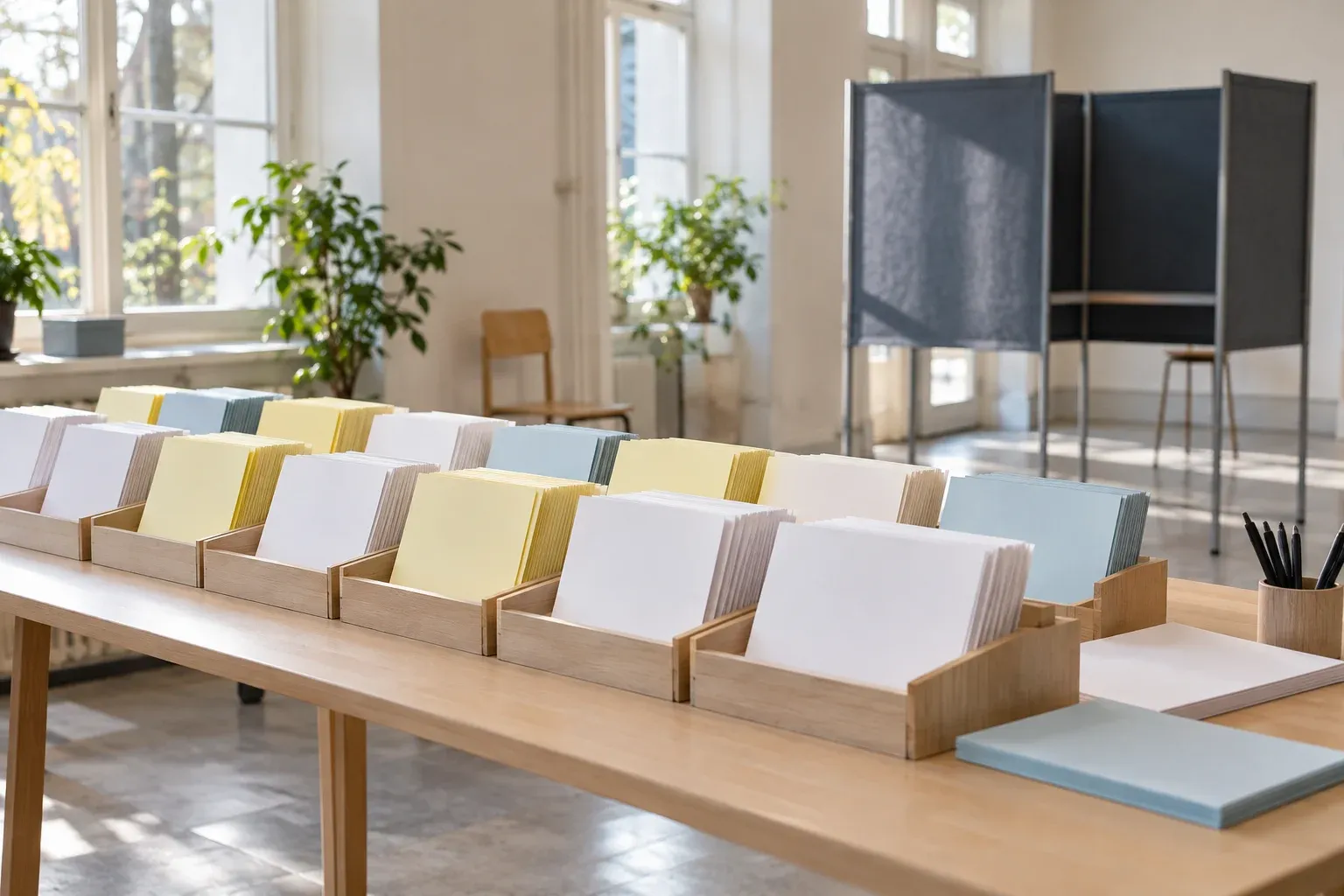
Swedish elections look old-fashioned from the outside: paper ballots, one per party, in three colors. The details are recent, though. The famous open ballot tables are gone, and the 2026 vote left the country with a one-seat margin and weeks of government talks.
When you need this
You’re in Sweden in an election year and see campaign posters and early-voting signs everywhere. Maybe you’re an exchange student and a Swedish friend asks you along to vote, or a newcomer with local voting rights who wants to know what happens inside. Or you’ve been following the 2026 result and wonder why, weeks later, there’s still no new government.
Who may vote at all is a separate question, covered in our guide to voting in Sweden as a foreign resident. In short: tourists can’t vote in any Swedish election, but they can watch.
Three elections on one Sunday
A Swedish general election is really three elections held together, always on the second Sunday in September every fourth year:
| Election | Elects | Runs | Ballot color |
|---|---|---|---|
| Riksdagsval | The 349-seat national parliament | National law, taxes, the state budget | Yellow |
| Regionval | The regional council (regionfullmäktige) | Healthcare, public transport | Blue |
| Kommunval | The municipal council (kommunfullmäktige) | Schools, elderly care, local planning | White |
Voters get three ballots and three envelopes and can split their vote, backing one party nationally and another at home. Foreign residents who have local voting rights use only the blue and white ballots. Our guide to how Sweden is governed explains what each level actually decides.
To win Riksdag seats a party needs 4% of the national vote, or 12% in one constituency for that constituency’s seats. Of the 349 seats, 310 are constituency seats and 39 are adjustment seats that make the result proportional nationally. Local thresholds are lower: 2% or 3% in municipalities, 3% in regions.
The ballot papers
Sweden votes on paper, and every party has its own ballot paper (valsedel). By law all ballots are A6 (105 x 148 mm), on the same paper, and all ballots for one election share a color. There are three kinds:
- A party ballot with just the party name.
- A party ballot with candidates, listed in numbered order, with a box next to each name.
- A blank ballot showing only the election, on which you write a party name yourself.
The state prints the ballots. The Election Authority (Valmyndigheten) supplies every ballot and envelope, and parties that won more than 1% nationally in either of the last two Riksdag elections, or sit in the Riksdag, get them free.
In the voting place you’ll always find blank ballots, party ballots for every party over that 1% line, and, for local elections, ballots for parties already on that council. Smaller parties may supply their own ballots, but only the election staff put them out, and all ballots must be presented the same way. If your party’s ballot is missing, take a blank one in the right color and write the party name on it.
The personal vote (personröst). You may put a cross next to one candidate on your party’s list. It still counts as a vote for the party, but it can move that candidate up. In Riksdag elections this only takes effect for a candidate whose personal votes reach at least 5% of the party’s votes in the constituency. Only one cross per ballot counts.
Why the ballot tables went behind a screen
For decades, ballots stood on open tables in the polling station. Anyone in the room could see which party’s paper a voter picked up, and many foreign descriptions still say so.
Out of date: the open ballot table is history. Since 1 January 2019 the law has required the ballots to be laid out in a screened-off area where each voter takes them unseen; it was first used at the 2019 European election. Since 1 February 2022 that area should be set up next to the voting room rather than inside it, wherever possible.
The reform protects the secrecy of the vote at its weakest point: the moment you choose a ballot. Valmyndigheten’s voter leaflet puts it plainly: the ballots are behind a screen, and you must be alone when you take them so that no one else sees. The authority also recommends that envelopes are handed out only after you’ve taken your ballots, so nobody uses the ballot rack as a voting booth.
Each municipal election board decides how its racks are screened and arranged. Local parties’ ballots appear only where that party sits on the council, so racks differ slightly from town to town.
Inside the polling station, step by step
Polling stations (vallokal) are open 08.00–20.00 on election day. A municipality may shorten hours at a station in a sparsely populated area, but it must stay open at least 09.00–13.00 and 17.00–20.00.
- Take your ballots alone in the screened area: one per election you vote in.
- Take envelopes (valkuvert), one per ballot.
- Go alone behind a voting screen (valskärm). Mark a personal vote if you want one.
- Put each ballot unfolded into its own envelope and seal it.
- Hand the envelopes and your ID to the polling staff (röstmottagare).
- Watch the staff check the electoral roll and drop each envelope into the right ballot box in front of you.
The voting card (röstkort) is optional; ID is not. If you have no ID, a staff member who knows you, or another person aged 18 or over with ID, can vouch for you. Only one envelope per election is accepted from each voter.
Voters with a disability or similar need can get help from the staff with both the ballots and the envelopes, and may bring a helper of their own. Valmyndigheten’s instruction is that a staff member must then be present, and polling staff are bound by confidentiality. Campaigning of any kind is banned inside the polling station and in the space next to it, though parties may hand voters their own ballots outside.
Early voting and changing your mind
Most Swedes no longer wait for Sunday. In 2026, 54.7% of votes were cast in advance. Early voting (förtidsröstning) starts on the 18th day before election day and isn’t tied to your home municipality, which suits students and travelers. In 2026 it ran from 26 August to 13 September.
Sweden also lets you change your mind. If you voted early, you can vote again in person at your own polling station on election day, and that vote replaces the early one. This is called ångerröstning, roughly “regret voting”. Two limits apply: you may vote early only once, since several early votes from the same person are all rejected, and a vote cast on election day is final.
Two things were new in 2026. Voting cards went to voters’ digital mailboxes where they had one, otherwise by post, and 20 municipalities tested a digital electoral roll alongside the paper one.
Election night and the count
When the polling station closes at 20.00, the staff start counting at once, without a break, Riksdag votes first. The count is public by law, so anyone can watch quietly, tourists included. It’s a calm, very Swedish piece of civic routine.
The figures on election night are preliminary. On the Wednesday after election day the municipal election board counts the remaining votes, and the county administrative board (länsstyrelsen) then does the final count. Close seats can still move.
The 2026 result and forming a government
The 2026 election was held on 13 September. Turnout was 84.9%, and 22.2% of voters cast a personal vote.
| Party | Vote share | Seats |
|---|---|---|
| Social Democrats (S) | 28.02% | 99 |
| Moderates (M) | 19.85% | 70 |
| Sweden Democrats (SD) | 17.48% | 62 |
| Left Party (V) | 8.40% | 30 |
| Centre Party (C) | 7.03% | 25 |
| Christian Democrats (KD) | 6.17% | 22 |
| Green Party (MP) | 6.12% | 22 |
| Liberals (L) | 5.34% | 19 |
S, V, C and MP together hold 176 seats; the four parties behind the outgoing government hold 173. A Swedish government isn’t formed on election night. The new Riksdag meets on the 15th day after the election, and the Speaker (talman), not the King, proposes a prime minister. The proposal fails only if more than half of all members, 175, vote no, so a candidate can win with far fewer yes votes. After four failed proposals an extra election must be held.
Since 17 September a caretaker government (övergångsregering) led by Ulf Kristersson has handled day-to-day business. As of 13 October 2026 no new prime minister had been voted in: the Speaker had given Social Democrat leader Magdalena Andersson a second sounding mandate, and a vote in the Riksdag was being prepared. Check riksdagen.se for the current status.
Mistakes to avoid
- Expecting open tables. Take your ballots from the screened rack first; envelopes come after.
- Two ballots in one envelope. That can void your vote for that election. One ballot, one envelope.
- Writing on the ballot. The only allowed mark is the personal-vote cross; other markings can invalidate it.
- Bringing the card but no ID. It’s the other way round.
- Voting early twice. All your early votes get rejected. Re-vote on election day instead.
- Reading election night as final. In 2026 the bloc margin was one seat; wait for the final count.
Practical information
| Item | Detail |
|---|---|
| Election day | Second Sunday in September, every four years; last 13 September 2026, next 8 September 2030 |
| Polling station hours | 08.00–20.00 (minimum 09.00–13.00 and 17.00–20.00) |
| Early voting | From the 18th day before election day, anywhere in Sweden |
| Ballot colors | Yellow Riksdag, blue regional, white municipal |
| What to bring | ID; the voting card is optional |
| Cost | Voting, ballots and envelopes are free (checked 2026-10-14) |
| European Parliament | Separate election, June every five years, next 2029; polls open 08.00–21.00 |
| Official information | val.se (results and how to vote, in English) |
FAQ
How do you vote in Sweden?
Take one ballot per election from the racks behind the screen: yellow for the Riksdag, blue for the region, white for the municipality. Go alone behind a voting screen, put each ballot unfolded into its own envelope and seal it. Hand the envelopes and your ID to the polling staff, who check the electoral roll and drop them into the ballot boxes in front of you.
Are Swedish ballots still on open tables?
No. Since 2019 the law has required the ballot papers to be laid out in a screened-off area where each voter takes them unseen, and since 2022 that area should be outside the voting room where possible. The old picture of open tables where neighbors could see which party’s paper you picked up describes elections before 2019.
Why does Sweden hold three elections on the same day?
The Riksdag, regional and municipal elections are fixed by law to the same day, the second Sunday in September every four years. Voters get three color-coded ballots and three envelopes, and can split their votes, for example voting for one party nationally and another locally. Foreign residents with local voting rights use only the blue and white ballots.
What is a personal vote in Swedish elections?
A personal vote is a cross next to one candidate on your party’s ballot. It still counts as a vote for the party, but it can move that candidate up the list. In Riksdag elections a candidate needs personal votes from at least 5% of the party’s voters in the constituency for this to apply. Only one cross per ballot counts.
Can I change my vote in Sweden after voting early?
Yes. If you voted early, you can vote again in person at your own polling station on election day, and that vote replaces the early one. You may vote early only once, however: if several early votes arrive from the same person, they are rejected. A vote cast on election day itself is final.
Who won the 2026 Swedish election?
The Social Democrats came first with 28.02% and 99 of 349 seats. Together with the Left, Centre and Green parties they hold 176 seats; the four parties behind the outgoing government hold 173. Turnout was 84.9%. Since 17 September a caretaker government has governed while the Riksdag works out who becomes prime minister.
Can tourists vote or watch Swedish elections?
Tourists cannot vote in any Swedish election; voting rights rest on citizenship or population registration. You can still see the system at work: the count at each polling station starts as soon as it closes at 20.00, and the law makes it public, so anyone may watch quietly. The final count by the county administrative board is public too.
Related guides
- Voting in Sweden as a foreign resident — who may vote in which election, and the three-year rule.
- How Sweden is governed — what the Riksdag, regions and municipalities you vote for actually run.
- Population registration (folkbokföring) — the register your local voting rights rest on.
- Personnummer explained — the number the electoral roll is built on.
- Swedish taxes and welfare — what the councils you elect spend your money on.
Facts verified 2026-10-14. Sources: Sveriges riksdag (Vallagen, Regeringsformen), Valmyndigheten (val.se), Regeringskansliet — full register in this topic’s source file. Found something outdated? Tell us and we’ll fix it.