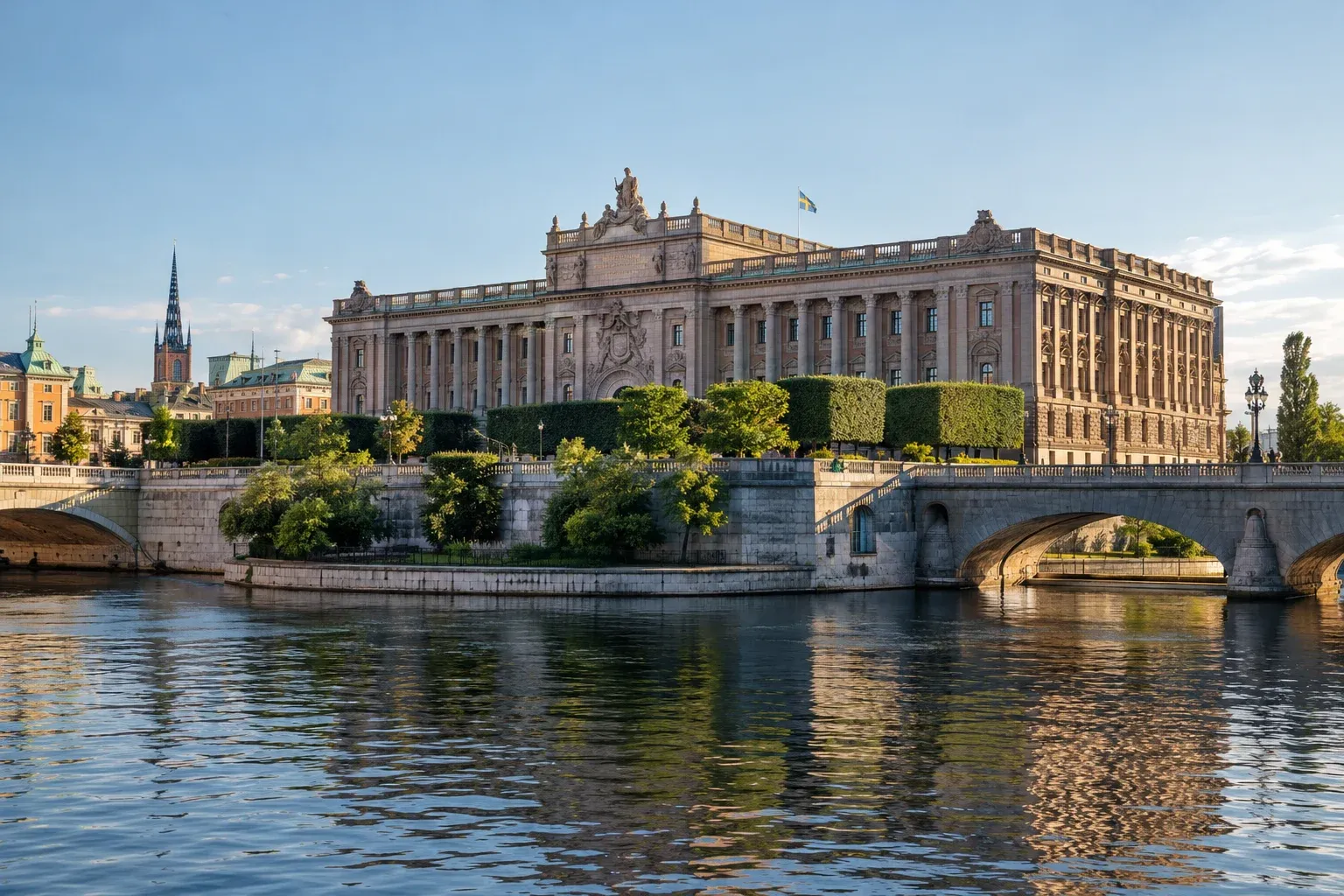
Sweden’s power sits in an elected parliament, not with the King. Most of what touches a visitor, from your bus ticket to a fire ban, is decided by a region or a municipality. Here’s who does what, and why it matters on the ground.
When you need this
You’re following the news during the 2026 government formation. Or a hospital bill, a bus app or a fire-ban notice mentions a region, a county or a municipality, and you can’t tell them apart. You might be visiting the Riksdag or the Royal Palace and wonder what the King actually does. Or you want to complain to “the authorities” and need to know which one.
The King: head of state, no political power
Sweden’s constitution, the Instrument of Government (regeringsformen), opens with “all public power in Sweden proceeds from the people”. It makes the king or queen who holds the throne the head of state, and it gives the job no political power. King Carl XVI Gustaf has reigned since 15 September 1973. Since 1980 the throne passes to the monarch’s eldest child, whatever their sex.
The Royal Court describes a “non-political Head of State”. His duties are ceremonial:
- opening the Riksdag’s working year each September, at the Speaker’s request
- chairing councils with the government, including the one where a new government takes office
- chairing the Advisory Council on Foreign Affairs
- state visits, incoming and outgoing
- receiving 30–40 new foreign ambassadors a year
He does not choose the prime minister, and the head of state cannot be prosecuted for his actions. A royal appeal is not a route for any visitor’s problem.
The Riksdag and the government
The Riksdag has one chamber with 349 members: 310 constituency seats plus 39 adjustment seats that make the national result proportional. It makes laws, sets taxes and decides the budget. A party needs 4% of the national vote, or 12% in one constituency, to win seats. Only Swedish citizens aged 18 or over who live or have lived in Sweden can vote, so visitors can’t vote in any Swedish election.
Elections are held every four years on the second Sunday in September, with Riksdag, regional and municipal elections on the same day. The government (regeringen), led by the prime minister (statsminister), governs and answers to the Riksdag.
How a prime minister gets the job surprises many visitors:
| Step | What happens |
|---|---|
| 1 | The Speaker (talman) consults every party group |
| 2 | The Speaker proposes a name to the Riksdag |
| 3 | The proposal fails only if more than half of all 349 members vote no |
| 4 | After four failed proposals, the process stops and an extra election is held |
This “negative” rule means a prime minister can take office with far fewer than 175 yes votes, as long as 175 members don’t vote against. After an election, a new Riksdag must test the sitting prime minister within two weeks of meeting, unless he or she has already been dismissed.
The 2026 election and the caretaker government
The 2026 election was held on 13 September. The final seat count, published by the Riksdag on 19 September:
| Party | Seats |
|---|---|
| Social Democrats (S) | 99 |
| Moderates (M) | 70 |
| Sweden Democrats (SD) | 62 |
| Left Party (V) | 30 |
| Centre Party (C) | 25 |
| Christian Democrats (KD) | 22 |
| Green Party (MP) | 22 |
| Liberals (L) | 19 |
Added up, S, V, C and MP hold 176 seats. The four parties behind the outgoing government (M, SD, KD, L) hold 173. The new Riksdag met on 28 September and the session opened on 29 September.
Since 17 September 2026 Sweden has had a caretaker government (övergångsregering) led by Ulf Kristersson. Under the constitution, a dismissed government stays on until a new one takes office. The government’s own site says a caretaker government mainly decides ongoing or urgent matters. The 2027 budget bill must still reach the Riksdag by 12 November 2026. This status is current as of 5 October 2026. Check regeringen.se for the latest. The next ordinary election is on 8 September 2030.
Agencies ministers can’t overrule
Sweden has some 400 central government agencies, and they do most of the state’s day-to-day work. The constitution forbids “ministerial rule” (ministerstyre). No authority, not even the Riksdag or the government, may decide how an agency rules in an individual case about a person or about applying the law. The government steers agencies through instructions and budgets. In its own words, it has “no powers to intervene in an agency’s decisions in specific matters”.
The practical consequence: if an agency decides something about you, don’t write to a minister. Use the appeal route printed on the decision (hur man överklagar). A few bodies, including the Parliamentary Ombudsmen (JO), the National Audit Office and the Riksbank, sit under the Riksdag rather than the government.
Regions, municipalities and county boards
Below the state are two layers of elected, self-governing authorities, each with its own taxes. Beside them is the state’s own office in each county.
| Level | How many | What it runs for you |
|---|---|---|
| Region (elected) | 21, one per county | Healthcare, including immediate care for visitors; regional public transport, jointly with the municipalities |
| Kommun (municipality, elected) | 290 | Rescue services, public libraries, household waste, bathing-water checks, schools, local order regulations, local fire bans |
| Länsstyrelsen (county administrative board, state) | One per county, led by a governor (landshövding) | Fire bans, nature conservation, fishing, food control and animal welfare, elections, civil defence |
Gotland is the exception: one municipality does both the municipal and the regional job. The police are a single national agency, the Swedish Police Authority, not a municipal force.
A kommun is rarely a single town. It usually covers several towns and a lot of countryside, and its rules apply across all of it.
Who to contact for what
| You need | Go to |
|---|---|
| Healthcare advice or an appointment | Your region, via 1177 — see healthcare as a visitor |
| Buses, trams, regional trains | The county’s own transport operator, e.g. Stockholm public transport |
| Fire bans | The municipality and the county board — see how fire bans work |
| Nature reserves, hunting and fishing | Länsstyrelsen |
| Bins, libraries, beaches, local alcohol zones | The municipality — see drinking in public and local rules |
| A crime | The national police — see reporting a crime |
Anyone can watch Riksdag debates and public hearings, and guided tours are open to everyone. Expect a security check at the entrance.
Warning: Don’t assume one ticket works nationwide. A ticket from one county’s operator generally doesn’t cover local buses in the next county, because each county’s transport authority runs its own fares. Cross-border deals exist only on some routes.
Mistakes to avoid
- Calling the King the head of government. The Speaker proposes the prime minister and the Riksdag approves. The King only chairs the council where the new government takes office.
- Mixing up county, region and county board. The län is the territory. The region is the elected body running healthcare and transport there. Länsstyrelsen is the state’s agency in the same territory.
- Reading the neighbouring municipality’s fire-ban status as yours. Burning under a ban you didn’t know about is still an offence.
- Expecting identical healthcare fees everywhere. Each region sets its own patient fees.
- Expecting a government on election night. In Sweden the government forms afterwards, in the Riksdag, sometimes over weeks.
- Expecting big new decisions during the caretaker period. Announced reforms can wait until a new government takes office.
Practical information
| Item | Detail |
|---|---|
| Riksdag seats | 349 (310 constituency + 39 adjustment) |
| Threshold | 4% nationally, or 12% in one constituency |
| Last election | 13 September 2026 |
| Next ordinary election | 8 September 2030 |
| Government status (5 Oct 2026) | Caretaker government since 17 September, led by Ulf Kristersson |
| Regions / municipalities | 21 / 290 |
| Watching a Riksdag debate | Open to anyone; security check |
| Riksdag guided tours | Open to everyone; booking and times on riksdagen.se |
| Healthcare fees, transport fares | Set by each region and changed yearly. See the healthcare and transport guides |
FAQ
Does the King of Sweden have any real power?
No political power. The constitution makes the King head of state, but the government governs and answers to the Riksdag. His duties are ceremonial: opening the parliamentary session each September, chairing councils with the government, chairing the Advisory Council on Foreign Affairs, state visits and receiving ambassadors. He does not appoint the prime minister and cannot be prosecuted.
How many seats does the Swedish parliament have?
The Riksdag has one chamber with 349 seats: 310 constituency seats and 39 adjustment seats that make the result proportional nationally. A party needs 4% of the national vote, or 12% in one constituency, to win seats. Elections are held every four years on the second Sunday of September; the last was 13 September 2026.
Who won the 2026 Swedish election?
The Social Democrats came first with 99 of 349 seats. Together with the Left, Centre and Green parties they hold 176 seats; the four parties behind the outgoing government hold 173. Since 17 September a caretaker government led by Ulf Kristersson has run day-to-day affairs while a new government is formed. Check regeringen.se for the current status.
When is the next Swedish election?
The next ordinary election is on 8 September 2030, the second Sunday in September, when Swedes vote for the Riksdag, their regional council and their municipal council on the same day. An extra election can be called earlier, for example if the Riksdag rejects the Speaker’s proposed prime minister four times.
What is the difference between a region and a municipality in Sweden?
Both are elected, self-governing and tax-raising. The 21 regions each cover a county and run healthcare and, with the municipalities, regional public transport. The 290 municipalities run local services such as schools, libraries, rescue services, waste collection and bathing-water checks, and issue local order regulations. Gotland is one municipality doing both jobs.
Who decides fire bans in Sweden?
Both the county administrative board (länsstyrelsen) and the municipality can ban outdoor burning, fully or in part. County boards often ban fires in only some municipalities, so status is looked up per municipality. Check the municipality you are standing in on the day, using krisinformation.se or the Brandrisk Ute app.
Can a Swedish minister change an agency’s decision?
No. The constitution forbids any authority, including the Riksdag and the government, from deciding how an agency rules in an individual case involving a person or the application of law. The government steers agencies through instructions and budgets, but individual decisions are appealed through the process written on the decision, not through politicians.
Related guides
- Healthcare as a visitor: what your region’s care costs and how 1177 works
- How fire bans work: the county and municipal levels in action every summer
- Drinking in public: how municipal order regulations draw no-alcohol zones
- Swedish taxes and welfare: where municipal and regional income taxes go
- The Royal Palace in Stockholm: where the King chairs his councils
Facts verified 2026-10-05. Sources: Sveriges riksdag (Instrument of Government, Elections Act and statute texts, 2026 election results), Regeringskansliet, Government.se, the Royal Court, the Swedish Police Authority. The full register is in this topic’s source file. Found something outdated? Tell us and we’ll fix it.