Sweden lets foreign residents choose the councils that run their schools, healthcare and buses, but not the national parliament. What decides your vote is the population register, not your passport or permit. Here’s who qualifies, what to do, and when.
When you need this
You’ve moved to Sweden for work or study and wonder whether your vote counts here. Maybe you’re British or American and counting your registered years, or an EU citizen who wants to vote in the European election from Stockholm rather than at home. Or a voting card (röstkort) just landed in your digital mailbox and you’re not sure what it covers.
Who can vote in which election
Sweden holds three elections on the same Sunday every four years: the Riksdag (national parliament), the regional council (regionfullmäktige) and the municipal council (kommunfullmäktige). Only the last two are open to foreign citizens. The constitution gives the Riksdag vote to Swedish citizens aged 18 who live or have lived in Sweden, and to nobody else.
| You are | Municipal + regional | Riksdag | European Parliament (in Sweden) |
|---|---|---|---|
| Swedish citizen, 18+ | Yes, if registered in the municipality | Yes | Yes |
| EU, Icelandic or Norwegian citizen, registered | Yes, from day one | No | EU citizens only, after written registration |
| Other foreign citizen or stateless, registered 3 years in a row | Yes | No | No |
| Other foreign citizen, registered under 3 years | No | No | No |
| Coordination number only | No | No | No |
The local rule sits in the Local Government Act (Kommunallagen): you must be registered (folkbokförd) in the municipality, turn 18 by election day, and be a Swedish or EU citizen, an Icelandic or Norwegian citizen, or have been registered in Sweden “three years in a row before election day”. The regional vote simply follows the municipal one.
Sweden opened local elections to foreign residents in 1976. The rule is unchanged in the current law. A 2025 Riksdag motion asked for a Swedish-citizenship requirement, but as of 6 October 2026 it has not become law.
How the three-year rule works
The clock is your population registration, not your arrival date or your residence permit. Registration itself requires that you’re expected to sleep in Sweden regularly for at least a year, which is why short-term visitors and people with only a coordination number (samordningsnummer) can’t vote at all.
Watch out: the law says three years in a row. If you’re removed from the population register, for example after moving abroad for more than a year, and then return, the count starts again. Short stays abroad of under a year, while you stay registered, don’t affect your local voting rights.
Brexit changed things for British residents. UK citizens are now non-EU citizens, so a newly registered Briton waits three consecutive registered years for a local vote, like an American or an Indian citizen. Danes and Finns, as EU citizens, and Icelanders and Norwegians, named in the law, vote from their first registered day.
There’s no sign-up for local elections. The Election Authority (Valmyndigheten) builds the electoral roll (röstlängd) automatically from population-register data as it stands 30 days before election day. In 2026 the right to vote was fixed on 14 August.
EU citizens and the European Parliament
European Parliament elections are held in June every five years; the next is in 2029. A non-Swedish EU citizen can vote in Sweden instead of at home, but only after acting:
- Be registered in Sweden (or resident but exempt from registration) and 18 by election day.
- Fill in the Election Authority’s form to join the Swedish roll for European Parliament elections.
- Send it to your county administrative board (länsstyrelsen) at least 30 days before election day, stating your nationality, address and home-country constituency, and promising not to vote in another member state.
Once registered, you stay on the Swedish roll until you ask to be removed. Before each EU election the Election Authority writes to every registered EU citizen with the relevant form. Non-EU citizens can’t vote in the European Parliament election in Sweden.
Voting cards, ID and early voting
Everyone with a vote gets a voting card, sent so it arrives at least 18 days before election day: to your Swedish digital mailbox if you have one, otherwise by post. It lists the elections you may vote in, which is the quickest test of your status, and your polling station (vallokal).
- Bring ID, not the card. The card is optional. Polling staff must check the identity of voters they don’t know; if you have no ID, another person with ID can vouch for you.
- Early voting (förtidsröstning) starts on the 18th day before election day and runs to election day, at any early-voting location in Sweden. In 2026 that was 26 August to 13 September.
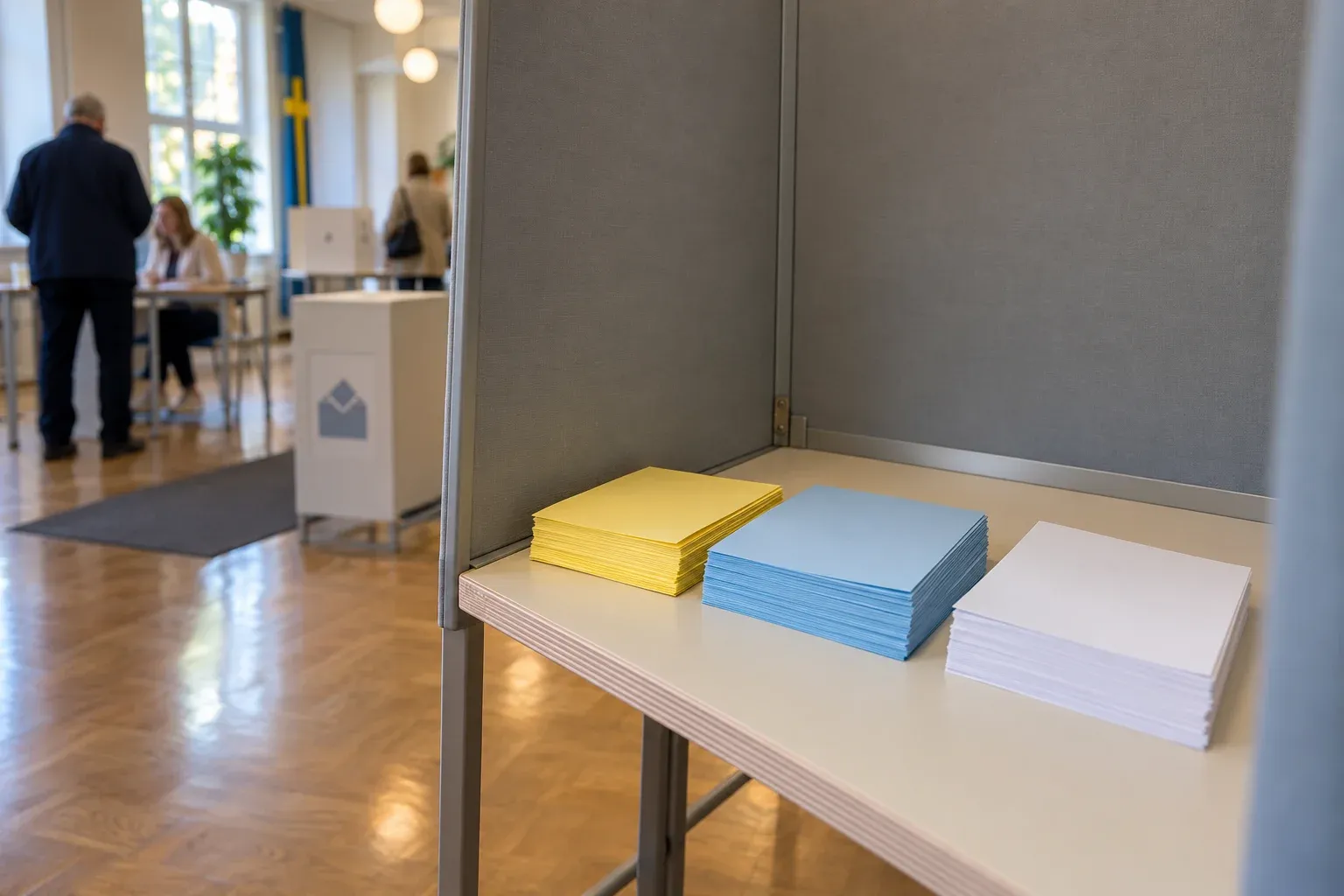
- Ballot colours: yellow for the Riksdag, blue for the regional council, white for the municipal council. Without Riksdag rights you use only blue and white.
- Assistance: you can bring a helper into the booth, but a member of the polling staff must be there too.
- Wrong details? Ask the county administrative board in writing at the latest 12 days before election day.
Swedes take this seriously: in the 2026 Riksdag election, turnout was 84.9% and 54.7% of votes were cast early.
Standing for election
Councillors are chosen among those with the right to vote, so a foreign resident who can vote in municipal and regional elections can also stand for those councils, normally on a party’s list. An EU citizen living in Sweden can also stand in the Swedish European Parliament election, with a declaration that they are not standing in another EU country.
Mistakes to avoid
- Thinking a permanent residence permit gives a Riksdag vote. Only citizenship does.
- Counting from your arrival or permit date. The three years run from registration; Skatteverket can tell you your date.
- Waiting for a sign-up letter before a local election. There isn’t one. Look for your card about three weeks before election day.
- Assuming EU citizens are automatically on the European roll. You have to send the form, 30 days ahead at the latest.
- Leaving ID at home because you have the card. It’s the other way round.
Practical information
| What | Detail |
|---|---|
| Last general election | 13 September 2026 |
| Next European Parliament election | 2029, normally June |
| Next general election | 8 September 2030 |
| Local voting rights, EU/Iceland/Norway citizens | From the first registered day in the municipality |
| Local voting rights, other foreign citizens | After 3 consecutive years in the population register |
| Electoral roll cut-off | Register data 30 days before election day |
| Voting card arrives | At least 18 days before election day |
| Early voting opens | 18th day before election day |
| Correction requests | County administrative board, at least 12 days before |
| EU roll registration | County administrative board, at least 30 days before |
| Cost | Free |
FAQ
Can foreigners vote in Swedish elections?
Yes, in municipal and regional elections. Citizens of EU countries, Iceland and Norway may vote once they are registered in the Swedish population register in the municipality. Other foreign citizens and stateless people need three consecutive years of registration before election day. Only Swedish citizens can vote in the Riksdag election, however long others have lived here.
Can I vote in Sweden with a permanent residence permit?
Only in the local elections, and the permit itself is not what counts. Your eligibility depends on population registration: three consecutive registered years before election day if you are not an EU, Icelandic or Norwegian citizen. A permanent permit never gives a vote in the Riksdag election; for that you need Swedish citizenship.
Do I need to register to vote in Sweden?
Not for municipal and regional elections. The Election Authority builds the electoral roll automatically from population-register data 30 days before election day and sends every eligible voter a card. The exception is the European Parliament election: non-Swedish EU citizens must notify the county administrative board in writing at least 30 days before election day.
Can UK citizens vote in Sweden after Brexit?
Yes, but on the same terms as other non-EU citizens. A British citizen needs three consecutive years in the Swedish population register before election day to vote in municipal and regional elections. UK citizens cannot vote in the Riksdag election or in the European Parliament election in Sweden, since neither is open to non-EU foreigners.
Can EU citizens vote in the European Parliament election from Sweden?
Yes, if you are registered in Sweden, are 18 by election day and send the registration form to the county administrative board at least 30 days before election day. You can vote in only one EU country, so you also promise not to vote at home. Once registered, you stay on the Swedish roll until you ask to leave.
When is the next election in Sweden?
The next European Parliament election is in 2029, normally in June. The next general election, for the Riksdag, regional and municipal councils on the same day, is on 8 September 2030. The last general election was on 13 September 2026, when early voting ran from 26 August.
Can I vote with a coordination number?
No. Voting rights in Sweden rest on population registration, and a coordination number (samordningsnummer) is issued to people who are not registered. To vote in local elections you need to be folkbokförd, which in turn requires that you are expected to live in Sweden for at least a year.
Related guides
- How Sweden is governed: what the councils you can vote for actually run
- Personnummer explained: population registration, the basis of your voting rights
- Moving to Sweden for work: getting registered in your first weeks
- Swedish taxes and welfare: where the municipal and regional taxes you vote on go
Facts verified 2026-10-06. Sources: Sveriges riksdag (Local Government Act, Elections Act, Instrument of Government, Population Registration Act, Riksdag documents), Valmyndigheten (Swedish Election Authority). The full register is in this topic’s source file. Found something outdated? Tell us and we’ll fix it.