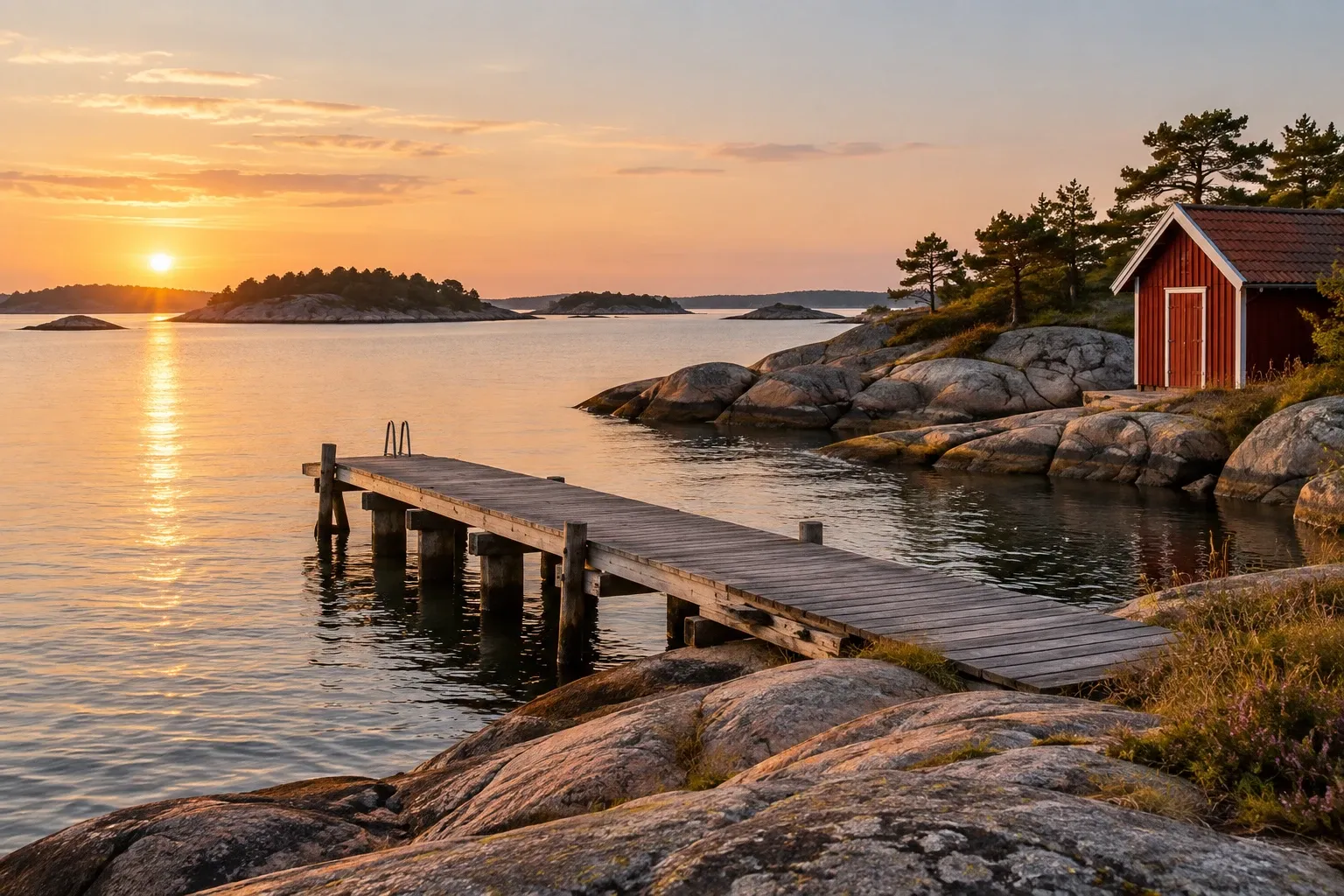
A Swedish summer is shaped less by the weather than by two dates: the Friday that closes the country and the month when half of it goes on leave. Here’s how both work, what the light and temperatures are really like, and the four hazards worth planning for.
When you need this
You’re choosing between June, July and August, or you’ve already booked and want to know what you’ve walked into. Maybe you’re planning around Midsummer weekend, booking a cabin or a Gotland ferry, heading north for the midnight sun, or planning to swim, paddle, camp or pick berries. Or you emailed a Swedish business in July and got an out-of-office reply saying “back in August”. This page is the overview; each topic links to a full guide.
How warm and how light
Swedish summers are mild rather than hot. SMHI, the national weather agency, publishes these normal July means for 1991–2020:
| Place | Normal July mean | Note |
|---|---|---|
| Stockholm | 18.7 °C | The warmest of any SMHI station |
| Utklippan, off the Blekinge coast | 17.1 °C (August: 17.6 °C) | On some coasts August is warmer than July |
| Randijaur, central Lapland | 14.4 °C | Typical of the inland north |
Those are 24-hour averages, so afternoons are warmer, and heat waves do happen: Överkalix in Norrbotten reached 34.3 °C on 26 July 2019. For month-by-month detail, see Sweden’s weather month by month.
The light is the bigger surprise. North of the Arctic Circle, at about 66.5° N, the sun stays above the horizon around the clock for part of the summer. SMHI quotes the Swedish almanac for Kiruna: midnight sun from 29 May to 14 July, 47 days in a row (the almanac year SMHI cites is 2013, and dates shift by about a day). At the Arctic Circle itself it lasts about one day, at the summer solstice. Further south the sun sets, but evenings stay long and light. Where and how to see it is in our midnight sun guide.
Midsummer: the day Sweden closes
Midsommarafton, Midsummer Eve, is the day Sweden most reliably shuts, and it is not a public holiday in law. The public-holidays Act names only Midsummer Day (midsommardagen), which is always the Saturday falling between 20 and 26 June. The Eve is the Friday before it, between 19 and 25 June. Learn the rule, not a date: it moves every year.
What that means on the ground:
| On Midsummer Eve | What to expect |
|---|---|
| Small shops, offices, non-tourist restaurants | Closed, many for the whole day, not a half day |
| Supermarkets | Usually open, on short hours |
| Systembolaget (the state alcohol retailer) | Closed on the Eve and on Midsummer Day |
| Major museums and attractions in big destinations | Usually open |
| Public transport | Saturday timetable on the Eve, Sunday timetable on Midsummer Day |
The alcohol point catches people out. Nothing above 3.5% beer is sold anywhere else, and the day before Midsummer Eve is Systembolaget’s busiest of the year, with more than 1.1 million customers. Shop two days early. The full picture of every red day is in our guide to Swedish public holidays, and the celebration itself in Midsummer in Sweden.
July: open, full and on holiday
July is industrisemester. The name dates from when whole factories closed for the month; today firms stagger leave and keep running, but July remains the peak because schools and preschools close. Payroll data shows weeks 29, 30 and 31 are the most popular leave weeks, with around half of employees off and week 30 the peak.
For a visitor that means two things. Tourist Sweden is open and at its fullest: campsites, cabins, coastal towns and family attractions are at their busiest and most expensive of the year. And everyday Sweden runs on thin staffing. Expect out-of-office replies, and some city restaurants and small shops closed for a week or more with a semesterstängt (closed for summer holiday) sign. Some major museums run separate summer opening hours from June to August; check each venue.
Booking the peak
July rewards booking early. The patterns our sibling guides found:
- Cabins (stugor): summer weeks are the main letting season. Balance payments can fall well before arrival (45 days at one agency), so a summer cabin is often fully paid in spring. Read the cancellation terms. See renting a stuga.
- Campsites: book July pitches and campsite cabins ahead rather than last minute. See Swedish campsites.
- Gotland ferry: fares are dynamic and highest on summer weekends, and car places sell first. Foot passengers and cyclists book far more easily. The island fills for Almedalsveckan (28 June – 2 July 2027) and Medieval Week (8–15 August 2027). See the Gotland ferry.
- Mountain huts: open from midsummer to mid- or late September, with dates varying by area. See STF mountain huts.
For when to book what, see our booking timeline.
Summer hazards: ticks, mosquitoes, fire and water
None of these should keep you away, but each deserves five minutes of planning.
| Hazard | When and where | What to do |
|---|---|---|
| Ticks | Reported from every municipality; densest in the south and centre; season March–November | Check your body every evening; pull ticks straight out with tweezers. Consider TBE vaccination for risk area 1, which includes the whole Stockholm archipelago |
| Mosquitoes | Worst mid-June to early August in birch forest and bog; drop clearly in August | Choose coasts and the windy open fell; carry repellent |
| Fire bans | Forest fires usually occur May–July; bans set by county board or municipality | Check the fire-ban map at Krisinformation.se on the day; breaking a ban means fines |
| Water | 103 drowned in 2025, most in July; July averages about 24 deaths this century | Wear a life jacket on every boat trip |
Ticks carry Lyme borreliosis and TBE. Good TBE protection comes after two doses, and even the fast schedule spaces them two weeks apart, so decide before you travel: see ticks in Sweden and TBE vaccination.
Mosquitoes are worst in still, damp forest. Sun, warmth and wind reduce them. The worst areas are not only in Lapland: two floodplain areas in the central lake belt, Nedre Dalälven and Klarälven at Forshaga, hold state permits for mosquito control. See mosquitoes in Sweden.
Fire is where summer gets legal. Allemansrätten lets you camp for a night or two on most land, but a fire ban overrides it, and status changes locally and quickly. See fire bans in Sweden and campfire rules.
Water is the serious one. Studies cited by Krisinformation found almost half of those who drowned after falling from a boat would have survived with a life jacket. The good news: July 2026 was well below average, at 15 deaths. In the mountains, snowmelt raises rivers fast in early summer, so a ford that is easy in August can be dangerous in June.
Two smaller points: 1177, the regions’ health service, warns that sun reflected off water and white sand can damage the eyes, so pack sunglasses. And dogs must be kept from running loose in nature until 20 August.
June, July or August?
| Month | For | Against |
|---|---|---|
| June | Midnight sun in the north; lighter crowds before July | Midsummer Eve closes the country; snowmelt rivers in the mountains; mosquito peak starts mid-month |
| July | Everything tourist-facing open; warmest in most places; berries begin | Highest prices, fullest accommodation, thin staffing in everyday Sweden; peak drowning month |
| August | Mosquitoes drop; some coasts warmest; blueberries, then lingonberries | Ticks still active; Medieval Week fills Gotland; dog leash period ends only on 20 August |
Our best time to visit Sweden guide weighs summer against the rest of the year, and Sweden in winter covers the other half.
Practical information
| Item | Detail |
|---|---|
| Midsummer Eve | Friday between 19 and 25 June; Midsummer Day is the Saturday after |
| Peak leave weeks | Weeks 29–31, week 30 the peak |
| July normal mean | 18.7 °C Stockholm; 14.4 °C Randijaur, Lapland (SMHI 1991–2020) |
| Midnight sun, Kiruna | 29 May – 14 July in the almanac year SMHI quotes (2013) |
| Gotland events 2027 | Almedalsveckan 28 June – 2 July; Medieval Week 8–15 August |
| Mountain huts | Midsummer to mid- or late September |
| Dog leash period in nature | Until 20 August |
| Wild camping | Free under allemansrätten, a night or two |
| Prices | Not published here: accommodation and ferry fares are demand-priced and peak in July |
FAQ
When is high season in Sweden?
July. It is the month of industrisemester, when around half of Swedish employees are on leave in the peak weeks, and campsites, cabins, coastal towns and family attractions are at their fullest and most expensive. June and August are quieter and still light and warm, and they give better value, especially for cabins and island ferries.
When is Midsummer in Sweden?
Midsummer Eve is always the Friday between 19 and 25 June, and Midsummer Day is the Saturday after it, between 20 and 26 June. Only Midsummer Day is a public holiday in law, but the Eve is the day the country closes: shops and offices shut, Systembolaget is closed, and transport runs a Saturday timetable.
Where can I see the midnight sun in Sweden?
North of the Arctic Circle, at about 66.5° N. The further north you go, the longer it lasts. SMHI quotes the Swedish almanac for Kiruna: midnight sun from 29 May to 14 July, 47 days in a row. At the Arctic Circle itself it lasts about one day, at the summer solstice. Southern Sweden gets long, light evenings instead.
How warm is Sweden in summer?
Milder than many visitors expect. SMHI’s normal July mean for 1991–2020 is 18.7 °C in Stockholm, the warmest station, and 14.4 °C at Randijaur in Lapland. Daytime highs are warmer than these averages, and heat waves happen: Överkalix in Norrbotten reached 34.3 °C in July 2019. On some southern coasts August is warmer than July.
Is everything closed in Sweden in July?
No. July is industrisemester, a period of mass simultaneous leave, not a closure. Shops, transport and attractions run normally. What you notice is thin staffing: out-of-office replies, and some city restaurants and small shops closing for a week or more. The real closure is Midsummer Eve in late June.
Do I need a tick vaccine for Sweden in summer?
It depends where you stay. Folkhälsomyndigheten, the public-health agency, recommends TBE vaccination for people at risk of tick bites in risk area 1 municipalities, which include the whole Stockholm archipelago. Good protection comes after two doses, and even the fast schedule spaces them two weeks apart, so start well before the trip. Either way, check for ticks every evening.
Can I have a campfire in Sweden in summer?
Only if no fire ban applies where you are. Forest fires usually occur in May to July, and bans are set by the county board or the municipality and can start within days. Check the fire-ban map at Krisinformation.se on the day. Breaking a ban is punishable by fines.
Related guides
- Swedish public holidays — every red day, and why Midsummer Eve closes more than any of them
- Sweden’s weather month by month — pin down your travel month
- Ticks in Sweden — the one summer hazard worth real preparation
- Fire bans in Sweden — how to check status on the day
- Best time to visit Sweden — summer against the rest of the year
Facts verified 2026-09-24. Sources: SMHI, Sveriges Riksdag, Isof, Folkhälsomyndigheten, SVA, 1177, Krisinformation, Naturvårdsverket, Svenska Livräddningssällskapet and Visit Sweden — full register in this topic’s source file. No prices or operators are recommended on this page. Found something outdated? Tell us and we’ll fix it.