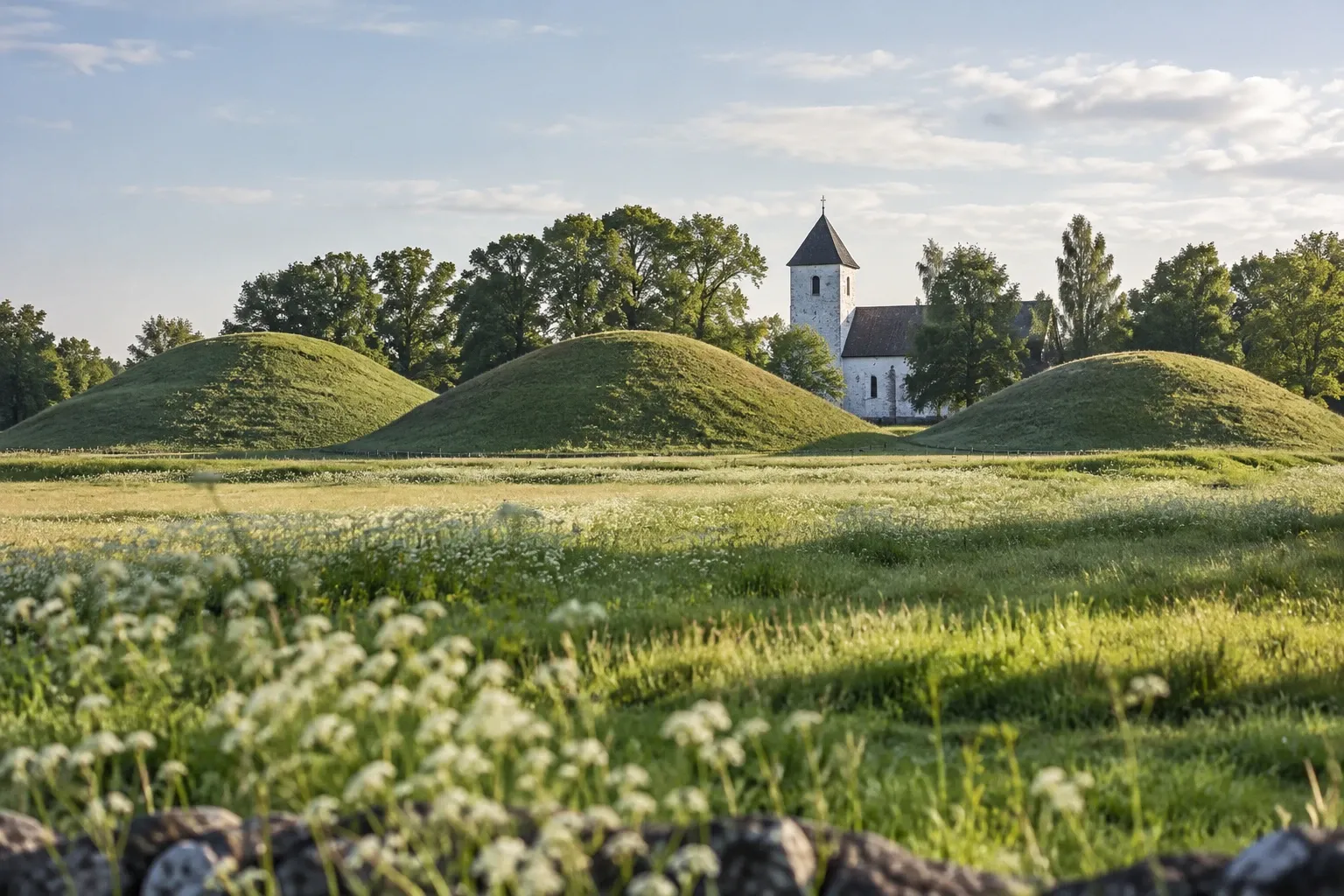
Gamla Uppsala was the seat of the Svear kings and, by one famous account, the site of a golden pagan temple. What survives is a landscape of great mounds, hall platforms and a medieval church. Here is what each part is, what is legend, and how to visit.
When you need this
You are spending a day in Uppsala and wondering whether the bus ride north is worth it. You have read about human sacrifices in a temple at Uppsala and want to know what is evidence and what is story. Or you are arriving in October and need to know which days the museum opens. For the wider Viking picture, start with our guide to Viking sites in Sweden; this page goes deep on one site.
What is at Gamla Uppsala
Gamla Uppsala means “Old Uppsala”, and it is the original one. It was an Iron Age royal estate a few kilometers north of today’s city, which took the name only after the archbishop moved south in the 1270s. The State Property Agency (Statens fastighetsverk), which owns the land, describes it as the seat of the Svear kings from the mid-500s to the late 1200s. It was not a town but a central place for religion, law, trade, crafts and politics, and the county museum calls it an area of national interest.
There are no ruins to speak of. The site is a landscape, and it has six parts:
| Part | What it is | Ticket |
|---|---|---|
| The royal mounds (kungshögarna) | Three great burial mounds, East, Middle and West, on a ridge; the landowner lists Tingshögen with them | Free; mounds fenced |
| The grave field | Smaller mounds and graves around the great ones, with walking paths | Free |
| Kungsgården | Raised plateaus behind the church where great halls stood | Free |
| Gamla Uppsala kyrka | What survives of Sweden’s first archbishop’s cathedral (1164), now a parish church | Open daily |
| Gamla Uppsala museum | Finds from the mounds; permanent exhibition opened 2022 | Paid |
| Disagården | Open-air museum of a 19th-century Uppland farming village | Free (not Midsummer Eve); summer only |
Older than the Vikings
The great mounds were raised in the 500s–600s. The county museum puts the main use of the burial ground in the Vendel period (vendeltid), about 550 to 750, two centuries before the Viking Age. Calling them Viking graves is the most common mistake in writing about the site.
They are huge. Each holds about 10,000 cubic meters of earth, sand and gravel, approaching ten meters in height and up to 80 meters across. Who lies in them is unknown. The dead were cremated on pyres with their belongings, so when excavators opened the East Mound in 1846 and the West Mound in 1874, they found burnt bone and fragments, not a treasure chamber.
Those fragments still tell a story of a rich elite:
- Hunting: bones of horses, dogs and trained birds of prey; the West Mound held a goshawk, probably a hunting bird.
- Feasting and play: glass drinking vessels and ivory gaming pieces.
- Long-distance contacts: garnets thought to come from Sri Lanka and onyx cameos made in Constantinople.
- Status: the East Mound held remains of a helmet and gold fragments.
To see the objects, go to the museum. The mounds themselves are grass.
Can you climb the mounds?
Not on your own. Paths worn across the soft ground were eroding the mounds, so the landowner fenced the great mounds. Its stated approach, from 2019, is that visitors go up with a guide instead. The fence was still in place in December 2025. Many older guides still invite you to walk to the top; that advice is out of date.
The mounds are also protected ancient monuments (fornlämningar) under the Historic Environment Act. That law makes some things crimes, not just bad manners:
| You may not | Law |
|---|---|
| Move, remove, dig out, cover or damage an ancient monument without a permit | Kulturmiljölagen 2 kap. 6 § |
| Use a metal detector without a permit, or carry one onto a monument except along a public road | Kulturmiljölagen 2 kap. 18 § |
| Dig, detect or otherwise intervene in the grave field without the county board’s permission | As stated by the museum |
Breaking these rules is fornminnesbrott, a crime against an ancient monument, punishable by fines or up to six months in prison, and up to four years if it is gross. This is not theoretical. In December 2025 museum staff found about 40 dug holes inside the fence around the Middle Mound, probably made with a metal detector, and reported it to the police. The museum asks anyone who sees digging or detecting in or near the site to contact the police.
The temple at Uppsala
The most famous description of Gamla Uppsala was written by a German churchman, Adam of Bremen, in the 1070s. His chronicle describes:
- a temple “built entirely of gold”, with idols of Thor in the center and Odin and Frey beside him;
- an evergreen tree and a spring where sacrifices were made;
- a festival every ninth year, lasting nine days, at which nine males of every living creature were offered, and the bodies hung in a sacred grove.
Read him as a hostile witness. Adam wrote for the Hamburg-Bremen mission, which was trying to convert the Svear, and he reports the festival from informants, including “a Christian” who told him he had seen 72 bodies. The parish that now runs the church says plainly that the temple’s existence is not established. The museum suggests that a great feasting hall at the royal estate may have inspired the story.
What archaeology has found is the hall, and it is impressive enough.
Kungsgården and the post rows
Walk north past the church to Kungsgården, the royal estate. Behind the church rise artificial plateaus where buildings stood. On one of them stood a hall of about 600 square meters, among the largest in Scandinavia, built at the same time as the mounds. Excavations show several halls were built there in succession, with the plateau raised each time. Uppsala University researchers describe an estate of the 500s to 700s with halls, workshops, paved yards and fences.
The biggest recent surprise came from excavations in 2012–2013 ahead of a new double-track railway, covering about 70,000 square meters. They found two rows of tall wooden posts, each almost a kilometer long: about 270 pine trunks set some six meters apart, one row east of the mounds and one on the field to the south. No one knows what they were for. A boundary and a processional way are the leading ideas. The museum’s permanent exhibition, opened in 2022, includes them.
Viking Age graves are still turning up too. In autumn 2018 archaeologists working by the vicarage found two boat graves. The intact one, excavated in 2019, held a man with a sword, spear and shield, buried with a horse and a dog. Only about ten boat-grave cemeteries are known in all of Sweden.
From pagan centre to first cathedral
A first church was probably built at Gamla Uppsala in the 1000s. In 1164 it became the cathedral of Sweden’s first archbishopric, under the Cistercian monk Stefan from Alvastra. After a fire, the archbishopric moved to Östra Aros, today’s Uppsala, in the 1270s, and the old cathedral became a parish church. The church you see is only part of the original building.
The place kept its pull. Gustav Vasa made speeches here, Olof Rudbeck argued in the 1600s that it was the sunken Atlantis, 19th-century students drank mead on the mounds, and in 1943 there were riots when Nazis marched to the mounds with flags. Pope John Paul II visited in 1989. Gamla Uppsala has always been claimed by someone; the evidence is in the museum.
The dry, sunny slopes of the mounds are also managed for rare plants, endangered butterflies and wild bees, alongside the monuments.
Getting there and opening days
By bus: UL bus 2 from central Uppsala, from the stop outside Uppsala Konsert & Kongress by the Central Station, runs to its end stop, Kungshögarna, about 100 meters from the museum at Disavägen 15. Buses 110 and 115 towards Storvreta stop at Regins väg. UL buses are cashless: buy in the UL app or by card on board. An SL ticket alone is not valid on UL buses, so a Stockholm travel card needs a UL supplement; our Uppsala guide explains the tickets.
By bike or car: a cycle path runs along Vattholmavägen. Drivers follow signs for Gamla Uppsala from the E4; parking near the museum is free.
From Stockholm or the airport: take the train to Uppsala first. See Arlanda to Uppsala if you are coming straight off a flight.
Opening days decide what you get:
| Season | Museum | Church |
|---|---|---|
| May–September | Daily 11:00–17:00 | June–August Mon–Sat 09:00–17:00, Sun 09:00–18:00 |
| October–April | Wed–Sun 12:00–16:00, extra days in school holidays | September–May Mon–Sat 09:00–16:00, Sun 09:00–18:00 |
The museum is closed on Walpurgis Eve, Midsummer Eve, Christmas Eve, Christmas Day, New Year’s Eve and New Year’s Day, so a 30 April Uppsala trip cannot include it. On a winter Monday or Tuesday you get the mounds and paths but none of the finds. In the church, sightseeing pauses during the Sunday evening service, 17:00 to about 18:00.
Access, families and a full day
The museum suggests making a whole day of it: the grave field, the church and, in summer, Disagården, an open-air museum of 19th-century farm buildings moved here from across Uppland, with animals. Its 2026 season opened on 30 May with free tours, and it had closed for the season by September; when the gates are open, you may still walk in.
- Tours: English at 15:00 on Saturdays and Sundays, Swedish at 13:00 and a family activity at 14:00, all included in admission. Groups can book tours of the exhibition and the monument area.
- Wheelchairs and strollers: the museum has a lift with automatic doors, an accessible toilet with a changing table and wheelchair access through the exhibition. Two disabled parking spaces are 15–20 meters from the entrance along gravel and stone slabs. Strollers can be left on the entrance floor, unattended.
- Disagården: paths are gravel or grass, and the house interiors are up steps. There is an accessible toilet with a changing table.
- Dogs: not allowed inside the museum, except guide dogs.
Practical information
| Item | Detail |
|---|---|
| Gamla Uppsala museum, adult | 150 kr |
| Student or pensioner | 120 kr |
| Ages 0–19 | Free |
| Annual pass (this museum and Upplandsmuseet, one year) | 280 kr |
| Weekend tours, including English at 15:00 | Included in admission |
| Grave field, mounds, Kungsgården | Free, open-air, all year |
| Disagården | Free except Midsummer Eve; summer season |
| Parking | Free |
| UL bus fare | Not reproduced; check UL |
Prices and hours from the museum’s and the parish’s own pages, checked 2026-10-15.
FAQ
How do I get to Gamla Uppsala from Uppsala?
Take UL bus 2 from central Uppsala to its end stop, Kungshögarna, about 100 meters from the museum; buses 110 and 115 towards Storvreta also stop nearby at Regins väg. Buses are cashless, so buy in the UL app or by card on board, and note that an SL ticket alone is not valid. By bike, follow the path along Vattholmavägen.
Can you climb the royal mounds at Gamla Uppsala?
Not on your own. The great mounds were fenced because paths were eroding them, and the landowner’s stated approach is that visitors go up with a guide; the fence was still in place in December 2025. The mounds are protected ancient monuments, and in 2025 looters dug about 40 holes inside the fence, which became a police case.
Are the Gamla Uppsala mounds Viking graves?
No, they are older. The great mounds were raised in the 500s and 600s, and the burial ground was used mainly in the Vendel period, about 550 to 750, before the Viking Age began. They hold cremations of high-status people whose names are unknown. Viking Age graves do exist nearby: two boat graves were found by the vicarage in 2018.
Was there really a pagan temple at Gamla Uppsala?
Nobody knows. Adam of Bremen wrote in the 1070s of a golden temple with idols of Thor, Odin and Frey, and of sacrifices every ninth year, but he relied on informants and wrote as a missionary churchman. The parish says the temple is not established; the museum suggests a great feasting hall may have inspired the story.
Is Gamla Uppsala free to visit?
Mostly. The grave field, the royal mounds, Kungsgården and the walking paths are open-air with no ticket, parking is free, and Disagården is free except on Midsummer Eve. The church is open daily. Only the museum charges admission, and visitors aged 0 to 19 get in free. Check the Practical information table for current adult prices.
When is Gamla Uppsala museum open?
From May to September every day from 11:00 to 17:00. From October to April Wednesday to Sunday from 12:00 to 16:00, with extra days during the sports, Easter and autumn school holidays. It closes on Walpurgis Eve, Midsummer Eve, Christmas Eve, Christmas Day, New Year’s Eve and New Year’s Day. The open-air site never closes.
Related guides
- Viking sites in Sweden — Historiska museet, Birka and Sigtuna, and how Gamla Uppsala fits a short trip.
- Uppsala — the city next door: cathedral, trains and which ticket works on the bus.
- Runestones in Sweden — Uppland’s stones, from the Viking Age that followed the mounds.
- Birka — the Viking Age town on Lake Mälaren, the next chapter of the story.
- Sigtuna — the Christian town where Adam of Bremen’s bishop was seated.
Facts verified 2026-10-15. Sources: Stiftelsen Upplandsmuseet, Statens fastighetsverk, Svenska kyrkan (Uppsala), Arkeologerna at Statens historiska museer, Uppsala University, the National Museum of Denmark (Adam of Bremen in translation), Sveriges Riksdag (Kulturmiljölagen), UL and SL — full register in this topic’s source file. Prices and hours are 2026 figures. Found something outdated? Tell us and we’ll fix it.