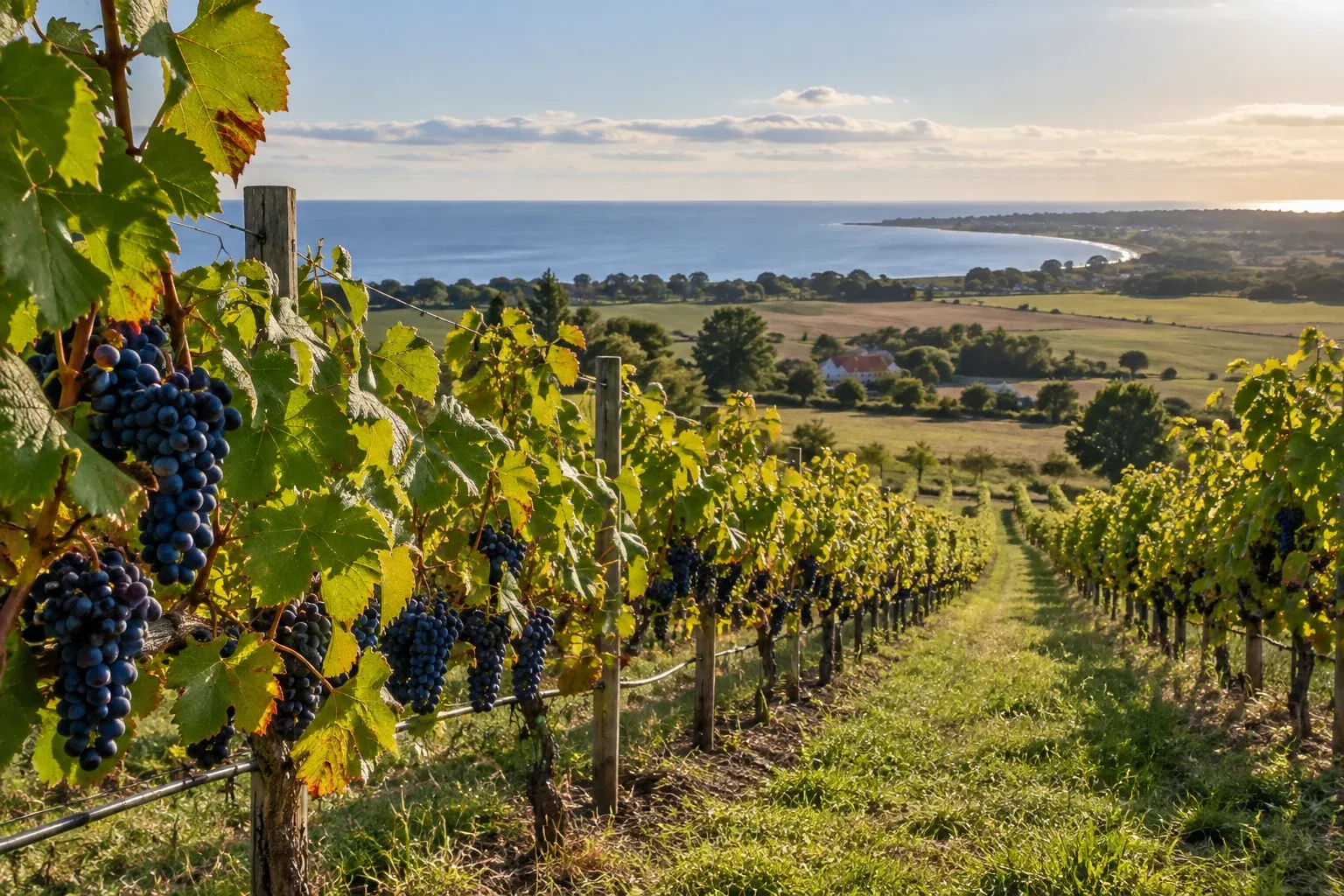
Sweden is a young wine country, a big cider exporter and a crowded beer scene. What makes it different is how you buy: a vineyard can sell you a bottle only after you have booked and joined a paid visit, and everything else goes through the state monopoly.
When you need this
- You are planning Skåne, Österlen, Öland or Gotland and wonder whether vineyard visits are worth it
- A Swedish wine or cider at Systembolaget has caught your eye
- You want to buy bottles straight from a winery, brewery or distillery, perhaps on a Sunday
- You want a Swedish drink to take home that isn’t snaps
- You can’t work out why a cider brand sold everywhere abroad is so weak in a Swedish supermarket
Swedish wine: small, young and mostly in Skåne
Sweden has been an officially recognised wine country only since 1999. The vineyards are few and small. Systembolaget’s own guide gives a planted area of 100–150 hectares, while the industry body Svenskt Vin reported about 50 commercial vineyards on 230 hectares in 2025. The figures differ because the sector is growing fast and the sources are of different ages. Either way, it is tiny by European standards.
Most vineyards sit on the low coasts of Skåne, just north of the 55th parallel. Öland and Gotland are the other wine islands, and commercial growing reaches as far north as Mälardalen. In north-west Skåne, nine vineyards and their municipalities market themselves together as Terra Skåne — a brand, not a protected appellation.
| Style | What to expect |
|---|---|
| White | The core of Swedish wine, mostly from solaris, a disease-resistant grape with high acidity |
| Sparkling | Growing fast, usually made by the traditional method |
| Rosé | Made most years, often from rondo |
| Red | Only in good years — some producers make red three years in ten |
Quality has started to get noticed. Kullaberg vineyard’s Immelen was served with the main course at the 2025 Nobel banquet, the first Swedish wine to be. Frost and short seasons still swing each vintage hard, so bottles are scarce and sell out.
Cider: the export success
Sweden’s cider fame is mostly abroad. The brewers’ trade body, Sveriges Bryggerier, says Swedish producers have made “Swedish Cider” one of the best-selling cider categories in the world, and that 79% of Swedish-made cider is exported.
At home the law gets in the way. Cider is not beer in Swedish law, so it is not folköl (the up-to-3.5% beer supermarkets may sell). Supermarket cider must be 2.25% or weaker; anything stronger is sold at Systembolaget or by a producer at a farm sale. Our folköl guide explains the line.
Apple country has two hearts worth knowing. On Österlen, Kiviks Musteri, run by the Åkesson family near Kivik, traces its orchards to 1888 and makes cider and apple juice. And by Lake Vättern near Huskvarna lies Äppledalen, whose fresh apples received an EU-protected name in June 2026.
Beer: 400 breweries and counting
Sweden has more than 400 active breweries with their own production, according to Sveriges Bryggerier, and most of them are very small. Their strong beer (starköl, above 3.5%) reaches you through Systembolaget or a farm sale. Many also brew 3.5% versions, which supermarkets may sell and which the brewery itself may sell from its premises.
Buying direct: how farm sales work
Since 1 June 2025, a licensed small producer may sell its own drinks to visitors — gårdsförsäljning, farm sales. It is not a cellar-door shop. The sale is lawful only to someone who has taken part in a paid besöksarrangemang, a visit arrangement of at least 30 minutes with something to learn: a guided tour of the vineyard or brewery, or a lecture with tasting.
| Rule | What it means for you |
|---|---|
| Paid visit first | Book the tour or tasting; you can’t just turn up and buy |
| 10:00–20:00, any day | Sundays included — the only takeaway route above 3.5% on a Sunday (see hours) |
| Age 20 | Bring ID if you could look under 25 |
| Per-person caps | 0.7 l spirits; 3 l each of wine, strong beer and other fermented drinks such as cider |
| Own grapes only | A winery may farm-sell only wine from its own vineyards |
| No bargains | Price may not be set below production cost plus a reasonable markup |
Municipalities grant the licences, and the rules run as a trial until 31 May 2031. One detail changed on 1 June 2026: producers must now hand you Folkhälsomyndigheten’s leaflet on alcohol harms during the visit, instead of telling you orally.
The scheme has caught on. Folkhälsomyndigheten’s first statistics show 155 licensed producers in 2025 and 188 licences by June 2026, with every region represented. Skåne and Västra Götaland have the most; per head, Gotland leads by far. About 83,000 people joined a paid visit in 2025, and 104 of the 155 producers can also serve you a glass, so a tasting, lunch and purchase can be one stop.
Two practical warnings. Four standard bottles of wine is the most one person can take — a case is not possible. And Sweden’s drink-driving limit is 0.2 per mille, so whoever drives skips the tasting.
Systembolaget’s local shelf
No time for a visit? Systembolaget’s Lokalt & Småskaligt (“local and small-scale”) range, running since 2014, puts small producers’ drinks in stores near where they are made. The criteria: made at most 15 Swedish miles (150 km) from the store, by hand on a small scale, by a limited number of people, and in customer demand. Each product is sold in up to 10 stores within that radius.
That is why a local wine you saw in Skåne may be missing from your store in Stockholm. You can almost always order it online to any store or ombud (pickup point) at no extra cost. Some local drinks sit in the fixed range instead and carry no label.
Protected names and one apple myth
Livsmedelsverket’s register of Swedish protected geographical indications lists three drinks, all spirits: Svensk Aquavit, Svensk Punsch and Svensk Vodka. Svensk Aquavit, for example, must be distilled in Sweden from Swedish-grown grain or potato — see our snaps and aquavit guide.
The newest protected name is not a drink at all. “Äpplen från Äppledalen”, registered on 4 June 2026, covers six apple varieties grown on the south-east shore of Lake Vättern — not the Österlen orchards around Kivik, which many assume.
Practical information
| Item | Detail |
|---|---|
| Commercial vineyards | About 50 on 230 ha (Svenskt Vin, 2025); Systembolaget’s guide says 100–150 ha |
| Breweries | 400+ active, most very small (Sveriges Bryggerier) |
| Cider exported | 79% of Swedish-made cider |
| Farm sales | Legal since 1 June 2025; paid visit of 30+ min; 10:00–20:00 any day; age 20 |
| Farm-sale caps per person | 0.7 l spirits; 3 l wine; 3 l strong beer; 3 l other fermented |
| Farm-sale licences | 155 producers in 2025; 188 licences by June 2026 |
| Visit and bottle prices | Set by each producer — check its booking page |
| Local range at Systembolaget | Up to 10 stores within 150 km of the producer; ordering in is free |
| Supermarket cider | 2.25% or weaker |
| Small-producer tax relief | Since 1 July 2026, for producers — not a shelf discount |
FAQ
Does Sweden make its own wine?
Yes, though not much of it. Sweden has been an official EU wine country since 1999, and the industry body Svenskt Vin counted about 50 commercial vineyards on 230 hectares in 2025, mostly in Skåne with others on Öland, Gotland and up to Mälardalen. Cool-climate grapes such as solaris dominate, and fresh whites and sparkling wines are the strongest styles.
Can you buy wine directly from Swedish vineyards?
Yes, since 1 June 2025, but only as part of a visit. A licensed small producer may sell its own drinks to people who have booked a paid visit lasting at least 30 minutes, between 10:00 and 20:00 on any day. You must be 20, and each person may buy at most 3 litres of wine and 0.7 litres of spirits.
What is Swedish cider like, and where can I buy it?
Sweden is known abroad for sweet fruit ciders: the brewers’ trade body says 79% of Swedish-made cider is exported. At home, cider stronger than 2.25% is sold only at Systembolaget or by a licensed producer at a farm sale, because cider does not count as folköl. Supermarket cider is therefore light or alcohol-free.
How many craft breweries are there in Sweden?
More than 400 active breweries with their own production, according to Sveriges Bryggerier, and most of them are very small. Their strong beer reaches you through Systembolaget, often via the Lokalt & Småskaligt range near the brewery, or through a farm sale after a booked visit. Many also brew 3.5% versions that supermarkets may sell.
Why can’t I find a local Swedish wine in my Systembolaget?
Because small producers’ bottles in the Lokalt & Småskaligt range are sold in at most 10 stores within 15 Swedish miles, or 150 km, of where they are made. Volumes are tiny too. You can almost always order the product online to any Systembolaget store or ombud at no extra cost, and collect it a few days later.
Which Swedish drinks are EU-protected names?
The drinks on Livsmedelsverket’s register are three spirits: Svensk Aquavit, Svensk Punsch and Svensk Vodka, registered EU geographical indications that only products meeting their specifications may use. Swedish aquavit, for example, must be distilled in Sweden from Swedish-grown grain or potato. Regional wine labels such as Terra Skåne are marketing brands, not protected names.
Related guides
- How Systembolaget works — the shop for everything on this page above 3.5%
- Systembolaget hours — and why a booked farm visit is the Sunday option
- Folköl — why supermarket cider stops at 2.25%
- Taking alcohol home from Sweden — your destination’s allowance decides how many bottles fly home
- Snaps and aquavit — Sweden’s best-known protected spirit
Facts verified 2026-10-06. Sources: Folkhälsomyndigheten, Sveriges Riksdag (Alkohollag 2010:1622), Systembolaget, Livsmedelsverket, Regeringen, Sveriges Bryggerier, Svenskt Vin (via EFN), Visit Sweden and Dagens PS — full register in this topic’s source file. Found something outdated? Tell us and we’ll fix it.