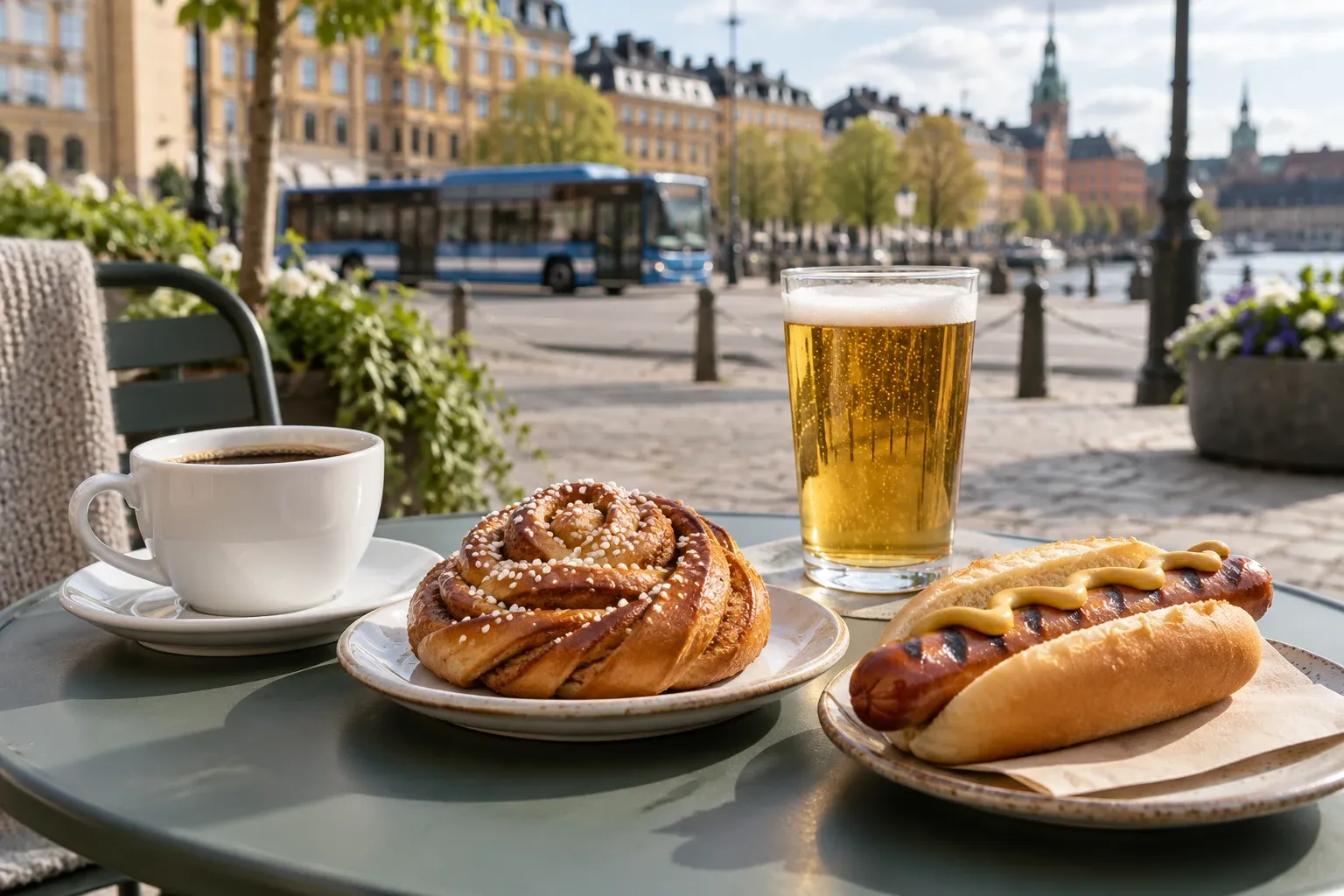
Swedish everyday prices come in two kinds. Some are set by a public body and published, so you can know them before you land. Others are set by each café, kiosk and bar, and the useful thing to know is how they are built.
When you need this
You’re at a café counter wondering whether the price on the board is normal or a tourist markup. You’re about to board your first bus and want to know what the reader will charge. You’ve found a “prices in Sweden” table on a forum and want to know if it’s still true. Or the supermarket till charged more than the shelf said, and you’d like to know why before you ask.
If you want a per-day budget rather than item prices, start with how expensive Sweden is and come back here for the details.
Two kinds of price
The honest answer to “what does a coffee cost in Sweden?” is that it depends on the café, and no Swedish authority or statistics agency publishes an average. Statistics Sweden tracks how bar and restaurant prices change in its consumer price index, not what they are. Any single figure you find online is one café’s price on one day.
Other everyday prices are a different matter. A regional transport authority sets one fare for everyone, the deposit system sets one deposit, and the postal operator sets one stamp price. Those are published, dated and the same at every till.
| Set publicly, same everywhere in the area | Set by each seller |
|---|---|
| Bus, tram and metro fares (per region) | A cup of coffee or an espresso drink |
| Surcharge for riding without a ticket | A hot dog, kebab or tunnbrödsrulle |
| Deposit (pant) on cans and bottles | A beer or glass of wine in a bar |
| Stamps for letters and postcards | A pastry, a sandwich, an ice cream |
| City street-toilet fees | A plastic bag at the supermarket |
| Alcohol prices at Systembolaget (one national list) | Restaurant dinners |
This page gives you the dated numbers for the left column in the table at the end, and the structure behind the right column.
Bus and tram tickets
Sweden has no national city fare. Each region’s public transport authority sets its own prices, and they cluster fairly tightly: the regional authorities’ own annual survey found an average urban single just over 34 kr in autumn 2025. Stockholm is the most expensive. Smaller regions mostly charge in the 30s.
What a single buys differs too:
- Stockholm (SL): one ticket covers metro, commuter trains, trams, buses and boats for 75 minutes. Tap a contactless card at the gate or reader. The fare was not raised for 2026.
- Gothenburg (Västtrafik): zone-based; a one-zone single is valid for 90 minutes. The fare rose on 9 June 2026, not in January as many regions do.
- Skåne (Skånetrafiken): zone-based, with Malmö, Lund and Helsingborg on a higher price level than smaller towns. The app shows the price for your stops. Tapping a card on a city bus buys a full adult ticket only.
Two rules matter more than the price. Buses don’t take cash, so bring a card or download the regional app. And one card buys one ticket: if two of you tap the same card, only one is covered. Riding without a valid ticket triggers a surcharge (tilläggsavgift) of well over a thousand kronor. For a full sightseeing day, compare with the 24-hour ticket; in Skåne it costs the same as two singles. The guide to paying for buses covers the how-to region by region.
Coffee
The Swedish default is plain brewed filter coffee, bryggkaffe, not espresso. It is the cheaper cup on almost every board, and the one most likely to come with a refill. Seven in ten Swedes expect a free påtår (refill) at cafés and restaurants, but it isn’t guaranteed, so ask: “Ingår påtår?” Espresso-based drinks cost more and rarely include one.
Two things move the price at the counter:
- Where you drink it. Since 1 April 2026, coffee and food sold to take away carry 6% VAT, while the same cup served at the table carries 12%. A café that offers both may charge two prices. The 6% rate is temporary and runs to the end of 2027.
- Where you buy it. Gas stations, train stations, airports and central Stockholm price higher than a café in a small town. That is the market, not a tourist trap.
The best-value coffee in the country is the one included in a weekday dagens lunch. More on coffee culture in coffee in Sweden.
Hot dogs and street food
A sausage in a bun (korv med bröd) is sold everywhere: street kiosks (korvkiosk), grills (gatukök), gas stations and some large stores. Every seller sets its own price, so the range is wide and no average is published.
The tax rule is the same as for coffee. Taken away, a hot dog carries 6% VAT; eaten at the seller’s own tables it can carry 12%. Pay by card. No tip is expected at a counter. For what to order beyond the plain sausage, see street food and korv kiosks.
Beer
Beer is where the gap between shop and bar is widest, and the reason is tax, set by law:
| Where you buy it | Strength allowed | VAT | Alcohol tax |
|---|---|---|---|
| Supermarket or kiosk | Up to 3.5% (folköl) | Food rate | None up to 2.8%; per volume percent above |
| Systembolaget | Any strength | 25% above folköl | Per litre per volume percent |
| Bar or restaurant | Any strength | 25% above folköl | Same tax, plus the venue’s markup |
At Systembolaget, alcohol tax and VAT together make up roughly half of an average shelf price, and that price is identical in every store in the country. A bar pays the same tax, then adds its own markup. That is why a beer at the bar costs several times the price of the same can at Systembolaget, and why no one can give you a meaningful national “pint price”. Each venue sets its own.
If you are buying beer anyway, buy it at Systembolaget. Supermarket shelves stop at 3.5%; see folköl and alcohol prices in Sweden for the full arithmetic.
The small charges
These are fixed, and they trip visitors up because they have changed recently:
- Deposit (pant). Cans and bottles carry a deposit added at the till on top of the shelf price. It was raised in September 2025. Feed the empties into the machine at any supermarket entrance and cash the voucher at that store’s checkout. See how pant works.
- Shopping bags. The plastic bag tax was abolished on 1 November 2024. Stores still charge for bags, now about 4 kr where they were about 7 kr while the tax applied.
- Public toilets. City street toilets charge a small fee, by card, but department stores, libraries and road rest areas are commonly free. See public toilets.
- Stamps. One price for a letter or postcard in Sweden, double that for anywhere abroad.
- Tips. None expected. Displayed prices include VAT and there is no service charge.
Cards cover all of it: about nine in ten in-store purchases in Sweden are made by card.
Why old price lists are wrong
Prices kept moving through 2025 and 2026. Bar and restaurant prices rose 3.2% in the year to May 2026, even as grocery prices fell after the food VAT cut. At the same time, the deposit went up, the bag tax went away, takeaway VAT halved and fares changed on different dates in different regions.
An undated list gets these small charges wrong in both directions. Check the date on any price you rely on, including the ones below, and use the operator’s own app for fares on the day.
Practical information
| Item | Price (date) |
|---|---|
| Urban single ticket, national average | 34.1 kr (autumn 2025 survey) |
| Urban single ticket, range across regions | About 30–43 kr (2025 survey) |
| Stockholm SL single, 75 min | 43 kr adult / 26 kr reduced (2026) |
| Stockholm SL 24-hour ticket | 180 kr adult (since January 2025) |
| Gothenburg Västtrafik single, one zone, 90 min | 38 kr adult / 29 kr youth (from 9 June 2026) |
| Skåne single ticket | Zone-based; shown in the app |
| Riding without a ticket | 1,850 kr + ticket (SL); 1,500 kr (Västtrafik, Skånetrafiken) |
| Coffee, hot dog, beer in a bar | Set by each seller; no official average |
| Dagens lunch, coffee included | Roughly 135–145 kr (2026) |
| VAT: takeaway / eaten in / alcohol above folköl | 6% (1 Apr 2026 – 31 Dec 2027) / 12% / 25% |
| Tax share of an average Systembolaget price | About half (alcohol tax ~31% + VAT ~20%) |
| Deposit (pant) | 2 kr cans and bottles under 1 l; 3 kr larger (since 1 Sep 2025) |
| Supermarket carrier bag | About 4 kr, set by the store |
| City street toilet | 10 kr Stockholm, 5 kr Gothenburg |
| Stamp up to 50 g | 22 kr in Sweden, 44 kr abroad (2026) |
| Tip | Not expected |
FAQ
How much is a coffee in Sweden?
It depends on the café, and no Swedish authority publishes an average, so treat any single figure online as one café’s price. Plain brewed coffee, bryggkaffe, is the cheaper standard cup and often comes with a free refill; espresso drinks cost more. Takeaway is taxed at 6% VAT and a cup at the table at 12%. A weekday dagens lunch includes coffee.
How much does a beer cost in a Swedish bar?
Each bar sets its own price and no official average exists, so read the menu. What is fixed is the structure: beer stronger than 3.5% carries 25% VAT, alcohol tax applies above 2.8%, and tax already makes up about half of an average Systembolaget price before the bar adds its markup. That is why a bar beer costs several times the shop price.
How much is a hot dog in Sweden?
Every kiosk, grill and gas station sets its own price, and no national average is published, so check the board before you order. Prices are generally higher at stations, airports and city-centre stands than in small towns. Taken away, a hot dog carries 6% VAT until the end of 2027; eaten at the stand’s own seating it can carry 12%. Bring a card.
How much is a bus ticket in Sweden?
It depends on the region. Swedish public transport authorities set their own fares, and the national average urban single was 34.1 kr in autumn 2025. In 2026 Stockholm’s SL charges 43 kr for 75 minutes and Gothenburg’s Västtrafik 38 kr for one zone. Skåne prices by zone in its app. Buses take no cash: tap a card or use the regional app.
Is takeaway cheaper than eating in?
Usually, by tax design. Since 1 April 2026 food and non-alcoholic drink sold to take away carry 6% VAT, while a meal served on the premises carries 12%. Where a café or kiosk offers both, the seller can charge different prices for the same item. The 6% rate is temporary and is scheduled to end on 31 December 2027. Alcohol stays at 25% either way.
Why did the till charge more than the price on the can?
That is the deposit, pant. Since 1 September 2025 it is 2 kr on cans and plastic bottles under one litre and 3 kr on larger bottles, added at the till on top of the shelf price. You get it back by feeding the empty container into the deposit machine at any supermarket and cashing the voucher at that store’s checkout.
Do I need cash for small purchases in Sweden?
No. Cards cover almost everything, including a coffee, a hot dog or a toilet: 92% of in-store purchases are made by card, and card-only businesses are lawful. Buses do not sell tickets for cash at all. A contactless Visa or Mastercard, or a phone wallet, is the practical way to pay for small everyday items.
Related guides
- How expensive is Sweden? A realistic trip budget — per-day bands that put these item prices in context.
- Coffee in Sweden — bryggkaffe, påtår and how Swedes actually drink it.
- Alcohol prices in Sweden — the tax arithmetic behind every beer.
- How to pay for buses in Sweden — tap, app or travel card, region by region.
- Dagens lunch — the meal out that includes the coffee.
Facts verified 2026-10-15. Sources: Svensk Kollektivtrafik, SL, Västtrafik, Skånetrafiken, Skatteverket, Systembolaget, Sveriges Riksdag (Lag 2022:156), SCB via Visita, Sveriges Riksbank, Returpack/Pantamera, PostNord — full register in this topic’s source file. Found something outdated? Tell us and we’ll fix it.