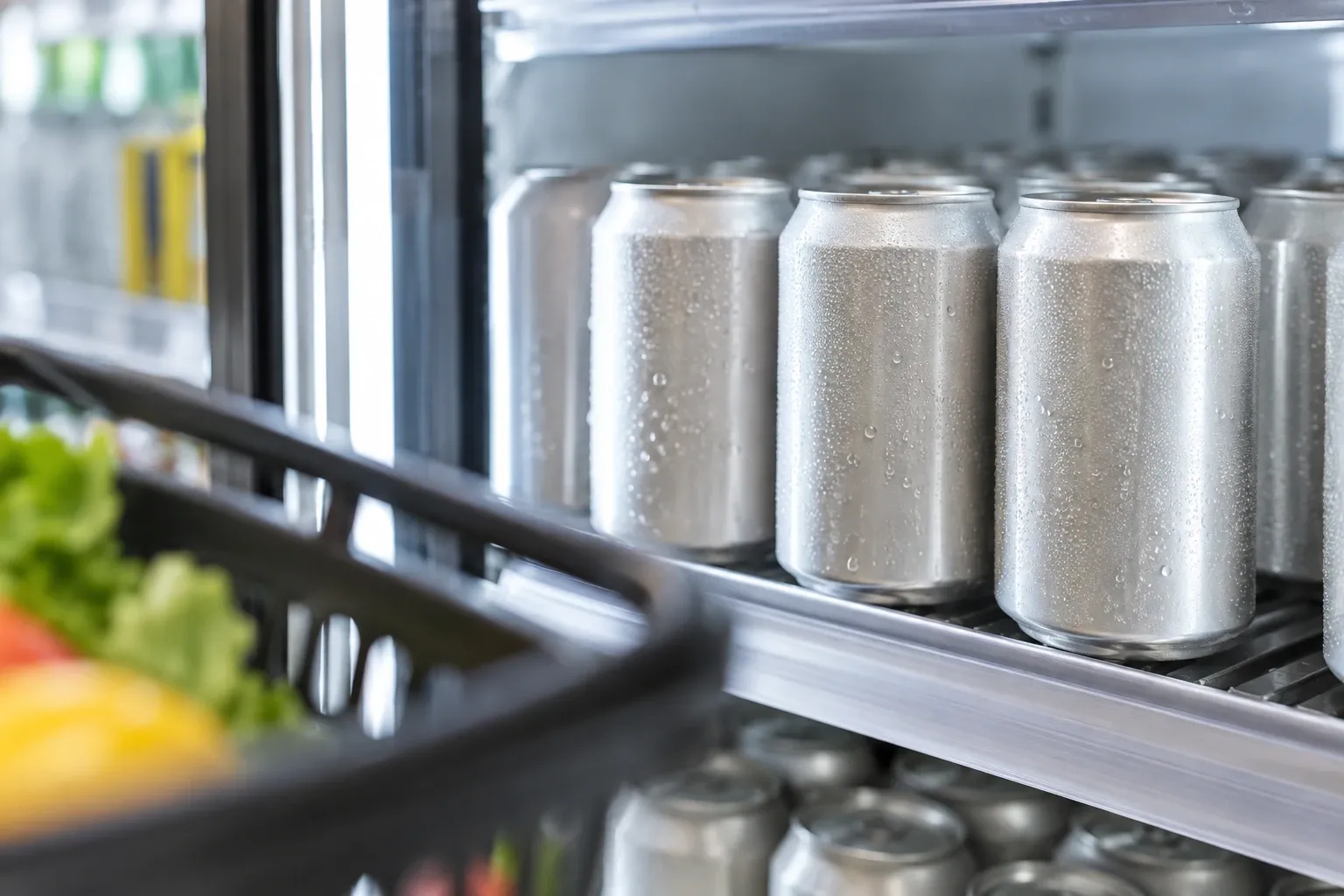
Every other guide tells you what Swedish supermarkets can’t sell. This one is about what they can. Two numbers govern the whole thing — 3.5 and 18 — and the second one is the one visitors get wrong.
When you need this
You are looking at a Swedish beer shelf where every can says 3,5 % or 2,8 %. It is Sunday evening and Systembolaget shut hours ago. You are 18 or 19 and nobody in your group agrees on what you may buy. Or you opened a familiar brand at a cabin and it tasted like a memory of itself.
What folköl actually is
Folköl — literally “people’s beer” — is not a style. It is a legal box, and the Alcohol Act draws its edges precisely.
| Strength | Legal name | Who may sell it | Age |
|---|---|---|---|
| Up to 0.5% | alkoholfri (alcohol-free) | Anyone | None in law |
| Up to 2.25% | lättdryck / lättöl | Anyone — not legally alcohol | None in law |
| Above 2.25%, up to 3.5% | folköl | Shops that also sell food | 18 |
| Above 3.5% | starköl | Systembolaget only | 20 |
Two boundaries matter. 2.25% is where alcohol legally begins in Sweden: at or below it, a drink is a lättdryck and the Alcohol Act’s age rules do not touch it. 3.5% is where the monopoly begins: above it, beer becomes starköl and only Systembolaget may sell it to take away.
Folköl is the strip between them.
The two age limits: 18 and 20
More visitors trip on this than on the 3.5% ceiling.
- 18 — to buy folköl in a shop, and to be served any alcohol in a licensed bar or restaurant.
- 20 — to buy anything at all at Systembolaget.
The same person, on the same afternoon, is old enough for the supermarket and not old enough for the monopoly. An 18-year-old can legally buy a six-pack of 3.5% beer at ICA and legally order a full-strength pint in a pub, but cannot buy a bottle of wine to take home for two more years.
One rule has no age exception: buying alcohol on behalf of someone under the limit is a criminal offence in Sweden — langning — and the liability sits with the buyer, not the recipient. The staff member who sells to a minor faces fines or up to six months’ imprisonment, which is why nobody at the till treats the question casually.
Where you can buy it — and when
Folköl is sold in supermarkets, convenience shops, kiosks and gas-station shops — but not automatically. The law allows folköl retail only in premises registered as a food business that also sell food, and the shop must notify its municipality before it starts and keep a documented self-inspection routine. In practice that covers essentially every grocery store, and most gas-station shops, because they sell food too.
The part nobody writes down is the timing:
The Alcohol Act sets no opening hours for folköl. There is no closing time, no Saturday cutoff, no Sunday rule. If the shop is open, the beer is on sale — Sunday evening, a public holiday, 21:45 on Midsummer Eve. That is the exact opposite of the monopoly, whose hours come from a separate state agreement and which is closed every Sunday of the year.
So the practical answer to “can I buy beer in Sweden on a Sunday?” is yes — just not the strong kind. If you only want beer, you never need to think about Systembolaget’s opening hours at all.
Two extras worth knowing. Supermarket delivery services will bring folköl to your door, but somebody has to show ID at handover or the beer goes back and is refunded. And a café or restaurant may serve folköl on a simple notification to the municipality rather than a full alcohol licence — which is why a small lunch place with no wine list still has beer. That last rule loosened on 1 June 2026: parliament voted in May to scrap the requirement that food be served wherever folköl is served, so expect to find it in more places that don’t cook.
The ID check, and when staff must refuse
Swedish law does not say “check anyone who looks under 25”. It says something stricter in principle: the seller must satisfy themselves that the buyer is old enough. Official guidance fills in the rest — if age is hard to judge, ask for identification, and if the customer cannot or will not show it, refuse the sale.
Staff are also required to refuse in two other situations, and these are duties rather than judgment calls:
- The customer is visibly intoxicated.
- There is special reason to believe the beer will be passed on to someone who may not have it.
Municipalities enforce this with undercover kontrollköp — control purchases by someone over 18 who looks younger — so a cashier asking for your passport is following a rule that gets tested, not making a point about you. Bring the physical document; a photo on a phone does not count. And note that, unlike tobacco, there is no legal requirement to display an age-limit sign for folköl, so the absence of one tells you nothing.
Why the category exists
Sweden’s alcohol policy trades convenience for public health, and folköl is where that trade was struck.
Between 1965 and 1977, Swedish grocery stores sold mellanöl — “middle beer”, 3.6–4.5% ABV. It was withdrawn in 1977 amid concern about teenage drinking, and folköl took its place as the strongest beer a shop could sell. Nearly fifty years later the line has not moved, even as the neighbors moved theirs: Norway allows grocery sale up to 4.7%, and Finland raised its ceiling for fermented drinks to 8% on 10 June 2024. Sweden stayed at 3.5%.
That is the whole logic of the category. Beer is available everywhere, at all hours, to adults from 18 — but only weak beer, and everything stronger goes through one state-owned door with short hours and a higher age limit.
The same brand is a different beer
Here is the thing visitors notice and cannot explain: the can looks exactly like the one at home, and the beer inside does not taste like it.
Swedish brewers produce separate, weaker versions of their flagship brands specifically for grocery sale. Spendrups lists Norrlands Guld — one of the country’s best-known lagers — at 2.8%, 3.5%, 5.3% (Export) and 0.5% alcohol-free. Four products, one name, one logo. The supermarket shelf carries the two weak ones; Systembolaget carries the strong one.
So read the percentage, not the brand. It is printed on the front of every Swedish can, usually with a comma: 3,5 %.
Is it any good? It varies. Swedish tasting panels rate some 3.5% beers as genuinely enjoyable and others as an obvious compromise — the same brand is routinely judged better in its starköl version. The pleasant surprise of recent years is craft folköl: Swedish and imported microbreweries now brew 3.5% versions deliberately rather than reluctantly, and the good ones taste like beer rather than an apology.
Beer only — why there is no 3.5% cider
The 3.5% allowance is written for beer. It is not written for anything else.
Swedish law classes cider, mead and fruit wine as other fermented alcoholic drinks — a separate category from beer — and the monopoly covers those at any strength above 2.25%. So cider on a Swedish supermarket shelf is 2.25% or weaker, full stop. Anything stronger is a Systembolaget product.
Swedish cider producers have asked parliament more than once to extend the beer allowance to cider, pointing out that a brewery may sell 3.5% in a shop while an orchard may not. Parliament has declined each time.
Why folköl is cheap
Two separate tax boundaries stack up in the shopper’s favor, and neither is obvious from the shelf.
Alcohol duty starts at 2.8%. Beer at or below 2.8% ABV pays no Swedish alcohol tax at all; above that, duty is charged per litre for every volume percent. That is why so much supermarket beer sits at exactly 2,8 % rather than pushing to the legal 3.5% ceiling — it is a tax decision as much as a taste decision.
VAT is the bigger gap. Folköl counts as food in Swedish tax law, so it carries the reduced food rate — which fell from 12% to 6% on 1 April 2026 and is set to stay there until 31 December 2027. Spirits, wine and starköl carry the standard 25%. The gap between the supermarket beer and the Systembolaget beer got wider this spring, and no English-language guide has caught it.
We publish no shelf prices here — they move by chain and by week. The comparison against Denmark, Germany and the ferry lives in what alcohol costs in Sweden.
What to expect at a barbecue, cabin or picnic
If the shopping was done at a supermarket, the beer is 3.5% or 2.8%. Plan accordingly.
- It is a longer, milder evening. Four folköl is not four lagers, which is exactly the point of the category and why Swedes drink it at lunch, on boats and in the afternoon without comment — see drinking in Sweden for the wider culture.
- Split the shop for a cabin week. Wine and strong beer from Systembolaget while it is open; folköl from the supermarket for the days and hours when it is not.
- Folköl is still alcohol. Sweden’s drink-driving limit is about 0.2 per mille — roughly 0.10 mg per litre of breath — and it is one of Europe’s strictest. Two cans of 3.5% can put a light adult over it. Penalties run to fines or six months’ imprisonment, and to two years for the aggravated offence. Nobody drives after the picnic.
- Keep the empties. Cans and bottles carry pant, the refundable deposit, exactly like soft drinks. See our pant guide.
One thing worth being precise about: the buying rules above are national and identical in all 290 municipalities, but where you may actually open the can is not. That is set by municipal ordinance, and folköl counts as alcohol for the purpose — a park that bans drinking bans folköl too, at 3.5% as much as at 5%. Two towns an hour apart can treat the same kind of park differently. See drinking in public for how to read the local rule.
Mistakes to avoid
- Assuming the age limit is 20 everywhere. For folköl in a shop it is 18.
- Reading 3.5% as the strength of everything on the shelf. Much of it is 2.8%.
- Expecting 3.5% cider. It does not exist in Swedish shops.
- Buying by the logo instead of the percentage.
- Bringing a photo of your passport instead of your passport.
- Treating alkoholfri and folköl as the same thing — one is 0.5% and unrestricted, the other is alcohol.
- Planning a whole Sunday around Systembolaget when the supermarket beer shelf was open until 22:00.
Practical information
| Item | Detail |
|---|---|
| Legal definition | Beer above 2.25% and up to and including 3.5% ABV |
| Below that | At or under 2.25% = lättdryck, not alcohol in law |
| Above that | Starköl — Systembolaget only |
| Age to buy in a shop | 18 |
| Age at Systembolaget | 20 |
| Age to be served in a bar | 18 |
| Where sold | Registered food premises that also sell food: supermarkets, kiosks, gas stations |
| Opening hours | None set by law — sold whenever the shop is open, Sundays included |
| ID | Seller must satisfy themselves of your age; physical document, not a phone photo |
| Refusal | Mandatory if you are visibly intoxicated or the beer appears destined for a minor |
| Cider in shops | 2.25% maximum — the 3.5% allowance is for beer only |
| Alcohol duty | 0 kr at or below 2.8% ABV; charged per volume percent above that |
| VAT | Food rate, cut to 6% on 1 April 2026 (to 31 Dec 2027); starköl, wine and spirits 25% |
| Serving folköl | Municipal notification, not an alcohol licence — and since 1 June 2026 no food requirement |
| Drink-driving limit | About 0.2 per mille — folköl counts |
FAQ
What is folköl?
Folköl is a legal category in Sweden’s Alcohol Act: beer above 2.25% and up to 3.5% alcohol by volume. It is the strongest alcoholic drink an ordinary shop may sell. Anything above 3.5% is starköl and belongs to the Systembolaget monopoly; anything at or below 2.25% is a lättdryck and is not legally alcohol at all.
How old do you have to be to buy folköl in Sweden?
Eighteen. That is the point most visitors get wrong, because Systembolaget’s limit is twenty. An 18-year-old may legally buy folköl in a supermarket, kiosk or gas station, and may be served full-strength beer in a licensed bar, but may not buy a bottle of anything at Systembolaget until they turn twenty.
Can I buy beer in a Swedish supermarket on a Sunday?
Yes. Nothing in the Alcohol Act limits the hours for folköl, so it is on sale whenever the shop is open — Sunday evenings and public holidays included, when every Systembolaget in the country is closed. That makes the supermarket beer shelf the only lawful takeaway alcohol in Sweden for large parts of the week.
Why is Swedish supermarket beer so weak?
Because the monopoly’s boundary is drawn at 3.5% ABV, and shops may sell only beer below it. The category replaced mellanöl, a 3.6–4.5% grocery beer sold from 1965 until it was abolished in 1977 over concerns about teenage drinking. Norway allows 4.7% and Finland went to 8% in 2024; Sweden has not moved.
Is folköl the same beer as the strong version of the same brand?
No. Brewers produce separate, weaker products under the same name: Spendrups lists Norrlands Guld at 2.8%, 3.5% and 5.3% Export, plus an alcohol-free 0.5%. The can looks familiar and the beer is not. Swedish tasting panels judge some 3.5% versions genuinely good and others a clear compromise on the original.
Can I buy cider in a Swedish supermarket?
Only at 2.25% or less. Cider counts in law as an “other fermented alcoholic drink”, not beer, and the monopoly covers those at any strength above 2.25%. So the 3.5% allowance is for beer alone. Swedish cider producers have repeatedly asked parliament to extend it to cider; parliament has repeatedly declined.
Will I be asked for ID when buying folköl?
Very likely if you look young. The law requires the seller to satisfy themselves that you are eighteen, and official guidance tells staff to ask for identification whenever age is hard to judge and to refuse the sale if none is shown. Municipalities run undercover test purchases to check that shops comply. Bring a physical document.
Related guides
- How Systembolaget works — everything above 3.5%, and the monopoly’s own rules
- Systembolaget opening hours — the closed days folköl exists to cover
- Swedish supermarkets — which chains, and where the beer shelf sits
- Age limits and ID checks — every Swedish alcohol age limit in one place
- Self-checkout in Swedish stores — why scanning a six-pack stops the machine
Facts verified 2026-07-26. Sources: Sveriges Riksdag (Alkohollag 2010:1622, read directly; prop. 2025/26:221 and prop. 2025/26:55), Folkhälsomyndigheten, Skatteverket, Systembolaget, Polismyndigheten, and the Norwegian and Finnish governments — full register in this topic’s source file. Found something outdated? Tell us and we’ll fix it.