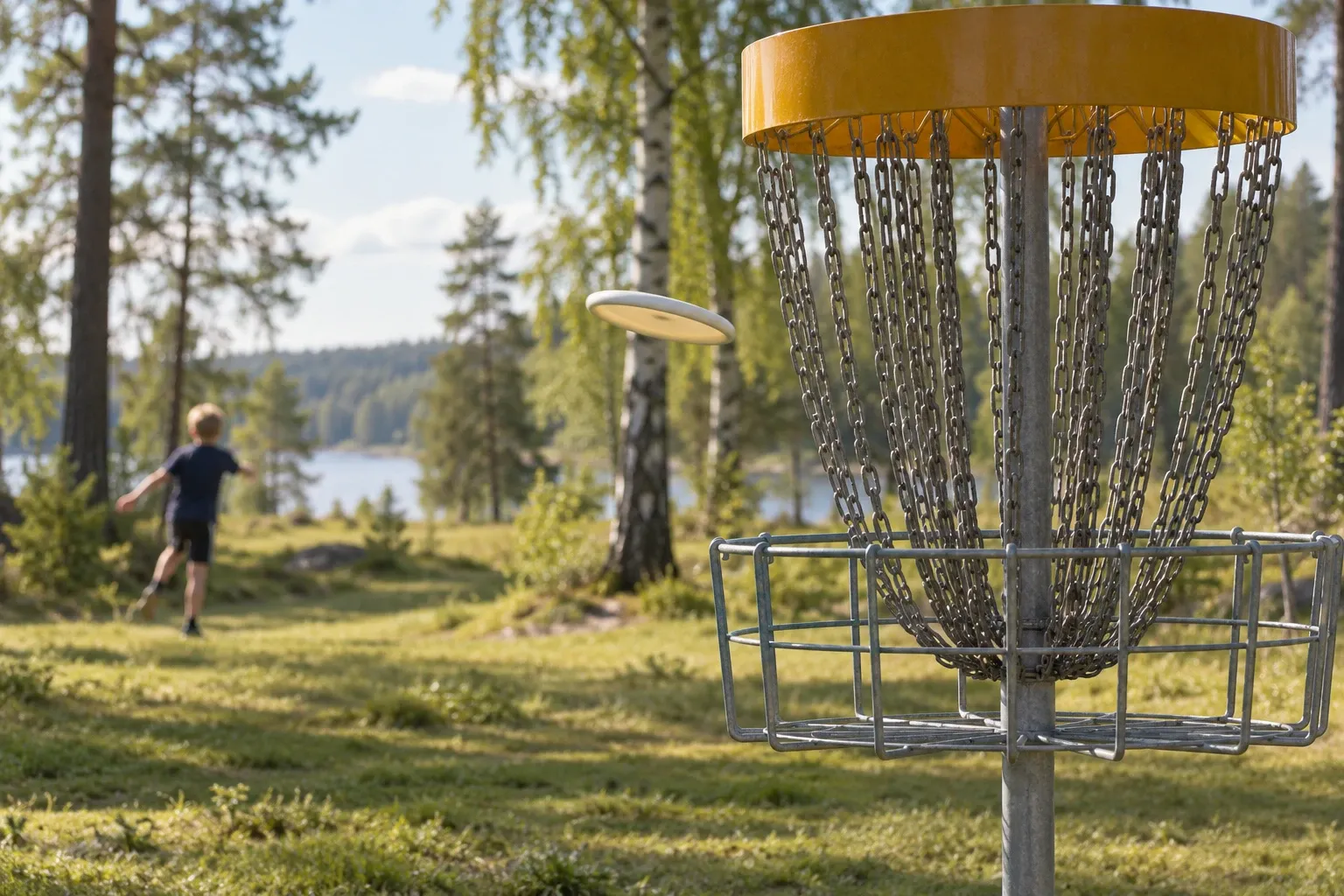
Those metal baskets with hanging chains in Swedish parks are disc golf targets, and most of them are free for anyone to use. Here’s how a visiting family finds a course, gets discs and plays a safe first round.
When you need this
You’re in a Swedish town with restless children and want something between a walk and a playground. Or you’ve spotted those chain baskets among the trees and wondered what they’re for. Maybe you play disc golf at home and want to know how Swedish courses work, or you’re staying for a few weeks and thinking about joining a club. And if you’re simply walking through a park where people are throwing discs, the safety section tells you what players are supposed to do.
What disc golf is
Disc golf is golf with a frisbee. You throw from a tee towards a metal basket, and the hole is done when your disc drops in. Chains hanging above the basket catch the disc and let it fall. Fewest throws over the whole course wins.
Courses have 9 or 18 holes and run through parks, meadows and forest. The discs are heavier than a beach frisbee, about 160 to 180 grams, and good players throw over 100 meters. That weight and distance is why the safety rules below matter.
Sweden is one of the sport’s big countries. The Swedish Disc Golf Federation (Svenska Discgolfförbundet, SDGF) counted 838 courses in 2025, 73 more than the year before, using a course-map app’s annual figures. That app listed about 870 in October 2026, around a third of them with 18 or more holes. Courses are found across the whole country, from the south to Norrbotten.
Freshness note: some tourism pages still say Sweden has “just over 130” courses. That figure is years out of date; the federation’s 2025 count was 838.
Is it really free?
Mostly, yes. The federation says most Swedish courses cost nothing to play, with no booking and no membership. Many encourage a voluntary green fee (frivillig green fee) that goes to the club maintaining the course, and some courses are pay courses with a set fee.
| Course type | What you pay | How you know |
|---|---|---|
| Public park or forest course | Nothing | Sign at hole 1, municipal page |
| Course with voluntary green fee | Whatever you choose to give | Sign or payment code at the first tee |
| Pay course | A fee set by the owner | The owner’s website or sign |
Nobody checks a handicap or a green card. That sets it apart from ball golf, whose handicap and green-card rules are covered in our guide to golf in Sweden.
Getting discs
You need one disc per player, and the federation says one is enough to start. Experienced players carry many, each with a different flight, but a family’s first round doesn’t need that. You have three options:
- Bring your own. Write a name and phone number on each disc so a finder can return it.
- Borrow for free. Fritidsbanken, a network of free sports-gear libraries, lends equipment for up to 14 days at no charge. Its website shows each branch’s stock, so check for discs before you go. Our guide to Fritidsbanken explains how borrowing works for visitors.
- Rent on site. Some courses have a rental activity box nearby; the course sign or municipal page says so.
A small marker helps you mark where each disc landed. Competitive players use a mini marker disc, but any small object does the job.
Your first round, step by step
- Find a course. Search a course-map app, a web map or the municipality’s leisure pages. For a first round with children, pick a 9-hole course in a park.
- Read the sign at hole 1. It gives local rules, the hole order and any fee.
- Get a disc for each player and a marker.
- Throw from the tee. Every hole starts from a marked tee area (utkastplats).
- Look before every throw. Don’t throw if anyone could be hit.
- Throw again from where the disc landed. The player furthest from the basket goes next.
- Finish in the basket, count the throws and move to the next tee.
- Let faster groups through and keep score as you go.
- Leave no trace: take your trash home and leave trees and plants alone.
- Return found discs to their owner or to the course’s found-disc spot.
A 9-hole par-3 park course is a good family size. One municipal course in Mölndal, near Gothenburg, is signposted as suitable for beginners and lets you start at any basket. In Boden, in the north, the municipal 9-hole course starts at a grill house next to sand courts, an outdoor gym and barbecue areas, which turns a round into a half-day outing.
Safety with children
Disc golf courses are shared space. Most run through public parkland where people walk, cycle and jog, and one Stockholm-area municipality moved a hole and put rule signs at every hole after neighbors complained about safety. Courses are planned with safety distances, but they depend on players looking first.
The rule on Swedish course signs is blunt: kasta aldrig om någon befinner sig på fairway, never throw while anyone is on the fairway. With children that cuts both ways:
- Your thrower: wait until walkers, dogs and other groups are well clear.
- Your other children: keep them behind the person throwing, never ahead.
- Other groups: don’t let children run onto the next fairway to fetch a disc while another group is throwing there.
Discs also go missing in long grass, bushes and water. An unmarked disc can only be handed in, not returned, so a name and number on it is worth the 30 seconds.
The rules
Casual disc golf has no legal rules. What you’ll meet are the federation’s basic rules of play and the course owner’s signs, usually the municipality’s.
| Rule | What it means |
|---|---|
| Aim | Tee to basket in as few throws as possible |
| Next throw | Front foot where the disc stopped |
| Order | Furthest from the basket throws first |
| Close to the basket | Within 10 meters, don’t step past your marker after releasing |
| Next tee | Lowest score on the last hole throws first |
| Discs | Use as many as you like |
The federation publishes a one-page “how to play” and etiquette sheet in 18 languages, including English and German, which clubs often post at courses.
Etiquette
Swedish disc golf runs on fair play and respect for other players, the course and the surroundings. The federation’s sheet boils it down to five points: don’t harm nature, which is part of the course; take your trash home; don’t throw if you would risk hitting someone; let faster players and groups pass; and keep the noise down, even when it’s going badly. And if you’re unsure about anything, the federation’s advice is simple: don’t be afraid to ask other players.
Clubs and competitions
Casual rounds need no membership, but disc golf in Sweden is organized through clubs (föreningar) under the national sports movement. Joining a club gets you playing partners and weekly club rounds (veckogolf), the usual first step into competing.
Competitions come in tiers, and the license rules differ:
- Unsanctioned events such as doubles, two-disc or glow rounds often need no license or rating.
- Swedish Championship and National Tour events require an SDGF competition license (tävlingslicens). You get it through paid membership of a Swedish club, and it includes accident insurance during club and federation activities. Playing without one gets you disqualified.
- From 2027 the license requirement extends to every PDGA-sanctioned C-tier event and above. This is a recent change, stated on the federation’s license page as of October 2026; its new-player page still describes the C-tier requirement as the organizer’s choice, so check the event listing.
Families with older children can look out for junior events: the federation started a push for children and youth disc golf in 2025, and the 2026 junior national championship began on 31 July. The national calendar peaks in summer: the 2026 Swedish Championship was played in July in Luleå. Players with a disability will find that not every course is adapted, but the federation says almost every course has some playable holes and lists courses owners report as suitable. Looking further ahead, Borås hosts the European Disc Golf Championships in 2029.
Practical information
| Item | Detail (checked 2026-10-14) |
|---|---|
| Number of courses | 838 in 2025 (federation); about 870 listed in October 2026 |
| Most courses | Free, no booking; voluntary green fee often encouraged |
| Pay courses | Fee set by the owner |
| Borrowing gear | Free for up to 14 days at Fritidsbanken, stock varies |
| Disc weight | About 160-180 grams |
| Competition license | Junior 200 kr per year (to the end of the year you turn 18); senior 300 kr per year |
| Entry fees | C-tier about 250-500 kr; B-tier about 400-800 kr; A-tier from about 700 kr |
| National body | Svenska Discgolfförbundet (SDGF) |
FAQ
Is disc golf free in Sweden?
Usually, yes. The Swedish Disc Golf Federation says most of the country’s courses are free to play, with no booking and no membership, though visitors are often encouraged to pay a voluntary green fee that supports the club looking after the course. Some courses are pay courses with a set fee. Check the sign at the first tee or the owner’s website.
Do I need my own discs to play?
No, but you need at least one disc per player, and one is enough to start. You can bring your own, borrow discs free for up to 14 days from a Fritidsbanken branch that has them in stock, or use a rental box where a course has one. A disc golf disc is heavier than a beach frisbee, about 160 to 180 grams.
Is disc golf suitable for young children?
Yes, with supervision. The federation calls the sport easy to start, and 9-hole park courses suit beginners, sometimes next to barbecue areas and outdoor gyms. The main risk is other players’ discs, so keep children behind the thrower and never let them run ahead onto a fairway where another group may be throwing.
Do I need a license or membership to play disc golf in Sweden?
Not for a casual round. Public courses are open to anyone. A Swedish competition license is needed only for sanctioned events: today the Swedish Championships and the National Tour, and from 2027 all PDGA-sanctioned C-tier events and above. The license requires paid membership of a Swedish club and includes accident insurance during club activities.
How do I find a disc golf course in Sweden?
Use a course-map app, a web map or the local municipality’s leisure pages; the Swedish Disc Golf Federation points newcomers to the same places, plus local clubs. Sweden had about 870 courses listed in October 2026, so courses are widespread. For a first family round, pick a 9-hole course in a park close to parking or a bus stop.
What are the etiquette rules on a Swedish disc golf course?
Don’t throw if you could hit someone, and never while people are on the fairway. Let faster groups pass, keep the noise down, don’t damage trees or plants, and take your trash home. The player furthest from the basket throws next. If you find a disc, return it to its owner or leave it at the course’s found-disc spot.
Can a tourist enter a disc golf competition in Sweden?
Yes, at the casual end. Weekly club rounds and unsanctioned doubles or glow events often need no license or rating. Sanctioned competitions are a different matter: Swedish Championship and National Tour events require an SDGF license through a Swedish club, and from 2027 that extends to C-tier events. Entry fees for local C-tier events run at a few hundred kronor.
Related guides
- Fritidsbanken: borrow outdoor gear for free — how to borrow discs, skates or a tent as a visitor.
- Sweden with kids — the bigger picture for families traveling in Sweden.
- Golf in Sweden — if someone in the family wants to try ball golf, and why it has stricter entry rules.
- Orienteering in Sweden — another forest sport families can try for little money.
- Allemansrätten, the right of public access — the rules behind Swedish outdoor life beyond the course.
Facts verified 2026-10-14. Sources: Svenska Discgolfförbundet, Boden Municipality, Mölndal Municipality, Täby Municipality, Fritidsbanken — full register in this topic’s source file. Found something outdated? Tell us and we’ll fix it.